
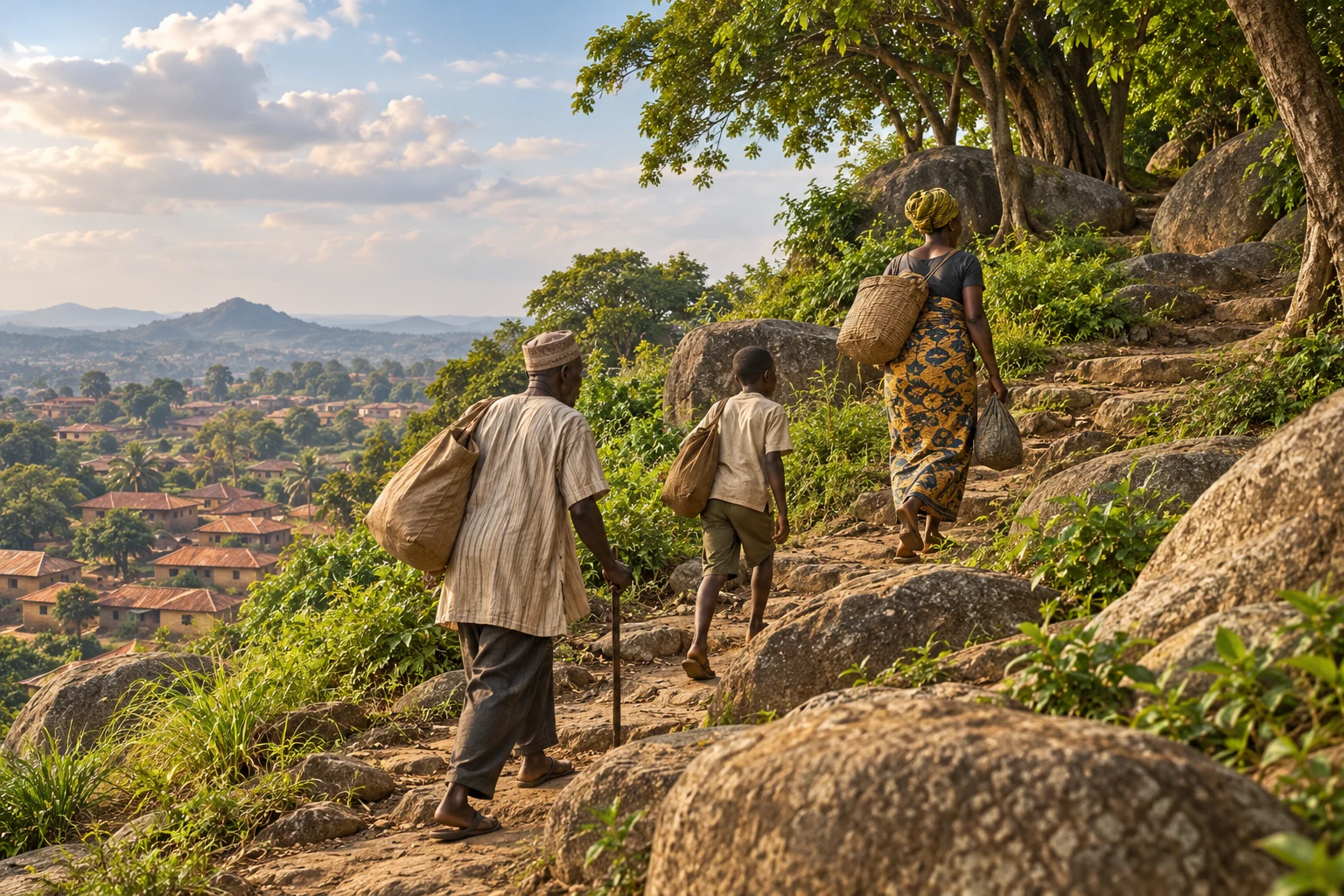
A city is more than the buildings it contains. It is also a memory of where people found safety, gathered strength and learned to call a place their own. Òkèbàdàn opens the study of a sacred hill through that relationship between refuge and belonging. The subject is a particular place in Ibadan, not a generic mountain symbol.
The hill recalls refuge and a community’s obligations of welcome.
1. The hill and civic memory
Borokini’s field study of sacred sites discusses Òkèbàdàn within Ibadan’s religious and commemorative landscape. The source supports a local connection among the hill, protection and collective remembrance. It should not be stretched into a universal story about all Yorùbá hill powers.
The Academy retains a separate entry for Òkè Olúmọ, whose setting belongs to Abeokuta. Similar functions can help a comparison, but they do not erase distinct histories.
2. Key theme: refuge becomes an obligation
A place that once sheltered a community can later become a focus of gratitude and return. The remembered relationship asks something of those who inherit it. Safety is not only a past event to celebrate; it can become a question about whom the present community is willing to shelter.
This is a contemporary ethical interpretation, not an invented ritual instruction. It asks whether the memory of having needed refuge enlarges solidarity or merely becomes a story of entitlement. A city can proudly recount its own survival while forgetting the people currently seeking a place within it.
3. Belonging and the right to arrive
Most communities contain histories of movement. The distinction between established inhabitants and newcomers may feel ancient even when it is regularly remade. Remembering a place of refuge can make that process visible.
In personal life, the question concerns the spaces that allowed us to become ourselves. A home, school or religious house may have offered a form of safety that we could not yet provide for others. Receiving that shelter does not make us its sole owners. It can become part of the reason to make room for someone else.
4. Religious identity and the scope of this study
Òkèbàdàn concerns a particular sacred hill within Ibadan's religious and civic memory. It should not be introduced as a generic mountain power detached from that city. Borokini's field based account places Oke-‘badan beside Olúmọ as a separately situated sacred height, connecting remembered ancestral refuge with continuing commemoration. That supports the opening discussion's attention to protection and belonging. It does not establish identical histories for the two sites. The book has no dedicated Òkèbàdàn portrait. Its combined earth chapter treats Oke as height, perspective, retreat and possible remoteness.
Those passages provide a shared interpretive framework that can be applied to this hill, while local factual claims require local evidence. Contemporary psychological inquiry can ask how a place of safety becomes part of collective identity and how gratitude can coexist with openness to later arrivals. The hill is not reduced to that inquiry. It remains a sacred place whose custodians, community and remembered history exceed a symbolic reading. A strong article can move from specific landscape to inner development without pretending that topography determines personality, that tourism establishes devotion or that a general Oke passage explains every shrine, festival and religious relationship associated with Ibadan.
5. Knowledge that gives the figure depth
5.1 How did terrain become remembered protection?
The independently verified starting point is a relationship between height and refuge in a named city. Borokini reports traditions of ancestors escaping enemies by retreating into the sacred heights, followed by commemorative worship. His brief grouping supplies a comparative observation, not a detailed chronology of Ibadan's founding or a single definitive origin narrative. The article should avoid filling those gaps with attractive names and dates drawn from memory. What can be analyzed is the transformation of terrain into remembered protection. A hill is materially capable of changing visibility and access; a community's account gives that terrain an enduring place in its identity.
The contemporary ethical question is what happens after immediate danger has passed. Memory can preserve awareness that safety was once received through dependence. It can also simplify vulnerability into a story of permanent superiority. Òkèbàdàn offers a precise site through which to explore that tension. Gratitude deepens when remembrance includes the need that made refuge necessary, rather than celebrating only the strength of survivors. This is an original interpretation of a documented relation. It should invite the reader toward the city's custodial accounts, not replace those accounts with an invented universal narrative about mountains saving people or guaranteeing protection to visitors.
Evidence: Temitope Israel Borokini, Sanctuary of the Spirits: Okwu-muo, Ori Oke and Mammy Water in the Veneration of Sacred Natural Sites in Southern Nigeria — 2016 field study identifies Òkèbàdàn in Ibadan and Olúmọ in Abeokuta as distinct commemorative sacred heights related to ancestral refuge; differentiates indigenous Christian prayer mountains.
5.2 What does recurring commemoration sustain?
Commemoration turns a single remembered relation into something revisited. Borokini's account names annual festivals and continuing shrine devotion at the sacred heights. We can note that recurrence matters without supplying an unverified calendar or describing protected practices. A return to a place can renew belonging through bodily presence, social encounter and remembered obligations. It is more than information stored about the past. Contemporary interpretation can consider the difference between repetition that restores attention and repetition that becomes automatic display. A city may celebrate its heritage while failing to sustain the people who carry the stories or maintain the place.
In that case the event remains visible while its relational basis thins. Conversely, a modest act of custodial care may preserve more continuity than an elaborate spectacle. These are ethical possibilities, not claims about the actual condition of Òkèbàdàn's festival. The specific research lesson is to ask whose work makes commemoration possible. Priestly, household, artistic and civic participants may have different roles, and a public visitor should not assume that watching an event confers equal access to every aspect of it. Learning the named setting gives the symbol depth and keeps heritage from being treated as a free floating resource for personal inspiration.
Evidence: Temitope Israel Borokini, Sanctuary of the Spirits: Okwu-muo, Ori Oke and Mammy Water in the Veneration of Sacred Natural Sites in Southern Nigeria — 2016 field study identifies Òkèbàdàn in Ibadan and Olúmọ in Abeokuta as distinct commemorative sacred heights related to ancestral refuge; differentiates indigenous Christian prayer mountains.
5.3 Why distinguish Christian prayer mountains?
Borokini distinguishes traditional sacred heights from numerous Christian prayer mountains in southwestern Nigeria. That distinction is essential because similar topography can support different religious histories and practices. The fact that people retreat to height in both settings does not establish a single cult or uninterrupted identity. The book's Oke interpretation can illuminate the experiential change produced by leaving crowded ground, but it cannot erase the difference between Òkèbàdàn's local commemoration and a church's biblical understanding of prayer retreat. This gives the knowledge section an opportunity to teach how comparison works.
Shared functions such as distance, silence or vantage can be identified while the source of authority and religious meaning remains distinct. A contemporary reader may recognize the usefulness of stepping back from urgency without claiming that every hill is spiritually interchangeable. The same principle applies within the Yorùbá landscape: a common word for hill does not make separate places one deity with interchangeable biographies. The article's specificity depends on retaining names and locations throughout. A mountain framework becomes helpful when it generates better questions about this place, not when it replaces the place with a general theory. Height matters through material conditions, remembered events and active relationships together.
Evidence: Temitope Israel Borokini, Sanctuary of the Spirits: Okwu-muo, Ori Oke and Mammy Water in the Veneration of Sacred Natural Sites in Southern Nigeria — 2016 field study identifies Òkèbàdàn in Ibadan and Olúmọ in Abeokuta as distinct commemorative sacred heights related to ancestral refuge; differentiates indigenous Christian prayer mountains.
6. A depth-psychological reading
Interpretive basis: The shared chapter discussion in Babá Tilo de Àjàgùnnà’s The Orishas and the Human Soul, especially “Onílẹ̀, Oke, and Oko”, “Before the Òrìṣà Become Archetypes”, “Water, Wind, Dust, Mud, and the Elemental Atmospheres of the Psyche”. The book has Oke passages in a shared terrestrial chapter, not a dedicated Òkèbàdàn chapter. Their application to a distinct Ibadan hill is contemporary analysis, with local refuge/commemoration externally sourced.
6.1 Depth psychology: distance without superiority
A depth psychological lens can examine the desire to rise above immediate pressure. The book's Oke passages distinguish perspective from aloofness, and that distinction can be applied to Òkèbàdàn without claiming a dedicated author chapter. An illustrative person facing a crowded conflict may find that every new message provokes a reaction before they understand the situation. The hill image offers a question about the distance needed to see relationships among events. That distance is valuable if it supports later participation. It becomes defensive when the person treats overview as proof that ordinary needs no longer apply to them.
The inner tension therefore concerns position: can I step back without imagining myself outside the consequences? A refuge history adds seriousness to the inquiry. Height can be sought because one is vulnerable, not because one is superior. Remembering that changes how a person carries clarity once it returns. They may be able to acknowledge both the benefit of distance and the help that made it possible. This contemporary application does not determine how devotees think or diagnose a need for retreat. It asks how a specific image can improve discrimination between reflective space and emotional withdrawal. The point of gaining perspective is a more truthful relation to the world below, rather than permanent residence above the claims of other people.
6.2 Relational development: receiving and offering refuge
A relational lens concerns the movement from receiving safety to offering it. The opening discussion's refuge theme can be developed through the question of whether protection enlarges generosity or narrows a person's boundaries into suspicion. An illustrative adult remembers a school or religious house that gave them room to recover during a difficult period. Later, when responsible for admitting newcomers, they demand that applicants prove they will never introduce uncertainty. Their gratitude has become a wish to freeze the conditions that once protected them. Òkèbàdàn's remembered refuge permits a different question: what did safety make possible, and can that possibility be extended without pretending there are no limits?
Good shelter needs workable boundaries. It cannot simply accept every demand, but neither does gratitude require defending the place against all change. The book's Oke material supports the distinction between retreat and avoidance, while its broader relational method keeps the focus on actual consequences. This is not a claim that the hill's custodians enact this example or a recommendation about local access. It is a contemporary psychological application. Inner development involves learning to carry the experience of having needed others without shame, and to offer support proportionately without making recipients reproduce the provider's own history before they deserve a place.
6.3 Collective systems: whose belonging is remembered?
A collective and family systems lens can follow a city's story of belonging. A community may define itself through survival and return, but members inherit that story from different positions. Some have recognized ancestral ties; others arrived recently; some maintain the place through work without being included in the public narrative. Òkèbàdàn's civic setting makes the question of who is remembered particularly important. The book's account of personhood within land, ancestry and community offers a method, not factual proof about Ibadan's current social relations. An original application can ask whether a shared story permits multiple ways of belonging or requires everyone to claim the same origin.
A family offers a smaller illustration: one branch may tell the founding story while another carries practical care and remains unnamed. Restoring the latter's place need not discredit the former's contribution. It can make the account more accurate. The danger is to use sacred history as an unquestionable verdict about whose present voice counts. A mature relation to heritage can hold gratitude and correction together. It can recognize that earlier refuge was meaningful while asking who now needs safety and who bears its costs. This lens does not settle political entitlement or erase local custodial authority. It examines how collective memory shapes the possibilities available to individuals within an inherited place.
7. What this relationship means for a person
7.1 In an established devotional or initiatory relationship
An established relationship with Òkèbàdàn is grounded in the particular hill and the people authorized to carry its religious account. Public research does not support presenting a universal head initiation equivalent to those of every widely known Òrìṣà. The relevant relationship may involve custodial, communal or devotional responsibilities that cannot be inferred from a reader's affinity with mountains. The article should make space for that specificity. The book's shared Oke framework can accompany an acknowledged relation by asking how gratitude, retreat and belonging change across a person's life.
A community member may return to the site through celebration, mourning or a renewed awareness of dependence; these are possible interpretive contexts rather than a prescribed sequence. Sustained relationship also concerns the labor through which memory remains available. Someone must teach, maintain, remember and negotiate the place's continued life within a changing city. Contemporary reflection can honor that work without turning it into a complete account of local ritual. It can ask whether devotional gratitude becomes practical care and whether pride in heritage remains able to hear correction.
Established relation should not be described as immunity from danger or a guarantee that no future crisis will occur. Its inner dimension lies partly in remembering vulnerability without being permanently ruled by it. A hill associated with refuge can orient a person toward responsible participation, while the actual religious obligations remain those taught within the local tradition.
7.2 When the figure becomes relevant in consultation
When Òkèbàdàn becomes relevant in consultation, the article should retain the difference between encountering a named presence in a specific reading and acquiring a permanent religious identity. The available research does not document one universal consultation system for this hill, so the discussion must remain conditional and interpretive. A trained practitioner may recognize a question of refuge, perspective or relation to place within the consultation's own framework. The public text can explain those possibilities without declaring which one has been revealed. An illustrative client might be caught between loyalties to a community and the need for temporary distance from conflict.
The Oke framework can ask whether retreat would support clearer participation or merely postpone a conversation that remains necessary. Another person may dismiss the place that helped them because acknowledging dependence feels humiliating. The refuge theme could then open a question about gratitude rather than withdrawal. These examples demonstrate why a shared image cannot dictate a single recommendation. Local history, personal circumstances and the actual reading matter. The consultation need not convert Òkèbàdàn into an Odù synonym or imply that every hill dream is a summons.
Its reflective contribution is to make a relation more legible: what offered shelter, what remains owed and what form of participation is possible now. Any religious next step requires the particular practitioner's accountable knowledge, not a generalized landscape metaphor.
8. Nature, materials and human knowledge
Òkèbàdàn's ecology begins with a named hill within an inhabited city. Height changes vantage, routes, exposure and the practical possibilities of shelter; civic memory makes those conditions socially consequential. The book's elemental discussion helps distinguish summit air from cultivated soil, while its earth chapter differentiates perspective from ground and yield. Those distinctions support a contemporary analysis without establishing local botanical correspondences that have not been verified. No particular animal, plant, number or color should be assigned merely to make an association table complete. The social ecology includes custodians, visitors, residents and the ongoing work of remembering.
A place can be materially present while its account becomes less accessible, or publicly celebrated while daily care is overlooked. Borokini also cautions that sacred status alone does not demonstrate environmental success at every site. We can therefore ask how use, preservation and religious significance interact without presuming that all development is harmful or all reverence protective. Contemporary responsibility means attending to the actual conditions of the hill and those whose lives surround it. Ecological interpretation is strongest when it remains answerable to that material place, rather than treating height only as an image inside an individual's mind.
9. Diaspora, comparison and syncretism
The clearest documented comparison is with other sacred heights, especially Olúmọ, but comparison should not be mislabeled as identity. Borokini places them in the same discussion because both are remembered through refuge and commemoration. He still names different cities and places. The article should retain those distinctions and avoid treating the shared Oke chapter as a missing dedicated Òkèbàdàn theology. Christian prayer mountains offer a further comparison with different religious justifications, not evidence that the hill has become a Christian saint or that all uses of elevation are one syncretic system.
No inspected source establishes a Catholic counterpart, fixed diaspora equivalent or standardized cross Atlantic initiation for Òkèbàdàn. Saying so leaves room for future local research rather than filling uncertainty with a familiar deity name. A contemporary psychological resemblance is also not syncretism. The feeling of clarity after retreat can be recognized across traditions without equating their presences. The value of a careful section is methodological: it teaches readers to ask who makes a correspondence, in which practice and with what limits. This protects the hill's place in Ibadan's own memory and prevents a universal mountain category from absorbing the people and histories that make this particular height sacred.
Evidence: Temitope Israel Borokini, Sanctuary of the Spirits: Okwu-muo, Ori Oke and Mammy Water in the Veneration of Sacred Natural Sites in Southern Nigeria — 2016 field study identifies Òkèbàdàn in Ibadan and Olúmọ in Abeokuta as distinct commemorative sacred heights related to ancestral refuge; differentiates indigenous Christian prayer mountains.
10. Questions for a fuller understanding
10.1 What is the actual book basis?
Can the book's Oke chapter be used for Òkèbàdàn? Yes, as a shared interpretive framework concerning height, perspective, retreat and the danger of remoteness. It should not be cited as though the author wrote a separate local history or a dedicated portrait of the Ibadan hill. The figure specific factual basis comes from external research and eventually from accountable custodial learning. That distinction does not weaken psychological interpretation. It makes the reasoning visible: a documented refuge relation is considered through the book's broader method, producing a contemporary question about gratitude and belonging. The reader can then distinguish inherited evidence from new analysis and avoid confusing a useful application with a traditional doctrine claimed for every hill.
10.2 How can refuge memory remain generous?
How can refuge memory avoid becoming exclusion? An original ethical answer is to keep the experience of vulnerability within the story of survival. A community that remembers only triumph may forget why shelter mattered. Remembering dependence can enlarge attention to people currently seeking safety, while still allowing realistic boundaries and local responsibilities. This is a reflective application, not a report about how Òkèbàdàn custodians currently govern access or a demand that every sacred space be open to everyone. The question concerns conduct within one's own sphere: does gratitude make it easier to recognize another person's need, or is heritage being used to deny that need in advance? Memory becomes more sustaining when it supports truthful participation in the present.
11. Correlations to life dimensions
| Dimension | A question for reflection |
|---|---|
| Belonging | Which place made my own arrival possible? |
| Community | Does remembering refuge make us more willing to offer it? |
| Heritage | Can I honor a city’s particular history without turning it into a universal formula? |
| Gratitude | What practical act would make remembrance more than a celebration? |
12. Study through the place
Learn the local festival and custodial account before treating the hill as a spiritual attribute detached from Ibadan. Sacred geography remains meaningful through relationships with actual places and people. The public entry is a route toward that precision, rather than a replacement for it.
13. Sources for the expanded interpretation
Interpretive basis: The shared chapter discussion in Babá Tilo de Àjàgùnnà’s The Orishas and the Human Soul, especially “Onílẹ̀, Oke, and Oko”, “Before the Òrìṣà Become Archetypes”, “Water, Wind, Dust, Mud, and the Elemental Atmospheres of the Psyche”. The book has Oke passages in a shared terrestrial chapter, not a dedicated Òkèbàdàn chapter. Their application to a distinct Ibadan hill is contemporary analysis, with local refuge/commemoration externally sourced.
- Temitope Israel Borokini. Sanctuary of the Spirits: Okwu-muo, Ori Oke and Mammy Water in the Veneration of Sacred Natural Sites in Southern Nigeria. 2016 field study identifies Òkèbàdàn in Ibadan and Olúmọ in Abeokuta as distinct commemorative sacred heights related to ancestral refuge; differentiates indigenous Christian prayer mountains. Article full text inspected; local historical detail is brief and does not establish complete cult histories.
External account is brief; no verified founder names, dates, liturgical calendar, botanical list or universal consultation/initiation system. Oke framework does not establish identity of local hills.