
A lagoon is neither an anonymous piece of water nor simply a smaller sea. Its edges, exchanges and relation to surrounding life matter. Olóṣà opens a study of that particularity. The figure reminds a reader that a shared element does not make every sacred water presence the same.
The lagoon brings distinction and exchange into the same image.
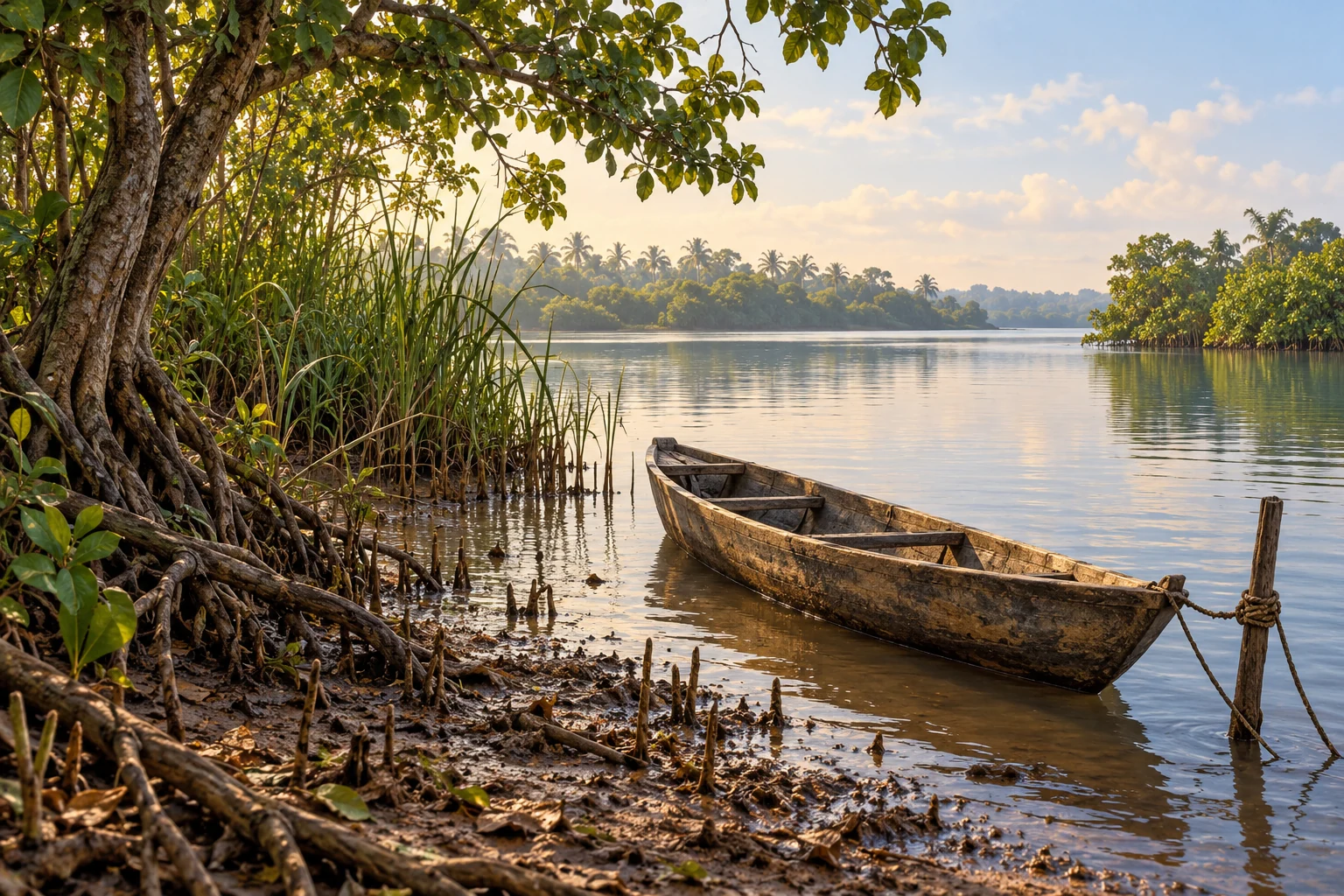
1. A lagoon-related setting
Olóṣà appears in accounts of lagoon waters, particularly in coastal Yorùbá religious geography. Older documentary records and the AUC Woodruff Library’s reference glossary provide starting points for the name. A glossary can locate a term, but it should not be treated as a complete account of contemporary devotion or as proof of every family relationship repeated elsewhere.
Early colonial writing also needs critical reading. It can preserve names and local observations while misrepresenting the religious world it describes. Its usefulness does not depend on accepting its categories or judgments without examination.
2. Key theme: exchange at an edge
The lagoon offers a contemporary image of relationship through exchange: waters enter, leave and meet a surrounding landscape. The point is not to invent a traditional doctrine from geography. It is to explore what the material setting can help a modern reader notice.
A boundary can connect as well as divide. A healthy relation distinguishes what belongs to each participant while allowing something to pass between them. Without distinction, closeness becomes confusion. Without exchange, distinction becomes separation. The practical work is to learn the form of contact that preserves both life and relation.
3. Local knowledge and the limits of a universal map
It is tempting to assign Òṣun to river, Yemọja to sea and Olóṣà to lagoon, then consider the subject finished. The chart is useful only if it leads back into actual places and religious accounts. Yemọja’s African river settings already show why a one-line global map is insufficient.
Olókun and Yemowo add further distinctions involving depth, sovereignty and shelter. Their relationships can be learned through particular narratives without being forced into one fixed list of daughters or attendants.
4. Religious identity and the scope of this study
Olóṣà belongs in this collection because lagoon-related sacred presences should not disappear behind more internationally familiar river and sea figures. The directly verified Woodruff Library glossary names Olosa and Olósà as a lagoon spirit. That is a limited but useful identification. It does not provide a complete contemporary account of a shrine, a genealogy, or the forms through which a particular community maintains relationship. The reference should keep its religious subject visible while making the documentary limit explicit.
There is no dedicated Olóṣà chapter in The Orishas and the Human Soul. Within Yemọja’s portrait, Olossá/Oloxá appears as a lagoon and meeting-water manifestation associated with fishing and contained aquatic wealth. Similar spelling and shared waters do not establish that this manifestation and every independently named Olóṣà are identical. The psychological material proposed here is consequently a new application of the book’s broader relational and ecological method. Its center is the boundary that permits exchange: a place can remain distinguishable while receiving movement from beyond itself. This gives the article a strong contemporary question without inventing a traditional doctrine. It asks what kind of contact sustains a relationship, and what forms of enclosure or intrusion cause that relationship to lose its distinct life.
5. Knowledge that gives the figure depth
5.1 What can a short glossary establish, and what does it leave open?
The verified library entry supplies a name and a lagoon association. It is valuable precisely because it gives the article a modest factual beginning. A reference should not silently expand that beginning into a universal list of relatives, colors, ritual objects, and obligations. Doing so would create the appearance of knowledge by adding details the source does not actually provide. The first knowledge lens is therefore documentary precision: learning to distinguish the existence of an association from a full account of the religious relationship that gives it meaning.
This need not produce an empty entry. A sparse record can sharpen the questions that further research should ask. Which lagoon is named in a local account? Who carries the relevant teaching? Does a similar name identify a distinct power, a title, or a manifestation in that setting? The questions protect actual local knowledge from being overwritten by the most convenient published diagram.
The opening discussion’s concern with colonial writing remains pertinent, but a historical author’s description would need to be identified and read before its details became evidence here. No colonial narrative is used as a substitute for present practitioners. We can teach the reader how to hold a limited identification responsibly while developing a clearly labeled contemporary interpretation of the material setting.
Evidence: Atlanta University Center Robert W. Woodruff Library, African Traditional Religions Textbook: Ifa, Appendix B — Entries Olosa and Olósà identify lagoon spirit; no fuller genealogy or contemporary shrine account established.
5.2 Why is the Olossá/Oloxá passage insufficient to prove identity?
The Yemọja chapter groups Olossá/Oloxá within a set of manifestations and interprets its lagoon, confluence, fishing, and wealth associations through a maternal frame. That passage is genuine book evidence, but its placement matters. A manifestation discussed inside another figure’s portrait is not automatically a historical statement that every similarly named sacred presence belongs to that figure. It supplies one situated configuration in the author’s synthesis.
The reference can use this configuration comparatively. It shows how contained waters might be understood through provision, relationship to a larger aquatic world, and intelligence concerning a threshold. It also presents a research problem: how does the account of this particular manifestation relate to independent uses of Olóṣà? Without additional local evidence, the correct relationship remains open. Shared chapter space cannot settle the question.
This distinction has an ethical consequence for writing. A reader seeking a personal religious relationship should not be handed a family tree manufactured by editorial convenience. The text can instead make the alternatives intelligible: a distinct local power may be related to other water deities, while a diaspora house may organize a cognate name differently. Neither possibility should be declared universal. The book’s own warning against reducing traditions to one system supports leaving the comparison specific, useful, and unfinished where the evidence is unfinished.
5.3 What does the lagoon teach when treated as a place rather than an element?
A lagoon becomes analytically interesting through the relationship between enclosure and connection. NOAA’s general description identifies a water body separated from a larger one by a natural barrier, often connected to the ocean through an inlet. This scientific description concerns landforms; it does not establish religious symbolism. Used openly as a contemporary analogy, however, it helps the reader imagine a boundary that does more than keep things out. The boundary shapes the conditions under which contact occurs.
This is more exact than treating the lagoon as a compromise between river and sea. Its particularity comes from its own form of relation, not from being an incomplete version of something larger. A person, household, or community can likewise participate in a wider world without being reducible to it. The important questions concern routes, timing, access, and what contact changes.
The National Park Service’s distinction between lagoons and estuaries also cautions against automatic language about every lagoon as an equal mixing of fresh and salt water. Material accuracy improves the metaphor. The contemporary interpretation should follow the actual idea of a partly sheltered water body, then ask how differentiated relation becomes possible. It should never infer an ancient teaching merely because a natural feature appears to fit a modern psychological argument.
Evidence: NOAA National Ocean Service, What is a lagoon? — General landform explanation: separation by natural barrier and frequent inlet connection; not evidence about religion; U.S. National Park Service, Estuary Landforms — Cautions that lagoons and estuaries should not be mechanically equated; physical context only.
6. A depth-psychological reading
Interpretive basis: A contemporary application of the wider interpretive framework in Babá Tilo de Àjàgùnnà’s The Orishas and the Human Soul, especially “Before the Òrìṣà Become Archetypes”, “Yemọja / Yemanjá”, “Water, Wind, Dust, Mud, and the Elemental Atmospheres of the Psyche”. No dedicated chapter exists. Paragraph3201 discusses Olossá/Oloxá within Yemọja; identity with independently named Olóṣà is not proved. All three psychological readings newly apply the book’s general method and ecological distinctions, with the limited name identification supplied independently by Woodruff Library.
6.1 A boundary that permits contact
The first psychological application concerns a false choice that often organizes intimate life: either keep everyone out or permit unrestricted entry. The lagoon image suggests a third possibility, a relationship with form. A person can decide when, how, and about what to be available. Such decisions need not be a rejection of closeness. They can make closeness sustainable by preserving the distinction between participants. This interpretation extends the book’s insistence that material atmospheres be read specifically rather than reduced to a general equation between water and emotion.
An illustrative family situation is an adult who loves relatives but cannot sustain constant access to their time. The family treats every limit as evidence of disaffection, so contact alternates between overavailability and abrupt withdrawal. A more workable boundary might distinguish willingness to help from permanent readiness to absorb any demand. The important change is conceptual: the relationship is no longer measured only by how completely one person yields.
This application also has a shadow. A person may praise their boundaries while refusing any encounter that could revise their preferences. Protection then becomes a language for preventing reciprocity. The question is what the boundary makes possible. Does it support continued exchange and a recognizable self, or does it merely freeze the relationship? This is contemporary DAILY IFÁ interpretation through the book’s method, not a claim that Olóṣà’s worshippers share a personality or that lagoon devotion carries a standardized psychological doctrine.
6.2 Partial disclosure without emotional disappearance
The book’s ecological method allows the threshold to be read as a matter of timing as well as space. A person need not disclose everything to be in truthful relationship. Some experience becomes communicable gradually; some information belongs to more than one person; some conversations require conditions that do not yet exist. The psychologically important distinction is between privacy that sustains the person and opacity that deprives others of information they need.
Consider an illustrative work relationship in which someone needs time before discussing a conflict. A clear statement that the conversation will resume can preserve contact while allowing reflection. Silence with no explanation may instead leave the other person responsible for guessing whether the relationship continues. The difference is not the amount of material disclosed but the form of acknowledgment. Partial access can be honest when its limits are named.
The lagoon analogy helps describe a permeable edge without pretending that the landscape proves a theory of communication. The broader book supports attention to distinct atmospheres and ethical consequences. Applied here, it asks whether reserve remains connected to relationship. The person does not owe every listener intimate access, yet meaningful connection may require some intelligible signal of presence, limit, and responsibility. This application differs from Yewá’s dedicated portrait of hiddenness: it concerns the management of exchange at an edge, rather than claiming that two water figures embody the same form of withdrawal.
6.3 Reciprocity when an exchange has unequal costs
A boundary can appear open while exchange remains profoundly unequal. One person provides attention, translation, labor, or emotional support; the other experiences the relationship mainly as convenient access to those resources. The first may feel ashamed of resentment because giving has become the basis of belonging. A lagoon-based interpretation can ask what enters and what leaves, who notices the difference, and which conditions make continued exchange possible. These are analytical questions, not a reconstruction of an otherwise undocumented Olóṣà ritual economy.
An illustrative community setting is a small group expected to make itself endlessly available to a larger institution. It may be praised for openness while losing time and authority over its own priorities. The problem is not solved by declaring all exchange exploitative. Instead, reciprocity requires terms that let the smaller participant retain a meaningful interior life and decision-making capacity. Contact should not mean that the larger system determines every route of movement.
The book’s relational personhood supplies an important corrective in the other direction. Autonomy is not total isolation or exemption from responsibility. A sustainable relationship involves receiving as well as refusing, giving as well as protecting. The contemporary Olóṣà application therefore examines the quality and terms of connection. It asks whether contact leaves both parties more able to continue, rather than assuming that either maximum openness or maximum closure is the measure of spiritual maturity.
7. What this relationship means for a person
7.1 In an established devotional or initiatory relationship
For a person who already has a devotional or other established religious relationship involving Olóṣà, public study should begin by preserving the specificity of that relationship. The existence of a name in a general glossary cannot determine how their community understands it. Nor should a passage about Olossá/Oloxá under Yemọja be used to correct their teachers without further evidence. The most valuable contribution of this reference is to articulate careful questions: which local presence is addressed, which waters matter, how is the relationship carried, and how does the house distinguish related names?
The psychological application can then remain a companion rather than an authority over practice. A devotee may find the threshold questions relevant to generosity, privacy, communal access, or responsibilities to a place. The relevance should be tested against lived obligations and teaching, not assumed because the imagery feels persuasive. Established devotion can involve particular people, custodians, and histories that an online account has not documented.
It is especially important not to invent a universal personal-head initiation for this figure. Some religious relationships are local, communal, inherited, or established through a particular revelation, and their forms should be learned where they are carried. Inner development here can be described without specifying an unsupported ritual status. It may concern learning how to remain connected while protecting what has been entrusted, or how to receive from a community without treating that community as an unlimited source. Such questions honor relationship precisely by keeping its concrete form open to the people responsible for it.
7.2 When the figure becomes relevant in consultation
If Olóṣà is named in a consultation, the relevant meaning belongs to the consultation’s own explanation. The sparse public documentary record makes this especially important. A reader should not substitute an elaborate online reconstruction for what the practitioner actually said. The encounter may concern a local spiritual relationship, a water setting, an obligation, or another context that this research cannot determine in advance. The interpretive material can help formulate questions afterward, but it cannot establish the reading itself.
The book’s distinction between patterned situation and sacred presence offers an orientation. Odù and Òrìṣà can be related without being interchangeable, and a figure’s relevance to a present question does not automatically assign a permanent identity to the person asking it. One consultation concerning boundaries does not make somebody a lagoon personality. Nor does interest in a coastal landscape prove that a religious relationship has been established.
As a clearly contemporary application, the reader might examine where exchange has become costly or unclear. Are they refusing all help because help feels invasive? Are they making themselves continually available because they fear losing belonging? Is a local place being approached as a resource without attention to those responsible for it? These questions become useful only if they fit the actual account. A reference should strengthen listening and accountability. It should not turn the documentary absence of detail into permission to invent ritual requirements, future events, or personal affiliations.
8. Nature, materials and human knowledge
The ecological basis must remain both modest and concrete. Lagoon is the directly supported religious association. General scientific sources explain why a lagoon should not be pictured as an anonymous quantity of water: a natural barrier and a restricted connection shape the place’s relation to a larger water body. The National Park Service also distinguishes lagoon conditions from a simple universal estuary model. These descriptions improve material accuracy without supplying a religious doctrine.
The book’s Olossá/Oloxá passage introduces fishing, meeting waters, and wealth within its particular maternal configuration. Those relations can be discussed as features of that passage, not automatically transferred to every independent Olóṣà tradition. Human life enters the new interpretation through access, provision, local knowledge, and the work of maintaining a habitable edge. The shore is significant because relationships happen there, not because every boundary is inherently sacred in the same way.
A contemporary ethical question follows: what does it mean to approach a place through the people and conditions that sustain it? Looking at water through a universal chart may conceal those relations. Learning a local account can restore the difference between admiring a landscape and being answerable within it. That is a research direction, not a claim that the present card documents a particular community’s environmental practice.
9. Diaspora, comparison and syncretism
No verified saint correspondence is supplied for Olóṣà. The most important comparison concerns how names and sacred relations are organized across accounts. A glossary’s independent lagoon entry and the book’s placement of Olossá/Oloxá among Yemọja manifestations can be set beside each other without declaring that either exhausts the other. The interpretive task is to identify the scope of each statement. Similar orthography, adjacent waters, or a shared maternal vocabulary does not alone prove identity.
This distinction also preserves other water powers. Olókun’s oceanic sovereignty, Yemọja’s river and sea histories, and Ọ̀ṣun’s named river should remain available as comparisons whose particulars must be learned. A tidy chart may be convenient for navigation, yet it cannot decide how communities understand related presences. The book’s method explicitly resists that kind of flattening.
The present psychological reading is another kind of crossing that requires its own label. It brings contemporary questions about boundaries and reciprocity to a limited documentary base through a general interpretive method. It is therefore a DAILY IFÁ framework application, not a recovered secret teaching or an additional author chapter. Stating this openly protects the religious subject and gives the reader a more honest account of where interpretation begins.
Evidence: Atlanta University Center Robert W. Woodruff Library, African Traditional Religions Textbook: Ifa, Appendix B — Entries Olosa and Olósà identify lagoon spirit; no fuller genealogy or contemporary shrine account established.
10. Questions for a fuller understanding
10.1 Does the book contain a dedicated Olóṣà portrait?
No. The chapter map has no dedicated Olóṣà chapter. The relevant name Olossá/Oloxá appears within Yemọja’s manifestations, where the author discusses lagoon and meeting-water relations. That passage supports discussion of its own configuration; it does not establish that every use of Olóṣà names the same manifestation. The present card therefore applies the book’s broader method of relational personhood and differentiated ecological atmosphere. The boundaries, privacy, and exchange readings are contemporary interpretive work. Keeping that distinction explicit allows the article to be substantial without presenting editorial imagination as a chapter the author did not write. It does not supply a separate Olóṣà theology.
10.2 Can the lagoon image tell me which ritual relationship I should establish?
No. A compelling image can help a person think, but it cannot determine a religious obligation. The directly verified glossary supplies only a lagoon identification, and general ecology supplies a description of a landform. Neither establishes a universal form of initiation or devotion. Someone with an existing relationship should learn its particulars from the people accountable for it. Someone encountering the name in consultation should ask for that encounter’s explanation. An interested reader can still use the contemporary interpretation fruitfully by considering the conditions of sustainable exchange, while preserving the difference between reflective insight and an established sacred relationship. The lagoon association alone cannot settle that question.
11. Correlations to life dimensions
| Dimension | A question for reflection |
|---|---|
| Relationships | Which boundary makes a fruitful exchange possible? |
| Belonging | Do I understand this place through local knowledge or only through a general category? |
| Change | What needs to move through my life, and what needs protection from intrusion? |
| Study | Has a convenient chart replaced the account it was meant to help me learn? |
12. An invitation to precise study
Olóṣà’s place in the Academy keeps lagoon-related traditions visible beside better-known water figures. For a personal religious relationship, seek the account held by your own teachers. The public study provides a clear beginning without manufacturing a universal genealogy from a small documentary record.
13. Sources for the expanded interpretation
Interpretive basis: A contemporary application of the wider interpretive framework in Babá Tilo de Àjàgùnnà’s The Orishas and the Human Soul, especially “Before the Òrìṣà Become Archetypes”, “Yemọja / Yemanjá”, “Water, Wind, Dust, Mud, and the Elemental Atmospheres of the Psyche”. No dedicated chapter exists. Paragraph3201 discusses Olossá/Oloxá within Yemọja; identity with independently named Olóṣà is not proved. All three psychological readings newly apply the book’s general method and ecological distinctions, with the limited name identification supplied independently by Woodruff Library.
-
Atlanta University Center Robert W. Woodruff Library. African Traditional Religions Textbook: Ifa, Appendix B. Entries Olosa and Olósà identify lagoon spirit; no fuller genealogy or contemporary shrine account established. Public institutional page, actual descriptive text read; current web edition.
-
NOAA National Ocean Service. What is a lagoon?. General landform explanation: separation by natural barrier and frequent inlet connection; not evidence about religion. Public institutional page, actual descriptive text read; current web edition.
-
U.S. National Park Service. Estuary Landforms. Cautions that lagoons and estuaries should not be mechanically equated; physical context only. Public institutional page, actual descriptive text read; current web edition.
No dedicated author chapter or verified contemporary local ethnography for independently named Olóṣà. No universal genealogy, saint correspondence, crocodile cult details, or initiatory form established. Psychological sections are explicitly new applications.