
Familiarity can make a name travel far from the relationships that once explained it. Oluorogbo offers a useful lesson in staying close to those relationships. The figure belongs to Ifẹ̀’s sacred memory, where shrines, narratives and later interpretations do not always form one simple genealogy.
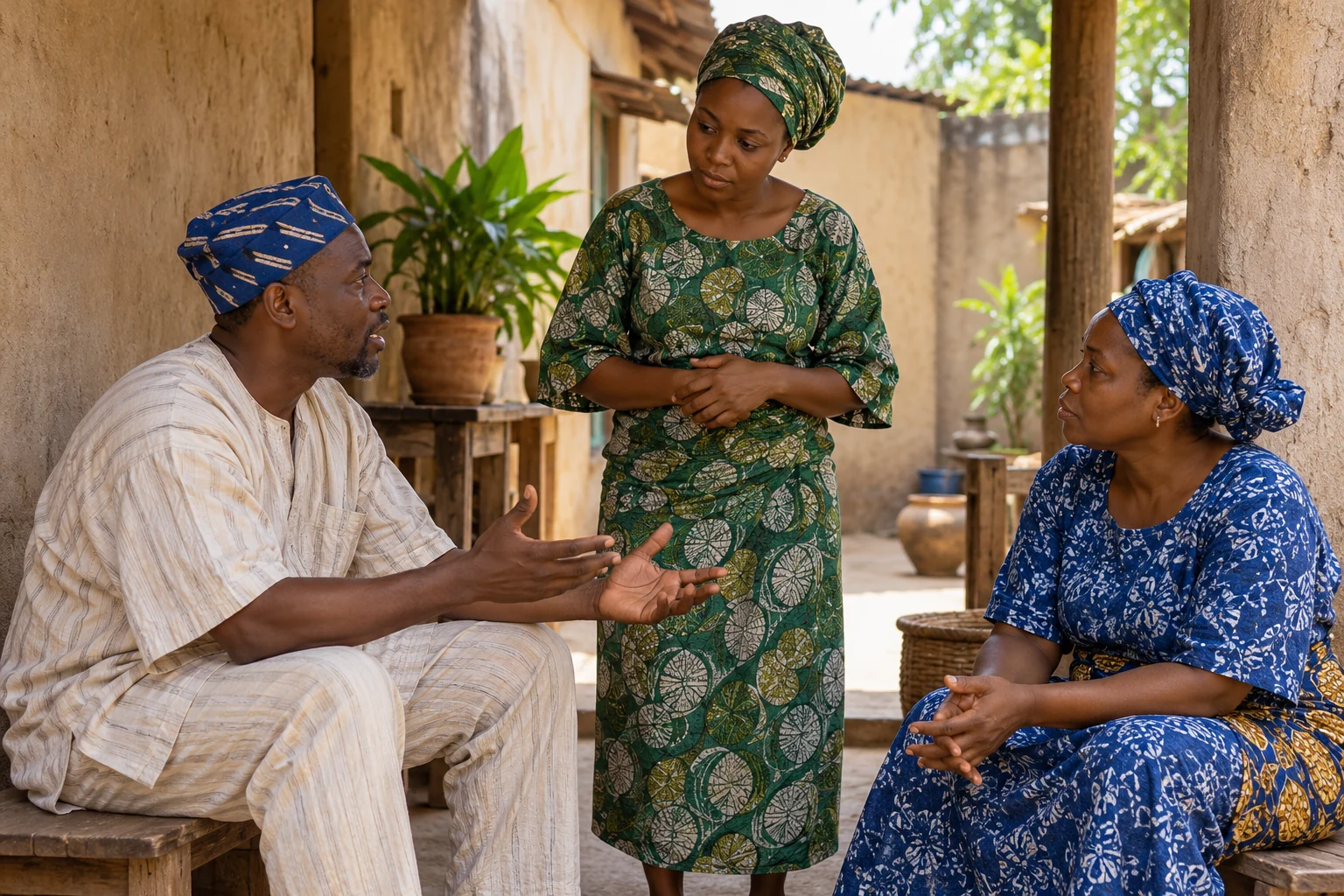
The passage is a contemporary visual metaphor for mediation, not an inherited sacred emblem.
1. A documented shrine, an open historical question
Fabunmi’s local documentation of Ifẹ shrines gives Oluorogbo an identifiable religious place. Accounts can involve mediation or messenger functions. Some retellings connect an Ela Oluorogbo with Moremi, while other historical reconstructions organize the relationships differently.
The responsible approach is to identify the account rather than use the repeated name to fuse all of them. A local religious figure, a narrative role and a later interpretation may be connected without supplying one universally agreed biography.
2. Key theme: the relation between memory and explanation
When a story contains a gap, a fluent explanation can feel better than uncertainty. Yet the missing part may be exactly where different communities preserve different relationships. Filling it too quickly can make a library easier to read while making the tradition harder to understand.
The contemporary question concerns the way we tell family and institutional histories. A polished narrative may give everyone a clear role, but it can also erase the contradictions through which actual lives were lived. Precision sometimes means preserving more than one account and explaining why they should not yet be combined.
3. Mediation without becoming invisible
Where a figure is approached through a mediating role, one can ask what makes communication between different settings possible. A mediator does more than carry words unchanged. They may need to understand relationships, risk and the consequence of a message arriving at the wrong moment.
This is an interpretive route, not a reconstruction of an unverified sacred episode. It can help a modern reader recognize the skilled work performed by people who make cooperation possible while receiving little of its visible credit.
4. Religious identity and the scope of this study
Oluorogbo has an identifiable place in Ifẹ̀'s sacred landscape. Fabunmi's shrine survey lists a distinct chapter, and Suzanne Preston Blier's authored study of religion and art describes visiting the messenger deity's temple with its priest. These sources establish more than a free-floating name while leaving significant questions about narrative identity and local practice open. A complete universal biography would exceed the evidence.
The supplied book has no dedicated Oluorogbo chapter. It briefly discusses Oluorogbo and Alásẹ̀ within a wisdom-bearing Obàtálá field, while also acknowledging that associated figures and classifications can remain fluid. That authorial arrangement should not erase the independently documented shrine. The relationship between a shared symbolic field and a distinct local presence needs to remain visible.
The opening discussion's themes of mediation and truthful memory are therefore appropriate for a new framework application. The psychological question is how someone makes understanding possible between different worlds without becoming a mere instrument, claiming omniscience or disappearing from the relationship. Another concerns the temptation to fill narrative gaps too quickly. These applications give the entry depth through precise human tensions while respecting the limits of the selected sources and the sacred presence that cannot be reduced to a messenger personality.
5. Knowledge that gives the figure depth
5.1 What can be said securely about the messenger relation?
Blier's account independently identifies Oluorogbo as an ancient messenger deity and locates a temple visit in the company of its priest. This establishes a specific religious setting for mediation. The book's separate interpretation of wisdom within the Obàtálá field supplies another kind of evidence: how the author organizes symbolic understanding. These accounts can be placed in conversation without treating either as proof that every local classification is identical.
A messenger is not necessarily a passive carrier. Communication between settings requires attention to who can speak, what has to be recognized and what changes when a message arrives. Those questions are developed extensively through Èṣù in the book, but applying them to Oluorogbo is new interpretation. A shared mediating concern does not establish identity between the two powers.
The contemporary application can examine the skilled work that makes a relationship possible. A translator, negotiator or trusted intermediary may understand both sides while belonging completely to neither. Their work includes timing, listening and protecting distinctions. Public appreciation often notices only the final agreement, leaving that labor unrecognized. Reading beside Oluorogbo asks what gives mediation its integrity and how it can remain accountable to the people involved. The inquiry should stay grounded in the documented messenger context without inventing an unverified sacred episode to illustrate it.
Evidence: Suzanne Preston Blier, Religion and Art in Ile-Ife — Authored account of messenger deity and temple visit; analysis of situated viewing. Not a universal biography and no procedure reproduced; M. A. Fabunmi; National Library of Nigeria repository, Ifẹ Shrines — 1969 publication and distinct Oluorogbo shrine chapter only; catalogue is not full-text proof of genealogies.
5.2 What does a situated act of viewing teach about knowledge?
Blier's temple account is especially valuable for showing that seeing is situated. The visitor's expectations, bodily state and the conditions of access affected the encounter with sacred art. Her analysis treats viewing as an event involving relationships and preparation rather than neutral inspection of an object. A public article can discuss that methodological insight without repeating or recommending the procedure she describes.
This gives the reference a concrete route beyond biography. A shrine is not merely a repository from which an observer extracts information. Its custodians organize access, and the observer brings expectations that shape what becomes visible or meaningful. The source does not prove that psychology exhausts religious experience; it demonstrates that a scholar can acknowledge her own response while remaining attentive to the religious setting.
The book's material and threshold frameworks deepen a contemporary application. People often assume that looking confers understanding. Yet an unfamiliar image can be interpreted through fear or reassurance imported before the encounter. The developmental task is to become aware of that participation without concluding that nothing real has been encountered. Reading beside Oluorogbo therefore asks how a person can approach what they do not yet know, recognize the conditions of their perception and remain available to correction by those whose relationship with the place is established.
Evidence: Suzanne Preston Blier, Religion and Art in Ile-Ife — Authored account of messenger deity and temple visit; analysis of situated viewing. Not a universal biography and no procedure reproduced.
5.3 Why should the Moremi/Ela question remain open here?
A repeated name does not by itself prove one continuous biography across texts. The opening discussion mentions retellings involving an Ela Oluorogbo and Moremi, but the selected independent evidence here does not establish how that relationship should be reconstructed. The stronger research decision is to preserve the question rather than promote a familiar narrative into a universal genealogy. Fabunmi's indexed shrine chapter confirms a subject, not every later account attached to the name.
The book supports this discipline through its insistence on distinctions among traditions and modes of truth. Its local classification of a wisdom-bearing figure cannot settle a separate historical argument. A new source may eventually connect accounts more precisely, but fluent synthesis is not a substitute for that evidence.
The psychological application concerns the desire for narrative completion. A gap can feel like disorder, and a writer may unconsciously prefer a coherent story to an accurate one. Families and institutions do the same when an unexplained event is assigned a convenient cause. Reading beside Oluorogbo offers a concrete counterpractice: identify what is actually known, retain the names in their settings and state what would be needed to connect them. The result may be less final, but it makes truthful continuation of the inquiry possible.
Evidence: M. A. Fabunmi; National Library of Nigeria repository, Ifẹ Shrines — 1969 publication and distinct Oluorogbo shrine chapter only; catalogue is not full-text proof of genealogies.
6. A depth-psychological reading
Interpretive basis: A contemporary application of the wider interpretive framework in Babá Tilo de Àjàgùnnà’s The Orishas and the Human Soul, especially “Obàtálá / Òṣàlá”, “Èṣù”, “Òrúnmìlà”, “Before the Òrìṣà Become Archetypes”, “Metals, Tools, Fire, Cloth, Stones, and the Crafted Body of Power”, “Numbers, Colors, Directions, Thresholds, and the Grammar of Sacred Pattern”. No dedicated Oluorogbo chapter. Brief named material in Obàtálá supports an authorial wisdom association, not universal identity. Messenger psychology and truthful-memory analysis are new applications; independent Blier account secures local temple/messenger context.
6.1 How can a mediator remain a person rather than become only a function?
A mediator can become indispensable while losing a sense of existing outside the needs of others. They know how to phrase the difficult message, calm the angry relative or make a meeting possible, but may struggle to state their own preference directly. Their competence has become tied to preserving connection among other people. If those people manage without them, relief can mingle with an unsettling loss of identity.
This new application draws on the book's relational view of personhood and its account of consequential communication. The issue is not that mediation is unhealthy. It is that a real gift can acquire a defensive obligation: conflict must always be translated before anyone sees the mediator's own anger, need or vulnerability. They remain useful by becoming difficult to encounter as a separate participant.
An illustrative adult child interprets every disagreement between relatives. Their absence produces guilt because they imagine the family will fragment without them. A more differentiated response asks which responsibilities are genuinely theirs and which have been delegated through habit. They may continue to help while refusing to carry every message. Applied beside Oluorogbo's documented messenger field, the question is how mediation can retain a self. This is not a diagnosis of devotees or a claim that the deity exemplifies psychological erasure. It uses the book's method to examine the human costs and gifts of making relationship possible.
6.2 Can understanding carry a difference that remains unresolved?
Someone who understands several settings can feel pressure to make them agree too quickly. Difference becomes experienced as personal failure: if conflict remains, perhaps the mediator has not explained enough. The resulting translation may erase precisely what makes the parties distinct. A convenient agreement is achieved, but each side has been heard only through the terms the mediator could make compatible.
The book's resistance to flattening religious traditions provides a strong method for a new psychological application. Understanding a relationship does not require producing identity. Two accounts can remain connected while differing in authority, language and aim. The mediator's task may be to make the difference bearable and accurately stated rather than to abolish it.
An illustrative interpreter helps a family discuss an inherited obligation. One person hears continuity; another hears the repetition of injury. Rephrasing both as a shared love of family can conceal the actual dispute. A more exact intervention distinguishes what each person means and what each can accept. The tension may remain, but it has become more truthful. Reading beside Oluorogbo asks whether the wish for harmony serves the relationship or protects the mediator from the distress of unresolved difference. This question deepens the messenger theme while preserving the sacred figure's independence from the contemporary scenario used to illuminate it.
6.3 What allows authority to survive the words “I do not yet know”?
Uncertainty can threaten self-esteem when knowing has become the main basis of authority. The person may feel that admitting a gap will expose them as fraudulent, so they construct an explanation that keeps the narrative moving. The immediate relief is considerable: ambiguity disappears and their competence appears intact. The longer consequence is that later evidence must be resisted because it threatens an account now tied to identity.
The opening discussion's attention to truthful memory makes this tension especially relevant. The book's method permits several kinds of truth without allowing one to swallow the others. Applied to Oluorogbo, it supports the capacity to distinguish secure evidence, provisional interpretation and unanswered questions. That is a psychological development as well as an editorial discipline: the person learns to remain in relationship while not yet knowing.
An illustrative researcher encounters two figures with overlapping names. Joining them produces an elegant story, but the sources do not establish the link. A more mature response can state what is documented and why the relation remains open. This may feel less impressive, yet it protects the subject from the writer's need to appear complete. The same capacity matters in intimate life, where asking rather than assuming can preserve the other's reality. Such humility does not abandon understanding. It gives understanding room to become more accurate through time and continued encounter.
7. What this relationship means for a person
7.1 In an established devotional or initiatory relationship
For a person already connected to Oluorogbo through an established religious setting, the primary account belongs to that setting's custodians. The independently documented temple and shrine chapter establish that the figure is not simply an abstract label for wisdom. They do not supply universal details of initiation, personal head affiliation or ritual office. A public article should preserve that distinction rather than build an imagined practice from scattered references.
The book's brief discussion can be used as a companion for reflection if its status is clear. It offers a wisdom-bearing interpretation within an Obàtálá field, while this study develops mediation and truthful memory through the broader framework. A practitioner may find those questions useful, but the application cannot overrule their received account or decide how the divine presence is classified in their community.
The psychological inquiry concerns participation: does a person use their skill in mediation to deepen truth, to avoid their own needs or to maintain an image of being the only one who understands? Can they acknowledge what remains unknown without experiencing that as religious inadequacy? These are human questions, not traits assigned to every devotee. Established relationship can provide a context in which answers become accountable over time. Public scholarship contributes by identifying sources carefully and respecting the difference between a visitor's observation, an author's interpretation and a custodian's living responsibility. The resulting article can be substantial while leaving the relationship larger than its explanation.
7.2 When the figure becomes relevant in consultation
When Oluorogbo appears in a consultation, its meaning should be learned from that consultation's question and identified narrative. A messenger association may suggest communication or mediation, but it cannot be assumed to be the full interpretation. Nor does an encounter through counsel automatically confer a permanent devotional affiliation or prescribe initiation. The least familiar name is not an invitation for the writer or client to supply the most elaborate speculation.
The psychological framework can help clarify reception. Does the client feel required to rescue everyone through mediation? Are they confronting a message whose arrival changes an obligation? Have they accepted a completed family narrative because uncertainty feels intolerable? These are possible lines of reflection, not a diagnostic list activated by the name. Their relevance must come from the actual concern and the responsible diviner's account.
An illustrative consultation about failed communication might invite the person to distinguish carrying a message from deciding the outcome. Their task could be honest transmission while the recipient retains the right to respond. Another situation might concern memory or a completely different relation the public sources do not anticipate. The appropriate response is to clarify what has actually been said and what follows in that religious setting. A carefully bounded encounter can still be meaningful. It need not become a universal biography of the client, a claim of special ancestry or a substitute for practical investigation of the present problem.
8. Nature, materials and human knowledge
Oluorogbo's strongest documented ecological anchor is a temple within Ifẹ̀'s sacred landscape. Blier's account places an encounter with art among custodians, thresholds, bodily perception and expectations. Fabunmi's shrine survey adds an independently catalogued local place. The evidence does not establish a universal animal, color, plant or element list, and these should not be invented to make the entry resemble more familiar Òrìṣà portraits.
The author's crafted matter framework nevertheless makes the setting analytically rich. Sacred objects do not live only as shapes available to inspection; their significance involves location, access, shaping and continued relation. A threshold organizes who is approaching, under what conditions and with what readiness. The contemporary application concerns the environments that allow a message to become intelligible.
A difficult conversation can fail because the setting makes listening impossible, not simply because the message lacks truth. Exposure, audience, fatigue and fear may determine how the words are received. Reading beside a documented messenger presence asks what kind of approach respects both content and recipient. This does not translate a temple into a communication technique. It shows how the book's material ecology can deepen attention to situated encounter while leaving the actual religious setting, its custodians and its meanings distinct.
9. Diaspora, comparison and syncretism
No verified source here establishes Oluorogbo as Jesus, as every manifestation of Ẹlà, or as an automatic equivalent of the figure called Ela Oluorogbo in Moremi retellings. Those relations require identified accounts and careful historical comparison. The opening discussion's open question should remain open instead of being replaced by a confident story assembled from similar names and mediating functions.
The book's placement beside Alásẹ̀ and within an Obàtálá wisdom field also needs its proper scope. It is evidence for the author's interpretive organization. It does not erase a distinct shrine or prove that all lineages classify the figure identically. The chapter's own acknowledgment of associated and historically entangled forms supports restraint.
A productive comparison can ask how wisdom, message-bearing and sacred authority are related in particular settings. What distinguishes knowing from transmitting? Who authorizes a messenger, and what changes when an account crosses a social or religious boundary? These questions remain substantive without a one-to-one identity. Psychologically, they also expose the temptation to domesticate an unfamiliar presence through a familiar religious figure. Letting the difference remain can be an act of respect: the subject is allowed to be more than the observer's need for a completed map, while the search for better evidence continues.
10. Questions for a fuller understanding
10.1 Why can a messenger be connected with wisdom without becoming Òrúnmìlà or Èṣù?
A shared concern does not establish identity. Wisdom may concern interpreting, forming, transmitting or approaching, and particular accounts organize these relations differently. The book itself differentiates forms of wisdom and warns against interchangeable symbolic labels. Oluorogbo's messenger context can therefore be studied beside Òrúnmìlà and Èṣù while preserving a distinct local temple and name. The contemporary psychological comparison asks what each relation helps us notice, rather than arranging the powers as departments within one mental machine. A more specific identity claim would require evidence from the actual tradition and account in which it is made. Further evidence is still required.
10.2 Does leaving a narrative question open make the article incomplete?
It makes the scope honest. An article can teach what the sources establish, distinguish kinds of evidence and develop a clearly identified contemporary interpretation without manufacturing a final biography. In this case, the distinct shrine and messenger context are secure enough to support study; the relationship to some retellings still needs further evidence. Naming that difference helps future research continue. The book's method values precision among several modes of truth. Applied editorially, that means uncertainty should be explained where it matters rather than hidden under fluent prose. A responsible boundary can therefore be part of a substantial account, not a failure to think.
11. Correlations to life dimensions
| Dimension | A question for reflection |
|---|---|
| Memory | What has been made artificially simple in the history I inherited? |
| Communication | Who makes understanding possible between people who do not share a setting? |
| Study | Can I preserve a distinct name without inventing a finished biography? |
| Recognition | Which mediating work disappears when only the final agreement is celebrated? |
12. Following the Ifẹ̀ connections
Moremi, Odùdùwà and Òràmfẹ̀ provide further reading within Ifẹ̀’s sacred landscape. Each entry keeps its own account. A house-specific explanation or identified scholarly study can deepen the connection without turning similarity into a substitute for evidence.
13. Sources for the expanded interpretation
Interpretive basis: A contemporary application of the wider interpretive framework in Babá Tilo de Àjàgùnnà’s The Orishas and the Human Soul, especially “Obàtálá / Òṣàlá”, “Èṣù”, “Òrúnmìlà”, “Before the Òrìṣà Become Archetypes”, “Metals, Tools, Fire, Cloth, Stones, and the Crafted Body of Power”, “Numbers, Colors, Directions, Thresholds, and the Grammar of Sacred Pattern”. No dedicated Oluorogbo chapter. Brief named material in Obàtálá supports an authorial wisdom association, not universal identity. Messenger psychology and truthful-memory analysis are new applications; independent Blier account secures local temple/messenger context.
-
Suzanne Preston Blier. Religion and Art in Ile-Ife. Authored account of messenger deity and temple visit; analysis of situated viewing. Not a universal biography and no procedure reproduced. Chapter28 in The Wiley-Blackwell Companion to African Religions, edited by Elias Kifon Bongmba,2012; author-hosted Harvard PDF text verified via indexed retrieval.
-
M. A. Fabunmi; National Library of Nigeria repository. Ifẹ Shrines. 1969 publication and distinct Oluorogbo shrine chapter only; catalogue is not full-text proof of genealogies. University of Ife Press1969; record verified, PDF download returned503.
No dedicated author chapter or settled Moremi/Ela/Jesus identity. Ritual instructions, universal personal initiation and natural correspondence list are unsupported. Local classification remains open where selected sources differ in scope.