
A place does not remember power in exactly the same way as its neighbor. Òràmfẹ̀ invites a reader to stay with that local difference. Familiar associations involving thunder and authority can offer an opening, but they should not make the Ifẹ̀ figure disappear inside a more widely recognized name.
Òràmfẹ̀’s study keeps place and local sacred authority together.
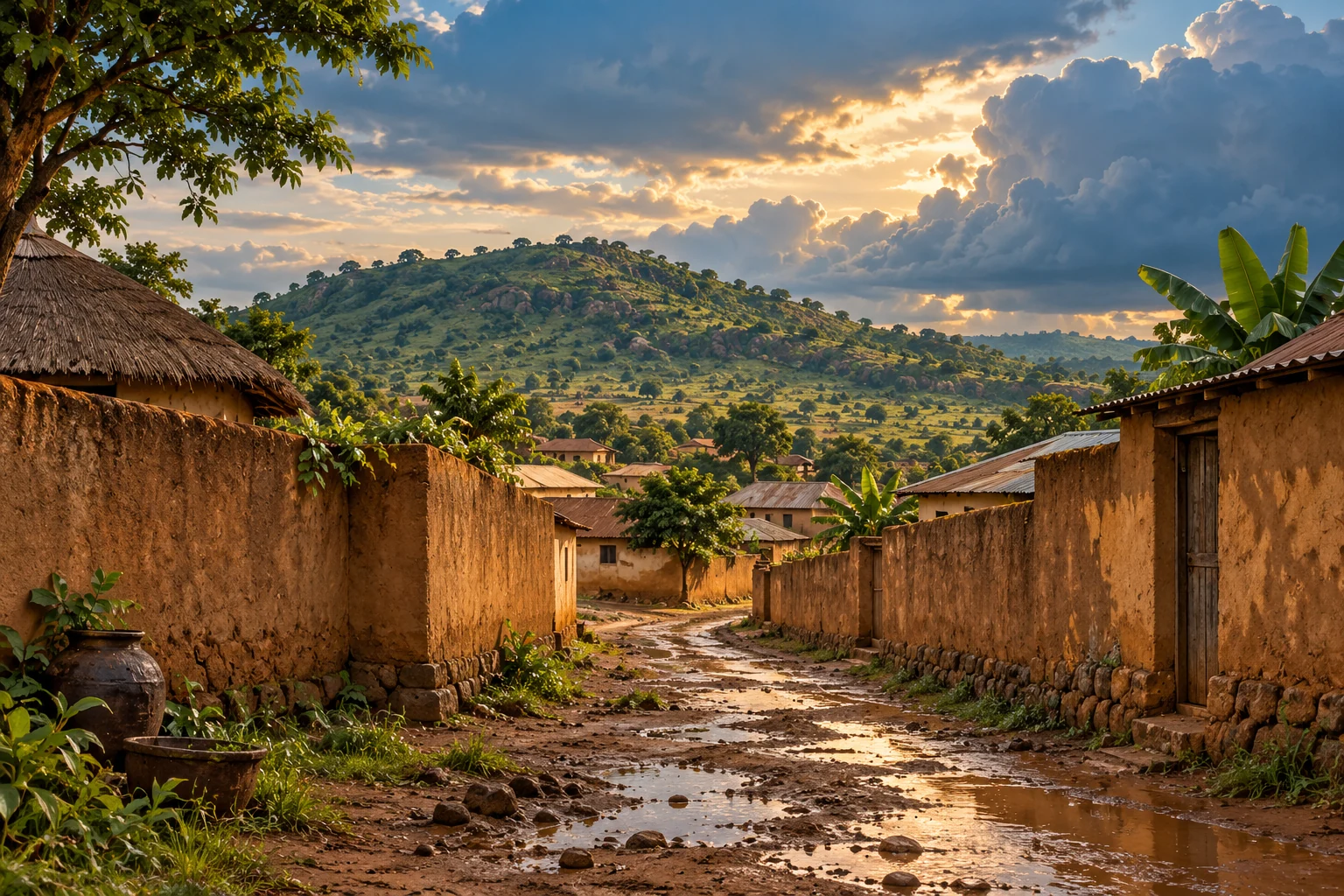
1. A local documentary anchor
Fabunmi’s Ifẹ Shrines places Òràmfẹ̀ in Ifẹ̀’s sacred geography and connects the account with Oke Ora. This gives a concrete orientation. It does not support a fully reconstructed chronology or a universal family tree extending across all Yorùbá communities.
The Academy therefore preserves separate entries for Òràmfẹ̀, Ará and Ṣàngó. Shared thunder-related descriptions do not settle the relationships among local cults, remembered rulers and later comparisons.
2. Key theme: a landscape can carry an account of authority
A hill or shrine can make a relation to power visible in an ordinary journey through a town. Sacred geography means that memory is encountered bodily: one passes a place, gathers there or learns why it matters. The account is not carried only through a written definition.
For contemporary reflection, this raises a question about the spaces through which institutions teach people to recognize authority. A monument, central building or protected site can make an inherited order feel natural. Looking carefully includes asking how that meaning is maintained and who has a voice in explaining it.
3. Learning without replacement
An introductory library can make an unfamiliar figure accessible by comparison, but it should also identify when the comparison has reached its limit. Saying that Òràmfẹ̀ is simply the local version of another figure may remove the very history the reader came to discover.
The more useful habit is to hold a name open long enough to learn its place. That habit can change encounters with people as well. A person becomes easier to categorize when described as the new version of someone already known, but harder to hear in their own terms.
4. Religious identity and the scope of this study
Òràmfẹ̀ must be approached through particular Yorùbá places and histories, especially Ifẹ̀, rather than defined as a redundant name for Ṣàngó. Suzanne Preston Blier’s published study of ancient Ifẹ̀ brings together thunder and lightning, rain, sovereignty, and jurisprudence in discussing Oramfe, with attention to earlier authors and local traditions. Fabunmi’s shrine bibliography provides another place-based orientation. The spelling variants Oramfe, Oranfe, Aramfe, and Ora occur in the scholarship, but variation in names should prompt source comparison rather than automatic merger of all thunder powers.
This identity has both atmospheric and civic dimensions. The force perceived in the sky is connected to the credibility of order on the ground. A reader therefore gains more from asking how authority is made answerable to a larger world than from extracting a personality adjective such as explosive. Oramfe’s significance also changes with locality: Lawuyi’s study treats Ondo origin narratives as work upon political belonging and independence. That is evidence that a sacred figure participates in contested historical memory. It does not authorize one master biography. The psychological study is a new application of the book’s general method, with the local religious identity held open.
5. Knowledge that gives the figure depth
5.1 What does the thunder–sovereignty connection actually establish?
Blier’s account connects Oramfe with the atmospheric and political order at Ifẹ̀. Present that as a historically situated account, including the fact that she attributes specific formulations to E. Bolaji Idowu and F. Euba. Her discussion does not license rewriting every royal or solar claim as direct observation. The secure interpretive point is that natural force, public protection, and authority are brought into relation; each enriches the meaning of the others.
Analytically, this relation complicates the idea that authority is simply a person’s capacity to issue commands. A ruler operates within conditions of fertility, vulnerability, and collective survival. Sacred authority can make that dependence visible: the office is larger than the officeholder, and the world that sustains the office cannot be owned by it. A contemporary analogy would distinguish a leader’s impressive presence from the conditions that make leadership trustworthy. Does the leader protect the community, recognize limits, and sustain order when applause is absent? That question is an application rather than an Ifẹ̀ doctrine supplied by the researcher. It keeps thunder meaningful as public consequence while resisting the seductive shortcut that a powerful display proves legitimate rule.
Evidence: Suzanne Preston Blier, Cosmic References in Ancient Ife — Author-hosted published text indexes Oramfe as Ifẹ̀ thunder/lightning presence linked to rain, royal power, jurisprudence; specific solar/supreme claims attributed by Blier to Idowu and Euba.
5.2 Why do Ondo variations matter to a reference centered on Ifẹ̀?
Olatunde Bayo Lawuyi’s article examines two Oramfe origin-myth versions in relation to Ondo identity, including independence from Ifẹ̀ and differences among Ondo subgroups. The available institutional and bibliographical records verify that argument’s subject and publication; full-text access was not obtained here. The verified research question is therefore regional identity; the specific contents of the two versions remain outside the evidence available here. This is a useful positive limit: variation itself shows that myth can be political thought.
A local narrative may acknowledge an important religious center while refusing to let that center determine every aspect of local identity. Belonging and independence can therefore coexist. The reader should not mistake difference for corruption or imagine that one uniform version preceded every legitimate community. A contemporary interpretive parallel concerns a family member who can recognize inherited loyalties while developing a distinct judgment. The parallel illuminates a relational tension; it does not explain away Ondo political history as family psychology. The direction of reasoning matters. First establish that real communities use Oramfe narratives to speak about their position. Then explore how inherited authority may be received, contested, and transformed without denying the inherited relationship altogether.
Evidence: Olatunde Bayo Lawuyi; Smithsonian Libraries record and AfricaBib, Mythical images, historical thought, and Ondo religion: the Oramfe myth as clue to Ondo-Yoruba identity — 1990 Africa 45(1):55–71; catalogue/abstract verifies two myth versions and the question of Ondo independence, not the unviewed stories themselves.
5.3 What can sacred geography teach beyond a list of attributes?
Oke Ora and the local shrine bibliography give the study a concrete geographical beginning. A shrine or hill is not merely a container for a story already complete elsewhere. Place can give memory a route, a point of orientation, and a continuing social constituency. People learn the significance of power through where they walk, who keeps a site, and which names are used when they explain it.
This approach prevents an encyclopedia entry from becoming only thunder, fire, king, and justice. Those terms gain specificity through their arrangement in a town’s remembered world. The wider material study in the book offers a method for asking how a durable object or site anchors presence, but it is not an independent record of Oramfe’s shrine. Contemporary analysis can extend the point to civic architecture. A building may teach deference before anyone explains its history. A monument may make one account appear natural while other memories remain peripheral. Oramfe invites attention to that embodied instruction. The research question becomes who can interpret the place and how the place continues to organize relationships. This is substantive even without an invented inventory of sacred stones, animals, colors, or days.
Evidence: M. A. Fabunmi; National Library of Nigeria, Ifẹ Shrines — Local shrine bibliography, retaining earlier discussion’s Oke Ora geographical context.
6. A depth-psychological reading
Interpretive basis: A contemporary application of the wider interpretive framework in Babá Tilo de Àjàgùnnà’s The Orishas and the Human Soul, especially “Before the Òrìṣà Become Archetypes”, “Metals, Tools, Fire, Cloth, Stones, and the Crafted Body of Power”, “Water, Wind, Dust, Mud, and the Elemental Atmospheres of the Psyche”, “Numbers, Colors, Directions, Thresholds, and the Grammar of Sacred Pattern”. No dedicated chapter for this figure exists in the supplied book. The historical and devotional orientation comes from the separately identified public sources. Psychological lenses and contemporary examples are NEW DAILY IFÁ applications of the book’s interpretive framework, not a recovered author portrait, doctrine of the source community, or clinical finding.
6.1 Internal authority: conviction that can survive a limit
The book offers a disciplined distinction between sacred presence, symbolic force, and psychological reading. Applied newly to Oramfe, a useful lens concerns the inner experience of authority. Some people can act only while feeling certain; doubt then feels like collapse. Others continually defer, treating every strong voice as evidence that someone else knows better. Thunder-associated sovereignty can illuminate the middle task: developing a conviction substantial enough to act and flexible enough to remain answerable.
The light is an internal authority that makes commitments and accepts consequence. The shadow is identification with command itself. A person may mistake the emotional charge of speaking forcefully for the truth of what they say. An illustrative manager might deliver an impressive speech during a crisis, then resist the information that reveals a failed decision. In such a case, the protective office has become protection of the self-image. An Oramfe-centered reflection would ask whether authority can withstand correction without needing either humiliation or another display of dominance. The developmental movement is from needing to appear sovereign toward becoming reliable within an office or responsibility. This is not a claim that devotees possess a fixed temperament. It is a precise human tension suggested by the relation between public force and order: strength becomes trustworthy when it can recognize the world beyond its own emotional intensity.
6.2 Inherited prestige and the anxiety of independent judgment
Lawuyi’s research question invites a new family-systems application without converting political history into private drama. A community or person may inherit a prestigious origin and still need room to interpret its own path. The psychological conflict appears when recognition of the inheritance is confused with permanent submission to it. Independence then seems possible only through denial, while loyalty seems possible only through obedience. Both positions keep the earlier authority at the center.
The book’s account of relational personhood offers a more exact frame. A self is formed in relationships, yet formation does not eliminate singularity. An illustrative adult raised in a respected professional family may experience every independent decision as betrayal, even when the family has never explicitly prohibited it. Their inner audience is older and more absolute than the actual conversation. Oramfe’s regional narrative field can prompt reflection on how a received source of legitimacy is acknowledged without being allowed to settle every future question. Development involves distinguishing gratitude, membership, and consent. One can inherit a name and still deliberate about its present meaning. The shadow would be using sacred or ancestral language to make another person’s development appear impious. The positive movement makes room for a relationship that survives difference. This interpretive use preserves the locality of the historical question rather than claiming an ancient myth already teaches a modern therapy.
6.3 The desire for dramatic correction versus durable justice
Thunder makes consequence perceptible in an instant. The psychological temptation is to wish that every moral disorder could end with an equally unmistakable event: truth becomes visible, the wrongdoer is exposed, and uncertainty disappears. That wish is understandable when ordinary processes feel slow or compromised. Its shadow is the substitution of spectacle for repair. A dramatic rebuke may relieve anger while leaving the conditions of wrongdoing intact.
A new Oramfe application can investigate how a person relates to moral force. Is indignation helping them establish what happened, protect the affected people, and sustain an accountable response? Or does the intensity of feeling become its own evidence? An illustrative committee might unanimously condemn one member but refuse to examine the shared practices that enabled the problem. The action produces a moment of solidarity at the cost of learning. The developmental movement is toward justice that can continue after the emotional climax: clear records, proportionate response, and changes in responsibility. These are contemporary ethical examples, not Oramfe ritual instructions. The book’s attention to shadow and existential consequence supports asking what a person’s desire for judgment contains. It may include care for the injured, a wish for recognition, fear of uncertainty, or enjoyment of moral superiority. Naming those motives can deepen responsibility without denying the reality of the original wrong.
7. What this relationship means for a person
7.1 In an established devotional or initiatory relationship
An established relationship with Oramfe would be situated among actual custodians, local memories, and religious responsibilities. The research does not justify treating every thunder-related relationship as the same initiation, nor does it establish a universal system of Oramfe personal-head affiliation. A person connected through Ifẹ̀ or another identified community needs the account of that community, especially where names and relationships differ. Understanding deepens when a shrine’s religious authority and a contemporary interpreter’s contribution remain distinguishable.
Within such a relationship, the new psychological questions concern the quality of responsibility. How does a devotee distinguish firmness from the need to appear beyond correction? What happens when a respected lineage teaches a difference that an outsider’s comparison cannot accommodate? Can reverence increase patience with difficult knowledge rather than make questioning feel impossible? These questions do not prescribe how the shrine should operate. They offer language for a human being who already lives within a relationship and wants to understand its effect on conduct.
A continuing affiliation also permits learning through time rather than dramatic self-classification. Someone may discover that their strongest attachment is to public recognition, while the harder lesson concerns service that receives little attention. Or they may find that chronic deference has prevented responsible action. These are distinct possibilities. Their resolution requires situated discernment, not a claim that all devotees are naturally leaders. The sacred relationship exceeds the personality pattern through which a contemporary reader temporarily approaches it.
7.2 When the figure becomes relevant in consultation
An Oramfe encounter in consultation differs from a determination of permanent religious affiliation. The actual divinatory context matters. A concern might involve an office, the credibility of a promise, a conflict about legitimacy, or a frightening event that has been interpreted too quickly. The name alone cannot settle which concern is present. Nor should a thunder association be turned into a forecast of punishment or proof that an accused person is guilty.
The book’s method supports a layered question. The outer situation may contain a failure of authority or an inherited dispute about belonging. Inner development concerns how the client responds: surrendering judgment to an impressive person, defending prestige against unwelcome information, or seeking a dramatic correction that avoids sustained work. These possibilities are not a coded catalogue. They invite a responsible interpreter to listen for the specific relation between circumstance and character. The sacred presence remains more than an inner state, while the person remains more than the current configuration of events.
A useful consultation outcome could be a clearer account of who holds responsibility, which evidence is missing, and what action belongs to the client. It may also reveal that the client has claimed responsibility for matters beyond their office. Such clarification is different from proclaiming them an Oramfe type. The consultation opens a situated relation; any continuing religious obligation requires the competent tradition’s own discernment. That discernment remains particular to the encounter.
8. Nature, materials and human knowledge
The most defensible associations are thunder, lightning, rain, sovereignty, jurisprudence, and named Ifẹ̀ geography, all with their source-specific qualifications. Blier’s discussion also reports broader celestial and seasonal interpretations from earlier authors. These should remain attributed rather than expanded into an unsourced cosmological system. The relational logic is a connection between atmospheric order and the conditions of collective life.
The book’s elemental chapter supplies a contemporary interpretive method: examine what an atmosphere makes possible, intensifies, or interrupts. A storm can make human limits impossible to ignore, while rain also belongs to continuing fertility. This double field matters psychologically. An authority that merely strikes is different from an authority responsible for conditions in which life continues. Likewise, a hill or shrine gives force a place in a remembered world; it is more than an illustrated attribute. Sky, ground, site, and community form an intelligible relational ecology even without an established universal inventory of animals and plants. This is not a claim that weather events directly disclose someone’s moral condition. It is an account of how particular natural relations can become religiously and ethically meaningful within a local tradition.
9. Diaspora, comparison and syncretism
Shared thunder language creates a real comparative question among Oramfe, Ará, and Ṣàngó, but it does not resolve that question in advance. Marc Schiltz’s separately identified article on thunder deities and sovereignty confirms a scholarly field of distinction; the available catalogue verifies its existence rather than its detailed conclusions. Blier sometimes uses predecessor and extension language in the Ifẹ̀ context. That wording should be attributed, not transformed into a universal statement that every figure is the same deity.
No verified Catholic saint correspondence for Oramfe was established here. Borrowing a familiar Ṣàngó correspondence would simply transfer an unsupported identity across a second comparison. A stronger account explains what can be compared: atmospheric force, the authorization of rulers, public judgment, and the remembering of local power. It then asks what differs in narrative, shrine, historical constituency, and ritual relationship. The same discipline applies when older sources use supreme or solar descriptions. Such language may disclose an author’s interpretation of a specific setting; it need not imply that a complete pan-Yorùbá hierarchy has been proven. Keeping differences legible is a positive form of knowledge. It lets readers approach a local presence without demanding that the unfamiliar disappear inside a better-known system.
10. Questions for a fuller understanding
10.1 Why preserve a separate Oramfe study if Ṣàngó is better documented?
Because a shared association does not contain a whole religious history. A separate study makes room for Ifẹ̀ geography, local authority, and the Ondo questions investigated by Lawuyi. It also makes the limits of comparison visible. A reader can learn that thunder connects several sacred fields without concluding that the names are interchangeable. Psychologically, this is a useful discipline of attention: familiarity should help us begin listening rather than decide what another voice must mean. The separate entry therefore adds knowledge even where the available public record remains uneven. Its purpose is to retain a place for the community’s own account, not to invent details merely to fill a standard profile.
10.2 Can thunder imagery justify harsh behavior by a religious leader?
No automatic inference follows from the imagery. A contemporary ethical reading asks whether conduct protects people, accepts consequence, and remains answerable to the responsibility claimed. Emotional intensity can accompany responsibility, but intensity alone does not establish truth or legitimacy. The same applies to a devotee interpreting their own anger: feeling powerful does not show that one’s judgment is complete. Oramfe’s public-order field can sharpen this question because force and authority are held in relation. This is an interpretive application of the book’s ethical lens, not an attempt to legislate a local shrine’s doctrine from outside it or identify a person’s religious status through temperament.
11. Correlations to life dimensions
| Dimension | A question for reflection |
|---|---|
| Place | Which spaces teach me whom to recognize as authoritative? |
| Learning | Does my comparison preserve the local account or replace it? |
| Memory | Who keeps the significance of a shrine or monument alive? |
| Responsibility | Can I distinguish what is documented from what I would like to complete? |
12. A careful point of departure
This entry provides local context and an interpretive path rather than an invented mythic biography. Further identified teachings can deepen it. Obalufon and Odùdùwà offer other ways into Ifẹ̀’s relationships among sacred presence, art and sovereignty.
13. Sources for the expanded interpretation
Interpretive basis: A contemporary application of the wider interpretive framework in Babá Tilo de Àjàgùnnà’s The Orishas and the Human Soul, especially “Before the Òrìṣà Become Archetypes”, “Metals, Tools, Fire, Cloth, Stones, and the Crafted Body of Power”, “Water, Wind, Dust, Mud, and the Elemental Atmospheres of the Psyche”, “Numbers, Colors, Directions, Thresholds, and the Grammar of Sacred Pattern”. No dedicated chapter for this figure exists in the supplied book. The historical and devotional orientation comes from the separately identified public sources. Psychological lenses and contemporary examples are NEW DAILY IFÁ applications of the book’s interpretive framework, not a recovered author portrait, doctrine of the source community, or clinical finding.
-
Suzanne Preston Blier. Cosmic References in Ancient Ife. Author-hosted published text indexes Oramfe as Ifẹ̀ thunder/lightning presence linked to rain, royal power, jurisprudence; specific solar/supreme claims attributed by Blier to Idowu and Euba. 2012 published chapter; relevant text verified through indexed author-hosted PDF; no inference of universal agreement.
-
Olatunde Bayo Lawuyi; Smithsonian Libraries record and AfricaBib. Mythical images, historical thought, and Ondo religion: the Oramfe myth as clue to Ondo-Yoruba identity. 1990 Africa 45(1):55–71; catalogue/abstract verifies two myth versions and the question of Ondo independence, not the unviewed stories themselves. Full text not retrieved; bibliographic/abstract scope only.
-
M. A. Fabunmi; National Library of Nigeria. Ifẹ Shrines. Local shrine bibliography, retaining earlier discussion’s Oke Ora geographical context. Catalogue, not independent proof of a detailed myth.
-
Marc Schiltz. Yoruba Thunder Deities and Sovereignty: Ara versus Sango. Anthropos 80(1–3), 1985, 67–84. Verifies a scholarly comparison worth consulting; detailed contents not claimed. Catalogue-verified publication; full text not read.
No dedicated chapter; local histories differ. Lawuyi and Schiltz available only through metadata/abstract; no invented myth versions, fixed colors, animals, saint correspondence, or standard initiation. Blier’s attributed historical interpretations remain attributed.