
Yemowo belongs to Ifẹ̀’s sacred landscape and accounts of Obàtálá’s relationships. A careful study begins with her distinct name, local setting and religious standing. It also opens a contemporary question about sustaining work: who enables a life or institution to become visible, and how is that contribution recognized?
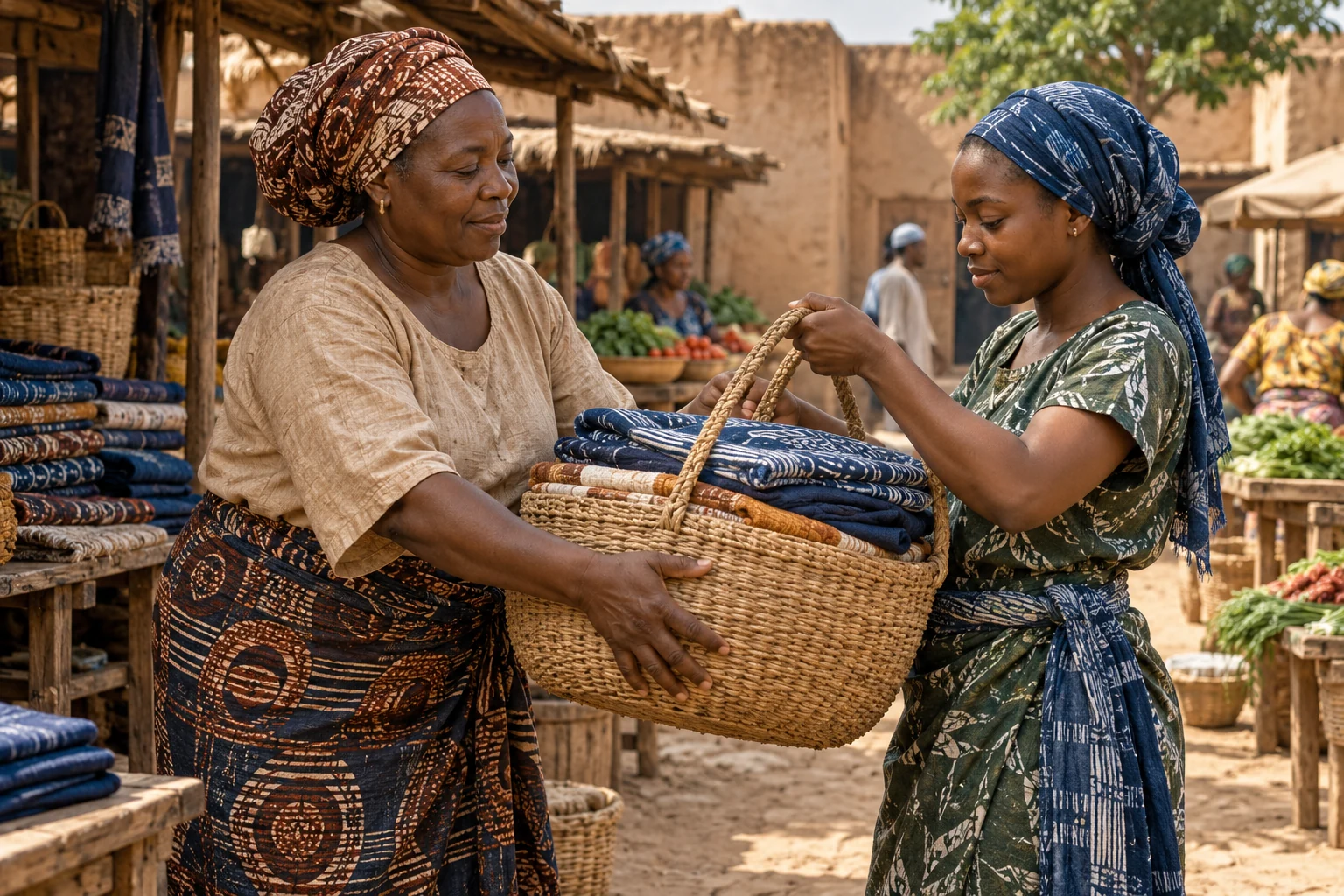
The basket directs attention to the labor that supports a shared life.
1. An Ifẹ̀-centered name
Yemòwó, Yemòó and related spellings are encountered in accounts of a sacred female presence connected with Obàtálá at Ifẹ̀. M. A. Fabunmi’s Ifẹ Shrines, published by the University of Ife Press, identifies a distinct Yemòó shrine chapter in its indexed contents. The record establishes a local bibliographic subject; the chapter’s complete theology has not been independently checked here.
Yemowo should not be automatically substituted for Yemọja, or confused with Yeyemoolu on the basis of similar spelling. A relationship among names needs a specific account. Similarity is an invitation to investigate, not a completed explanation.
2. Key interpretive theme: form needs a sustaining place
Reading Yemowo alongside Obàtálá opens a contemporary question about formation and shelter. An undertaking can be given a clear shape while remaining unable to survive. A child, an idea or a new institution needs conditions of support as well as a definition of what it is supposed to become.
This is an interpretation of a sacred relationship, not a claim that every house expresses its theology in the same conceptual pair. It makes an important distinction available to a modern reader: the work that protects becoming is not less significant because it happens before public recognition.
3. Hidden care and unequal credit
The person presenting a finished result may receive nearly all the credit, while the people who made the work possible disappear into the background. A household can organize the same inequality around care. Someone is said to have succeeded alone because the labor that sustained them has been treated as natural and therefore uncounted.
The study invites a more honest account of dependence. Gratitude becomes concrete when it changes recognition, resources and the distribution of work. Praise that leaves every burden where it was may be pleasant, but it has not yet answered the relationship on which the achievement depends.
4. Religious identity and the scope of this study
Yemòwó, including the spelling Yemòó in Ifẹ̀ documentation, needs to be approached through a specific local sacred landscape. Fabunmi's indexed shrine survey verifies a distinct shrine subject. An extract explicitly credited to Suzanne Preston Blier associates Yemoo with Obàtálá's consort, historic queens and market work, while separately listing Yemoja and Yeyemolu. This is firmer evidence than a general claim that similar names all describe one water mother.
The theme of shelter and overlooked support can be developed as contemporary interpretation. It should not be mistaken for a fully documented local theology of hidden water. The supplied book contains no dedicated Yemowo chapter. Its accounts of formation, relational personhood and material conditions nevertheless provide a method for asking how a visible achievement depends on support that may remain uncredited.
This new application gives the figure more specificity by preserving the tension between support and authority. Being related to Obàtálá does not make Yemowo merely a backdrop to his activity, nor does the relation authorize an invented universal gender partnership. This study can begin with the documented local distinctions and then openly ask what kind of inner development allows someone to receive care, recognize its work and support another without losing their own standing.
5. Knowledge that gives the figure depth
5.1 Why distinguish Yemowo from names a reader already knows?
Names that look similar can occupy different places in the same account. Blier's published extract separates Yemoo, Yemoja and Yeyemolu rather than presenting them as spellings of one figure. Fabunmi's table of contents likewise has a Yemoo shrine chapter and separate subjects elsewhere. This evidence establishes a reason to investigate distinctions; it does not justify a new etymology or settle every relationship among names in living practice.
The distinction matters because familiar associations can move faster than evidence. A reader who knows Yemọja may attach maternity and water to an unfamiliar name before noticing its local setting. The result feels informative while obscuring what is particular about the less familiar figure. A reference should instead identify the spelling, place and author, and explain which claim each supports.
The book's method supplies the interpretive principle: shared elements do not make sacred powers interchangeable. Applied here, this becomes a disciplined form of attention. The reader can remain interested in possible relationships without treating curiosity as proof. It also gives contemporary psychological inquiry a useful question about recognition: do we allow another person or presence to become known in their own relationships, or do we fit them immediately into the role we already understand? That question deepens the study without inventing an ancient teaching.
Evidence: Suzanne Preston Blier, extract introduced by The Guardian Nigeria, Ife coronation rituals and the primacy of history — Credited extract from Art and Risk in Ancient Yoruba; separate Yemoo/Yemoja/Yeyemolu, Obatala consort and market/queen associations; M. A. Fabunmi; National Library of Nigeria repository, Ifẹ Shrines — Verified1969 University of Ife Press record and separate Yemoo shrine chapter; catalogue metadata does not prove full chapter theology.
5.2 What does the market association add to the theme of support?
The association with market work supplies a concrete alternative to reducing support to an invisible domestic atmosphere. Markets involve labor, valuation, bargaining, circulation and relationships extending beyond a single household. Blier's short characterization cannot establish a detailed festival narrative or economic history, but it makes a significant public point: the figure's local field should not be confined to passive maternity simply because she is described through a consort relationship.
The contemporary interpretation can connect this with the opening discussion's question about unequal credit. Someone's visible success may depend on another person's capacity to organize resources, maintain contacts and absorb uncertainty. These are forms of agency. Calling them natural care can remove their skill from view and make their continuation seem obligatory. The problem is not merely insufficient praise; it is a misdescription of how achievement occurs.
A psychologically developed response changes how dependence is understood. The person receiving support recognizes that it comes from another participant with purposes, limits and alternatives. The supporting person can also claim competence without making permanent indispensability the basis of their value. This application is new and explicit. It should sit beside the documentary relation rather than appear as a recovered Yorùbá account of exactly how Yemowo's power operates.
Evidence: Suzanne Preston Blier, extract introduced by The Guardian Nigeria, Ife coronation rituals and the primacy of history — Credited extract from Art and Risk in Ancient Yoruba; separate Yemoo/Yemoja/Yeyemolu, Obatala consort and market/queen associations.
5.3 What can the Ita Yemoo site establish, and what remains open?
Ita Yemoo is also an archaeological place. IFRA's account of the Ife-Sungbo project reports work there involving pavements and other material evidence. Such findings establish a setting for investigating Ifẹ̀'s history; they do not by themselves supply a biography of the divine figure or prove a particular water association. A place name, a shrine record and an excavated object answer related but different questions.
This distinction is productive for a reference article. It lets the reader encounter a real landscape without turning every artifact into an illustration of a predetermined myth. A pavement can disclose organized human making and a durable environment. Its interpretation still requires the archaeologists' account of context, dating and use. A shrine's continuing significance requires another kind of knowledge from custodians and religious history.
The author's crafted matter framework can then support a clearly labelled contemporary reflection: support becomes effective through actual arrangements, not only affectionate intention. A surface must hold weight; a vessel must carry what is placed inside it; a house needs conditions that make staying possible. Reading beside Yemowo asks which arrangements support emergence in a particular life. The interpretation gains precision from material reality while acknowledging that archaeology has not certified the psychological meaning proposed here.
Evidence: Institut français de recherche en Afrique, Nigeria, Ife-Sungbo Archeological project2018–2026 — Ita Yemoo excavations and material site context only; archaeology does not establish a divinity’s full biography.
6. A depth-psychological reading
Interpretive basis: A contemporary application of the wider interpretive framework in Babá Tilo de Àjàgùnnà’s The Orishas and the Human Soul, especially “Before the Òrìṣà Become Archetypes”, “Obàtálá / Òṣàlá”, “Metals, Tools, Fire, Cloth, Stones, and the Crafted Body of Power”. No dedicated Yemowo chapter. Formation/containment and relational personhood support a newly proposed psychology of supporting conditions. Local identity is independently anchored; no water theology or identity with similarly named figures inferred.
6.1 Why can gratitude coexist with the erasure of supporting labor?
Invisible support can become psychologically difficult to acknowledge because it disturbs the image of being self-made. A person may sincerely appreciate help while continuing to tell the story of success as solitary effort. The contradiction protects autonomy from the felt humiliation of needing another. In this new framework application, the opening discussion's theme of hidden labor becomes a question about how dependence is represented inwardly.
The first developmental step is descriptive accuracy. Who organized time, maintained the home, introduced the contact, absorbed financial risk or provided the emotional setting in which work could continue? These contributions differ, and naming them specifically is more useful than declaring that everyone is connected. The next step concerns consequence. If recognition never affects credit, authority or the distribution of burden, gratitude may remain a performance that leaves the arrangement intact.
An illustrative professional thanks a partner publicly but continues to treat that partner's time as permanently available. The praise reassures the speaker that they are grateful while avoiding the practical implication of another person's agency. A reading beside Yemowo asks what would change if the support were understood as skilled participation rather than natural background. This does not turn the consort relation into a modern household formula. It uses the book's relational account of personhood to examine a concrete defense: denying dependence in order to preserve an inflated image of independent achievement.
6.2 When does supporting another become a need to remain indispensable?
The person who supports others can also become dependent on remaining indispensable. Their care may be generous and competent, while the prospect of another person's independence provokes anxiety. If usefulness has become the only secure basis of self-worth, a request for distance feels like rejection. Support then risks becoming a form of quiet control, even when the caregiver experiences themselves as merely giving.
The book's relational and formative frameworks permit a new reading of this tension without diagnosing the sacred figure. Holding helps another person develop enough form to meet life. It becomes restrictive when the recipient must remain incapable in order to protect the holder's identity. The distinction appears in small responses: is a new competence welcomed, corrected endlessly or met with a reminder of past sacrifices?
An illustrative mentor has helped a younger colleague acquire a role. When the colleague develops independent contacts, the mentor feels erased and begins withholding introductions. The underlying pain may concern recognition, but the response interferes with the very emergence the support originally served. A mature application asks how care could retain a relationship while allowing the other to become less dependent. It also asks what else can ground the supporting person's life. Recognition, reciprocal resources and a meaningful interior beyond service can make separation less threatening. Yemowo's documented relation remains larger than this contemporary example, which is offered as reflective work rather than inherited theology.
6.3 What kind of shelter prepares someone to face the world?
Shelter has psychological value because a developing life needs conditions in which it can experience, think and recover without every feeling becoming an emergency. The book's Obàtálá chapter describes form and containment as necessary for inhabitable life. Applied beside Yemowo's distinct local relationship, this offers a question about the environment that permits formation. The application must remain explicit: the book does not itself supply a Yemowo psychology.
A protective setting differs from an arrangement that removes all challenge. The former helps someone acquire capacities; the latter can make outside reality increasingly frightening. It also differs from a setting so conditional that safety disappears whenever the supported person expresses difference. Genuine containment can receive anger or uncertainty without demanding immediate agreement as the price of continued care.
An illustrative student needs time and reliable support while entering a demanding field. If every hesitation is treated as failure, the student may learn to conceal confusion and lose access to help. If all discomfort is removed, they may never develop judgment about what they can carry. The developmental middle involves support sufficient for experiment, mistake and increasing responsibility. This is a precise account of shelter as a condition for becoming, rather than a sentimental celebration of softness. Reading beside Yemowo makes the supporting environment visible while preserving both its active intelligence and its limits.
7. What this relationship means for a person
7.1 In an established devotional or initiatory relationship
For someone already connected to Yemowo through a recognized local or lineage setting, the primary account of the relationship belongs to that setting. A public reference should not infer a universal personal initiation from an Academy entry or construct a standard cult from scattered name similarities. The shrine record supplies a documentary anchor; it does not disclose the whole current practice or authorize an outsider's reconstruction.
The book-based material is a contemporary application that can accompany, rather than define, devotion. It may help a person examine how they support others, receive support or claim credit. Those questions can deepen religious life when they remain accountable to the actual relationship. They cannot determine a devotee's obligations from a psychological resemblance, and they should not require women to identify with caregiving simply because the divine presence is female.
The documented association with a consort and with market work also encourages respect for several forms of agency. A practitioner might reflect on partnership, public competence, resourcefulness or the balance between recognition and concealment. These are possible lines of inquiry, not a list of traits expected of every devotee. The mature aim is a more precise relation to what sustains life. Public study contributes by distinguishing evidence from application, acknowledging local custodianship and leaving room for knowledge that the selected sources do not provide. That honesty makes the entry more useful to established practitioners as well as interested readers.
7.2 When the figure becomes relevant in consultation
If Yemowo is named in consultation, the client's first task is to understand how the name is being used in that particular account. Similarity to Yemọja or Yeyemolu cannot settle the interpretation. Ask which story or relationship has been identified and how it addresses the question brought. A brief consultation reference does not automatically establish a lifelong affiliation or a requirement for a new initiation.
The psychological framework can then help examine a specific relation if the consultation gives reason to do so. A concern about support might involve unacknowledged labor, dependence experienced as shame, or care that has become conditional. Yet none of these is a universal meaning of the name. Assigning all three at once would replace listening with a template. The diviner's interpretation and the client's actual circumstances need to remain central.
An illustrative person might discover that a celebrated achievement has strained the relationship that made it possible. Reflection could ask what recognition would change practically and how support could become more reciprocal. Another consultation might disclose an entirely different issue, which this public reading cannot anticipate. Preserving the occasion keeps uncertainty from becoming a reason to invent. It also prevents the less familiar sacred presence from serving as a blank screen for whichever psychological theme a writer prefers. A meaningful encounter can open careful inquiry without giving the article authority over the person's religious identity.
8. Nature, materials and human knowledge
Yemowo's ecological discussion should begin with local place and human work. The verified evidence identifies a shrine subject, a consort relation, market associations and the archaeological site Ita Yemoo. It does not establish a universal list of waters, animals, plants or colors. Retaining that limit avoids turning a small documentary base into an elaborate invented theology.
The author's material framework makes this restraint compatible with depth. A supporting environment has surfaces, containers, schedules, resources and relationships through which life is carried. Markets circulate goods and value; houses organize provision and exposure; a pavement bears movement. These relations are specific enough to prompt thought without assigning every object to Yemowo as a sacred attribute.
The contemporary application asks what in a life is doing the work of holding. A person may experience an environment as secure because another continually anticipates its breakdown. Their calm rests on someone else's vigilance. Another may find that a previously supportive arrangement has become too narrow for their growth. Ecology then becomes a practical inquiry into the fit between emerging life and its conditions. The religious figure remains distinct from that inquiry, while the book helps explain why support has both material and psychological substance.
9. Diaspora, comparison and syncretism
The sources examined do not establish Yemowo as Yemọja, Yeyemolu or a Catholic saint. Blier's explicit separation of the names gives a positive reason to preserve distinctions. A shared sound or a general association with female sacred power is not enough to merge histories. Nor does a consort relation make Yemowo a universal title for every maternal or supporting aspect of Obàtálá's field.
The opening discussion's water language should consequently be handled as a theme requiring further documentation, rather than expanded into an assured system of springs, hidden rivers and maritime counterparts. The theme of shelter can remain useful when openly presented as interpretation. Its value lies in what it helps a reader examine, not in being falsely certified as a complete account of local belief.
A responsible comparison can ask how different traditions make sustaining work visible and how they distinguish a divine presence from a domestic function. Those questions do not need a one-to-one equivalent to become substantial. They also resist a psychological narrowing in which every female figure becomes mother and every male counterpart becomes form. The book's relational method is more flexible: several powers can illuminate support and formation, each through particular histories and relations that deserve to be learned before they are organized into a modern conceptual pair.
Evidence: Suzanne Preston Blier, extract introduced by The Guardian Nigeria, Ife coronation rituals and the primacy of history — Credited extract from Art and Risk in Ancient Yoruba; separate Yemoo/Yemoja/Yeyemolu, Obatala consort and market/queen associations.
10. Questions for a fuller understanding
10.1 Can the shelter interpretation remain if a water theology is unverified?
Yes, if its status is clear. The existing theme can be developed through the book's analysis of support, containment and the conditions that allow form to emerge. That is a contemporary application beside a locally documented figure, not evidence that every Ifẹ̀ account describes Yemowo as a hidden water mother. The distinction lets useful thought continue without manufacturing certainty. A future identified local source may deepen or redirect the interpretation. Until then, claims about specific waters should remain open, while we can teach something exact about receiving support, recognizing labor and making care compatible with another person's independent life.
10.2 Why does calling care natural sometimes make it harder to recognize?
When care is treated as a natural attribute of the person providing it, its decisions and costs can disappear. Time, skill and attention become background rather than contributions that another could reasonably limit or refuse. Gratitude then risks praising a trait while leaving the burden untouched. The book's relational view supports a more accurate description: support occurs through active participation, and the recipient remains dependent on another being's agency. This is a contemporary ethical application, not a universal theology of Yemowo. Its practical question is whether recognition changes credit, resources and responsibility enough to make the relationship more truthful for both participants.
11. Correlations to life dimensions
| Dimension | A question for reflection |
|---|---|
| Care | What supports a life before its achievements become visible? |
| Work | Have I counted the labor that allowed my own contribution to appear? |
| Relationships | Does gratitude change anything practical? |
| Spiritual study | Have similar names concealed distinct sacred histories? |
12. Following distinct relationships
Olókun and Olóṣà offer different water studies. They should not be arranged into one supposedly universal family list. The linked DAILY IFÁ newsletter develops a contemporary conversation about Yemòwó and hidden water mothers. That thematic reading is distinct from an independently established local water theology. The reference article and essay serve complementary purposes: one establishes an orientation; the other develops an interpretive conversation.
13. Sources for the expanded interpretation
Interpretive basis: A contemporary application of the wider interpretive framework in Babá Tilo de Àjàgùnnà’s The Orishas and the Human Soul, especially “Before the Òrìṣà Become Archetypes”, “Obàtálá / Òṣàlá”, “Metals, Tools, Fire, Cloth, Stones, and the Crafted Body of Power”. No dedicated Yemowo chapter. Formation/containment and relational personhood support a newly proposed psychology of supporting conditions. Local identity is independently anchored; no water theology or identity with similarly named figures inferred.
-
M. A. Fabunmi; National Library of Nigeria repository. Ifẹ Shrines. Verified1969 University of Ife Press record and separate Yemoo shrine chapter; catalogue metadata does not prove full chapter theology. Record verified; PDF download returned503.
-
Suzanne Preston Blier, extract introduced by The Guardian Nigeria. Ife coronation rituals and the primacy of history. Credited extract from Art and Risk in Ancient Yoruba; separate Yemoo/Yemoja/Yeyemolu, Obatala consort and market/queen associations. Published28August2015; explicit Blier attribution at opening, not anonymous independent corroboration.
-
Institut français de recherche en Afrique, Nigeria. Ife-Sungbo Archeological project2018–2026. Ita Yemoo excavations and material site context only; archaeology does not establish a divinity’s full biography. Public institutional text verified; source-specific scope applies.
No dedicated author chapter or independent water theology verified. Fabunmi available as catalogue only; Blier’s concise published extract supplies bounded local relations, not a complete ritual account.