A Deep Reading of Sacred Water, Fertility, and the Nine Daughters in Yorùbá Tradition
Recommended Deep Dives: Myths about Olokun and Myths about Yemojá.
Among the better-known Òrìṣà, names such as Ọbàtálá, Yemọja, Ọ̀ṣun, Ṣàngó, Ògún, and Ọ̀rúnmìlà circulate widely. Yet beneath that familiar layer lies a quieter and older sacred grammar—one preserved in Ifẹ̀-centered memory, local shrines, oral theology, and house lineages rather than in the simplified lists that often dominate popular summaries. It is within that deeper current that Yemòwó appears: white-clad, maternal, and profoundly dignified, the consort of Ọbàtálá, an elder among water powers, and one of the most refined images of gestational protection in the Yorùbá sacred imagination.
In the most accessible scholarly overview now available, Yemòwó is described as the most superior female deity, the wife of Ọbàtálá, a general water goddess not tied to one specific river, Ìyá-Ayé (“Mother of the World”), Olórí-Bìrìn (“Head of Women”), and a power especially revered by women seeking children.
That description matters because it places Yemòwó far above the category of a “minor” or merely domestic goddess. She belongs to the theology of origin, protection, and continuity. If Ọbàtálá gives shape, coolness, composure, and the white architecture of life, Yemòwó is the maternal water that makes life inhabitable before it enters the public world. She is not simply “water” in the broad sense. She is enclosing water—the kind that protects before emergence, sustains before naming, and surrounds the unborn with sacred continuity. That logic is entirely consistent with the older Ifẹ̀-centered memory in which her role survives most clearly. Both lexicographic and summary sources note that her worship became increasingly localized in Ifẹ̀, even while the cult of Ọbàtálá remained widespread.
The name itself is also worth handling carefully. Modern devotional interpretation often hears in Yemòwó an association with maternal abundance and wealth. But the accessible lexicographic evidence does not support the simplistic reduction of the name to “mother + money” in a literal modern sense. Rather, the strongest public lexical note glosses the name as deriving from ìyá / iye + mòwó, and explicitly marks Yemòwó as an Ifẹ̀-centered theonym.
That means the richer theological reading is preferable to a crude literal one: Yemòwó is not “money” as cash, but maternal abundance, the blessing that makes continuity possible—fertility, children, shelter, viability, and the wealth of survival itself
Yemòwó and Ọbàtálá: the marriage of form and enclosure
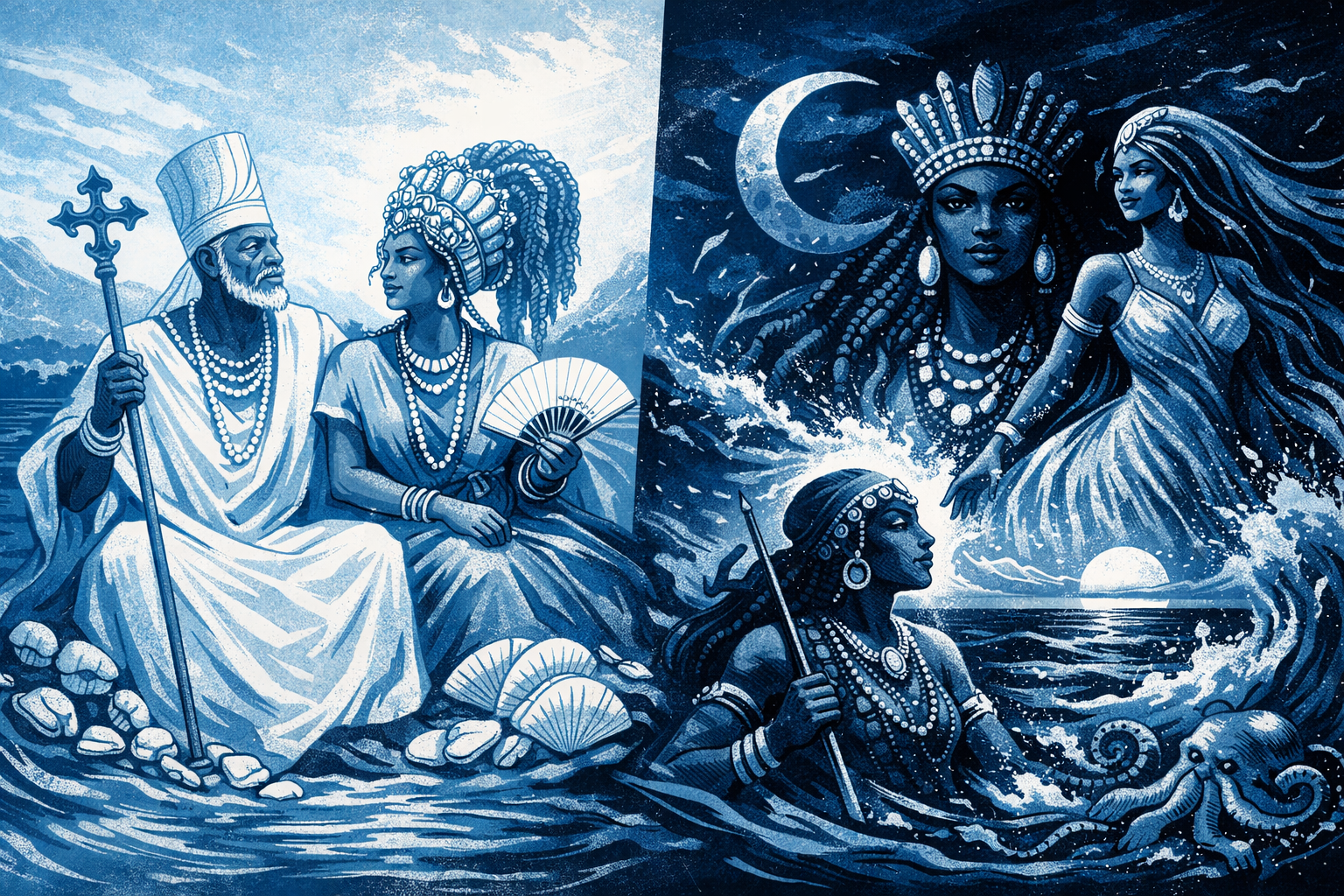
In Yorùbá theology, Ọbàtálá stands for whiteness, clarity, coolness, moral composure, sacred seniority, and the shaping dimension of creation. He is associated with the ordered, refined, cooling aspect of existence—the principle that prevents life from collapsing into frenzy or disorder. In the public record, Yemòwó is specifically identified as his consort. In fact, even brief summary entries preserve that pairing as central: Yemòwó is a water-and-creation deity whose spouse is Ọbàtálá.
The spiritual brilliance of this union is easy to miss if it is read only as mythic marriage. It is far more than that. It expresses a metaphysical law: life requires both form and shelter. Form without shelter fractures. Shelter without form remains undifferentiated. Ọbàtálá shapes. Yemòwó preserves. Ọbàtálá cools and orders. Yemòwó encloses and nourishes. The old saying preserved in a recent scholarly summary of the Ọbàtálá festival in Ilé-Ifẹ̀—“Òrìṣà-Nlá saw the possibility of marrying 200 wives yet cleaved to Yemoo”—is therefore not trivial romance but a statement of theological compatibility. Among many possibilities, divine form cleaves most deeply to the force that can hold life gently.
This is precisely why Yemòwó should not be flattened into a generic maternal category. She is the inner sanctuary of creation. She is the watery hush before biography begins.
Why Yemòwó is not simply another name for Yemọja
Because both are maternal water powers, modern retellings often collapse Yemòwó into Yemọja. That is too simple. Yemọja is a major and widely loved mother-Òrìṣà, but in strict Yorùbá theology she is, above all, a river deity, especially associated with the Odò Ògùn (Ogun River) and other inland waters. Crucially, in Yorùbáland it is Olókun, not Yemọja, who fills the role of the sea deity. Only in the Atlantic diaspora—especially Brazil and Cuba—does Yemọja / Yemanjá / Yemayá become primarily identified with the ocean.
That distinction clarifies Yemòwó’s place. Yemọja is maternal flow in an expansive, public, moving sense—riverine continuity, nourishment, motherhood that travels, the broad current of life. Yemòwó belongs to a more intimate and interior register: not the public river, but the protective water of gestation, enclosure, and first viability. In other words, Yemọja is often the great moving mother, while Yemòwó is the holding mother. The two overlap, and later lineages sometimes fold one into the other, but their emphases are not identical. The historical reduction of Yemòwó’s cult to Ifẹ̀, combined with the far wider diffusion of Yemọja, helps explain why later traditions often remember Yemòwó through Yemọja rather than alongside her.
Yemòwó in Ifẹ̀: a localized memory, not a marginal one
The fact that Yemòwó is less publicly visible today should not be mistaken for insignificance. Several sources point in the same direction: her cult became especially localized in Ifẹ̀, the ritual and historical heartland of Yorùbá civilization. Even outside direct theology, this survives in the sacred topography of the city itself. Ita Yemoo remains one of the best-known archaeological place names in Ilé-Ifẹ̀, associated with major excavations and important art-historical finds. Older art-historical scholarship also notes that Yemo / Yemoo had shrines at Ifẹ̀ alongside the cultic presence of related primordial figures.
This should be read correctly: Yemòwó is not “obscure because unimportant.” She is esoteric because localized, and localized because Ifẹ̀ retained older layers of divine memory that later public religion often redistributed among more widely diffused mother deities.
Olókun: depth, sovereignty, and the waters beneath all waters
No serious treatment of Yemòwó can stop at her alone. The wider water theology around her opens naturally into the mystery of Olókun. In public summaries, Olókun is the deity of the bottom of the ocean, ruler of all waters, and the source of wealth, health, and prosperity. Just as importantly, communities across West Africa and the diaspora understand Olókun as female, male, or androgynous, depending on place, lineage, and ritual framework. One concise reference captures the core distinction well: in coastal West African settings Olókun often appears in a male form, while in inland or hinterland settings Olókun is more often remembered as female; in broader Yorùbá thought, Olókun is marked by a kind of gender duality or balance rather than a single fixed sex.
That fluidity is not confusion. It is theology. Olókun is depth—the hidden, pressurized, treasure-bearing, dangerous, healing, and immeasurable side of reality. Depth does not fit cleanly into ordinary social categories. The deep sea nourishes and terrifies; it conceals riches and swallows ships; it hides both memory and force. This is why Olókun is linked not only to water, but to hidden wealth, serious healing, majesty, secrecy, and the part of life that the visible surface cannot explain. Public summaries consistently preserve this: Olókun is associated with the bottom of the ocean, the authority over other water deities, and the power to grant great wealth. Olókun is also widely remembered as the parent of Ajé, the power of wealth.
This is also where the comparison between Africa and the diaspora becomes especially important. In Yorùbáland, Olókun remains the deep-water sovereign. In Brazilian Candomblé, Olókun is recognized as a divinity of great African importance but historically occupies a much less public place than orixás such as Iemanjá or Oxalá; available summaries note that Olókun is recognized in terreiros, often understood as the mother of Yemoja and owner of the sea, but traditionally has no major public xirê cycle of her own. By contrast, in Santería, Olokún remains highly significant and is often treated explicitly as an androgynous or dual-gender orisha, with different ritual expressions in Ifá and Ocha.
The “nine daughters” of Olókun: fixed canon, regional memory, and house theology
The so-called “nine daughters” must be approached with both reverence and precision. There is no single universally fixed pan-Yorùbá list, publicly attested in the same way as the great major Òrìṣà. What exists instead is a layered structure:
First, there is the broad and well-attested theology of female water powers in Yorùbá religion, with Yemòwó, Yemọja, Ọ̀ṣun, and related figures holding major places. Second, there are older regional traditions, especially coastal and lagoon-centered ones, that preserve distinct aquatic beings such as Olóṣà. Third, there are house-preserved and diaspora lineages, especially in Brazilian and Cuban circles, where some names survive as independent powers, some as “roads” or manifestations of other goddesses, and some as retinues or grouped assistants. Even the number nine itself is not always organized identically: in some Afro-Cuban houses, for example, the number nine appears not as nine universally named daughters, but as a cluster of Olosá attendants in nine covered vessels serving the Olókun current.
So the deepest and most accurate reading is this: the “nine daughters” are best understood as a sacred hydrology—a way of differentiating the powers of water—rather than as a universally standardized genealogical chart.
1. Yẹmú: spring water, well water, and the emergence of hidden nourishment
The name Yẹmú survives chiefly in lineage-based theology rather than in widely available public reference works. In that older house logic, Yẹmú is not the open public mother of river expansiveness, but the keeper of water that rises from below: wells, springs, seepage, and the life-bearing freshwater that appears because the earth releases what it has hidden.
In spiritual terms, Yẹmú governs concealed sustenance becoming available. She is the blessing that comes from within the ground of life rather than from external display. The spring is humble, local, and essential. It does not announce itself with grandeur. It simply nourishes. In that sense, Yẹmú belongs to inner reserves, ancestral support, secret replenishment, and the grace by which life is restored quietly after depletion.
If Yemòwó is the water that encloses the unborn, Yẹmú is the first hint that hidden life can begin to rise toward the world.
2. Yemọja: the broad maternal current
Unlike several of the rarer names, Yemọja is abundantly documented. In Yorùbá tradition she is a mother spirit, patron of women—especially pregnant women—and a major river deity, with particular association to the Odò Ògùn. In Yorùbáland, she is not primarily the sea itself; rather, she is the maternal force of rivers and inland fresh waters, even though she is believed able to visit many bodies of water. By contrast, in Brazil and Cuba, she becomes primarily the great sea-mother.
In the deeper water grammar, Yemọja is the daughter—or maternal expression—of movement, carrying, and visible continuity. If Yẹmú is emergence, Yemọja is procession. She is the water that travels, feeds settlements, links territories, carries children forward, and turns maternal life into public continuity. That is why she remains one of the most universally beloved mother-powers: she is not only protective; she is abundantly active.
3. Akadume: a clue preserved in Arará and Lukumí memory
Akadume is especially interesting because the public evidence suggests that it does not survive most clearly as an independent primordial daughter in widely circulated literature. Instead, in multiple Afro-Cuban and Arará-facing sources, Akadume appears as the Arará-linked name of a warlike path of Yemayá, often associated with Yemayá Ogunte / Ogúnté / Ogumasomi, a fierce and iron-linked manifestation aligned with Ògún. These sources repeatedly describe Akadume as brave, severe, and allied with metal or warfare imagery rather than as a separate “water mother” in the gentle sense.
That is a major clue. It suggests that some names in the daughter-list may survive in the diaspora not as separate primordial beings, but as roads, specialized manifestations, or fused liturgical identities. In symbolic terms, Akadume points to harder water: surf, impact, forceful movement, iron-bearing current, the water that cuts, drives, or defends. Rather than the soft maternal image of a quiet river, Akadume belongs to the strand of aquatic power that can fight, clear, and intervene.
So if the older lineage names are read as a sacred taxonomy, Akadume likely preserves the memory of martial water—water in alliance with iron, discipline, incision, and active protection.
4. Olóṣà: lagoon, estuary, and the threshold between river and sea
Of the lesser-discussed names, Olóṣà is one of the most clearly recoverable in older regional tradition. Multiple sources identify Olóṣà (also called Ọ̀ṣàrà / Osara in some traditions) as the deity of the lagoon and estuary, especially in the Lagos region. Even popular summaries today preserve the contrast explicitly: okun is sea, ọ̀sà/osa is lagoon. A much older ethnographic source from the early twentieth century describes Olosa as “owner of the lagoon,” goddess of the Lagos Lagoon, and notes a regional tradition in which she “sprang from the body of Yemaja.”
This makes Olóṣà spiritually indispensable. She rules the threshold waters—not the inland river, not the open sea, but the mixed and transitional body where fresh and salt negotiate, where river becomes coastal, where land loosens and water widens. In natural terms, she corresponds to lagoons, estuaries, wetlands, mangrove edges, shallow brackish crossings, and all the ambiguous aquatic zones that mediate between categories.
Spiritually, Olóṣà is the force of transition, filtering, adaptation, and crossing. She teaches how one world passes into another without total rupture. In psychological and ritual terms, she belongs to migration, initiation, social thresholds, mixed identities, and the unstable but fertile space between settled forms.
5. Anabi: surface, shimmer, and the readable skin of water
Public documentation on Anabi is extremely thin. No widely accessible mainstream source fixes a universally agreed cult role for this name. That makes dogmatic certainty impossible. What can be said responsibly is that in a lineage-structured water sequence, Anabi is best read as the power of water’s expressive surface: shimmer, reflection, vapor, the readable skin of the water, and the layer through which depth first becomes visible.
This interpretation is not arbitrary. Any full theology of water must distinguish not only hidden depth and flowing current, but also appearance—the reflective face through which water mirrors sky, receives light, and communicates mood. In that symbolic register, Anabi governs intuition, impression, omen, emotional weather, and the fleeting forms through which truth first presents itself.
Depth belongs to Olókun. Movement belongs strongly to Yemọja. Threshold belongs to Olóṣà. Anabi belongs to revelation through surface.
6. Agana: tidal mass, pressure, and the weight-bearing body of water
Like Anabi, Agana is sparsely documented in public sources and survives more clearly in house-preserved theological patterning than in standardized academic lists. The most coherent way to read Agana within a structured water cosmology is as the daughter of weight: heavy water, tidal body, dense accumulation, and the slow force of mass.
Water is often imagined as soft. Yet great bodies of water are also immensely heavy. They press. They bear. They hold. They erode by persistence. Agana therefore corresponds naturally to deep basins, tidal load, the submerged shelf, the heavy standing body of water, and the sheer density by which water shapes land over time.
Spiritually, Agana belongs to endurance, burden-bearing, and the kind of support that does not glitter but remains. She is the slow maternal strength that carries what must be carried.
7. Ajé Ṣálúgà: wealth, cowries, and the riches of the deep
Here the public tradition becomes clearer again. Ajé is widely recognized as the force or deity of wealth and prosperity, and public summaries repeatedly link Ajé to Olókun. Olókun is openly described as the parent of Ajé in current reference summaries, and modern Yoruba-facing writing frequently speaks of Ajé-Olókun as the prosperity current associated with the sea’s hidden riches.
An older ethnographic source also preserves the specific figure Aje Shaluga, describing this being as a power of wealth whose emblem is a large cowry, and even associating that power with dyes and colors as well as fortune. While the orthography in that old source is colonial and imperfect, the memory it preserves is valuable: the relation between aquatic depth, shells, and prosperity is ancient.
In the deeper theological sense, Ajé Ṣálúgà is not mere cash. She is the moment when hidden abundance becomes transferable. Shells emerge from water. Cowries historically circulate as value. Wealth rises from depths before it enters markets. That is the spiritual logic of Ajé Ṣálúgà: prosperity that is not fabricated at the surface, but drawn from a deeper reservoir of blessing, timing, and alignment.
8. Toro: whirl, turning current, and the force of reorientation
Like Anabi and Agana, Toro is preserved primarily through lineage logic rather than a strongly standardized public cult description. Within the daughter-sequence, however, Toro most convincingly signifies turning water—the whirl, the eddy, the spiral, the pull that changes direction.
This is theologically important because not all water moves in a straight line. Some water circles, gathers, folds, reverses, and intensifies. In nature, this is visible in whirlpools, turning currents, spiral eddies, and backflow. In spiritual life, it corresponds to reversals, returns, repeated lessons, and transformations that require circling before progress resumes.
Toro therefore belongs to reorientation. She rules those phases in which life stops advancing linearly and instead bends, loops, and compels a different reading. Her movement is not stagnation. It is restructuring through rotation.
9. Ogumasomi / Ògún-linked water: cutting current, martial surf, and the alliance of water with iron
The final figure becomes most illuminating when read through diaspora survivals. In Afro-Cuban and Arará materials, Ogumasomi / Ogunmasomi appears attached to the fierce Yemayá road often called Yemayá Ogunte / Ogúnté Ogumasomi, again linking that aquatic manifestation to Ògún, iron, and severity. That means the name likely preserves not a gentle domestic current, but a forceful, disciplined, even martial mode of water.
This is deeply coherent. Water is not only nourishing and reflective; it also cuts channels, breaks banks, clears obstruction, and carves stone. In a sacred hydrology, there must be a daughter or current that expresses water’s alliance with incision, pressure, and decisive clearing. That is what the Ogumasomi complex most likely preserves: the memory of ironized water—water that does not merely carry, but acts.
If Akadume signals the fierce road and Ogumasomi preserves the iron-bonded name, then together they reveal one of the most fascinating truths in the hidden water traditions: not all maternal waters are soft. Some defend by force.
What the number nine is doing
The repeated appearance of nine in these hidden aquatic structures is unlikely to be accidental. In one lineage, the emphasis falls on nine daughters. In some Afro-Cuban house teachings, the same number appears in the form of nine Olosá vessels or assistants. That means nine functions less as a single publicly fixed census and more as a structuring sacred number—one that organizes multiplicity within the maternal-water current.
In interpretive terms, nine fits the entire logic of this theology: gestation, development, the many stages of becoming, and the distribution of one deep source into multiple usable modes. The hidden water is one. Human life, however, encounters it as spring, river, lagoon, surf, reflection, tide, abundance, whirl, and cutting force. Nine, in this sense, becomes the number of differentiated maternal functions.
How this theology changes in Brazil and Cuba
Across the Atlantic, this subtle hydrology is not erased, but it is reorganized. In Candomblé, Iemanjá becomes the public sea-mother and receives the devotional visibility that, in strict Yorùbá terms, belonged more to the riverine Yemọja combined with sea symbolism that in Yorùbáland more properly belongs to Olókun. Olókun remains known and revered, but often more esoteric, more reserved, and historically less central to public celebration.
In Santería / Regla de Ocha, Yemayá and Olokún are both powerful, but the system of roads, secret attributes, and house-specific configurations becomes especially important. That is why names such as Akadume and Ogumasomi often survive there not as tidy entries in a fixed “Nine Daughters of Olókun” chart, but as active liturgical fragments—roads, titles, or fused identities nested inside Yemayá, Olokún, or their retinues. In other words, the Atlantic traditions did not necessarily lose the old distinctions; they often compressed and redistributed them.
Final reading: Yemòwó as the crown of hidden water
When the whole structure is read together, a remarkably sophisticated theology appears.
- Yemòwó is the elder stillness of gestation, the white maternal enclosure, the dignity of life before public life.
- Yẹmú is hidden freshwater emerging from below.
- Yemọja is the broad maternal current that carries life forward.
- Akadume preserves the fierce, martial, iron-adjacent road of water.
- Olóṣà rules the threshold where lagoon and estuary mediate between worlds.
- Anabi belongs to surface, shimmer, and reflection.
- Agana is tidal weight, pressure, and endurance.
- Ajé Ṣálúgà is the surfacing of wealth from the deep.
- Toro is turning current, reversal, and reorientation.
- Ogumasomi preserves the cutting, clearing, interventionist edge of aquatic force.
And beneath them all stands Olókun, the deep itself: sovereign, hidden, rich, dangerous, healing, and beyond easy categorization.
That is the real power of this forgotten theology. It does not treat water as a single symbol. It treats water as a complete spiritual language. There is water that holds, water that rises, water that carries, water that reflects, water that mixes, water that enriches, water that turns, and water that cuts.
To recover Yemòwó and the hidden daughters is therefore to recover a subtler sacred literacy: one in which nature is not merely observed, but read; not merely used, but understood as articulate.
From Ilé-Ifẹ̀ to Salvador and Havana: Yemòwó, Olókun, and the Hidden Water Mothers in Candomblé and Lukumí
When sacred traditions cross an ocean, they do not arrive unchanged. They survive, but they survive through compression, translation, reorganization, and selective emphasis. This is especially true of the water powers of the Yorùbá religious world. In West Africa, the distinctions between Yemòwó, Yemọja, Olókun, and related aquatic forces can be subtle, layered, and regionally precise. In the Atlantic diaspora—especially in Brazilian Candomblé and Cuban Lukumí / Santería—those same powers remain alive, but they are redistributed into a different ritual landscape, one shaped by enslavement, colonialism, Catholic overlay, house lineages, and the practical need to preserve complexity under pressure.
That Atlantic shift matters. A figure such as Yemòwó, who retains a highly dignified but relatively localized memory in Yorùbáland, especially around Ilé-Ifẹ̀, does not become a broadly public devotional center in the same way in Brazil or Cuba. By contrast, Yemọja—who in Yorùbá theology is fundamentally a river mother—becomes in the diaspora the great public mother of the sea, under the names Iemanjá in Brazil and Yemayá in Cuba. Meanwhile, Olókun, the sovereign of deep waters, remains spiritually powerful in both places, but in markedly different ways: more recessive and liturgically quiet in Candomblé, often more explicit, formidable, and esoteric in Lukumí.
This companion reading is essential because it reveals a key truth: the Atlantic traditions did not simply “lose” the older distinctions. Much of the older theology survived, but often in a compressed form. Powers that may once have circulated as distinct water mothers in regional Yorùbá memory are frequently preserved in the Americas as qualities, roads, secret lineages, companion forces, or submerged theological structures inside the much more publicly visible cults of Iemanjá, Yemayá, and Olokún.
Yemòwó in the Atlantic world: present as memory, rare as public cult
In the Yorùbá sphere, Yemòwó is remembered as the consort of Ọbàtálá, an elder maternal water force, and a deity of children, fertility, and general sacred water. In the Atlantic world, however, that role does not usually appear as a large, separate public cult identity. Instead, Yemòwó tends to survive in a more veiled way: as part of Ọbàtálá’s domestic and reproductive theology, as a submerged maternal current inside white-clad creation symbolism, or as an older memory that becomes partially absorbed into broader mother-water figures. The result is not disappearance, but liturgical quietness.
In Candomblé, this makes immediate sense. The public liturgical field is dominated by major, highly visible orixás such as Oxalá, Iemanjá, Oxum, Xangô, and Ogum. Some divinities of great West African significance remain recognized but comparatively recessed. The clearest published example is Olókun, who is acknowledged in Brazilian terreiros yet not normally the center of a public xirê cycle; available summaries explicitly note that there are no xirê chants dedicated to Olókun in the same way as for the more publicly celebrated orixás. That pattern helps explain why a more localized figure such as Yemòwó would also tend to remain implicit, esoteric, or folded into stronger public currents.
In Lukumí / Santería, the same logic appears in a different form. The system is highly developed in terms of roads, lineages, and house-specific distributions of power. Publicly, Obatalá, Yemayá, and Olokún are all familiar. But not every older West African distinction survives as a separate public-facing orisha name. Many survive through caminos, inherited attributes, ritual narratives, or secret associations known more deeply inside lineages than in popular summaries. That makes Lukumí especially good at preserving complexity, but not always in the form of a neat public roster.
Why Yemọja becomes Iemanjá and Yemayá
One of the most important Atlantic transformations is the expansion of Yemọja into a primarily oceanic mother. In Yorùbáland, Yemọja is classically a river deity, not the undifferentiated owner of the sea. In fact, the available reference tradition is explicit that in Yorùbá theology, the sea belongs more properly to Olókun, while Yemọja is a maternal inland water power associated with rivers and freshwater flow. In the diaspora, however, the Atlantic itself becomes the dominant sacred horizon, and so Yemọja’s maternal identity expands outward into the role of sea-mother, giving rise to the immensely beloved public images of Iemanjá in Brazil and Yemayá in Cuba.
This is not a contradiction. It is a reallocation of symbolic emphasis. Once the Atlantic becomes the overwhelming geographical and emotional reality of Afro-diasporic religious life, the mother of waters naturally takes on a more oceanic profile. Thus, in Brazil, Iemanjá becomes one of the most public and beloved of all the orixás; in Cuba, Yemayá likewise becomes a powerful and widely recognizable mother-orisha. The older Yorùbá distinction between river motherhood and sea depth does not vanish, but it becomes partially overlaid by diaspora devotional experience.
Olókun in Candomblé: revered, acknowledged, but often recessed
The Brazilian case of Olókun is especially instructive. The available reference tradition describes Olókun in Candomblé as recognized as the owner of the sea and even as the mother of Yemoja, yet it also notes that Olókun is not normally a central personal orixá in the same sense as more publicly active devotional powers. In practical terms, that means Olókun is acknowledged as a divinity of real authority, but remains comparatively hidden in the public liturgical profile of many terreiros.
That position is highly consistent with Olókun’s theological nature. Olókun is the deep sea, the bottom, the heavy pressure beneath the visible surface, the keeper of wealth, health, mystery, and sovereign depth. Such a force is not naturally a purely festive public current. Olókun belongs to gravity, hiddenness, and reserve. In Brazil, the more public face of maternal water is Iemanjá; the more hidden and abyssal depth remains associated with Olókun, but often at a more esoteric register.
In that sense, Brazilian Candomblé preserves an important Atlantic compromise: Iemanjá becomes the beloved public sea-mother, while Olókun remains the deep and less publicly theatrical sovereign beneath her devotional horizon.
Olokún in Lukumí / Santería: a deeper and often more explicit presence
In Cuban Lukumí / Santería, Olokún often appears with more explicit force. The reviewed sources describe Olokún in Santería as one of the most powerful orishas, ruler of the deep sea, associated with prosperity, mystery, and the hidden dimensions of life. This framing is deeply consistent with the older West African theology of Olókun as lord or lady of the ocean floor and keeper of immense, concealed wealth.
Just as importantly, the sources note that Olokún in the wider Yorùbá and diasporic sphere may be viewed as male, female, or androgynous. Lukumí is especially hospitable to that layered understanding. Rather than forcing a single fixed gender image, Cuban practice often preserves the sense that Olokún is too deep, too primordial, and too sovereign to be reduced to a simple social category. That makes Olokún, in Lukumí, not merely “the ocean,” but the unfathomable—the spiritual pressure beneath visible existence.
The result is that in Cuba, Olokún can remain far more explicitly present as a distinct, serious, and formidable ritual force than in many Brazilian public contexts. Where Brazil often gives the shoreline to Iemanjá, Cuba frequently preserves a sharper theological awareness of the abyss beneath the waves.
What becomes of the “nine daughters” in the diaspora?
The most useful way to read the so-called “nine daughters” in Candomblé and Lukumí is not as a universally standardized public genealogy, but as a distributed sacred structure. In West African and house-preserved theology, the hidden water powers can appear as differentiated daughters or maternal currents. In the Atlantic world, those distinctions often survive in another form: as roads of Iemanjá / Yemayá, lagoon powers associated with Olóṣà, prosperity currents related to Ajé, or deeper companion forces nested under Olokún.
In other words, what is sometimes spoken of as “nine daughters” in one theological register becomes, in the Atlantic world, a multi-layered system of water functions. The names may shift, compress, or disappear from public circulation, but the functions remain. The hidden hydrology survives even when the explicit roster changes.
Olóṣà: the lagoon mother and the bridge between worlds
Among the lesser-discussed water figures, Olóṣà is one of the most recoverable in public sources. The reviewed materials explicitly distinguish okun (sea) from ọ̀sà / osa (lagoon), and identify Olosa / Osara as the goddess of lagoon and estuaries. This makes Olóṣà indispensable for understanding the Atlantic transition of water theology, because the lagoon is the place where categories mix: fresh and salt, inland and coastal, contained and open.
That threshold quality makes Olóṣà especially relevant in the diaspora. In Atlantic religious life, many communities live symbolically in estuarial space—between Africa and the Americas, between inherited language and translated ritual, between remembered river gods and oceanic devotion. Olóṣà therefore becomes the perfect symbol of threshold water, the sacred intelligence of crossing, filtering, and adaptation.
A Brazilian-oriented interpretive source also preserves an especially rich line: Olossá / Olossá / Olosa is described there as connected to lagoons, as a very old water being, and as linked to Ajé Salugá through a lineage of wealth and estuarial power. Even where this is not universal public doctrine, it is an important witness to how some Afro-Brazilian and house traditions continue to preserve more granular aquatic distinctions.
Ajé Ṣálúgà in Atlantic reading: prosperity rising from water
The prosperity current associated with Ajé remains highly relevant in both Brazil and Cuba because the link between water and wealth survives strongly in Atlantic symbolism. The reviewed sources explicitly identify Olókun as the parent of Ajé, the power of great wealth. This is one of the clearest surviving clues to the older aquatic theology: abundance belongs to the deep before it belongs to the market.
This is why a figure such as Ajé Ṣálúgà—whether treated as an independent aquatic power, an old prosperity current, or a more lineage-bound expression—fits so naturally into Atlantic religion. The ocean bears shells, shells become symbols of wealth, and wealth itself is imagined as something first hidden, then revealed. In Candomblé and Lukumí alike, prosperity linked to water is not accidental. It is the lingering memory of the old teaching that the deep sea holds treasures the surface does not immediately disclose.
The fiercer water currents: how old daughter-theology survives inside roads
Some of the rarer names associated with hidden aquatic daughters do not circulate widely in public Atlantic religion as separate deities. Instead, their memory appears to persist through fiercer roads or martial expressions of Yemayá / Iemanjá, especially in traditions that maintain extensive internal differentiation of water powers. The general principle is more important than any one fixed name: not all mother-water is soft. Some forms of water defend, cut, clear, and intervene.
This is especially intelligible in Lukumí, where the existence of multiple paths or roads of Yemayá is itself a well-known structural feature of the religion, and in Brazilian practice, where Iemanjá can also appear in multiple liturgical moods depending on house, nation, and inherited theology. What older Yorùbá or house memory may preserve as distinct water daughters can therefore survive in the Americas as temperaments and specialized manifestations—lagoonic, martial, maternal, wealthy, deep, reflective, or threshold-like—inside larger public orisha identities.
A useful Atlantic key: the daughters as functions, not just names
For readers trying to reconstruct the older hidden water map, the most useful Atlantic key is this: in Brazil and Cuba, the “daughters” often make more sense as functions than as a fixed, universally taught list of separate public names. Those functions can still be recognized:
- the gestational and interior maternal current that belongs to Yemòwó,
- the broad public mother of waters embodied by Iemanjá / Yemayá,
- the deep and sovereign abyss of Olókun / Olokún,
- the lagoon and estuary threshold of Olóṣà,
- the prosperity-bearing aquatic current linked to Ajé,
- and the fiercer, clearing, or martial water modes distributed through specialized roads and lineages.
This reading is both theologically faithful and historically realistic. It avoids pretending that all Atlantic houses preserve the same named chart, while still honoring the fact that the deeper water grammar survived. The names may compress. The functions remain.
Brazil and Cuba as two different Atlantic solutions
Seen side by side, Candomblé and Lukumí offer two different but related solutions to the problem of preserving complex aquatic theology.
In Brazil, the public devotional center of maternal water becomes Iemanjá—beloved, oceanic, widely visible, and emotionally accessible. Olókun remains real and important, but largely more reserved in public ritual visibility. Subtler older distinctions often persist in house knowledge, in less public oral teachings, or in re-Africanizing theological work.
In Cuba, the structure often preserves sharper internal differentiation between Yemayá and Olokún, and the religious culture of roads, ritual lineages, and specialized transmissions makes it easier for older distinctions to survive in coded or inherited form. Publicly, Yemayá remains the maternal sea power; ritually and theologically, Olokún retains more of the direct weight of deep mystery.
Neither model is “truer.” Each is an Atlantic translation of the same older sacred challenge: how to preserve a theology in which water is not one thing, but many.
Final reflection
The real gift of this Atlantic comparison is not merely historical. It is conceptual. It shows that Afro-diasporic religion did not flatten the old water powers into a single symbol. It reorganized them for survival.
- Yemòwó remains the hidden maternal enclosure, even where her public name grows quiet.
- Iemanjá / Yemayá becomes the great public mother of the sea, carrying the emotional and devotional weight of Atlantic motherhood.
- Olókun / Olokún remains the abyssal sovereign, the keeper of wealth, mystery, and hidden power.
- Olóṣà preserves the threshold, where one kind of water becomes another.
And the older “daughters,” whether named openly or preserved as qualities, continue to speak through the many moods of water: holding, carrying, mixing, enriching, turning, and clearing.
That is the deeper continuity between Ifẹ̀, Salvador, and Havana: the conviction that water is never only physical. It is a sacred intelligence with layers, moods, mothers, thresholds, and depths.
Ìbà Yemòwó.
Omi ò.