
Fios de conta are bead necklaces whose religious meanings arise through their preparation, use, and relationships within Candomblé. They may express devotion, attachment to a house, initiatory history, or a particular responsibility. Their colors and arrangements matter, but a necklace is not a universal code that allows an observer to read everything about its wearer. Recognition depends on a religious setting and on people who know what they are seeing.
Bàbálórìṣà and Bàbáláwo Tilo Plöger de Àjàgùnnà's The Sacred Candomblé is the main interpretive foundation for this discussion. Its treatment is principally Ketu oriented, with comparisons across other settings. Here its attention to consecration, belonging, and differentiated forms is read alongside university and museum documentation. Names, arrangements, and permissions remain specific to nations and houses. The point is to understand what the necklaces do in relationships, rather than supply a color chart or a method for making sacred objects.
The first change of perspective is to stop treating appearance as the whole object. Two necklaces may look similar and have different histories. A modest strand may carry a relationship that an elaborate piece does not. A person can buy beads, appreciate their beauty, and learn their names without thereby receiving the religious connection or responsibility associated with a prepared fio de conta.
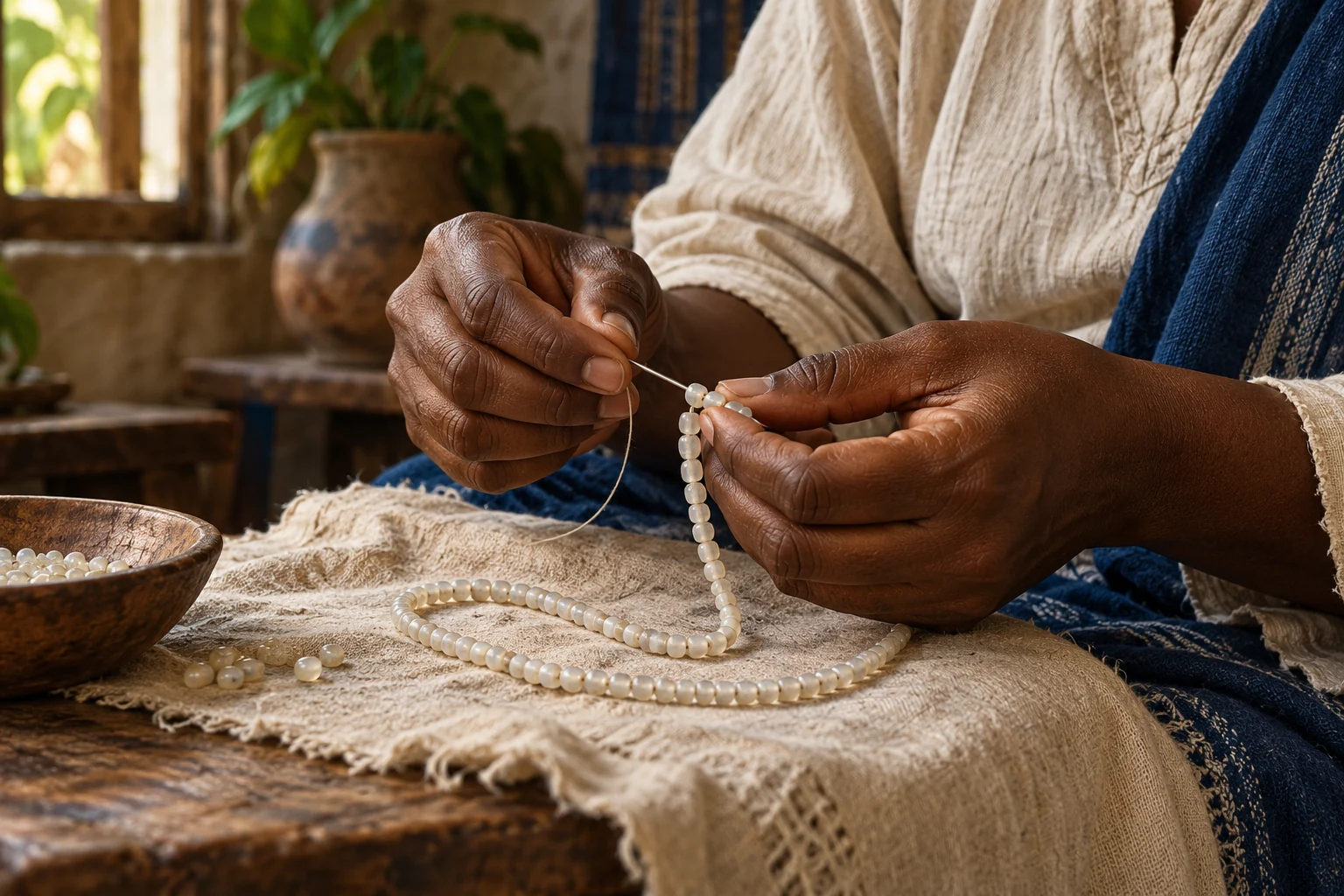
The phrase names more than a decorative necklace
Fio de conta literally directs attention to a thread or strand of beads. The plural fios de conta and the form fios de contas both appear in public writing. Other terms include colar de santo and cordão de santo. Babá Tilo lists names such as inhã, dilogum, brajá, lagdibá, and runjeve in discussing different forms and uses. Their relationship is not simply that every word means exactly the same necklace.
The vocabulary moves across religious and everyday settings. Guia is familiar in Umbanda and also circulates more broadly in Brazilian religious speech. Ilequê and related spellings occur in descriptions of bead necklaces. A reader should therefore ask how a term is being used in the passage at hand. An object in a Candomblé house and a similarly named object in Umbanda need their own explanations.
This matters especially with dilogum or related forms, because a reader may also encounter similar words in discussions of cowrie divination. The necklace and the divinatory system cannot be identified merely because names resemble one another. Context tells us whether someone is describing a strand arrangement, an instrument, or a practice. The Ifá and jogo de búzios study helps keep these different subjects intelligible.
Precise naming does not require stripping away local variation. An elder may pronounce or write a term differently from a printed catalogue. Listening to the house's usage is part of learning. The aim is to become more accurate about relationships, rather than make the living vocabulary conform to a single outsider's dictionary.
What consecration changes
In Babá Tilo's account, a fio de conta intended for religious use is prepared and consecrated within relationships of authority. The material necklace becomes involved in a particular person's obligations and divine connections. This religious status cannot be established by appearance alone. A photograph may show the beads while remaining silent about the preparation and recognition that matter to the wearer.
Consecration should therefore not be understood as a decorative finishing treatment. It places the object within a continuing religious life. There may be guidance about use, handling, care, and what happens if the necklace needs attention. Those matters belong with the responsible house and its officeholders. A public explanation can describe that relationship without reproducing a procedure.
The distinction also protects craftsmanship from being undervalued. Someone who strings a necklace may bring extraordinary material skill, even when the piece has not been consecrated. Religious preparation does not make the craft disappear, and excellent craft does not establish religious authorization. The two can meet in one object while remaining distinguishable kinds of work.
For the wearer, the necklace can become a reminder that devotion has been received through others. It is close to the body, yet its history exceeds a private feeling. Someone prepared it, someone taught its use, and a community recognizes the relationship. The object makes personal belonging material without making it solitary.
A named maker and two actual necklaces
Duke University's Sacred Arts of the Black Atlantic project documents two necklaces strung by Amilton Sacramento Costa, identifying their manufacture in November 2008 and their material as glass. The catalogue associates them with Iemanjá and, in the maker's Jeje setting, Aziri Tobossi. It also identifies the objects as intended for ritual use but not yet used. Duke's object record.
These details are valuable because they locate the objects. We have a named maker, a material, a date, and a stated religious association. The record gives more than an anonymous illustration of what believers supposedly wear. At the same time, a catalogue's comparison cannot resolve every question about the relationship between Nagô and Jeje divine names. Its strongest evidence concerns these documented pieces.
The phrase not yet used also interrupts an easy assumption. An object may be made for a religious purpose without having entered every relationship anticipated for it. Intended use, actual use, and museum display are different stages. The material form can remain while the circumstances around it change.
The human interpretation follows from that difference. We do not understand an object more deeply merely by assigning it a grander symbolic meaning. Sometimes the most revealing facts are who made it and what had or had not happened to it. A careful biography gives the necklace specificity before abstraction turns it into an example of everything.
Color is relational knowledge
White beads are widely associated with Obàtálá in familiar Brazilian descriptions, including Babá Tilo's. That provides a useful orientation. It does not establish that every white necklace has an identical meaning, belongs to a fully initiated person, or carries the same permission for use. A color can be meaningful while still requiring context.
The same caution applies to less familiar combinations. A house may recognize an Òrìṣà association, a particular quality, a connection to its own lineage, or a stage in the wearer's religious life. These layers can coexist. Counting visible colors does not tell the observer which layer is relevant, and some of the knowledge may not be public.
Color is also a material quality. Transparent and opaque glass, luster, size, and shape can change the appearance of what an English caption calls the same color. Lighting and photography can further alter it. The difficulty is not merely that an outsider lacks a chart. The object contains details that a flattened image can fail to preserve.
A responsible reader can learn associations without treating them as diagnostic. Instead of deciding who someone must be, the reader can recognize a reason to listen. A necklace may invite a public explanation; it does not compel its wearer to disclose a personal religious history. Knowledge includes the ability to stop at the boundary of what has actually been offered.
Shape, number, and the organization of a strand
Babá Tilo emphasizes that materials and arrangement contribute to a necklace's meaning. A simple strand, several strands joined together, larger accent beads, cowries, and disc forms can produce different recognizable objects. The general point is structural: meaning can reside in how elements are related, rather than in any single bead considered alone.
This makes a fio de conta a poor candidate for reduction to a shopping list. Buying the same kinds of materials does not establish the same object in religious terms. An arrangement can belong to a stage, office, or authorization that the buyer has not received. The relationship includes who may prepare and close the necklace, not just how it looks when finished.
Number likewise requires careful explanation. Babá Tilo discusses meaningful numerical arrangements, but one should not extrapolate a universal arithmetic from a particular example. The same number may have different significance across contexts. An observer who counts strands without knowing the house's teaching can be very exact about measurement while remaining mistaken about meaning.
There is a broader lesson about interpretation here. Accuracy is not the same as accumulating visible details. The details become useful when connected to the right relationship. A single well-founded statement about an object's use can tell us more than an elaborate analysis built from unverified correspondences.
Brajá and lagdibá are recognizable forms
Brajá appears in Babá Tilo's discussion as a long necklace made with paired cowries, associated in his account with particular divine and ancestral relationships and with recognized standing. Its material form matters. The shells create a different presence from a single strand of small glass beads. Calling both necklaces is correct but insufficient.
Lagdibá, also written laguidibá, is another form he associates particularly with Omolu and with related religious contexts. Disc-shaped elements, including horn or plant material in described examples, distinguish it from an ordinary sequence of rounded beads. These public descriptions orient recognition; they do not establish that every similarly shaped piece carries the same authorization or history.
The names help a reader see that the subject contains a vocabulary of forms. Yet familiarity should not become entitlement. Recognizing a brajá does not mean knowing why this person wears this one. A house's interpretation may involve details that cannot be inferred from the category. The object has both a general name and a particular life.
This distinction makes comparison richer. We can compare how shells and discs create different forms without claiming that all wearers share one experience. We can also appreciate the craft involved while acknowledging that religious significance is received within a community. Material attention and relational attention strengthen one another when neither claims to explain everything.
Runjeve and the material recognition of a passage
Babá Tilo discusses runjeve, related to forms written runjebe or hunjegbe in other accounts, as a necklace marking a particular religious passage. His account links it with the completion of an initiatory cycle and the responsibilities of maturity. Such a description belongs within its specific framework; it should not be converted into a universal seven-year rule for every nation or office.
The important interpretive point is that an object can recognize a passage rather than merely announce a personal preference. It may place a person's history visibly within the house's longer continuity. Receiving it can recall elders, obligations, and relationships through which the person arrived at that moment. Its significance cannot be reduced to being allowed to wear something more elaborate.
Babá Tilo also distinguishes the paths of ogãs and ekedis from the iaô's initiatory cycle in this discussion. That distinction helps prevent the necklaces from becoming a single ladder everyone must climb. Different religious responsibilities can be marked differently. Absence of one form does not establish absence of recognized standing.
The study of initiation and lifelong responsibility gives the wider context for these passages. The necklace makes a moment recognizable, but the obligations continue afterward. A material sign can remember what has been received while also making future conduct more consequential: others see a person who has been entrusted with more.
Belonging to a person and a house
A necklace may refer to a person's divine relationships and also to the house through which those relationships have been cultivated. These are not competing meanings. Personal devotion takes form within a history of teaching and transmission. The wearer can carry something intimate while acknowledging a community older and larger than themselves.
That is why the language of identification needs care. A fio de conta can identify belonging to people who share the relevant knowledge. It is not necessarily an identity card readable by every stranger. Some aspects may be public and others intelligible only through familiarity with the house. Recognition has degrees.
The study of named offices also helps explain why seniority and responsibility cannot be collapsed. A necklace may be associated with an office, a stage, a divine relationship, or several of these at once. The observer needs to know which question is being answered. What someone wears is evidence requiring interpretation, not permission to assign them a complete religious biography.
For the wearer, belonging can be demanding as well as comforting. A sign of attachment makes relationships visible in public. It can invite solidarity, curiosity, or misunderstanding. The meaning of wearing it includes the choice to carry that visibility, and the wearer should remain the person who decides what explanation to offer in a particular encounter.
An exhibition can preserve craft without conferring an office
The exhibition “Identidade por um Fio” brought historic pieces into conversation with work by Jorge Rodrigues and Junior de Ode. Francisco Moreira da Costa's published presentation identifies Roberto Conduru as curator and documents the exhibition at the Museu de Folclore Edison Carneiro in Rio de Janeiro in 2002. Studium's record.
This is a useful model of public attention because it keeps making and interpretation visible. The necklace can be studied as art, craft, and religious material culture without pretending that the exhibition reproduces the circumstances of its ritual use. A gallery visitor encounters an object through a different set of relationships from those of its wearer.
Documentation also creates responsibilities. A label can preserve the maker's name or leave it out. A photograph can reveal workmanship while obscuring scale or movement. A display can explain that usage differs or present a single example as a universal standard. Public interpretation therefore participates in how an object is remembered.
This does not make museum study impossible. It makes exactness valuable. The most useful display tells us what is known, whose knowledge is being represented, and where the record stops. Religious communities and researchers can meet around an object without assuming they have identical responsibilities toward it.
Necklaces can participate in a divination setting
Fios de conta are not confined to being worn on a human neck. The Horniman Museum documents necklaces surrounding the plate in a Candomblé divination set collected in Italy. Its commentary relates them to the diviner's devotion and the delineation of sacred space. The account belongs to that recorded set and its history. Horniman's object commentary.
The example widens our understanding without requiring a new universal rule. The same class of material object can participate in a setting through placement and relationship, rather than personal adornment alone. A necklace can contribute to how a place is religiously organized. Its significance depends on its use in that arrangement.
It also clarifies why possession of objects does not establish divinatory competence. A person may own the materials of a set without having received the preparation needed to consult an oracle. Objects, training, and authorization must be distinguished. The appearance of a completed arrangement cannot answer whether someone knows how to work within its religious obligations.
This is one reason to approach photographs with care. They can preserve an arrangement while leaving out the relationships that made it active. What the image shows is real; what it cannot establish also matters. Responsible interpretation works with both facts at once.
Care, damage, and the object's continuing life
A necklace worn close to the body experiences ordinary material stresses. Thread weakens; fastenings and beads can be damaged. The religious question of what to do belongs with the responsible house and the particular object. A general explanation should not turn a breakage into a universal prediction of danger or offer an improvised method of repair and reconsecration.
The distinction between physical damage and religious interpretation is useful. A snapped strand has a material condition that can be observed. Its meaning within the wearer's religious life requires another kind of judgment. Treating every accident as a transparent message can place unnecessary pressure on someone at precisely the moment they need calm, knowledgeable guidance.
Babá Tilo's larger emphasis on entrusted use encourages a more patient response. The object is part of a relationship that can be consulted and cared for. A wearer need not invent certainty from an internet list. Knowing whom to approach is itself part of having received the object through a community.
A history larger than a single origin story
Bead necklaces circulate across African and Afro-Atlantic religious worlds, and Candomblé belongs within that connected history. Their Brazilian forms also developed through particular materials, exchanges, and communities. Babá Tilo's account sometimes compresses these inheritances into a broad synthesis of African, Indigenous, and European contributions. That image should be read as an interpretive account of mixture, not as proof of one exclusive origin for the necklaces.
A specific historical claim requires evidence about dates, makers, routes, materials, and use. A three-part diagram of cultural contributions cannot supply those details. It can also make living peoples seem like fixed containers of traits, with one population supplying clothing and another supplying beads. Actual religious history involves people making choices under changing conditions.
The more rewarding approach follows particular objects and named makers where the evidence allows. It gives creativity a place within tradition rather than treating change as accidental corruption. A fio de conta can carry continuity precisely because people know how to prepare, recognize, and care for it in the circumstances of their own lives.
For readers, the enduring question is therefore relational: what has this object been entrusted to carry, and who can explain that history? Beauty opens attention. Careful study deepens it. The Academy collection and the books below provide further paths into the material and human life of Candomblé.
Sources and further reading
- Tilo Plöger de Àjàgùnnà, The Sacred Candomblé. Both substantive bead discussions, including named forms, consecration, belonging, and initiatory distinctions, consulted. Broad origin claims and house-specific permissions are not generalized.
- Tilo Plöger de Àjàgùnnà, Where the Sacred Takes Hold. Selected discussions of material relationships and the difference between possession of objects and recognized office consulted.
- Duke University, Sacred Arts of the Black Atlantic, two necklaces strung by Amilton Sacramento Costa, catalogue C091. Object record consulted for maker, manufacture, material, associations, and unused status; its broader religious generalizations are not adopted as universal rules.
- Francisco Moreira da Costa, “Identidade por um fio: colares e fios-de-contas no culto aos Orixás”, Studium 10. Exhibition presentation and abstract consulted. The exhibition dates to 2002; the journal portal displays a 2019 publication date for its digital record.
- Horniman Museum and Gardens, Candomblé divination-set commentary. Full object commentary consulted for the placement and role of necklaces in this particular set collected in Italy.