
Ìròsùn Òfún is a mixed Odù in Ifá’s 256-part corpus. Ìrosùn Òfún’s selected accounts concern cooperation and the limits of an intervention celebrated as beneficial. Obatalá’s search for sacred authority succeeds only through a chain in which guidance, deception, and physical skill contribute differently. Awó Lode’s household is transformed through forceful action, but a neighbor must request his release. Together the stories ask whether a desired result is sufficient to justify every method used in obtaining it.
A question to carry through the study: Who can question the method when everyone else praises the result?

This Academy reads the right column first, then the left. Each row carries a single or double mark.
Where this Odù belongs
Ìròsùn Òfún belongs to the Ìròsùn family in this Academy’s study sequence. It is a mixed Odù, distinct from Òfún Ìròsùn. The order matters. Its teaching is approached through its own narratives, rather than by adding two general descriptions of the principal signs together.
Key Òrìṣà and sacred relationships
The figures below are selected for their roles in the accounts discussed here. They offer connected reading paths through the tradition.
-
Obàtálá. Obatalá seeks help from several figures to meet Olofin’s condition, then approves the changed household in the second account. His role joins dependence on others with the authority to recognize an outcome.
-
Èṣù. Eleguá removes the obstacle posed by Agayú through a deceptive alliance but cannot complete the climb alone. His success depends on recognizing Ṣàngó’s complementary capacity.
-
Ṣàngó. Ṣàngó supplies the climbing skill in the first account and participates in the forceful household intervention in the second. The two roles should not be reduced to a single uncomplicated image of help.
-
Ògún. Ògún participates in changing Awó Lode’s household and agrees to release him after a neighbor intervenes. His action raises questions about both practical change and coercive control.
Key myths and their meanings
The path-opener still needs a climber
Agayú obstructs Obatalá’s attempt to obtain birds required for a grant of authority. Yemayá refers him to Òrúnmìlà, who refers him to Ṣàngó; the obstruction then leads to Eleguá. Through a false alliance, Eleguá distracts Agayú and reaches the house, but cannot climb to the roof. Ṣàngó supplies that ability. Their combined effort brings the birds before Olofin and yields different recognitions for the contributors.
The chain makes no single skill sufficient. Someone who clears a route still needs another who can finish the physical task. The deception toward Agayú remains morally unsettled rather than becoming a universal endorsement of trickery. The translated title misidentifies the birds, so a careful account keeps the category broad instead of building an association on a probable translation error.
Narrative setting: Account explicitly labeled Cuba.
The neighbor who asks for release
Awó Lode lives in a neglected household surrounded by dogs he hopes to teach to speak. Ṣàngó complains, and an intervention is organized with Ògún. They force a transformation of the home and bind Lode for several days. A neighbor, Awó Bota Funroso, investigates and asks them to free him. People later admire the changed place, and Obatalá praises its order.
The celebrated result does not cancel the method’s violence or the subject’s lack of agency. The neighbor’s request is therefore central, not incidental: someone must see a person where others see only a problem to be corrected. A responsible reading can discuss material care while refusing to equate poverty, odor, unconventional behavior, or neglect with a license for restraint and coercion.
Narrative setting: Account explicitly labeled Cuba.
Olókun’s daughter meets the trader whose vocation he had resisted
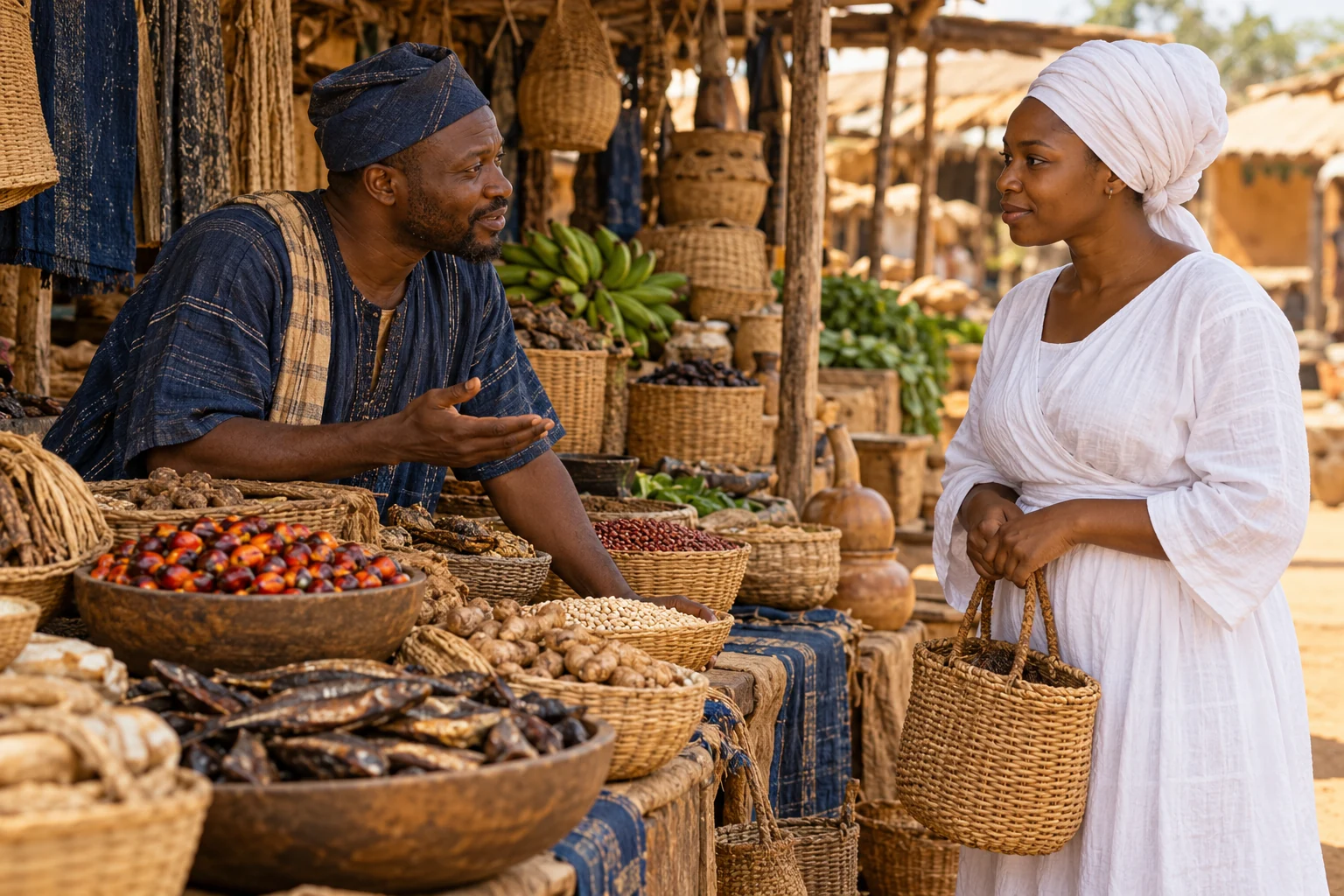
Before earthly arrival, the protagonist is advised to pursue trade rather than make Ifá his profession. He nevertheless becomes an effective but materially unsuccessful practitioner. Consultation redirects attention to the earlier counsel and a relation with Olókun. Remembering an exchange made in heaven, Olókun sends a daughter in white clothing to a market. The protagonist recognizes the visitor and follows her to a white dwelling, where her identity becomes clear. Servants bring goods that attract royal buyers, and the resulting trade creates wealth. The account also states that the marriage remains without children, leaving prosperity and parenthood as separate outcomes.
The correction does not deny the protagonist’s religious ability. His practice can help others while failing to supply the livelihood appropriate to his own path. That distinction prevents a simple equation between spiritual effectiveness and material success. Olókun’s remembered heavenly exchange also makes the trading encounter more than a lucky commercial opportunity: it realizes an existing sacred relation in an earthly market. Compared with the earlier birds’ difficult passage and the coercive household cleansing, this story gives movement a receptive form.
A person follows recognition into another sphere of work rather than forcing every result through his existing profession. Contemporary interpretation may ask whether a competence has been mistaken for a complete vocation. The account’s wealth includes a social economy in which enslaved people appear as payment; that element needs acknowledgment rather than celebratory repetition. The childless marriage also prevents wealth from becoming a shorthand for the fulfillment of every desired condition.
Narrative witness and setting: Cromwell Osamaro, white-clothed visitor at the market
Two friends discover that exposure is not a one-way weapon
A priest and a friend identified in the source through albinism compare the particular prohibitions associated with their lives. During a long meeting, hunger and thirst put those commitments under pressure. The priest privately violates his own restriction involving a drink. The two later share food that violates the friend’s restriction as well. When the friend threatens to reveal the priest’s breach, the priest points out that his companion has also crossed a prohibition. The scene ends with reciprocal exposure rather than a restoration ceremony, leaving both the shared conduct and the threatened disclosure visible to the reader.
The episode makes knowledge of another person’s sacred responsibility available as an instrument of leverage. The initial comparison of prohibitions could have supported mutual care, but the later threat turns that knowledge toward humiliation. The priest’s counterclaim does not establish that either breach has become harmless; it exposes the unequal position the friend tries to claim. Compared with the earlier coercive cleansing, the new account extends concern from imposed action to the control of reputational information.
Its religious content should not disappear into a generic lesson about hypocrisy: the obligations matter within the witness even when both people violate them. Contemporary interpretation can ask what someone intends when revealing another’s failure and whether mutual implication is being confused with accountability. The source’s description of the friend must not be transformed into a claim that all people with albinism share the narrated prohibition, character, or religious position.
Narrative witness and setting: Cromwell Osamaro, shared meal and concealed prohibitions
What was born in this Odù
“Born” can name an explicit traditional origin association or what emerges through a story: a capacity, relationship, practice or order of life. Interpretations drawn from a narrative are labelled below, so their basis remains clear.
Complementary skills become shared success
Contemporary interpretation from the selected myth.
As a contemporary interpretation, Eleguá’s need for Ṣàngó’s climbing skill reveals an emergence of collaboration beyond individual victory. This reading is grounded in the roof episode and is not attributed to a traditional born list.
An advocate interrupts coercive help
Contemporary interpretation from the selected myth.
As a contemporary interpretation, Bota Funroso’s request suggests the emergence of independent advocacy within a celebrated intervention. It draws attention to Lode’s release without treating coercion as care or asserting a canonical origin association.
Correlations to life dimensions
These questions bring the selected stories into contemporary life. They are interpretive invitations for study.
Work and resources
The bird account distributes the task across referral, access, strategy, and physical capability. A precise account of success should credit these differences instead of allowing the person who receives formal authority to appear as the only effective actor.
Reflect: What contribution made your final step possible?
Relationships and family
Bota Funroso visits because he notices a changed household, then asks for Lode’s release. The episode gives a neighbor’s attention a protective role that does not depend on official status or participation in the original intervention.
Reflect: Whose welfare needs an independent neighbor or advocate?
Character and inner life
Eleguá encounters a limit after overcoming the major obstacle. Calling Ṣàngó makes capacity collaborative, reminding a successful actor that one achievement does not remove the need to recognize another person’s different skill. The final success belongs to their connected efforts.
Reflect: Where do you need to ask for a complementary skill?
Community and responsibility
Public admiration arrives after a coercive transformation. A community needs more than an attractive outcome to judge an intervention: it should ask about consent, proportionality, and whether someone with authority can hear a request to stop.
Reflect: Can the person receiving help say no?
A deeper reading of the sacred relationships
Religious capacity and a person’s vocation can diverge
The trader story grants the protagonist effective Ifá practice while directing his livelihood elsewhere. His difficulty is therefore not simply lack of skill, fraudulent knowledge, or absence of spiritual relations. The account locates the issue in counsel given before earthly arrival and in an exchange remembered by Olókun. This is its actual religious explanation of vocation. Contemporary interpretation can distinguish competence from the whole shape of a life without claiming to identify a reader’s prebirth path. The friend episode adds another boundary: knowing a sacred responsibility does not mean one will reliably fulfill it. In both, possession of knowledge remains different from living its consequences.
Reciprocal implication is not the same as repair
The priest answers threatened exposure by showing that his friend is also implicated. That interrupts a one-sided accusation but does not narrate repair of either breach. The distinction matters because a clever ending can make the reader overlook what remains unresolved. The earlier coercive cleaning story likewise raises questions about who can impose religious action on another person. Contemporary comparison can ask whether a response seeks acknowledgment, protection, revenge, or control. Those aims should not be treated as interchangeable. The source permits discussion of shared vulnerability and compromised authority, while offering no basis to claim that two violations cancel one another or that secrecy restores the sacred relationship.
Prosperity does not close every dimension of a life
The market episode ends with wealth and a marriage without children. Preserving both details resists a totalizing account in which a corrected vocation produces every possible fulfillment. The earlier birds’ journey also depends on different powers contributing something the others cannot supply. Across these selections, an achieved outcome can coexist with a remaining limit. Contemporary interpretation may therefore discuss abundance without treating a household as deficient because it does not reproduce one expected pattern. Within the witness, Olókun’s relation and the heavenly exchange remain consequential. The absence of children should not be converted into a diagnosis, punishment, or forecast for a reader with similar circumstances.
Questions that deepen the study
Does the market story say a capable diviner should abandon religious work?
It concerns one protagonist whose pre-earthly counsel directs his livelihood toward trade. The account explicitly allows his Ifá work to be effective, so the change does not rest on a general rejection of religious practice. Its significance is the difference between possessing a capacity and making that capacity the center of one’s own profession. Contemporary interpretation can ask whether a person’s existing skill has narrowed their view of possible work. An article cannot use this narrative to announce another practitioner’s destiny. That would require an authority the summary does not possess and would erase the witness’s specific heavenly relation with Olókun.
Do the friends’ two breaches cancel each other?
The story says that the priest answers threatened disclosure by identifying the friend’s own breach. It does not state that either sacred obligation is thereby removed or that a shared offense becomes permitted. The reversal limits the friend’s attempt to speak from an uncontaminated position. Contemporary reflection can distinguish that exposure of hypocrisy from the separate work of acknowledgment or repair. It also matters that the account gives particular prohibitions to particular figures. Repeating them as rules for readers, or assigning the friend’s restriction to every person who shares a physical characteristic, would exceed the evidence and turn a narrative into an unwarranted prescription.
Why retain the childless ending after the account becomes prosperous?
It is an explicit limit on what the narrated success contains. The protagonist’s trade flourishes through an encounter linked to heavenly counsel and Olókun, yet the marriage is not described as producing children. Keeping that detail allows prosperity to remain specific rather than turning it into a claim of complete worldly fulfillment. A contemporary reader can recognize that wealth, partnership, vocation, and parenthood are different dimensions of life. The source does not authorize diagnosing the absence of children or calling it a punishment. Nor does the ending establish that a reader’s similar household circumstances share this protagonist’s sacred history.
What the four narratives reveal together
The new Ìrosùn Òfún accounts distinguish the life a capacity can support from the authority a person can claim over another. The capable practitioner’s livelihood changes when earlier counsel and Olókun’s relation become effective through trade. The two friends, meanwhile, discover that knowing another’s prohibition does not place one outside vulnerability. Both episodes resist a simple equation between knowledge and a fully ordered life. The earlier cooperative passage of sacred birds and the coercive household encounter add contrasting forms of dependence and control.
Contemporary interpretation can explore vocation, disclosure, and the limited scope of prosperity, while retaining the witness’s real sacred obligations. Its difficult elements also remain visible: an economy includes enslaved people, a bodily difference names a character, and wealth does not remove the stated absence of children. These details require precision rather than universal rules or retrospective diagnosis.
Living with this Odù
A continuing life or initiatory relationship
A received relationship with Ìròsùn Òfún can sustain attention to shared capability and the limits of imposing another’s improvement. Eleguá reaches the house but still needs Ṣàngó’s climbing capacity; access and completion are separate contributions. Lode’s changed home introduces another tension: public admiration for the result does not answer the neighbor’s question about the person being bound. Order and consent cannot be treated as identical achievements.
Olókun’s daughter adds vocation and prosperity within a sacred history the protagonist initially resists. The account leaves parenthood separate from material success, preventing one outcome from becoming the measure of every other. The friends’ shared prohibitions add an exchange in which neither can safely claim complete innocence while threatening exposure. Across a life, reflection may concern receiving complementary help, distinguishing care from coercion, recognizing a changing vocation, or admitting a limit without turning it into leverage against another. The sign does not prescribe one profession or describe real bodily difference through character. It invites responsibility for the means as well as the visible outcome, keeping Olókun’s relationship and each distinct contribution present rather than replacing them with generic advice about teamwork.
A particular consultation and its question
When Ìròsùn Òfún appears in consultation, the narratives help distinguish a task needing another capability from a person subjected to an imposed correction. The path-opener’s limitation is answered through collaboration; Lode’s binding raises a separate issue of coercion despite the improved appearance of the household. The actual concern determines whether the question is how to receive help or how to examine what has been done in the name of care.
The trader’s account introduces earlier counsel, a relation with Olókun, and an outcome in which prosperity does not settle every family desire. It cannot establish that the client should abandon a religious vocation or expect a particular marriage. The friends’ reciprocal exposure adds a question about what happens when admission of a breach becomes a weapon instead of a basis for responsibility. A practitioner may examine who contributed, whose consent is absent, and which hoped-for result has been confused with total fulfillment. These are interpretive possibilities within a present result. They neither identify an unknown visitor as Olókun’s daughter nor generalize the source’s descriptor of bodily difference into a spiritual or psychological profile. Consultation remains distinct from lifelong affiliation.
Constructive and adverse possibilities
Constructive unfolding can include complementary capacities acknowledged, a concerned neighbor able to question coercion, and success understood without demanding that it fulfill every possible hope. The path-opener and climber receive different recognitions, so cooperation need not dissolve each contribution into one indistinct achievement.
Adverse unfolding may involve a desired outcome used to justify binding another person, an earlier religious history ignored, or a shared breach transformed into mutual blackmail. The trader’s prosperity does not make childlessness an adverse moral verdict, and the friend identified through bodily difference is not a type representing deceit. These contrasts locate responsibility in specific actions and relationships. They do not authorize forced domestic transformation, prescribe vocational change, or determine a reading’s condition automatically. Sacred recognition, material prosperity, and family outcomes remain related but genuinely distinct dimensions of the witnesses.
An illustrative situation in everyday life
In a hypothetical example, relatives renovate an adult family member’s home while excluding him from decisions and restricting his movement because they believe he will interfere. Visitors praise the result, but a neighbor asks what the resident actually agreed to. Lode’s story makes the question of coercion visible beneath public approval. The path-opener account adds that needing another’s practical skill does not erase the person receiving help as an agent. The relatives may feel that questioning their method denies their effort; the resident may need support without accepting total control. A different arrangement could involve participation and complementary assistance. This illustration neither judges an actual household nor turns the narrative’s favorable appearance into evidence that coercion was necessary.
Sources and reading context
The first two narrative witnesses
Both narratives are labeled Cuban. No distinct non-diagnostic born list was found in the inspected opening, so the two emergence motifs are contemporary interpretations rather than canonical born claims. The first title incorrectly glosses eyelé as guinea fowl; the synopsis avoids that mistranslation. The second’s coercion is not endorsed.
Narrative motifs are summarized independently. The life-dimension reflections are contemporary interpretation. How these reference studies are built explains the wider source approach and the distinction between a reference article and personal divination.
Additional named witnesses
- Cromwell Osamaro. The named heading precedes the Olókun market account and the later episode of the two friends.
Olókun’s heavenly relation is this witness’s explanation, not a personal destiny reading. Enslaved people occur in the market economy and are not endorsed as payment. The friend’s bodily description and prohibition are not generalized. No Brazilian provenance is established by the Portuguese text.
Bibliographic identification
- C. Osamaro Ibie. Ifism: The Complete Work of Orunmila. Lagos; multivolume publication beginning 1986. Library catalogue record. Related bibliographic record for the named narrative witness. Exact volume, edition and page of the transmitted account have not been independently matched.
Read the source method and wider scholarly context.
The catalogue links identify published works and their authors. They are separate from proof of an individual episode’s wording or attribution. Contemporary comparisons and the synthesis above are editorial interpretation. The author’s books and Academy companions below provide further study; their sales links are separate from the source references.