
Ìwòrì Òsá is a mixed Odù in Ifá’s 256-part corpus. An apparently welcome goat is secretly linked with repeated losses, while Ayaguna deliberately introduces rivalry into peaceful communities and argues that conflict produces progress. These distinct stories locate danger in arrangements that participants do not fully see. The origin inventory explicitly names war and table utensils, permitting a study contrast between shared life and its disruption without accepting the source’s sweeping geographical or medical claims.
A question to carry through the study: Who is defining conflict as necessary, and what benefit do they expect from that definition?

This Academy reads the right column first, then the left. Each row carries a single or double mark.
Where this Odù belongs
Ìwòrì Òsá belongs to the Ìwòrì family in this Academy’s study sequence. It is a mixed Odù, distinct from Òsá Ìwòrì. The order matters. Its teaching is approached through its own narratives, rather than by adding two general descriptions of the principal signs together.
Key Òrìṣà and sacred relationships
The figures below are selected for their roles in the accounts discussed here. They offer connected reading paths through the tradition.
-
Èṣù. He notices the community’s losses, seeks help from Bereni, and joins the search for the goat whose hidden relationship with Iku drives the first narrative.
-
Àjàgùnnà. The story names Ayaguna as the figure who introduces disputes and defends war as a condition of progress; this is his particular narrative role, not a universal characterization.
Key myths and their meanings
The overnight guest’s hidden agreement
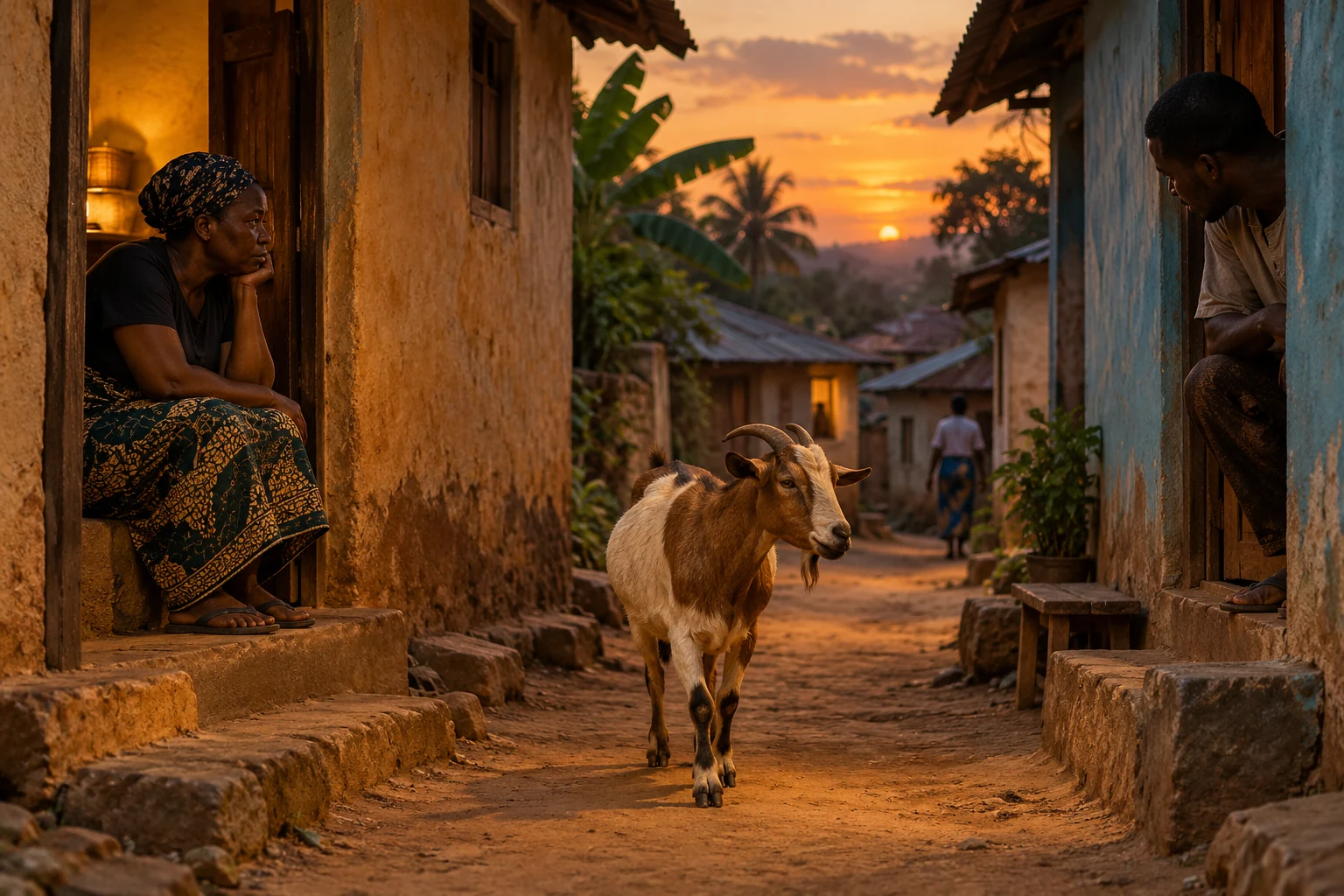
A goat moves among households in a troubled land, while people repeatedly die. Eshu becomes concerned and a diviner named Bereni identifies the goat’s secret agreement with Iku. Together they search for it and lure it into a staged encounter. The goat is killed, and the story describes Iku leaving, with further communal action following. The narrative turns a familiar visitor into an agent of concealed loss.
The story explains a crisis through a hidden pact, but that explanation must remain religious narrative rather than a cause of real deaths. Its grounded social question concerns how a community investigates an apparently ordinary relationship when harm is distributed and difficult to trace. The ending is violent and should not become a recommendation to identify or punish a scapegoat.
Narrative setting: Cuban/Lukumí-labeled patakín in the multilingual compilation; individual narrator and publication history remain unverified.
The ruler who needs a war
Assigned a role involving disputes, Ayaguna governs through arms. Olofin questions the resulting conflict and moves him to another region, where he finds peaceful people. He encourages a neighboring group to invade while telling those he governs that they must resist invaders. Confronted again, he argues that competition and the wish for more drive progress, leaving his father’s desire for peace unresolved.
The plot exposes how an authority can create the danger used to justify its own role. Ayaguna’s theory of progress is a claim made by an interested character, not the study card’s conclusion. The source’s Africa/Asia framing is broad and unsupported as history. The useful tension is whether development can be pursued without manufacturing enemies or treating domination as proof of capacity.
Narrative setting: Cuban/Lukumí-labeled patakín in the multilingual compilation; individual narrator and publication history remain unverified.
Three fruiting sisters acquire different relations to harvesters
Three related plants consult before leaving heaven. Two receive counsel involving dark cloth and complete their response, while Osan Agbalumo declines the response associated with red cloth. When all begin to fruit on earth, Eshu draws human attention to their food value. He tells people to leave the first two until their ripe fruits fall voluntarily. For Osan Agbalumo he makes the bright color a signal inviting children to throw objects and dislodge the fruit. The narrator contrasts an undisturbed ripening with a harvest forced upon both ripe and unripe fruit. The account explains unequal treatment at the moment when a plant becomes visibly productive.
The plants’ fruit makes them valuable to others, but value does not produce the same relation of care. Eshu mediates how humans approach each tree, joining a prior religious response to the timing and violence of harvest. The first two are not exempt from giving fruit; their contribution follows their own ripening and release. Osan Agbalumo’s visible color, by contrast, draws intervention before that process is complete. A contemporary interpretation can ask how another being’s productivity becomes an invitation to take and who determines readiness.
It should not claim that a tree’s treatment scientifically results from an ancient offering, nor turn the episode into advice for managing actual orchards. The compilation adds modern botanical explanations immediately afterward, but those are not an independently identified witness and should not be used to assign scientific species here. Keeping the local names preserves the religious account’s specific relations without pretending that every translated plant name has been securely identified.
Narrative witness and setting: Cromwell Osamaro’s explicitly headed account of Asala, Abuje Oro, and Osan Agbalumo.
Goat escapes a predatory journey and finds an obligated refuge
Goat agrees to travel with Hla but doubts that the journey will end safely. After consultation and a completed response, she carries prepared food. Hla has secretly planned to eat her. A lion appears with a complaint, and Goat’s provisions become the first response to his demand. When he continues asking for relief, Goat proposes a contribution from Hla’s own body, causing the predator to flee and drawing the lion away. Goat escapes toward town and seeks Odudua’s protection in a temple. Odudua shelters her through a change of posture and form. The ending identifies her continuing subordinate relation to the protecting power.
The escape is not completed merely by outwitting Hla. Goat moves from a relation in which she is secretly intended as food into an explicit sacred dependency at Odudua’s temple. Protection changes both her bodily form and her continuing status. The ending’s language of servitude should not be replaced by an uncomplicated celebration of autonomy, although the rescue from immediate predation remains real within the account. The food obtained through divination also matters materially in the encounter with the lion, giving Goat a role other than passive prey.
Contemporary interpretation can examine the obligations attached to refuge and the difference between hidden exploitation and an acknowledged protective relation. That reflection need not approve every social hierarchy represented in the tale. The source’s religious reality remains specific: consultation prepares the journey, and Odudua acts as a power who grants shelter. It is not evidence of an actual medical treatment for the lion or a zoological explanation of goat anatomy.
Narrative witness and setting: Bernard Maupoil’s explicitly headed Fon Woli Sa account, with a note comparing related folklore.
What was born in this Odù
“Born” can name an explicit traditional origin association or what emerges through a story: a capacity, relationship, practice or order of life. Interpretations drawn from a narrative are labelled below, so their basis remains clear.
Wars in the world
Selected traditional source association.
War is an explicit born association and receives a corresponding Ayaguna narrative. Present it as a local religious explanation of recurring conflict, not a factual origin of human warfare or a claim that all development requires violence.
The fork, plate, and knife
Selected traditional source association.
The inventory attributes ordinary eating utensils to this sign. Preserve the concrete material association without adding a historical invention claim. Their relation to shared meals offers a possible interpretive contrast with war, but that contrast is interpretation rather than an explicit source explanation.
Correlations to life dimensions
These questions bring the selected stories into contemporary life. They are interpretive invitations for study.
Work and resources
Ayaguna defines the wish to increase possessions as an engine of conflict and progress. We can inspect that claim from the position of those expected to bear its costs. A ruler’s argument for competition may benefit his office more than the community’s actual work.
Reflect: Who bears the cost of the proposed progress?
Relationships and family
Olofin repeatedly asks his son to change, while relocation merely gives Ayaguna another setting for the same conduct. The story suggests that changing location alone does not resolve a pattern of behavior. The disagreement remains explicit rather than ending in easy reconciliation.
Reflect: What behavior would need to change beyond the setting?
Character and inner life
The goat story makes familiar hospitality coexist with concealed intent, while Ayaguna openly rationalizes the harm he creates. Together they permit inquiry into the difference between suspicion based on evidence and a convenient theory that makes every disagreement seem necessary.
Reflect: What evidence supports your account of the conflict?
Community and responsibility
The ruler manufactures opposing threats so both communities believe violence is unavoidable. The narrative gives a precise basis for examining who controls information about an enemy. Verification across boundaries may expose a conflict that one authority benefits from maintaining.
Reflect: Can the two sides compare what they have been told?
A deeper reading of the sacred relationships
Protection establishes a relation with a named power
Goat’s refuge is granted by Odudua after a journey prepared through consultation. Her transformed body and continuing status make protection more than an inward feeling of safety. The fruiting sisters similarly receive different human approaches through Eshu’s action following their respective responses. The earlier goat and Iku account belongs to another narrative, where identifying a concealed pact changes the community’s relation to death. These should remain distinct episodes despite shared animals. A depth study can explain how sacred powers organize vulnerability and obligation without reducing every rescue to cleverness or assuming that every form of protection carries identical terms across Fon and Yoruba or Cuban witnesses.
Becoming valuable can increase exposure rather than security
The three plants begin to face human attention when their fruits become useful. Two receive a protected ripening, while another is struck before all fruit is ready. Goat’s vulnerability also follows from Hla’s valuation of her as a portable source of food. The earlier Ayaguna account places conflict beside an asserted movement of human affairs, offering a much larger and more troubling account of productive change. Contemporary comparison can examine who benefits when something is called valuable or progressive. The religious narratives do not supply a single economic theory, but they make the distribution of benefit and danger visible enough to resist a generic claim that usefulness automatically brings respect.
A new relation may preserve life while limiting independence
Odudua’s refuge ends immediate pursuit but also establishes Goat’s subordinate status. The first two plants give fruit through a different protected relation rather than ceasing to participate in nourishment. These outcomes distinguish survival from unlimited freedom and protection from complete withdrawal. The earlier communal removal of Iku adds another arrangement whose terms concern a whole place rather than one rescued traveler. Contemporary interpretation can ask what obligations become attached to safety and whether they remain acknowledged. The witness does not provide Goat’s later voice about those terms, so neither grateful consent nor secret resistance should be invented. The unresolved limit belongs to the account’s depth rather than needing a reassuring final moral.
Questions that deepen the study
Are the fruiting plants securely identified scientific species?
The narrative provides local names and some Bini equivalents, but the modern explanatory block that follows is not a separately identified botanical witness. It even acknowledges uncertainty about one plant. A reference study should therefore retain the names and the account’s contrast in harvesting rather than present speculative Latin identifications as verified facts. The religious episode concerns Eshu’s mediation of how humans approach productive beings after consultation. Contemporary readers can reflect on ripeness and taking without needing a false botanical certainty. Neither the story nor this analysis establishes actual harvesting instructions or a scientific cause for differences among fruit trees.
Is Goat’s rescue a simple victory for independence?
She escapes Hla’s hidden plan, but the final scene gives her refuge through Odudua and places her in a continuing subordinate relation. The account therefore narrates survival together with new obligation. Calling it complete independence would erase its religious and social terms. A modern interpretation may value the escape while examining the hierarchy attached to protection. It should not equate that temple relation with every human form of captivity or presume that Goat later rejects it. The supported ending names a sacred protector, a bodily transformation, and a continuing bond, leaving the later experience of that bond unexplored.
How do these additions relate to the earlier goat and Ayaguna?
The earlier goat’s pact with Iku concerns concealed danger within a community, whereas Maupoil’s Goat faces a traveling predator and finds refuge through Odudua. The shared animal does not make them one plot. The fruiting sisters add unequal exposure at the moment of productivity, while Ayaguna’s account associates conflict with an asserted expansion of human affairs. Together they invite scrutiny of what protection, benefit, and progress mean for those bearing the risk. The religious agents remain distinct, and the dramatic geography in Ayaguna’s story is not a historical account of world civilization. Comparison should reveal differences as well as recurring concerns about vulnerability and power.
What the four narratives reveal together
The earlier Iku and Ayaguna motifs approach danger through a concealed pact and an expansive claim about conflict. The new plant and traveling Goat accounts make vulnerability more local and embodied. Fruiting brings unequal exposure to harvesters, while a threatened traveler secures life through a new sacred dependency. Eshu and Odudua act within these worlds, and protection follows particular religious relations rather than a universal reward for innocence. The four stories can support contemporary inquiry into who benefits, who bears danger, and what obligations accompany refuge. They do not converge on a single reassuring answer: productive value can invite force, and rescue can preserve a hierarchy. Keeping those tensions and the separate witnesses visible produces a more faithful depth account than converting every difficult ending into a lesson about confidence, independence, or inevitable progress.
Living with this Odù
A continuing life or initiatory relationship
For someone whose received life or initiatory Odù is Ìwòrì Òsá, explanations of necessary conflict may need scrutiny of the authority proposing them. Ayaguna creates danger that makes his own role appear indispensable. The ordinary goat’s hidden agreement supplies another religious account of harm distributed through a relation people do not understand. Long development can involve examining arrangements without converting uncertainty into a license to identify and punish a scapegoat.
The fruiting sisters and Fon Goat’s refuge add questions about access and protective dependency. Being valuable does not mean that another is entitled to take before readiness. Escape from hidden predation can also end in an explicit subordinate relation rather than complete autonomy. A favorable change may preserve life while still requiring attention to the terms of protection.
A received sign does not make actual deaths evidence of a hidden pact or every confrontation a source of progress. Eshu’s differing mediations, Fa’s preparation, and Odudua’s refuge retain their settings. Across changing circumstances, the person can ask who defines the problem, who controls the time of harvest, and what freedom remains after assistance. Effective religious action need not erase the ethical questions posed by its narrated social order.
A particular consultation and its question
In consultation, Ìwòrì Òsá can distinguish conflict a participant encounters from conflict an authority deliberately produces. Ayaguna’s argument about progress is interested speech inside the story, not an instruction to manufacture rivals. A practitioner can examine who benefits from calling a danger inevitable. The goat and Iku account remains religious narrative, not evidence for blaming real losses on a convenient visitor or outsider.
The three plants ask who determines readiness once productivity becomes visible. Their differing harvest relations can support a question about timing and another being’s terms without becoming botanical identification or orchard advice. The Fon Goat’s escape asks what obligations attach to refuge. The protecting relation is explicit, yet the ending’s servitude cannot be rewritten as unrestricted autonomy.
The actual result determines how those distinctions address the visitor’s question. It does not identify a hidden pact, promise a harmless protector, or equate Ayaguna with every Obatala form. Consultation may clarify manufactured necessity, premature taking, secret exploitation, or acknowledged dependency. It remains a specific religious encounter rather than permanent identity as persecuted guest, unready provider, or agent of necessary strife. The interpretation should preserve survival and constrained freedom together where the source does so.
Constructive and adverse possibilities
Constructively, a community can question the claim that conflict is needed to justify an authority’s purpose. A productive being’s contribution can be received according to ripeness rather than forced availability, and a threatened traveler can find refuge through a named sacred relation. Religious efficacy changes actual conditions within the accounts rather than merely improving confidence.
Adversely, hidden arrangements can distribute harm, an interested ruler can create the threat offered as proof of usefulness, and visible productivity can become an invitation for premature taking. Protection can also move a person from concealed exploitation into continuing subordination. These contrasts do not declare the sign fortunate or adverse by nature. Iré and adverse conditions remain part of the real reading. The motifs ask who sets the terms and whether an ending described as escape has preserved room to examine the obligations and hierarchy that follow it.
An illustrative situation in everyday life
Hypothetically, a department head repeatedly provokes competition between teams and then requests greater control because only he can resolve their disputes. Ayaguna’s manufactured war asks who benefits from defining conflict as necessary. One team’s successful prototype is also demanded immediately, before its members can make it reliable, because its visible value seems to authorize taking. The fruiting sisters distinguish contribution from another party’s control of readiness. The teams can examine the head’s incentives and negotiate a tested release rather than accept urgency as proof of necessity. This hypothetical example concerns created demand and premature access. It does not identify colleagues with secret agents of death, prescribe a harvesting method, or promise that a protective authority will offer complete freedom.
Sources and reading context
The first two narrative witnesses
These Cuban narratives contain punitive death imagery and unsupported continent-wide framing, neither adopted as medical or historical fact. Ayaguna is linked cautiously to the supported Ajagunna key and is not collapsed into every form of Obatala. No ritual procedure or scapegoating action is endorsed.
Narrative motifs are summarized independently. The life-dimension reflections are contemporary interpretation. How these reference studies are built explains the wider source approach and the distinction between a reference article and personal divination.
Additional named witnesses
-
Cromwell Osamaro. The heading attached to the narrative introduces the three related plants and Eshu’s differing harvest relations.
-
Bernard Maupoil. The Fon Woli Sa heading governs Goat’s journey with Hla, the lion encounter, and Odudua’s refuge.
The modern botanical block is not treated as verified source identification. The Fon goat story is distinct from the earlier Cuban goat/Iku episode. The narrator’s refuge language includes servitude; the card preserves that limit without endorsing coercion or giving treatment instructions.
Bibliographic identification
-
C. Osamaro Ibie. Ifism: The Complete Work of Orunmila. Lagos; multivolume publication beginning 1986. Library catalogue record. Related bibliographic record for the named narrative witness. Exact volume, edition and page of the transmitted account have not been independently matched.
-
Bernard Maupoil. La Géomancie à l’ancienne Côte des Esclaves. Paris: Institut d’ethnologie, 1943. Library catalogue record. Historical bibliographic context for the Fon Fá witness; Fon and Yorùbá traditions retain their distinct settings.
Read the source method and wider scholarly context.
The catalogue links identify published works and their authors. They are separate from proof of an individual episode’s wording or attribution. Contemporary comparisons and the synthesis above are editorial interpretation. The author’s books and Academy companions below provide further study; their sales links are separate from the source references.