
Ìwòrì Ìká is a mixed Odù in Ifá’s 256-part corpus. A captured message carried by a pigeon ends a siege once the attackers understand the travelers’ purpose. A separate rumor about Orunmila reaches Olokun and Olofin, then is displaced by an accidental disturbance during a messenger’s flight. These specific plots focus on communication across suspicion: accurate information can correct a conflict, while interruption can also silence a dispute without establishing its truth.
A question to carry through the study: What message would allow the other side to test its assumption about your purpose?

This Academy reads the right column first, then the left. Each row carries a single or double mark.
Where this Odù belongs
Ìwòrì Ìká belongs to the Ìwòrì family in this Academy’s study sequence. It is a mixed Odù, distinct from Ìká Ìwòrì. The order matters. Its teaching is approached through its own narratives, rather than by adding two general descriptions of the principal signs together.
Key Òrìṣà and sacred relationships
The figures below are selected for their roles in the accounts discussed here. They offer connected reading paths through the tradition.
-
Ọ̀rúnmìlà. He is the target of an unfounded relationship rumor and responds through consultation and a message to Olofin, though an accidental disturbance diverts the investigation.
-
Olókun. He receives the rumor, seeks Olofin’s intervention, and later withdraws into the sea when a falling bundle frightens him, leaving the allegation unresolved by direct inquiry.
Key myths and their meanings
The pigeon whose message is intercepted
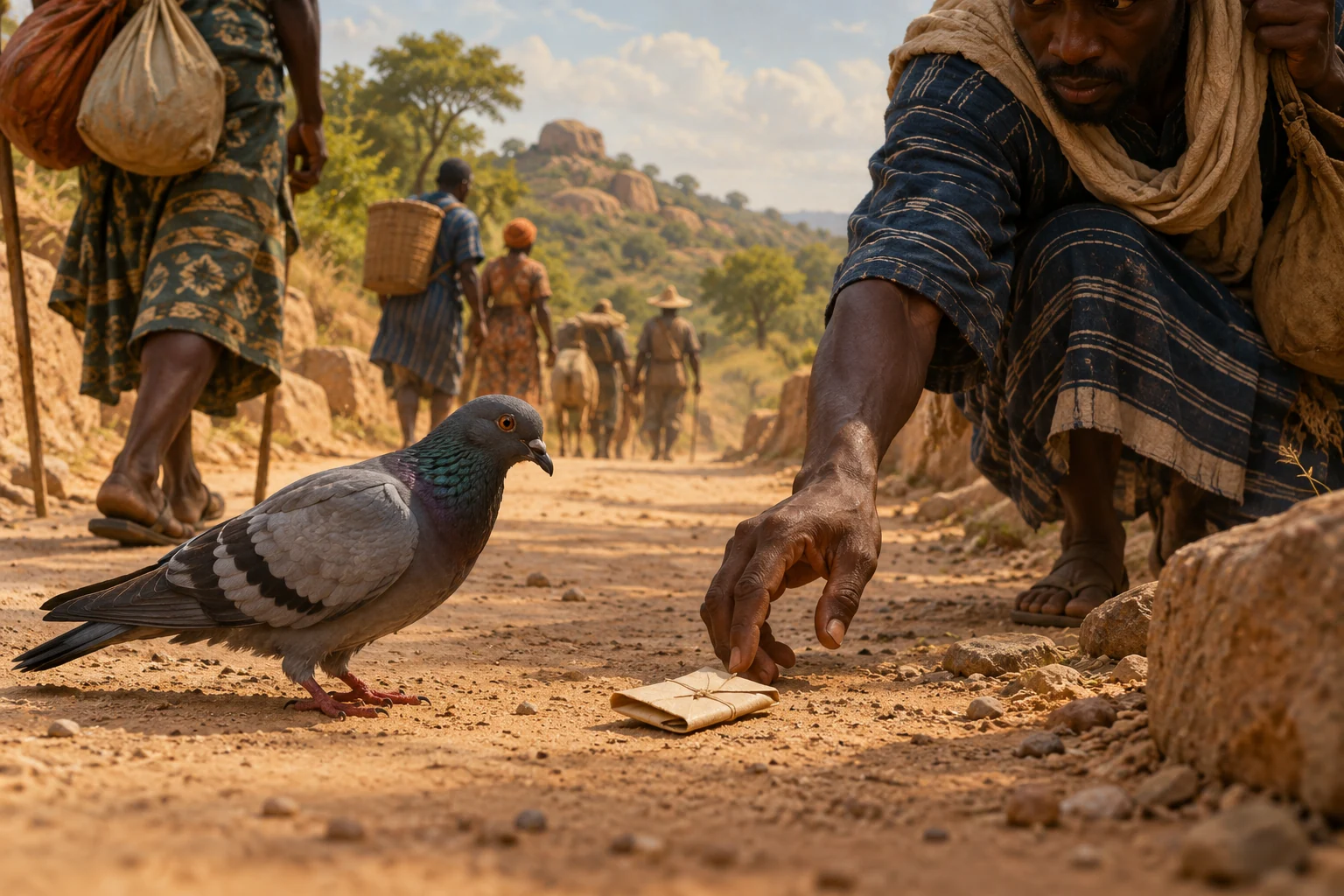
Peaceful travelers prepare to cross a region whose inhabitants mistake their arrival for an attack. Unable to defeat them, the local fighters surround them to force surrender. The travelers send pigeons to explain their predicament to their own leader. One message falls into the attackers’ hands. Reading the travelers’ actual purpose changes their judgment, and they permit the group to continue.
The apparently failed delivery becomes the successful communication: the message reaches people other than its intended recipient but supplies exactly what they lacked. This is a concrete account of revising an enemy image through evidence. The story does not imply that all armed conflict is misunderstanding; its particular opposition begins with a mistaken purpose and ends when that premise is corrected.
Narrative setting: Cuban/Lukumí-labeled patakín in the multilingual compilation; individual narrator and publication history remain unverified.
A rumor interrupted in the air
A woman’s desired marriage to Orunmila is not reciprocated, and she spreads a different allegation involving Olokun’s wife. Olokun appeals to Olofin, who sends an inquiry. Orunmila denies the claim and gives the messenger a bundle. An eagle pursues the airborne messenger, scattering the bundle noisily. Olokun retreats into the sea in fright, and Orunmila is left free of the immediate suspicion.
Unlike the pigeon story, the ending does not establish truth through shared evidence. A disturbance removes the accuser from the scene. The contrast is useful for distinguishing a conflict’s disappearance from a fair resolution. The story’s gendered accusation should not become a general claim about women or rejected affection; it concerns the particular conduct of a named narrative role.
Narrative setting: Cuban/Lukumí-labeled patakín in the multilingual compilation; individual narrator and publication history remain unverified.
Two men named Kayode are forced into unequal names
A wealthy Kayode makes a poorer man accept a degrading addition to the same personal name as a condition of receiving a loan. Unable to repay, the debtor works on the creditor’s farm. The creditor later demands a more submissive greeting even while the worker carries a heavy load. As he moves to strike, Eshu brings him down from his horse. An elder witnesses the scene, helps the injured man, and learns that a small debt caused the servitude. He supplies the amount needed to free the worker. The creditor must also confront a neglected religious obligation during treatment, while the worker resumes an unqualified name.
The loan controls more than labor: it imposes a public identity that marks the borrower as permanently lesser. The demand for a bodily greeting while he is burdened makes that identity claim concrete. The elder’s intervention is therefore not merely a second person becoming generous; it separates the original small debt from the humiliation and servitude built around it. Eshu’s action and the later inquiry into the creditor’s neglected response keep the reversal within a religious framework. Contemporary interpretation can examine the difference between recovering a loan and using it to possess another person’s standing.
The injury should not be celebrated as a model of justice, and the healer’s final naming condition is too damaged in translation to reconstruct confidently. What is clear is that the worker regains freedom and the simple name Kayode. The episode does not require inventing an apology, a full redistribution of the creditor’s wealth, or a permanent recovery that the surviving text does not describe.
Narrative witness and setting: Cromwell Osamaro’s explicitly headed Alayoka account, with a damaged final naming clause.
Asen investigates the voice that frightens an entire sacred assembly
Akeelu, a poor woodcutter, consults but does not complete the response. Legba arranges for a tortoise to hide beneath the tree he intends to cut. Each blow produces a threatening song, and Akeelu reports that the tree speaks. Royal messengers hear it and flee, followed by visiting voduns who are equally frightened. Akeelu returns for consultation and completes an increased response. Legba then sends Asen. Rather than flee from the voice, Asen attends to the hole below the tree and uses his distinctive power to expose the tortoise. The account ends by connecting that discovery with Asen’s continuing relation to tortoise as food.
The apparent evidence is shared by many witnesses, including sacred powers, but agreement about the sound does not establish its source. Legba has deliberately arranged the concealed speaker, so the uncertainty is a religiously produced condition rather than an ordinary misunderstanding detached from the consultation. Asen’s intervention combines attention to a particular opening with his own extraordinary bodily capacity. He does not succeed by declaring all invisible agency false; he uncovers one agency concealed beneath an assumed one. Contemporary interpretation can examine the difference between hearing an event and knowing what caused it.
That lens should not turn the story into a secular debunking of Fa, since Fa’s response and Legba’s sending of Asen make the disclosure possible within the witness. Nor should Asen be silently renamed Osanyin. The final food relation is an etiological religious conclusion, not an instruction to harm a creature or a claim that every ominous sound is a fraud waiting to be exposed.
Narrative witness and setting: Bernard Maupoil’s explicitly headed Fon Woli Ka account of Akeelu and the hidden tortoise.
What was born in this Odù
“Born” can name an explicit traditional origin association or what emerges through a story: a capacity, relationship, practice or order of life. Interpretations drawn from a narrative are labelled below, so their basis remains clear.
A message becomes a route out of conflict
Contemporary interpretation from the selected myth.
This contemporary interpretive emergence motif comes from the intercepted pigeon letter, not an explicit born list. A change in the understood purpose allows travel to resume, showing information creating a possibility that force alone had not secured.
Silence is distinguished from vindication
Contemporary interpretation from the selected myth.
This is a contemporary reading of the rumor episode, not a traditional origin claim. The accuser’s retreat ends the immediate danger but leaves the evidentiary question unanswered, making the absence of conflict different from an established truth.
Correlations to life dimensions
These questions bring the selected stories into contemporary life. They are interpretive invitations for study.
Work and resources
The travelers carry a communication system before they enter hostile territory. Their preparation becomes useful in an unexpected way when a message reaches the opposing side. The story supports examining what information remains available when a journey or shared undertaking is interrupted.
Reflect: What can communicate your purpose if you cannot speak directly?
Relationships and family
The rumor episode begins with an unreciprocated wish being turned into an allegation involving another household. Its precise relational issue is respecting the difference between affection offered and a relationship accepted. The tale does not justify predicting retaliation from disappointment generally.
Reflect: Can a refusal remain separate from someone’s public reputation?
Character and inner life
The besiegers revise their judgment after reading the intercepted message. That act matters as much as the travelers’ preparation. The story invites us to ask what evidence a person would be willing to accept when their first interpretation has already cast someone as an enemy.
Reflect: What evidence could change your first interpretation?
Community and responsibility
Olofin begins an inquiry in the rumor story, but accident replaces its completion. Reading the two episodes together highlights the responsibility to distinguish actual clarification from a problem merely becoming quieter. A settled process needs more than the disappearance of one participant.
Reflect: Has the matter been clarified or only interrupted?
A deeper reading of the sacred relationships
Religious disclosure can expose one agency through another
The singing tree has a concealed tortoise arranged by Legba, and Asen is sent only after Akeelu returns to consultation and completes the response. Revealing the hidden speaker does not remove sacred causality; it makes that causality more particular. The Kayode reversal likewise includes both an elder’s practical assistance and Eshu’s action. The earlier intercepted message and false accusation add other failures to identify a source accurately. A depth treatment can explain how divination, divine intervention, and attention work together without claiming that spiritual knowledge means believing every first appearance. The Fon names should remain distinct from familiar Yoruba equivalents unless the selected witness itself supplies an identification.
A name can become an imposed burden
The poorer Kayode’s altered name extends a financial claim into a continuing public hierarchy. His restored simple name therefore matters alongside freedom from farm service. The earlier rumor account similarly shows how a description can alter another person’s standing without a fair inquiry into its source. The hidden tortoise gives a third arrangement: Akeelu’s description of a speaking tree is sincere but incomplete. Contemporary comparison can distinguish an imposed label, a malicious claim, and an honest misidentification. These are not the same fault, even though all involve language that can shape conduct. The religious accounts give disclosure its own agents and conditions rather than leaving correction to good intentions alone.
Collective confidence does not complete an inquiry
Royal messengers and several voduns confirm that the tree produces a frightening voice, yet none has identified what is beneath it. The elder in the Kayode account asks a different kind of question, learning the amount and conditions behind an apparently fixed status of servitude. The earlier pigeons’ intercepted message also changes a conflict when its actual purpose becomes known. Contemporary reflection can ask what a group has really established before treating repeated testimony as a complete explanation. This does not deny the witnesses’ experiences. It distinguishes what they encounter from the cause or obligation they infer, while preserving Asen’s and Eshu’s active religious roles in the changes that follow.
Questions that deepen the study
Is the creditor punished simply for being wealthy?
The account emphasizes imposed humiliation, debt service, an unreasonable demand for deference, and a move to strike a burdened worker. Wealth supplies the means to enforce that relation but is not the only issue. The elder also has enough resources to repay the debt and uses them to free the worker. That contrast prevents a simple opposition between money and virtue. Eshu’s reversal follows the creditor’s neglected religious response within the story, while the exact final naming demand is textually damaged. Contemporary analysis can question domination without pretending that the episode abolishes every debt or narrates a complete redistribution of property.
Does Asen prove that the sacred world is an illusion?
No. Legba arranges the concealed tortoise and later sends Asen after the religious response is completed. The disclosure is itself an event within the sacred world. Asen identifies a hidden cause more precisely than the frightened witnesses, but the story does not declare all divine agency unreal. A contemporary reading can value inquiry and careful observation without replacing the religious account with a universal debunking. The lesson is more specific: an audible effect and a widely accepted description do not always reveal the agent producing it. The final relation between Asen and tortoise belongs to the account’s local religious etiology.
How do the new stories deepen the earlier message episodes?
The pigeons’ intercepted communication changes a siege when its purpose becomes known, while the accusation involving Orunmila and Olokun proceeds without a satisfactory inquiry. Kayode’s imposed name shows language fixing a social rank, and the singing tree shows an incomplete description gaining collective authority. The four motifs therefore concern more than keeping secrets or speaking cautiously. They ask who gives a description, which conditions make it credible, and what an inquiry must still establish. Religious intervention remains important in the new pair, so modern analysis of evidence should be presented as a related lens rather than a replacement for the witnesses’ sacred causality.
What the four narratives reveal together
The earlier pigeon message and rumor accounts make information consequential for conflict and reputation. The new Kayode and singing tree witnesses extend that concern to identity and collective certainty. A creditor turns a loan into a degrading name and a demand for bodily submission; an elder’s inquiry helps undo the relation. Akeelu and many witnesses hear a voice but misidentify its source until Asen exposes the hidden tortoise through a response enabled within Fa’s sacred order.
These are different failures and different corrections. The sign’s depth lies in distinguishing them rather than issuing a generic command to distrust appearances. Eshu, Legba, and Asen remain active agents, while contemporary reflection can examine labels, evidence, and domination. The damaged naming clause and the local food etiology remain limits rather than invitations to invent a cleaner ending or universal doctrine.
Living with this Odù
A continuing life or initiatory relationship
For someone whose received life or initiatory Odù is Ìwòrì Ìká, the end of suspicion may need to be distinguished from an explanation that people can test together. The intercepted pigeon message corrects the attackers’ mistaken view of a journey. The airborne disturbance ends another accusation without establishing its truth. Long development can involve asking whether relief has produced shared understanding or merely removed one participant from the dispute.
The two Kayodes and Asen’s investigation deepen questions about a claim’s source. Debt can be extended into control over labor, posture, and public identity. A threatening sound can be heard by many witnesses while its hidden speaker remains unknown. The same evidence that establishes an event does not necessarily establish its cause or justify the social arrangement built around it.
A received sign does not encourage humiliation of debtors or declare ominous experience fraudulent. Eshu’s intervention, an elder’s repayment, Legba’s concealed tortoise, and Asen’s disclosure retain particular religious agency. Across changing circumstances, the person can ask what a message would allow others to verify, how an obligation became a degrading identity, and whose attention can distinguish hearing a shared event from knowing the power actually producing it.
A particular consultation and its question
In consultation, Ìwòrì Ìká can distinguish correction through information from a conflict disappearing through fear. The pigeon reaches an unintended audience but supplies exactly the missing purpose. Olokun’s retreat after disturbance removes immediate suspicion without creating an equivalent shared inquiry. A practitioner can ask what would permit the other party to test an assumption rather than merely abandon pursuit.
The Kayode debt asks how far an obligation has expanded beyond the amount actually owed. A name and demanded greeting become instruments of subordination, while the elder separates repayment from the humiliating relation built around it. Asen’s tree inquiry asks what repeated witnessing confirms. Many hear the sound, but its source requires a different act of attention within the religious arrangement Legba has created.
The actual result determines relevance. It does not authorize a false rumor, infer gendered unreliability, or declare all frightening voices tricks. Consultation can clarify message, cause, imposed identity, and release while preserving Asen’s distinct Fon name. It remains a particular encounter rather than permanent identity as accused traveler, degraded debtor, or expert destined to expose every hidden agency. Relief, proof, and changed standing require related but separate judgments.
Constructive and adverse possibilities
Constructively, an unintended recipient can receive a message that corrects an enemy image, an elder can separate a small debt from humiliating servitude, and a shared alarming event can acquire a more exact account of its source. Sacred intervention and attentive inquiry remain active together. The exposure of one concealed agency does not remove the religious world within which it was arranged and disclosed.
Adversely, rumor can travel farther than evidence, a dispute can disappear without truth being established, and indebtedness can be turned into a permanent public identity of inferiority. Collective agreement about a sound can also be mistaken for knowledge of its cause. These possibilities do not settle the state of Ìwòrì Ìká. Iré and adverse conditions belong to the actual reading. The motifs ask whether communication and investigation change the terms of relation, rather than simply giving one side a more convenient story.
An illustrative situation in everyday life
Hypothetically, visiting volunteers are treated as commercial recruiters because local residents have received an inaccurate account of their purpose. A planning message inadvertently reaches the residents and permits them to compare the claim with the actual work. The pigeon motif illustrates correction through accessible evidence. At the same time, one volunteer is required to accept a degrading title because an organizer advanced a small travel loan. The Kayode motif asks whether an ordinary debt has become control over public standing. The group can clarify its purpose and repay or renegotiate the amount without treating humiliation as part of the obligation. This hypothetical example concerns verifiable communication and bounded debt, not a universal claim that every conflict is a misunderstanding.
Sources and reading context
The first two narrative witnesses
Two distinct Cuban stories are selected; the two pigeon versions are counted only once. No explicit safe born inventory appears, so both emergence motifs are labeled contemporary interpretation. Violent relationship and medical-causation material nearby is excluded, and no universal gender claim is made.
Narrative motifs are summarized independently. The life-dimension reflections are contemporary interpretation. How these reference studies are built explains the wider source approach and the distinction between a reference article and personal divination.
Additional named witnesses
-
Cromwell Osamaro. The explicit heading governs the two Kayodes, the humiliating loan condition, Eshu’s reversal, and the elder’s repayment.
-
Bernard Maupoil. The Fon Woli Ka heading governs Akeelu’s tree, Legba’s hidden tortoise, and Asen’s disclosure.
The final naming condition in the transmitted account repeats the same name and cannot support a confident reconstruction. Asen is retained as the Fon witness names him. Injury and forced exposure are narrated without a treatment recipe or endorsement of violence.
Bibliographic identification
-
C. Osamaro Ibie. Ifism: The Complete Work of Orunmila. Lagos; multivolume publication beginning 1986. Library catalogue record. Related bibliographic record for the named narrative witness. Exact volume, edition and page of the transmitted account have not been independently matched.
-
Bernard Maupoil. La Géomancie à l’ancienne Côte des Esclaves. Paris: Institut d’ethnologie, 1943. Library catalogue record. Historical bibliographic context for the Fon Fá witness; Fon and Yorùbá traditions retain their distinct settings.
Read the source method and wider scholarly context.
The catalogue links identify published works and their authors. They are separate from proof of an individual episode’s wording or attribution. Contemporary comparisons and the synthesis above are editorial interpretation. The author’s books and Academy companions below provide further study; their sales links are separate from the source references.