
Ìwòrì Ọ̀ṣẹ́ is a mixed Odù in Ifá’s 256-part corpus. A person held in slavery exposes a regent’s abuse and becomes a freed adviser; a separate Yoruba/Bini-framed narrative has Orunmila choose the elderly Ariku while others choose more attractive gifts. These distinct stories investigate value that a hierarchy misrecognizes. Both also require ethical care: the first resolves abuse through lethal sabotage, while the second can turn other people into possessions if repeated without context.
A question to carry through the study: What valuable person or capacity is being overlooked because another option is more immediately impressive?

This Academy reads the right column first, then the left. Each row carries a single or double mark.
Where this Odù belongs
Ìwòrì Ọ̀ṣẹ́ belongs to the Ìwòrì family in this Academy’s study sequence. It is a mixed Odù, distinct from Ọ̀ṣẹ́ Ìwòrì. The order matters. Its teaching is approached through its own narratives, rather than by adding two general descriptions of the principal signs together.
Key Òrìṣà and sacred relationships
The figures below are selected for their roles in the accounts discussed here. They offer connected reading paths through the tradition.
-
Òsanyìn. He hears the enslaved worker’s proposed response to the regent and approves within the story; this role is evidence of the narrative’s ethics, not an endorsement of lethal sabotage.
-
Ọ̀rúnmìlà. He chooses Ariku after the other divinities select more attractive gifts and then makes room for the resources that later gather around her.
-
Èṣù. He advises Orunmila to wait and choose the overlooked elder, making counsel redirect attention away from immediate appearance and toward a longer horizon.
Key myths and their meanings
The worker who becomes a free adviser
After a ruler dies, his associate Alayebi takes control while the children remain dependent. The regent pressures the daughter to marry him and withholds support when she refuses. An enslaved worker objects, consults Osanyin, and builds a structure that collapses under the regent. The daughter then takes office, frees the worker, and retains him as an adviser.
The worker’s knowledge of the household and refusal to accept the regent’s conduct make him politically important despite his imposed status. His freedom is a necessary part of the ending, but it does not erase the violence or validate slavery as a source of virtue. We should retain the daughter’s refusal as her own act and distinguish the story’s sabotage from a contemporary model of justice.
Narrative setting: Cuban/Lukumí-labeled patakín in the multilingual compilation; individual narrator and publication history remain unverified.
The elder among the heavenly gifts
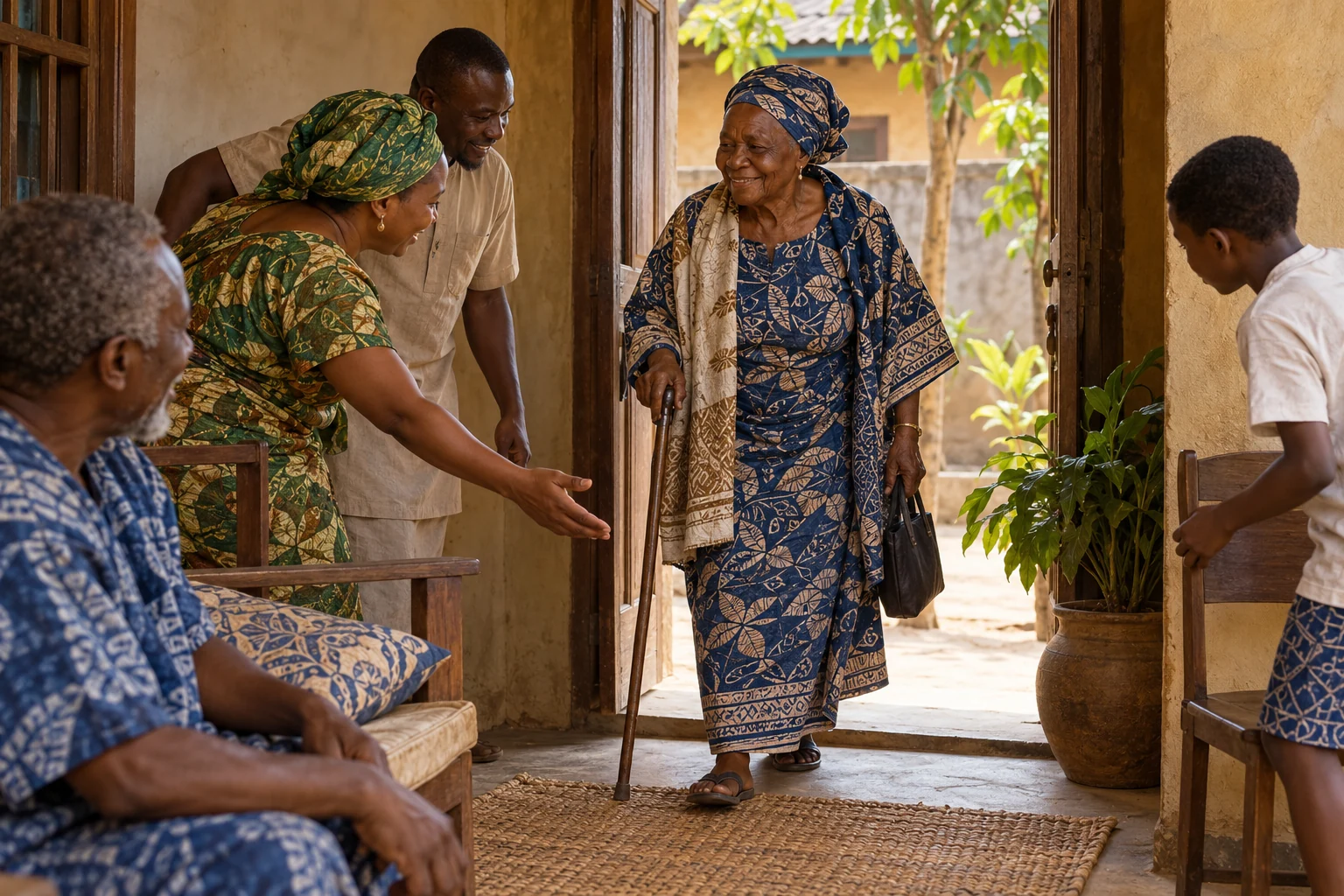
Orunmila and other divinities go to choose gifts for life on earth. Eshu advises him to let the others choose first and take Ariku, an elderly woman whom they overlook. As the other recipients die, the remaining gifts seek Ariku and are welcomed into Orunmila’s house. The story associates her with longevity and with the conditions under which valued things can remain.
The plot challenges judgments based on immediate attraction by placing duration and hospitality at the center. Its treatment of spouses, children, and attendants as gifts reflects the narrative’s historical hierarchy and should not be reproduced as legitimate ownership. The useful analytical tension concerns whether abundance is measured by acquiring things or by sustaining a place where relationships and resources can endure.
Narrative setting: Section explicitly headed revelations of Cromwell Osamaro; Portuguese rendering with Yoruba/Bini framing, precise edition and translator not established.
A diviner admits crossing the boundary of a client relation
A skilled practitioner neglects a response before earthly life and again after becoming involved with a woman who has approached him for divination. She is one of the ruler’s wives. Eshu asks the ruler whether a priest may properly have a sexual relation with someone seeking consultation, then discloses this particular case. Summoned to court, the practitioner consults and finally completes the response. Before the ruler he admits the offense and asks forgiveness. The ruler grants pardon while warning him to stop the conduct. The account then places expiation in relation to the ancestors. It narrates acknowledgment and correction rather than an unchallenged exercise of professional privilege.
The source explicitly frames the encounter as an unfair use of a consultation relation, so the woman’s narrated attraction does not remove the practitioner’s responsibility. Eshu makes the ethical question public before naming the offender, establishing a standard that the ruler then applies to a specific case. The later response does not erase the requirement to admit what happened, accept correction, and acknowledge the ancestors. This sequence is important for religious interpretation: sacred exchange and ethical conduct are joined rather than treated as substitutes.
Contemporary reflection can discuss the vulnerability created by a professional or spiritual care relation while remaining clear that this is not a complete modern disciplinary process. The source gives the ruler’s pardon but not the woman’s later voice, a wider inquiry, or a statement from other affected people. Those absences should limit any claim that the matter is fully repaired for everyone. The practitioner’s competence remains real in the account, but competence does not place his conduct beyond examination.
Narrative witness and setting: Cromwell Osamaro’s explicitly headed account of Iwori Iwowo and the ruler’s wife.
Hospitality to a traveling bride becomes a pretext for war
A bride’s escort takes shelter from heavy rain at the palace of Ijebu Ijesha while traveling to the ruler of Ijesha. The host receives them generously. On arrival, the escort describes that hospitality and denies that the host had a sexual relation with the bride. The ruler nevertheless turns suspicion into a threat of war. Iwori’s counsel against the humiliating conflict is ignored, and he consults instead for the threatened host, who completes the religious response. The invading force is repelled. A counterattack defeats Ijesha, and the narrator connects the outcome with Ijebu Ijesha’s independence and the diviner’s resulting epithet.
The conflict begins with a report of care and becomes destructive because the ruler substitutes suspicion for the testimony he has requested. The narrative does not reveal a hidden affair after all; the host’s denial and the escorts’ statements remain the available evidence. Divination distinguishes the two sides’ responses: the aggressor ignores counsel, while the threatened host completes it. The account therefore presents religious action alongside an explicit judgment about the justice of the quarrel. Contemporary interpretation can examine how power turns a private fear into collective violence, without claiming that every historical war follows the same cause.
The story’s independence claim belongs to the narrator’s local political etiology and requires separate historical evidence before being asserted as verified chronology. The bride herself is not given a voice, a limitation that should remain visible. The account supports criticism of unjust suspicion, not a new accusation against the woman or a universal guarantee that the more justified side always wins a battle.
Narrative witness and setting: Cromwell Osamaro’s explicitly headed Ijesha and Ijebu Ijesha account, presented as the origin of an epithet.
What was born in this Odù
“Born” can name an explicit traditional origin association or what emerges through a story: a capacity, relationship, practice or order of life. Interpretations drawn from a narrative are labelled below, so their basis remains clear.
Imperfection
Selected traditional source association.
The inventory explicitly attributes imperfections to the sign. This broad religious association can prompt inquiry into limits and overlooked worth, but does not justify classifying disability, age, or an individual body as a spiritual defect or a moral failure.
Loss of the head
Selected traditional source association.
The inventory names loss of the head, a motif elaborated in a different family-power story. It should remain an attributed religious image of endangered direction or authority, without a diagnosis, prediction, or instruction involving an actual person’s head.
Correlations to life dimensions
These questions bring the selected stories into contemporary life. They are interpretive invitations for study.
Work and resources
The regent’s business position gives him leverage over a bereaved household, while the enslaved worker has practical knowledge without recognized authority. The narrative supports examining whose labor and information make an institution function and whether those people have freedom to act.
Reflect: Who knows the institution but lacks a voice in it?
Relationships and family
The daughter refuses marriage despite pressure through withheld support. Her eventual leadership should not obscure that earlier exercise of agency. The story offers material for examining how economic dependency can be used to narrow another person’s intimate choices.
Reflect: Can a person refuse without losing essential support?
Character and inner life
Orunmila’s choice resists the appeal of the most immediately attractive gifts. The story supports looking beyond appearance while avoiding a formula that age automatically confers wisdom. Ariku’s value is established through the narrative’s duration and welcoming relationships.
Reflect: What value becomes visible only over time?
Community and responsibility
The freed worker remains an adviser by a changed relationship, not merely the same imposed position with praise attached. The story invites us to ask what actual change in rights must accompany recognition of someone previously treated as subordinate or replaceable.
Reflect: What freedom must accompany the praise being offered?
A deeper reading of the sacred relationships
Religious response and ethical acknowledgment work together
The practitioner completes the response before facing the ruler, but still admits the offense, receives a warning, and undertakes ancestral expiation. The host at Ijebu Ijesha likewise responds religiously within a conflict the narrator describes as unjustly imposed. These are not accounts in which ritual mechanically cancels responsibility or makes every claimant right. The earlier choice of Ariku shows sacred guidance distinguishing an overlooked sustaining relation from attractive gifts, while the enslaved worker’s eventual recognition adds another judgment about service and authority. A depth account can explain these particular religious relations before drawing modern parallels to accountability, discernment, or institutional care. The source does not provide a universal disciplinary code or formula for winning disputes.
An accusation should be distinguished from an admitted act
The practitioner acknowledges the relationship for which he is summoned. In the hospitality story, the escorts and host deny the alleged act, and the narrator supplies no later confirmation. Comparing them prevents the shared theme of sexuality from flattening different evidentiary situations into the same moral judgment. The earlier enslaved worker’s sabotage also depends on an abuse of authority, while Ariku’s overlooked value concerns a different kind of mistaken assessment. Contemporary interpretation can ask what has actually been established before power acts. The religious accounts add Eshu’s disclosure and divinatory counsel, but those agents do not remove the need to report whether a particular act is admitted, denied, or simply imagined by another character.
A ruler’s judgment can correct a boundary or magnify a fear
The court scene gives the ruler a corrective role when he questions a practitioner’s conduct, grants a pardon, and requires it to stop. The war scene shows another ruler refusing testimony and extending suspicion into an attack on a dependent place. Authority is therefore not automatically wise or corrupt across the sign. Its effects depend on what it attends to and how it acts on what is known. Contemporary analysis can compare these uses of power without endorsing every social term of either court. The bride and the consulted woman remain less fully voiced than the men deciding the outcome, a limit that should temper claims of complete justice or reconciliation in the surviving accounts.
Questions that deepen the study
Does the practitioner’s competence excuse the client relationship?
The account first establishes his competence and then explicitly questions the fairness of a sexual relationship arising through consultation. Those facts are allowed to coexist. Eshu asks for a judgment about the conduct before identifying the particular offender, and the practitioner later admits the offense. The completed religious response does not replace his acknowledgment or the warning to stop. Contemporary readers can recognize a boundary of spiritual care without pretending this short narrative supplies every element of a present professional standard. The woman’s later perspective is absent, so the ruler’s pardon should not be expanded into a claim that every affected relation has been fully repaired.
Is the Ijesha episode verified history of independence?
It is a named local narrative that explains an epithet and attributes independence to the outcome of a divinely framed conflict. That is valuable evidence of a tradition’s account, but it does not by itself establish dates, military chronology, or the entire political history of the places named. The actual narrative sequence is clear enough: hospitality, denied accusation, ignored counsel, religious preparation, defense, and counterattack. A public treatment can explain that sequence and its religious judgment while identifying the historical limit. It should not add a documented affair, a specific reign, or a modern territorial claim absent from the selected witness.
How do the additions deepen Ariku and the enslaved worker?
Ariku’s selection distinguishes a sustaining sacred gift from an attractive appearance, while the enslaved worker’s recognition follows suffering under misused authority. The new pair adds two different kinds of examination: a practitioner must admit an actual breach, and a ruler must distinguish suspicion from testimony but refuses. The four therefore concern the quality of judgment around power, service, and lasting value. Their religious relations remain specific, including Eshu’s disclosure, ancestral expiation, and counsel before conflict. Contemporary reflection can ask what authority recognizes and what it overlooks without turning every story into a generic reward for patience or proof that good people always prevail.
What the four narratives reveal together
The earlier enslaved worker and Ariku accounts distinguish overlooked worth from the appearances that dominate a powerful person’s attention. The added practitioner and hospitality narratives make the quality of judgment more exact. One scene concerns an admitted misuse of a consultation relation followed by correction and ancestral expiation. The other concerns an unsupported accusation that a ruler magnifies into war despite testimony and counsel. Religious agency remains central in both, yet the factual difference between an admitted act and an imagined one must be preserved.
Contemporary inquiry can examine boundaries, evidence, and authority without replacing the sacred world with a purely secular lesson. The women’s limited voices and the unverified independence chronology remain real limits. Together the four motifs deepen discernment without promising that every pardon completes repair or every justified community will prevail in conflict.
Living with this Odù
A continuing life or initiatory relationship
For someone whose received life or initiatory Odù is Ìwòrì Ọ̀ṣẹ́, recognizing overlooked value may require a changed relation rather than merely praising usefulness. The enslaved worker becomes a free adviser after opposing the regent’s coercion, while Ariku’s sustaining presence is chosen over immediately attractive gifts. Long development can involve asking whether a person is being received as a person or valued only while serving a hierarchy that still claims them.
The practitioner’s client boundary and the hospitality war add duties that competence cannot cancel. A capable diviner must acknowledge misuse of a consultation relation. A ruler turns an explicitly denied suspicion into collective violence, overriding testimony and counsel. These narratives distinguish real knowledge from entitlement to control another’s body, reputation, or future.
A received sign does not make longevity or victory guaranteed rewards, nor does it validate lethal sabotage. Osanyin’s aid, Eshu’s disclosure, Orunmila’s counsel, and ancestral expiation retain particular religious significance. Across changing circumstances, the person can ask what freedom recognition requires, what boundaries must accompany spiritual work, and whether repair includes those whose voices the narrative itself leaves absent. Pardon and restored office should not be expanded into a complete settlement for every person affected.
A particular consultation and its question
In consultation, Ìwòrì Ọ̀ṣẹ́ can distinguish overlooked contribution from a system that still treats the contributor as property. The worker’s freedom is essential to the political resolution, not a decorative reward for useful service. Ariku’s reception asks what sustains valued relations through duration rather than what attracts attention first. A practitioner can examine recognition without endorsing the narrative’s treatment of people as gifts or possessions.
The client-boundary account makes responsibility explicit even where the client is described as attracted to the practitioner. The consultation relation creates an obligation that competence and later religious response do not replace. The hospitality conflict asks whether testimony is being heard or power has already decided to make suspicion authoritative. Its local independence claim remains narrative etiology, not verified chronology.
The actual result determines relevance to the visitor’s question. It does not prescribe sabotage, guarantee longevity, or establish that a ruler’s pardon repairs every affected relationship. Consultation can clarify value, freedom, professional boundaries, and unjust suspicion while preserving the particular sacred responses in the accounts. It remains a specific religious encounter rather than permanent identity as rescuer, wise chooser, forgiven offender, or victorious host. The missing women’s perspectives must remain limits on confidence.
Constructive and adverse possibilities
Constructively, overlooked capacity can receive freedom and a consequential role, sustaining value can be preferred to immediate display, and a practitioner can admit a boundary violation instead of treating expertise as immunity. Testimony can also remain relevant when suspicion seeks to turn a private fear into public harm. Religious response and ethical acknowledgment work together in these accounts rather than cancel one another.
Adversely, a person can be useful without becoming free, attraction can be used to excuse misuse of care, and an authority can ignore denied allegations because its own fear already feels conclusive. A favorable pardon or battle outcome may leave other participants unheard. These possibilities do not predetermine whether Ìwòrì Ọ̀ṣẹ́ is Iré or adverse. The actual reading establishes its condition. The motifs ask what recognition changes in freedom, responsibility, and access to a voice, beyond the prestige of the person whose contribution or victory is celebrated.
An illustrative situation in everyday life
Hypothetically, a spiritual teacher recognizes that a talented assistant is being pressured to provide personal loyalty in exchange for a professional role. The freed-adviser motif asks whether recognition changes the assistant’s actual freedom or merely makes service more prestigious. The teacher also hears that a colleague has entered an intimate relationship with someone seeking consultation and is tempted to excuse it because the colleague is effective and admired. The client-boundary motif separates competence from responsibility within care. An appropriate inquiry can preserve the assistant’s choices and examine the professional conduct without treating attraction as a complete answer. This hypothetical example concerns freedom and accountable expertise, not a disciplinary formula, a report of an actual client, or a promise that admission alone repairs harm.
Sources and reading context
The first two narrative witnesses
The first episode is Cuban-labeled; the Ariku story appears under an explicit Cromwell Osamaro heading and keeps that distinct context. Slavery, coercive marriage pressure, and lethal sabotage are contextualized rather than endorsed. Origin imagery is not a diagnosis or a prediction about readers.
Narrative motifs are summarized independently. The life-dimension reflections are contemporary interpretation. How these reference studies are built explains the wider source approach and the distinction between a reference article and personal divination.
Additional named witnesses
- Cromwell Osamaro. The named heading governs the practitioner/client boundary and the later Ijesha/Ijebu Ijesha hospitality conflict.
Both added episodes are attributed to the same explicit witness, not independently corroborated here. The local independence account is a narrative historical claim, not verified chronology. The women’s later perspectives are absent; pardon and victory are not expanded into complete reconciliation.
Bibliographic identification
- C. Osamaro Ibie. Ifism: The Complete Work of Orunmila. Lagos; multivolume publication beginning 1986. Library catalogue record. Related bibliographic record for the named narrative witness. Exact volume, edition and page of the transmitted account have not been independently matched.
Read the source method and wider scholarly context.
The catalogue links identify published works and their authors. They are separate from proof of an individual episode’s wording or attribution. Contemporary comparisons and the synthesis above are editorial interpretation. The author’s books and Academy companions below provide further study; their sales links are separate from the source references.