
Òbàrà Ọ̀ṣẹ́ is a mixed Odù in Ifá’s 256-part corpus. Obara Ose places skilled production beside envy in two animal settings. Bees become vulnerable after teaching competitors who seek exclusive control, while an admired bird becomes more striking when rivals try to spoil its appearance. These are different outcomes: one requires relocation and assistance; the other converts a public attack into recognition. Neither makes envy harmless. Both distinguish another group’s hostile intention from the final meaning of what happens.
A question to carry through the study: What knowledge can you share responsibly while preserving the people and relationships that sustain it?
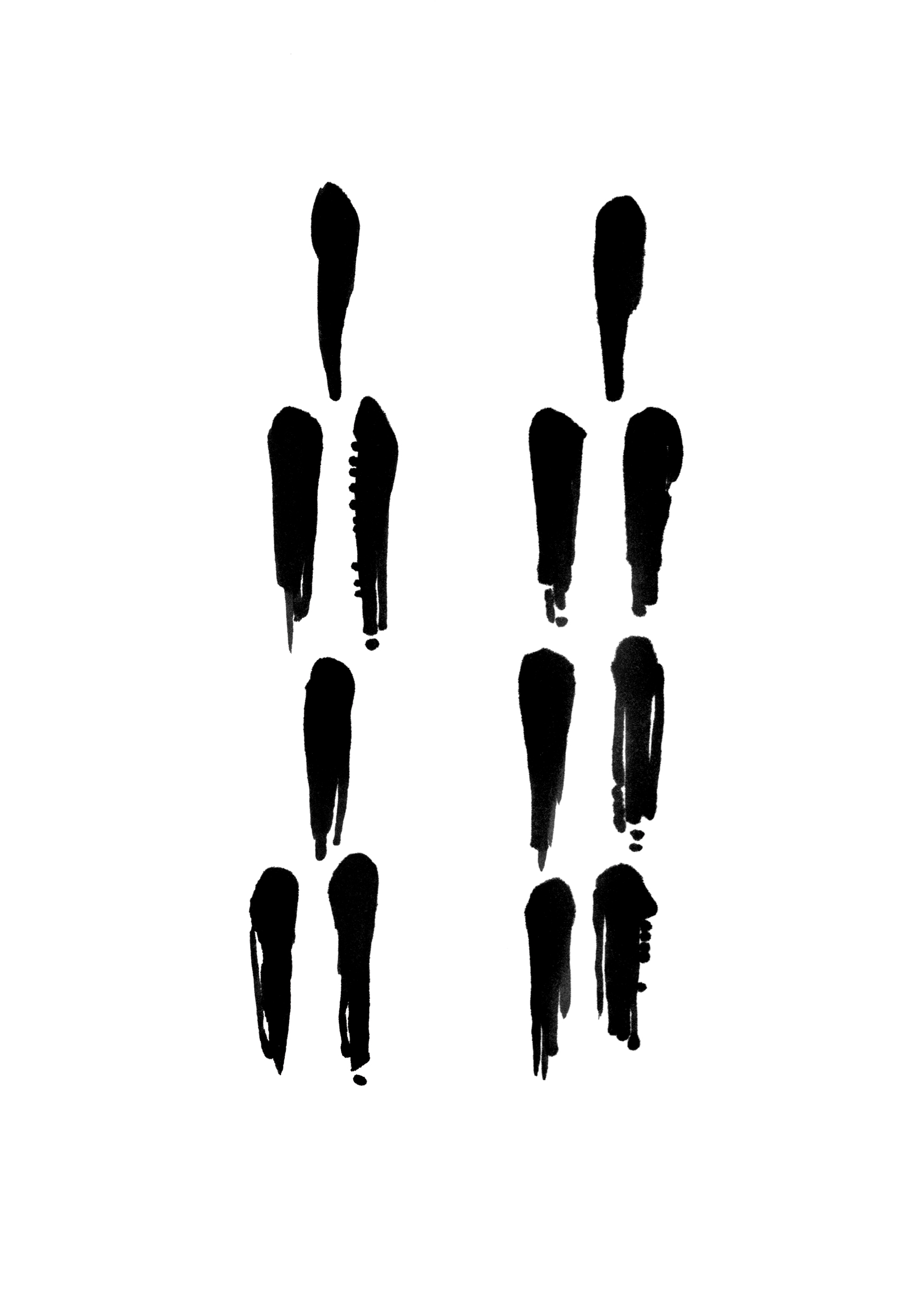
This Academy reads the right column first, then the left. Each row carries a single or double mark.

Where this Odù belongs
Òbàrà Ọ̀ṣẹ́ belongs to the Òbàrà family in this Academy’s study sequence. It is a mixed Odù, distinct from Ọ̀ṣẹ́ Òbàrà. The order matters. Its teaching is approached through its own narratives, rather than by adding two general descriptions of the principal signs together.
Key Òrìṣà and sacred relationships
The figures below are selected for their roles in the accounts discussed here. They offer connected reading paths through the tradition.
-
Ọ̀rúnmìlà. He helps the bees establish productive work and warns them about exposing its knowledge. His role concerns the conditions of livelihood in this particular narrative.
-
Èṣù. He intervenes when the wasps attack and makes the bees’ relocation possible, so their survival depends on help and movement rather than superiority alone.
Key myths and their meanings
The workshop the rivals could not reproduce
Bees develop a successful honey-producing home after consultation. Wasps pressure them for instruction, then decide to eliminate the bees so that they alone will control production. The attack kills one member. Esu’s intervention allows the remaining bees to move, while their rivals retain only an incomplete version of the craft.
The story distinguishes copying a structure from mastering the living process that makes it useful. It also gives secrecy a defensive setting rather than making it inherently virtuous. An article can examine consent, credit, and the safety of skilled workers without implying that every student is a threat or that knowledge should never circulate.
Narrative setting: Cuban/Lukumí patakín in a multilingual source compilation; no individual narrator is established.
The bird marked by envy
At an assembly of birds, an admired white bird attracts the hostility of others. They throw substances at its plumage, intending to diminish it. Instead its appearance becomes more remarkable, and the presiding authority grants it recognition. The short tale offers no account of apology or repaired relations among the birds.
The result changes the attack’s meaning without making its intention acceptable. The episode supports a distinction between a victim’s creative survival and the aggressors’ responsibility. Its brevity also matters: do not invent a detailed species history or imply that humiliation is necessary to become beautiful. The community’s later recognition does not itself establish justice.
Narrative setting: Cuban/Lukumí patakín in a multilingual source compilation; no individual narrator is established.
The apprentice recognizes one mark as the whole craft
Two learners travel to the heavenly maker of bodies to learn the making of identity marks. One receives and learns a fuller range. The other, after the first mark, announces that no more instruction is needed. Both return to earth, but their subsequent work reveals the difference: one can produce varied forms while the other repeats only the single pattern encountered before departure. The witness uses that contrast to explain different marking traditions. The account is a sacred narrative of embodied knowledge and interrupted apprenticeship; it is not accepted here as an ethnographic history of peoples or instruction in altering a body.
The story makes the learner’s declaration consequential because the skill involves a sequence whose extent he does not yet understand. He recognizes an element and mistakes that recognition for completion. The heavenly body-maker is important: instruction concerns a sacred relation between form and identity, not simply a craft certification transposed into the sky. Comparison with the earlier bees is especially productive. There, sharing a craft under pressure exposes a group to appropriation; here, the danger is leaving before the craft has been learned.
These are different limits on transmission and should not be collapsed into a rule that secrecy is always good. The bird’s altered plumage adds another distinction between outward marks and the intention behind them. An editor can ask what a form communicates without making marks a universal measure of belonging or assuming that a community’s visual practices prove the extent of its knowledge.
Narrative witness and setting: Translated excerpt in the multilingual compilation’s expressly attributed Cromwell Osamaro sequence, with Yoruba/Bini-facing material. The compilation’s language is not evidence of a Brazilian tradition.
The enslaved adviser receives freedom
Okpere lives in servitude to Onidoko and possesses religious knowledge capable of addressing a problem in the master’s household. After consulting, he offers assistance and later leaves on an Awo training journey. When he returns, the household has changed in the favorable way the narrative anticipated, and its members express visible happiness. Onidoko recognizes Okpere’s contribution and grants him freedom. The witness describes healing and childbearing through sacred service, but those mechanisms are not generalized into medical claims. Its social movement is from an enslaved person’s underestimated capacity to acknowledged contribution and release, while the unequal system itself receives little explanation.
Okpere is neither merely a grateful subordinate nor a passive recipient of the master’s generosity. His knowledge changes the household, and he continues to develop through training away from it. Religious capacity therefore exceeds the rank assigned by servitude. The eventual release recognizes this contribution, yet a contemporary study should not imply that a person must perform an extraordinary service to deserve freedom. The story’s own resolution is narrower: a particular master responds to help by altering a particular relation.
The earlier bees likewise show labor and knowledge held within an arrangement that can become predatory, while the marked apprentice story concerns a learner’s premature claim. Together they make the ownership of skill a more complex subject than a list of virtues. Sacred action is meaningful within the witness, but it does not erase the human inequality that structures who may ask for help, who can leave to study, and who possesses the authority to grant another person liberty.
Narrative witness and setting: Translated excerpt in the multilingual compilation’s expressly attributed Cromwell Osamaro sequence, with Yoruba/Bini-facing material. The compilation’s language is not evidence of a Brazilian tradition.
What was born in this Odù
“Born” can name an explicit traditional origin association or what emerges through a story: a capacity, relationship, practice or order of life. Interpretations drawn from a narrative are labelled below, so their basis remains clear.
Good and harmful action
Selected traditional source association.
The source names the emergence of good and evil together. The two stories allow comparison of intention and outcome, but do not supply an exhaustive moral system or prove that harm is required for benefit.
Tamales
Selected traditional source association.
The food is explicitly listed among origin associations, twice in the source. The selected narratives do not explain its preparation or historical origin, so it remains a local association rather than a reconstructed culinary history.
The bee’s sting
Selected traditional source association.
The sting is an origin item linked to the insect imagery. No separate anatomical explanation is established by the selected story; use it cautiously as a motif of vulnerability and defense.
Correlations to life dimensions
These questions bring the selected stories into contemporary life. They are interpretive invitations for study.
Work and resources
The wasps learn an external form without the full craft. Skilled labor includes tacit knowledge, relationships, and ongoing care that cannot be reduced to a copied object.
Reflect: What sustaining work is missing from a copied result?
Relationships and family
The bees yield after repeated pressure. Consent to sharing can be eroded by insistence even when an exchange looks voluntary.
Reflect: Where do you need a clearer boundary around requests?
Character and inner life
The bird’s altered appearance receives recognition, but its attackers remain accountable. Resilience does not erase the reality of injury.
Reflect: Can you value your response without excusing what happened?
Community and responsibility
Esu’s assistance enables relocation after the attack. Protecting a group may require a new setting rather than recovering the old position.
Reflect: What support would make a necessary move possible?
A deeper reading of the sacred relationships
Sacred knowledge is acquired through relationship
The body-maker episode places learning in a heavenly origin setting, while Okpere’s knowledge is developed through Ifa and continued training. The bees’ craft also becomes effective through consultation before it is pressured into another group’s hands. These accounts treat knowledge as something carried in relationships among divine persons, teachers, learners, and communities, not merely as isolated information. The religious logic therefore explains why premature closure or disrupted transmission matters. A contemporary discussion of training can draw on that structure, but should not replace the sacred agencies or present technical details. The study’s task is to explain how these relations authorize and sustain knowledge within each witness, including their differences in access and power.
The ethics of transmission has more than one danger
The bees are pressed to share with rivals who plan their elimination; the apprentice refuses further instruction; and Okpere’s expertise serves a household that owns his labor. These are not three versions of the same failure to obey. They distinguish coercive extraction, self-limiting overconfidence, and the use of valuable capacity under servitude. The earlier bird episode adds a hostile attempt to alter another’s appearance without consent. Together they support an exact inquiry into what kind of exchange is taking place. An article that simply praises knowledge-sharing or secrecy would miss the evidence. The ethical quality depends on the participants’ positions and what the proposed transfer enables.
A visible mark does not explain its own origin
The identity marks, the bird’s altered colors, and the wasps’ copied structures all become visible results, but the histories producing them differ. One involves interrupted instruction, another an attack transformed in effect, and another an appropriation that fails to reproduce the full craft. Okpere’s freed status likewise records a prior contribution that an observer might not see. This lens is about evidence rather than a claim that everything visible is deceptive. It asks what history a form carries and which parts remain hidden to spectators. The sacred narratives make such histories meaningful, while the contemporary reader must resist inventing an origin merely because a striking appearance calls for explanation.
Questions that deepen the study
Does the apprentice episode say that a people with fewer marks knows less?
The narrator uses a learning contrast to explain visible differences, but that is a localized sacred etiology, not reliable comparative anthropology. It should not become a hierarchy of actual peoples or a measure of any community’s intelligence. The story’s immediate action concerns one learner announcing completion too early. A contemporary interpretation can examine that act without adopting the wider generalization. Within the religious setting, the heavenly body-maker also makes form a serious subject of transmission. Both points can remain visible: the account has a sacred logic, and its historical or ethnographic reach must not exceed the evidence supplied.
What is gained by keeping Okpere’s servitude visible?
It prevents his eventual freedom from becoming a simple reward detached from the unequal relation that made it someone else’s power to grant. Okpere already possesses knowledge and the capacity to assist before release; his human worth does not begin at recognition. The witness gives sacred service a decisive role in the household’s changed condition, which should be explained within its religious world. Contemporary analysis then asks what the ending does and does not alter. It changes Okpere’s legal or social position as narrated, but does not establish that every servant can gain release through exceptional usefulness or that enslavement was justified until that contribution occurred.
How can the four stories support an account of responsible knowledge without one blanket rule?
They show different responsibilities on different sides of transmission. A learner should remain open to what has not yet been learned; a teacher or community needs to consider coercive appropriation; an employer or master must not confuse low rank with lack of capacity; and a spectator should not infer moral worth from an altered exterior. Those are contemporary analytical distinctions grounded in the episodes, not a universal four-part doctrine. The religious accounts themselves give Ifa, the body-maker, and Esu active roles in how knowledge and visible form become effective. Keeping those persons present preserves more than a modern workplace lesson.
What the four narratives reveal together
The new witness makes Obara Ose’s knowledge theme more discriminating. The unfinished apprentice mistakes one encounter for mastery; the enslaved Okpere possesses a capacity his rank does not adequately recognize. The earlier bees and marked bird then provide distinct histories of extraction and hostile alteration. Together the accounts ask who may learn, who may control a form, and what a visible result can establish about its making. Sacred transmission remains substantial: the heavenly body-maker, divination, and religious service belong to the events as narrated, rather than serving only as metaphors for skill acquisition.
Contemporary comparisons can examine consent and status while preserving those realities within the witness. No single command to share, conceal, submit, or display knowledge fits all four cases. Their depth comes from differentiating relationships and acknowledging that recognition can change a position without resolving every inequality around it.
Living with this Odù
A continuing life or initiatory relationship
For someone who has received Òbàrà Ọ̀ṣẹ́ as a life or initiatory sign, transmission can require different boundaries at different stages. The bees face coercive extraction by rivals who want the craft without its living workers, while the apprentice leaves before discovering the extent of what remains to learn. Neither supports a rule that knowledge must always be hidden or always be shared. Across changing circumstances, a person can learn to distinguish protecting a threatened practice from using secrecy to avoid teaching, and confidence from a premature declaration of completion.
Okpere's capacity exceeds the rank imposed by servitude and develops through continued training. His eventual freedom must not imply that liberty has to be earned through exceptional usefulness. The bird's altered appearance offers another distinction: survival can transform the effect of an attack without making the original aggression necessary or just. Long-term character may therefore include sustained apprenticeship, clear consent around knowledge and recognition of those whose skill a visible result conceals. The received sign does not identify every learner as a potential thief or every hostile response as evidence of envy. It keeps the histories behind visible marks and public standing open to examination.
A particular consultation and its question
A particular consultation yielding Òbàrà Ọ̀ṣẹ́ can help identify which danger surrounds an exchange of knowledge. Is someone demanding access without regard for the practitioners' safety, leaving instruction too early or using another person's expertise within a coercive relation? The bees, marked apprentice and Okpere illuminate those different conditions. A practitioner needs the actual question before treating a refusal either as a necessary boundary or as arrogance.
The sacred settings also differ. The body-maker teaches forms associated with identity, the bees' craft follows consultation and Okpere's service and further learning belong to Ifa. These cannot become instructions for altering bodies, an ethnographic origin claim or a medical explanation of a present household. The bird adds the distinction between an aggressor's intention and an outcome that becomes remarkable despite it. Consultation can ask what a visible success proves and what history it leaves unacknowledged. It should not certify freedom through performance, assume every audience's recognition amounts to justice or turn this result into a permanent personality of secrecy or giftedness. The present religious interpretation remains grounded in the identified narrative and the client's actual circumstances.
Constructive and adverse possibilities
Constructive unfolding could sustain learning long enough for its real extent to become visible, protect a craft without treating all sharing as danger and recognize capacity despite imposed status. Esu's intervention enables the threatened bees' movement within the Cuban witness; Okpere's knowledge and training remain religiously effective within the attributed account.
Adverse relations include extracting the worker while appropriating the product, mistaking one learned pattern for the whole art and assuming public admiration repairs an attack. The bird's changed appearance does not absolve its aggressors, and Okpere's release does not make servitude an acceptable exchange for useful service. These contrasts leave a real reading's state undetermined. They ask what transmission enables, who can consent to it and which visible result still carries a history of coercion, interrupted instruction or unacknowledged contribution.
An illustrative situation in everyday life
In a hypothetical craft collective, a sponsor demands that workers disclose their process while offering no guarantee that they will retain employment or credit. A talented apprentice meanwhile wants to teach after learning one visible technique. The bees' predicament distinguishes protection from unreasonable suspicion of every learner, while the marking story shows why recognizing an element does not establish mastery. The collective can negotiate access and a fuller course of instruction rather than answer both problems with blanket secrecy. This illustration does not reproduce the source's violence or provide a technique for bodily marks. It asks how skilled people remain agents in transmission and how a learner can discover the scale of what they have not yet received.
Sources and reading context
The first two narrative witnesses
These are Cuban stories and localized origin associations. The bee narrative differs from Obara Ogbe’s bee-and-wasp account, where internal leadership drives war; they must not be combined. No general biological, culinary, or historical claim is inferred from the motifs.
Narrative motifs are summarized independently. The life-dimension reflections are contemporary interpretation. How these reference studies are built explains the wider source approach and the distinction between a reference article and personal divination.
Additional named witnesses
- Cromwell Osamaro Ibie. The surrounding sequence is expressly attributed to Cromwell Osamaro. These selected episodes are read through the multilingual compilation’s translated renderings; exact edition and original translation chain remain unverified.
The marking narrative is not treated as an authenticated origin of ethnic practices or a hierarchy of peoples. Okpere’s household intervention remains religious testimony, not a fertility treatment. Names and translated craft terms are retained cautiously; servitude is described rather than justified.
Bibliographic identification
- C. Osamaro Ibie. Ifism: The Complete Work of Orunmila. Lagos; multivolume publication beginning 1986. Library catalogue record. Related bibliographic record for the named narrative witness. Exact volume, edition and page of the transmitted account have not been independently matched.
Read the source method and wider scholarly context.
The catalogue links identify published works and their authors. They are separate from proof of an individual episode’s wording or attribution. Contemporary comparisons and the synthesis above are editorial interpretation. The author’s books and Academy companions below provide further study; their sales links are separate from the source references.