
Òbàrà Ìrẹtẹ̀ is a mixed Odù in Ifá’s 256-part corpus. Obara Irete pairs a damaged landscape with an institution that excludes a capable young diviner. In the first, an ignored report is followed by intervention that clears the land; in the second, repeated successful judgment exposes the elders’ contempt. The common question is whose knowledge becomes audible when established authority has failed. Repair requires both attention to conditions and a willingness to recognize a person previously dismissed.
A question to carry through the study: Who has been excluded from a decision despite having relevant knowledge of the problem?

This Academy reads the right column first, then the left. Each row carries a single or double mark.
Where this Odù belongs
Òbàrà Ìrẹtẹ̀ belongs to the Òbàrà family in this Academy’s study sequence. It is a mixed Odù, distinct from Ìrẹtẹ̀ Òbàrà. The order matters. Its teaching is approached through its own narratives, rather than by adding two general descriptions of the principal signs together.
Key Òrìṣà and sacred relationships
The figures below are selected for their roles in the accounts discussed here. They offer connected reading paths through the tradition.
-
Odùdùwà. He takes the land’s distress to Olofin, then proceeds when that report is ignored, becoming the intermediary who secures Osanyin’s intervention.
-
Òsanyìn. He clears the afflicted landscape and is subsequently gathered into a vessel. The tale presents botanical and wind power in an ambivalent relationship of service.
-
Ọ̀rúnmìlà. Ifa is the knowledge institution into which the young diviner is initiated; the selected story concerns recognition within that institution rather than a direct speech by Orunmila.
Key myths and their meanings
The land no one would hear
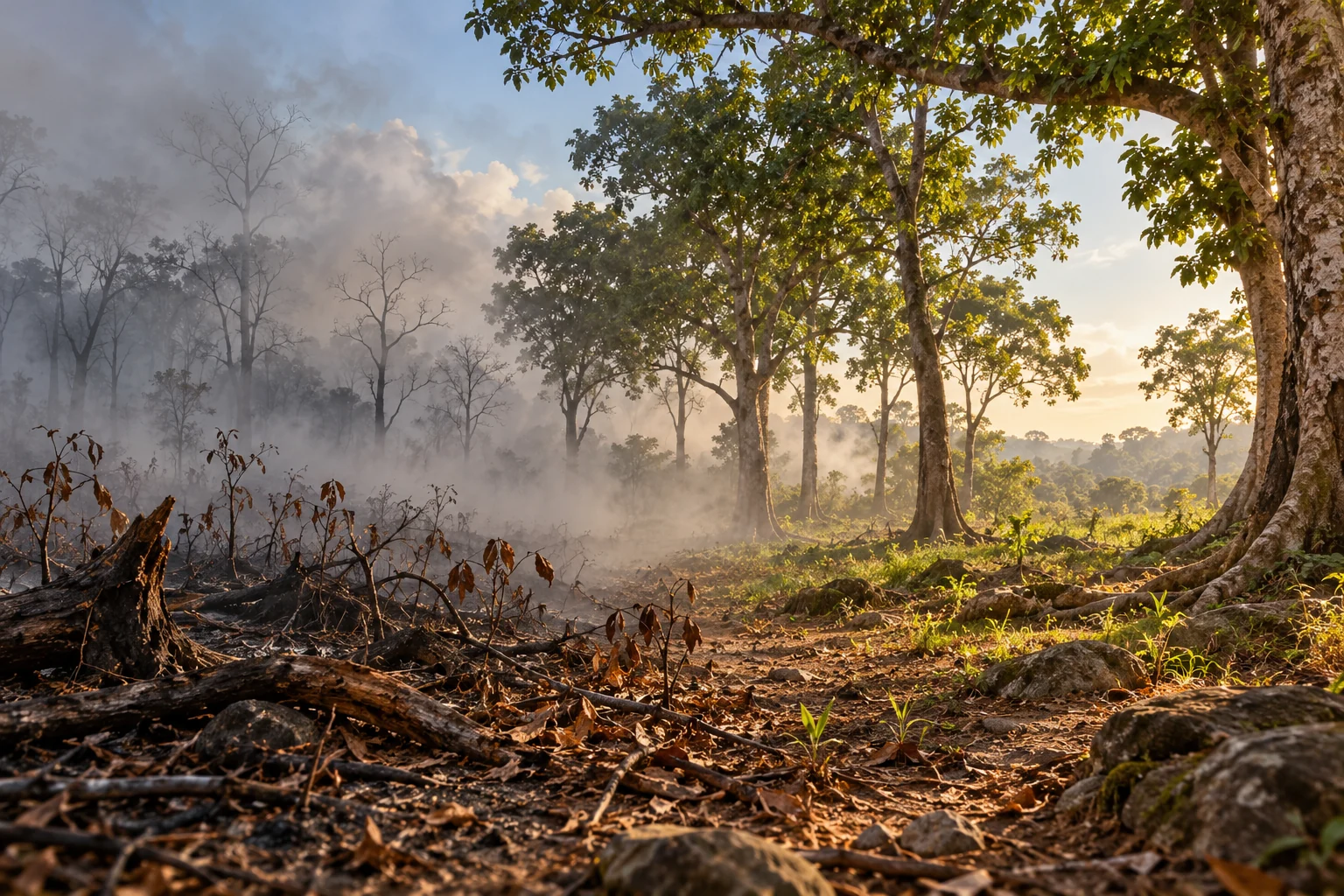
Trees and the land’s children suffer in a polluted landscape. Oduduwa reports the distress but receives no useful response from Olofin. He proceeds toward the place and calls Osanyin, whose whirlwind clears it. The narrative ends by establishing a relationship among the land, Oduduwa, and the power that performed the clearing.
The sequence makes ignored information a public problem. Repair requires someone to cross the distance between hearing a complaint and acting on it. Its disease and cleansing imagery should not become an environmental treatment prescription. The final claim that power may serve both beneficial and harmful ends also prevents a simple equation between capacity and moral goodness.
Narrative setting: Cuban/Lukumí patakín in a multilingual source compilation; no individual narrator is established.
The diviner they would not invite
After an ancestral inheritance leads a youth into Ifa, established diviners mock him and exclude him from meetings. Repeatedly, their own inability forces them to call him. His accurate understanding resolves matters they cannot settle, and their continuing resentment is finally exposed before others.
The story locates failure in a gatekeeping institution rather than in the supposedly inadequate newcomer. Competence has to be demonstrated several times because evidence alone does not immediately dissolve hierarchy. This gives an article concrete questions about invitations, authority, and recognition without reproducing the source’s insulting label for the young diviner.
Narrative setting: Cuban/Lukumí patakín in a multilingual source compilation; no individual narrator is established.
The forest plants prepare for height
The witness gathers the forest’s plants before their earthly arrival and describes their aspiration to become trees. They receive counsel and undertake the advised sacred commitment, apart from one plant named uncertainly in the rendering. That plant remains low while the others attain tree form. The passage is a compact religious explanation of differing growth, not a detailed adventure or a scientific classification. Its surrounding application turns toward bodily concerns, but those prescriptions are not needed to understand the selected motif. The concrete contrast concerns a collective preparation, one refusal, and a difference that remains visible in the living forest.
The forest becomes a community of differently situated beings whose visible forms carry a religious history. That is more specific than a modern slogan that effort leads to growth. The account locates transformation within counsel and obligation before arrival, and treats the plants as participants in that order. It also invites an important interpretive limit: an etiological contrast must not be carried over as a judgment that shorter people, disabled bodies, or less prominent lives failed spiritually. The earlier rotten-tree narrative gives the forest another history, one of suffering that calls for intervention rather than simple blame.
The excluded young diviner also attains recognition despite others’ low estimate of him. Reading these together prevents height and public standing from becoming interchangeable measures of worth. The new story explains a particular form inside its sacred world; contemporary reflection may ask about preparation and aspirations, but should not impose its hierarchy on actual human bodies or every species of plant.
Narrative witness and setting: Translated excerpt in the multilingual compilation’s expressly attributed Cromwell Osamaro sequence, with Yoruba/Bini-facing material. The compilation’s language is not evidence of a Brazilian tradition.
The divine feast cannot bypass Esu
The divine powers agree to establish supremacy through successful hosting, while Esu insists that none can complete a feast without first acknowledging him. They reject his claim. Repeated gatherings fail through devastating disruptions. Orunmila consults and honors the relation, so his own feast is interrupted without the loss suffered by others. Esu finally hosts successfully, after which the other powers’ gatherings can proceed. The witness explains a priority within sacred order through a contest over collective celebration. It does not present a calm ethical demonstration; its destructive episodes, including losses within households, are integral and troubling parts of the narrated means.
The feast is a scene where divine society tries to make rank visible through the power to gather without impediment. Esu’s claim is not simply that he deserves polite inclusion. Within this witness, his agency is a condition the others cannot evade by majority decision. Orunmila’s different response demonstrates religious discernment: he acknowledges the force at work and avoids the most severe consequence, although even his feast does not become the winning one. The account therefore makes recognition distinct from total control.
Compared with the earlier excluded young diviner, the challenge concerns a participant whose place the assembly refuses to grant. Yet the parallels should not become moral equivalence: Esu’s means are far more destructive than the youth’s demonstrations of competence. A reference article should explain why ritual priority is asserted in this story while keeping its cost visible and declining to infer a universal ranking, a personal threat to children, or an endorsement of coercion among human claimants.
Narrative witness and setting: Translated excerpt in the multilingual compilation’s expressly attributed Cromwell Osamaro sequence, with Yoruba/Bini-facing material. The compilation’s language is not evidence of a Brazilian tradition.
What was born in this Odù
“Born” can name an explicit traditional origin association or what emerges through a story: a capacity, relationship, practice or order of life. Interpretations drawn from a narrative are labelled below, so their basis remains clear.
Potable water
Selected traditional source association.
The origin association with drinkable water resonates with the damaged-land story but does not itself supply a technical method of purification. Its strongest contextual significance is a shared condition for life.
Mutual respect between Shango and Oshun’s children
Selected traditional source association.
The source explicitly names reciprocal respect across two religious affiliations. Treat this as a local relational norm, avoiding a claim that the affiliations are inherently hostile.
Ikofa
Selected traditional source association.
A named religious ceremony is listed as an origin association. The study notes its presence without disclosing procedures or assuming identical forms and eligibility across all lineages.
Correlations to life dimensions
These questions bring the selected stories into contemporary life. They are interpretive invitations for study.
Work and resources
The youth’s competence remains unavailable while invitations are controlled by contempt. Access procedures can waste a group’s most relevant capacity.
Reflect: Which invitation or credential rule needs re-examination?
Relationships and family
The ancestral inheritance opens a future, but recognition still has to be negotiated among living people. Family support and institutional fairness are distinct needs.
Reflect: Who helped you begin, and who must now make room?
Character and inner life
The elders’ embarrassment does not prevent renewed exclusion. A single demonstration may not change a defensive habit.
Reflect: What repeated evidence are you refusing to integrate?
Community and responsibility
Drinkable water and a livable landscape are shared goods. Leadership is measured partly by whether it hears the conditions of ordinary life.
Reflect: Which neglected condition should be addressed before another symbolic gesture?
A deeper reading of the sacred relationships
Ritual priority within divine society
The feast contest explains Esu’s acknowledged place through his power to affect the gathering, not through an abstract argument about moral goodness. Orunmila’s consultation recognizes that condition and changes his relation to it. Within the account, sacred exchange is therefore an act of discernment and alignment with a real agency, rather than an optional decoration on a social event. The plant story similarly places preparation before effective emergence. These logics should be described within their witness instead of translated wholly into inclusion policies or personal discipline. Modern questions can still be asked, especially about destructive means, but they follow an explanation of what the account regards as effective sacred order.
Recognition and domination do not coincide
The young diviner’s competence exposes unjust exclusion; the damaged land needs someone to hear distress; the low plant is explained through an unfulfilled commitment; and Esu forces acknowledgment through disrupted feasts. All four concern recognition, but their agents possess radically different degrees and kinds of power. Grouping them as a single story of an outsider proving themselves would erase that difference. The youth does not reproduce Esu’s methods, and a tree’s form does not have a human claim to public office. A careful synthesis can investigate what recognition requires in each setting and where its pursuit becomes domination, while resisting the temptation to make one favored moral fit every episode.
Collective beginnings can conceal unequal conditions
The plants receive a common preparation, and the gods agree on a common hosting contest. Yet the outcomes reveal a difference that was not exhausted by the collective announcement. The damaged-land account likewise shows that an authoritative audience can fail to respond to conditions elsewhere, while the young diviner’s initiation does not secure equal access to meetings. These comparisons make a formal beginning only one stage of an arrangement. What follows depends on capacities, recognition, obligations, and the ability to address a problem. This is a contemporary comparative lens grounded in the plots, not a claim that the witnesses all offer the same theory of equality or a single transferable institutional design.
Questions that deepen the study
Does the plant story teach that lesser stature is a spiritual failure?
It gives one plant’s form a religious etiology within this witness. Extending that account into a verdict on human bodies or lives would be an additional and harmful claim the source does not justify. The same section contains a forest that suffers through environmental disorder and a young diviner whose low status misleads others about his capacity. Those nearby accounts already complicate any direct equation of outward rank with worth. A spiritually attentive reading can explain preparation before emergence while leaving actual differences in growth, disability, or public position outside a moralized diagnostic scheme.
Why does honoring Esu not make Orunmila win the feast contest?
Because the account distinguishes acknowledging an effective agency from controlling the entire field. Orunmila’s feast is still interrupted, but he avoids the household loss suffered elsewhere. Esu then demonstrates his own claim through the successful gathering. The religious lesson is not a simple exchange of an offering for complete victory. It concerns recognition of priority and a changed relation to consequence. A contemporary reader can ask about limits on mastery, but should retain the divine persons and ritual context. The sequence cannot responsibly become a promise that a particular act will protect an actual household or determine another tradition’s hierarchy.
How can the feast story and the excluded-youth story be compared without making them equivalent?
Both show an assembly failing to recognize a participant, but their means and consequences differ. The youth repeatedly resolves a problem the elders cannot solve, exposing prejudice through competence. Esu asserts a sacred priority by preventing gatherings, with devastating consequences in the plot. The comparison is useful because it asks what justifies recognition and what costs its pursuit imposes. It becomes misleading if Esu is reduced to a modern marginalized employee or the youth’s case is used to excuse coercion. Each narrative must first be described on its own religious and social terms before the shared question is drawn.
What the four narratives reveal together
The new witness deepens Obara Irete through two unequal beginnings: forest plants prepare for visible form, and divine powers test rank through hospitality they cannot complete without Esu’s acknowledgment. Beside the earlier damaged land and excluded young diviner, these episodes make recognition a plural problem rather than an automatic virtue. Religious order remains substantive. Divination, preparation, and ritual priority describe effective relations inside the accounts, while contemporary questions about stature, exclusion, and coercion remain interpretations made in comparison.
The study should preserve the difference between a plant’s etiology, a land’s distress, a young person’s competence, and Esu’s destructive demonstration. Their details prevent a single moral from absorbing every case. The result is a richer account of what is needed before a beginning becomes sustainable, and of the limits on judging a life from its visible position.
Living with this Odù
A continuing life or initiatory relationship
For a person whose received life or initiatory Odù is Òbàrà Ìrẹtẹ̀, recognition can require identifying both neglected distress and the power to answer it. Oduduwa's report does not produce useful action until distance is crossed and Osanyin is called. The excluded young diviner also has competence before the established group is willing to grant it a place. Across a life, these tensions can sharpen attention to the difference between formally hearing someone and changing the conditions that keep their contribution or suffering outside the institution's account.
The forest and feast witnesses require other distinctions. The plants' sacred preparation explains a difference within their narrated world, not a hierarchy of human bodies. Esu's power to disrupt gatherings establishes a priority in a destructive divine contest; it is not equivalent to the young diviner's demonstrations of knowledge. Long-term character can include recognizing real agency without treating force as proof of moral entitlement. The received sign does not demand unconditional inclusion of every claimant or promise prominence after exclusion. It offers changing questions about preparation, response and the terms by which an assembly acknowledges what it has tried to bypass.
A particular consultation and its question
A consultation yielding Òbàrà Ìrẹtẹ̀ can invite a precise question about what recognition has failed to change. A complaint may have been heard without repair, a qualified participant may remain excluded despite repeated contribution or a gathering may try to proceed while disregarding a sacred relation. The damaged land, young diviner and Esu's contest concern different degrees of power. A practitioner should not assume they are interchangeable accounts of an outsider needing confidence.
The religious agencies remain specific: Osanyin performs the clearing, ancestral inheritance brings the youth into Ifa and Esu's action determines the feast's conditions. The plant account likewise places preparation within celestial emergence, but cannot measure actual bodies or explain disability. In a current institutional question, the narratives can help distinguish formal access from an arrangement able to respond. They also leave destructive means open to ethical examination; acknowledgment forced through household loss is not a modern model for securing recognition. The result belongs to this consultation and question. It does not make the person permanently an excluded genius or authorize them to claim Esu's priority for their own demands.
Constructive and adverse possibilities
Constructive relations may carry an ignored account toward effective assistance, let demonstrated understanding change an invitation structure or acknowledge a sacred condition that cannot be abolished by collective preference. Within the feast witness, Orunmila's consultation changes his relation to Esu without making his own gathering wholly sovereign. Recognition is therefore more specific than complete control.
Adverse unfolding may include gatekeeping that survives evidence, authoritative hearing without response or a claimant's pursuit of recognition through domination. The source's destructive feasts and plant hierarchy should not become threats directed at actual families or judgments of human bodies. These are possible relationships, not a determination of ìrè or òṣogbo for an unknown person. Their differences ask which form of acknowledgment is needed, what agency actually operates and whether a successful claim leaves others less able to live or speak.
An illustrative situation in everyday life
In a hypothetical training institution, a newcomer repeatedly solves problems but is invited only when senior members fail. Public praise never changes ordinary access to meetings. The young diviner's narrative helps distinguish occasional use of competence from recognition that alters participation. The ignored land adds another question if reports of harm are received politely and then left untouched. The example does not equate a newcomer with Esu or authorize disruption to compel acknowledgment. It asks what evidence the institution already has, what response has been withheld and whether its procedures allow learning to change hierarchy. The person's frustration is plausible, but neither resentment nor a claim of exceptional ability settles those institutional questions alone.
Sources and reading context
The first two narrative witnesses
The material is Cuban/Lukumí narrative with later English expansions. Inle here functions as land in the story and is not automatically identified with the deity Erinle. The source’s disrespectful labels, ecological causation, and ritual procedures are not carried into personal guidance.
Narrative motifs are summarized independently. The life-dimension reflections are contemporary interpretation. How these reference studies are built explains the wider source approach and the distinction between a reference article and personal divination.
Additional named witnesses
- Cromwell Osamaro Ibie. The surrounding sequence is expressly attributed to Cromwell Osamaro. These selected episodes are read through the multilingual compilation’s translated renderings; exact edition and original translation chain remain unverified.
The low plant’s name is uncertain and no species identification is attempted. The feast story asserts ritual priority locally and includes child loss, which is not generalized into a prediction or threat. Later bodily prescriptions are excluded, and no universal divine ranking is claimed.
Bibliographic identification
- C. Osamaro Ibie. Ifism: The Complete Work of Orunmila. Lagos; multivolume publication beginning 1986. Library catalogue record. Related bibliographic record for the named narrative witness. Exact volume, edition and page of the transmitted account have not been independently matched.
Read the source method and wider scholarly context.
The catalogue links identify published works and their authors. They are separate from proof of an individual episode’s wording or attribution. Contemporary comparisons and the synthesis above are editorial interpretation. The author’s books and Academy companions below provide further study; their sales links are separate from the source references.