
Ìrẹtẹ̀ Òbàrà is a mixed Odù in Ifá’s 256-part corpus. The selected Ìrẹtẹ̀ Ọ̀bàrà episodes place formidable figures in conditions of dependence. Asoyi receives shelter and care but violates the host’s trust, beginning an exile associated with pilgrimage. Ṣàngó, disguised as a dominant buffalo, is struck by Oyá and later depends on Yemayá’s intervention. The shared tension concerns vulnerability and responsibility: needing care does not cancel accountability, while possessing strength does not eliminate dependence on someone else’s practical attention.
A question to carry through the study: How can you accept needed care while remaining accountable for the effects of your conduct on the caregiver?
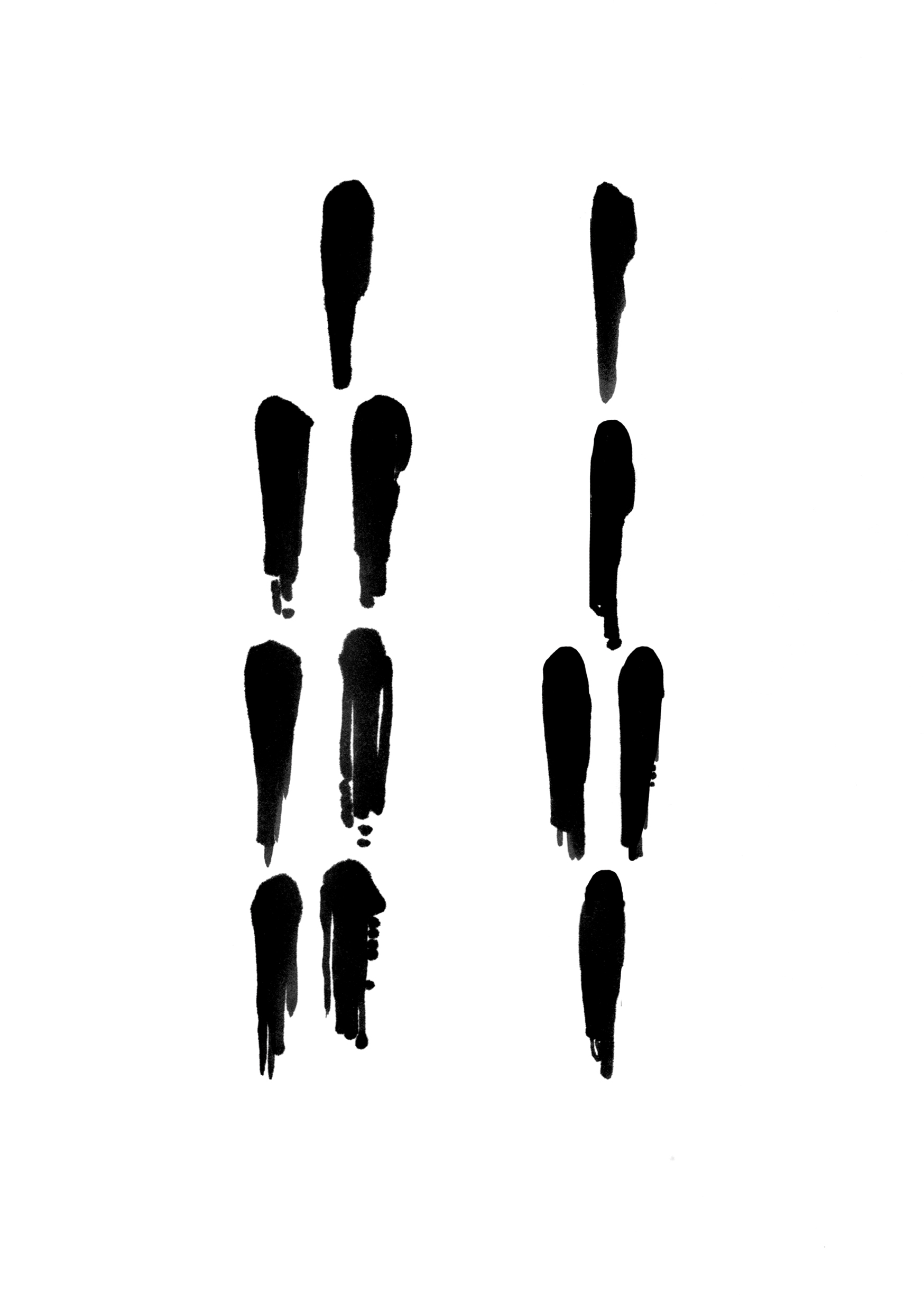
This Academy reads the right column first, then the left. Each row carries a single or double mark.

Where this Odù belongs
Ìrẹtẹ̀ Òbàrà belongs to the Ìrẹtẹ̀ family in this Academy’s study sequence. It is a mixed Odù, distinct from Òbàrà Ìrẹtẹ̀. The order matters. Its teaching is approached through its own narratives, rather than by adding two general descriptions of the principal signs together.
Key Òrìṣà and sacred relationships
The figures below are selected for their roles in the accounts discussed here. They offer connected reading paths through the tradition.
-
Aganjú. Agayú gives Asoyi shelter and places his daughter in a caregiving role, then expels the guest after learning of the harmful relationship; hospitality and household authority are both visible.
-
Ọya. Oyá challenges the buffalo’s domination of its territory without initially confronting Ṣàngó in his ordinary form; the disguise links perceived animal power with a divine rivalry.
-
Ṣàngó. Ṣàngó inhabits the buffalo form, becomes incapacitated after Oyá’s response and receives a new title following Yemayá’s intervention; strength is shown as recoverable through relationship.
-
Yemọja. Yemayá notices Ṣàngó’s condition, seeks counsel and personally carries out the supportive action described; she supplies the sustained attention that the otherwise powerful figure cannot provide himself.
Key myths and their meanings
A guest’s breach begins a long wandering
Asoyi arrives in distress and receives a home with Agayú. The host’s daughter provides attentive care. A sexual relationship develops between the guest and caregiver, and the narrative presents serious harm to her as a consequence. Discovering the situation, Agayú expels Asoyi. The displaced guest takes his vessel and begins traveling from place to place, making the breach of hospitality the starting point of a pilgrimage account.
The story asks what guests owe to the household and labor sustaining them. Its framing also assigns the daughter’s care without exploring her choice, a limit that should remain visible. The source’s specific disease sequence must not become medical evidence or a moral account of actual illness. Vulnerability and wrongdoing coexist; neither automatically erases the other.
Narrative setting: Cuban compilation, Asoyi and Agayú episode; Asoyi’s wider divine identification is not assumed.
The buffalo’s power depends on an attentive helper
A powerful buffalo dominates the region where Oyá lives. She responds against its arrogance, and the animal removes its skin to reveal Ṣàngó. His condition worsens and leaves him unable to act. Yemayá recognizes his distress, seeks Ọ̀rúnmìlà’s counsel and undertakes the intervention herself. The account closes with renewed strength and a title associated with youthful bull power, linking recovery to the care of someone outside the original contest.
The disguise makes dominance impressive at a distance but does not prevent dependence. The decisive action after conflict belongs to Yemayá, whose attention changes the outcome while the rival figures are preoccupied with power. We can retain this redistribution of agency without repeating the source’s anatomical claims, therapeutic materials or equation of worth with virility.
Narrative setting: Cuban compilation, Ogodo Makulenkue title episode.
The page’s fruit ornaments cannot survive prolonged royalty
Ahun is a trusted royal page whose cleverness makes him welcome, but he leaves a commission without the sacred preparation advised. He dresses as a ruler using fruit that resembles prestigious beads and accepts the reception meant for that office. The comfort encourages him to prolong the visit until the ornaments begin to decay. An attempt to conceal their nature through a fire instead prompts an investigation, which exposes his identity and leads to condemnation. His wife then seeks the preparation he had refused. Èṣù intervenes with the ruler, and a pardon leaves him alive under a renewed warning.
The disguise fails through time rather than through a single sharp-eyed observer. What can pass briefly as royal adornment cannot sustain the demands of a continuing office. The attempted concealment also changes the claim from accepting mistaken hospitality to demanding replacement for regalia that never existed in that form. The religious resolution does not simply reward cleverness: the wife’s action and Èṣù’s intervention reopen a relation the page had declined. The pardon preserves life without making the impersonation innocent.
Compared with the earlier Asoyi expulsion, continuing care is possible after a breach, but it arrives through another person’s initiative rather than an automatic right of the guest. Compared with Ṣàngó’s buffalo form, the page’s appearance is not a genuine divine transformation. A reference should preserve that difference between spiritually effective metamorphosis and a fraudulent use of signs, while leaving the severity of the original sentence open to contemporary ethical scrutiny. The entrusted role is not explicitly restored.
Narrative witness and setting: Portuguese African narrative in the section explicitly credited to Cromwell Osamaro.
Alao presents himself in place of the promised offering
Alao receives a divinatory obligation that includes an initial gift and a later completion. He performs the first part but does not provide the promised second offering in the same way. Instead, he stages an imitation in which his own body represents what is due and declares the relation completed. He and his wife then eat and retire. The next morning he does not wake. When others ask what happened, the wife recounts the previous act. The source interprets the death as the consequence of attempting to deceive the sacred recipient rather than completing the exchange that had been identified.
The episode makes the recipient’s recognition more consequential than the performer’s declaration that an imitation should count. That is a religious distinction about an obligation already established, not evidence that every symbolic act is meaningless. Other stories in this very family involve genuine transformations and effective representations, so the reference should not invent a universal opposition between literal action and sacred symbolism. Here the act is explicitly framed as evading a promised completion. The source’s fatal outcome must remain a narrative claim, not a medical explanation or a reason for readers to offer themselves in any form.
Compared with the page’s fruit ornaments, an appearance is made to carry a relation it does not actually fulfill. Compared with Yemayá’s intervention for Ṣàngó, help is not sought from another capable figure. The unresolved question is what makes substitution authorized within a particular sacred relationship, rather than merely convenient for the person who owes it.
Narrative witness and setting: Portuguese African narrative explicitly credited to Cromwell Osamaro.
What was born in this Odù
“Born” can name an explicit traditional origin association or what emerges through a story: a capacity, relationship, practice or order of life. Interpretations drawn from a narrative are labelled below, so their basis remains clear.
The beginning of Asoyi’s pilgrimage
Origin motif within the selected narrative.
No formal born list is present in the selected opening. The narrative explicitly explains the start of Asoyi’s wandering after expulsion, making it a source-supported narrative origin rather than a universal account of pilgrimage or a prescribed route.
The Ogodo Makulenkue title
Origin motif within the selected narrative.
The second narrative explicitly explains when Ṣàngó receives this local title. The source glosses it through youthful bull strength; this study retains the title’s narrative setting without offering an independently verified etymology or a universal identification.
Correlations to life dimensions
These questions bring the selected stories into contemporary life. They are interpretive invitations for study.
Relationships and family
Both stories depend on caregiving, but the first assigns it to a daughter while the second highlights Yemayá’s initiative. The difference helps examine how care is offered, expected and credited, especially when the recipient possesses status or authority.
Reflect: Has a caregiver freely chosen the responsibility others now expect from them?
Character and inner life
The buffalo form magnifies power but cannot prevent need. This allows a reading of strength that includes accepting help and recognizing dependence, without treating temporary incapacity as humiliation or restoring virility as the only meaningful recovery.
Reflect: What kind of strength becomes available when you stop concealing dependence?
Community and responsibility
Asoyi’s expulsion follows a breach, yet the narrative does not document lasting practical repair for the daughter. We should distinguish removing an offender from addressing the needs of someone harmed; exile is not automatically restoration.
Reflect: What care is still owed to the person harmed after a disruptive guest has left?
Work and resources
Shelter, attention and a secure household make Asoyi’s recovery possible before the breach. Those resources often appear ordinary until violated. The story supports explicit expectations around access and caregiving rather than assuming that gratitude alone will regulate conduct.
Reflect: Which expectation should be discussed before someone becomes dependent on your household’s resources?
A deeper reading of the sacred relationships
A representation needs an authorized sacred relation
Ṣàngó’s buffalo form is genuinely effective within the earlier narrative, and his new title follows Yemayá’s intervention through divinatory counsel. The page’s fruit regalia instead supports an untrue claim to office. Alao’s self-presentation likewise attempts to replace an identified obligation without an acknowledged authorization. These distinctions prevent a simplistic claim that all appearances are false or all ritual representation works automatically. The source gives different forms different relations to efficacy. A contemporary reader can compare authenticity, but the religious question is more precise: who or what recognizes the representation, and within which established relation can it stand? The narratives do not supply a universal rule for acceptable substitutions across lineages.
A reprieve may depend on someone other than the principal actor
Ahun’s wife acts after his own refusal, and Èṣù’s intervention changes the ruler’s response. Yemayá also supplies initiative when Ṣàngó cannot resolve his condition himself. Asoyi receives care but then breaches the household relation that sustains him, while Alao’s wife becomes the witness who can explain an act already completed. These are different positions around vulnerability: advocate, active helper, harmed caregiver and reporting witness. A reference should not flatten them into an anonymous supporting woman. A contemporary analysis can ask how agency and credit are distributed while preserving the particular spiritual intervention or social relation through which each person becomes consequential to the outcome.
A breached relation may end in exile, pardon or another dependence
Asoyi’s expulsion begins a wandering life. Ahun receives a reprieve that keeps the breach acknowledged. Ṣàngó’s renewed strength comes through another’s care, while Alao’s attempt at completion leaves no narrated route back. These endings differ even where a person has misjudged a condition or relied on an inadequate response. A contemporary reader should therefore resist making severity itself the proof of a single moral rule. The religious accounts identify distinct recipients, interventions and conditions. Their comparison can ask what permits repair and who enables it, without inventing an opportunity the source does not give or assuming a favorable outcome cancels responsibility for the prior act.
Questions that deepen the study
Does Ahun’s pardon mean the impersonation was justified?
No. The investigation establishes the false identity, and the final warning preserves its wrongness within the account. The change is that his wife’s sacred action and Èṣù’s intervention avert an already pronounced death sentence. That distinction lets a reference describe mercy without turning it into exoneration. A contemporary question about proportionality can then be asked separately from whether the page truly held the office he claimed. The religious mechanism remains active rather than being reduced to a ruler suddenly becoming lenient. The source offers a specific reprieve, not a guarantee that deception can always be repaired afterward.
Does Alao’s story show that ritual symbols never work?
It cannot support that generalization. The earlier buffalo transformation is real within its narrative, and the family contains other efficacious material forms. Alao’s episode concerns an imitation presented as completion of a particular obligation that the source says he was trying to evade. The question is authorization within a relationship, not whether representation as such is unreal. A reference should keep the fatal ending contextual and avoid presenting the act as an experiment or a clinical cause of death. Nor should it offer a rule for replacing materials in actual practice; those decisions require their own tradition-specific grounds.
What agency do the women around the vulnerable figures have?
They occupy different roles. Yemayá notices, seeks counsel and acts for Ṣàngó. Ahun’s wife initiates the response her husband declined, making a reprieve possible. Alao’s wife recounts the previous act when the community needs to understand what happened. The caregiver in Asoyi’s story is harmed within a relation assigned by the household. These differences matter more than a generic claim that women provide support. A contemporary reading can ask who chooses, who bears costs and who receives recognition, while preserving the divine and interpersonal mechanisms that make each role effective or vulnerable in the actual account.
What the four narratives reveal together
The African-attributed additions distinguish fraudulent appearance from a representation recognized within sacred order. Ahun’s fruit regalia cannot sustain the office it imitates, and Alao’s staged completion does not fulfill the relation he owes. The earlier Ṣàngó narrative supplies a different case: a genuine transformation and a restoration mediated by Yemayá. Asoyi’s wandering adds another outcome after a breach of care. Together these witnesses show why neither cleverness nor vulnerability settles how an act should be understood.
Religious efficacy depends on particular relations, recipients and interventions rather than on appearance alone. Contemporary questions about authorization, mercy and agency can clarify the comparison, while preserving the women’s different roles and the unresolved severity of some endings. The reference should not transform a narrative death into medical evidence or make a fortunate reprieve certify every prior action as innocent.
Living with this Odù
A continuing life or initiatory relationship
A received life or initiatory relation with Ìrẹtẹ̀ Ọbàrà can invite a continuing examination of what appearance can and cannot sustain. Ahun's fruit regalia works briefly but cannot support a prolonged claim to royal standing. Alao's imitation likewise declares a relation complete without fulfilling what was promised within that witness. These are not grounds for condemning all sacred representation: the buffalo account contains genuine divine transformation whose efficacy differs from fraudulent signs. Across a life, a bearer can ask whether a visible form expresses an acknowledged relation or is being used to bypass its demands.
Asoyi's dependence and breach of hospitality add responsibilities toward the people whose labor supports a guest, while Yemayá's intervention reveals care beneath impressive strength. The narratives do not predict illness, sexual conduct or a fatal outcome for a bearer. Asoyi remains the figure named in the Cuban telling rather than being silently identified with another deity. Contemporary inner development accompanies the sacred accounts by examining shame, prolonged pretense and willingness to receive help without using vulnerability as exemption from responsibility. It also keeps the caregivers' agency and the severity of punishment visible, rather than treating survival, pardon or recovered strength as proof that every preceding arrangement was just.
A particular consultation and its question
In consultation, Ìrẹtẹ̀ Ọbàrà can help distinguish a genuine capacity in need of care from an appearance claiming a relation it does not fulfill. Ṣàngó's transformation is religiously effective in its witness; Ahun's ornaments imitate regalia whose material cannot endure. Alao's attempted completion concerns evasion of an established obligation, not a universal failure of symbolism. The actual question determines which distinction matters. A practitioner can ask what was promised, who authorized a substitution and whose initiative makes another chance possible. Ahun's wife reopens a refused relation through her action; the pardon does not explicitly restore his entrusted office.
Asoyi's story also requires attention to care assigned to the daughter without an adequate account of her choice. These inquiries do not diagnose actual illness or establish a client's secret breach. Receiving the sign in consultation is not the same as a permanent initiatory identity. Its reflective value lies in differentiating acknowledgment, impersonation, dependence and authorized representation while preserving Èṣù's intervention and the sacred recipient's agency. It should not convert the fatal ending into a personal threat or invite a reader to imitate the protagonist's bodily substitution in any form.
Constructive and adverse possibilities
Constructive movement may involve accountable participation, receiving another's capable help and recognizing that a pardon preserves life without automatically restoring a role. Adverse movement includes extending a temporary appearance until it claims an enduring office, concealing its failure through further deception or declaring an obligation fulfilled without the recipient's acknowledgment. Actual iré or òṣogbo depends on the consultation. The buffalo's genuine transformation and the page's false ornaments prevent one universal rule that appearances are either wholly powerful or wholly empty. Asoyi's vulnerability does not erase a breach, while the daughter's assigned caregiving must not disappear behind the guest's journey.
Contemporary interpretation can ask what a repair actually changes and whether severe punishment is proportionate. Religious efficacy remains specific to the narratives, without becoming medical evidence, a prediction of death or a guarantee that another person's intercession will always reopen a refused relation for someone who has avoided it.
An illustrative situation in everyday life
In a hypothetical organization, a trusted assistant accepts an event's mistaken assumption that they hold a senior office. The brief convenience becomes a prolonged claim, and attempts to hide the mismatch create further demands. Another leader, genuinely competent but incapacitated by conflict, recovers only because a colleague recognizes the need and acts. The narratives distinguish pretense from real capacity requiring support, and a convenient declaration from an acknowledged completion. A family member's effort may obtain a second chance for the assistant, but that would not make the impersonation innocent or guarantee return to the former role. This is an illustrative interpretation rather than a ritual or clinical report. Its focus is whether appearance carries a real relationship and whether help restores responsible participation instead of protecting an indefinite claim to unearned standing.
Sources and reading context
The first two narrative witnesses
The Cuban source lacks a formal born list here; both entries are explicit narrative beginnings, so evidence remains partial. Asoyi is not silently equated with Asójanò, Soponná or Babalú Ayé. Medical sequences, ritual materials and personalized sexual predictions are omitted; title glosses are limited to the source’s claim.
Narrative motifs are summarized independently. The life-dimension reflections are contemporary interpretation. How these reference studies are built explains the wider source approach and the distinction between a reference article and personal divination.
Additional named witnesses
- Cromwell Osamaro. The named African section supplies Ahun’s royal impersonation and Alao’s attempted completion through imitation.
The Portuguese leaves one sentence of Èṣù’s appeal grammatically confused, but the pardon itself is explicit. Alao’s bodily imitation is summarized without its operative details and never presented for reenactment. The earlier Asoyi figure is not silently equated with other disease deities, and the source’s fatal or bodily outcomes are not personal diagnoses.
Bibliographic identification
- C. Osamaro Ibie. Ifism: The Complete Work of Orunmila. Lagos; multivolume publication beginning 1986. Library catalogue record. Related bibliographic record for the named narrative witness. Exact volume, edition and page of the transmitted account have not been independently matched.
Read the source method and wider scholarly context.
The catalogue links identify published works and their authors. They are separate from proof of an individual episode’s wording or attribution. Contemporary comparisons and the synthesis above are editorial interpretation. The author’s books and Academy companions below provide further study; their sales links are separate from the source references.