
Strength becomes visible when something resists it. The harder question is whether the person carrying a burden understands what they are carrying and why. Aganjú opens that field of reflection through royal, warrior and river-related accounts that do not fit into one simple biography.
The study follows carrying and passage without claiming limitless strength.
1. A distinct figure, rather than a spare name for Ṣàngó
The Getty iconographic authority record identifies Aganju through a deified warrior-king setting and records differing relationships to Shango. That variation matters. A single genealogy assembled from incompatible accounts can appear helpful while teaching a history that no community actually preserves in that form.
Afro-Cuban Agayú and Brazilian Aganjú also require their own contexts. Familiar volcanic imagery in some diaspora accounts should not be imposed on every local Yorùbá history. The Academy keeps the entry separate from Ṣàngó so that comparison can sharpen rather than erase the figure’s individuality.
2. Key narrative theme: carrying another across
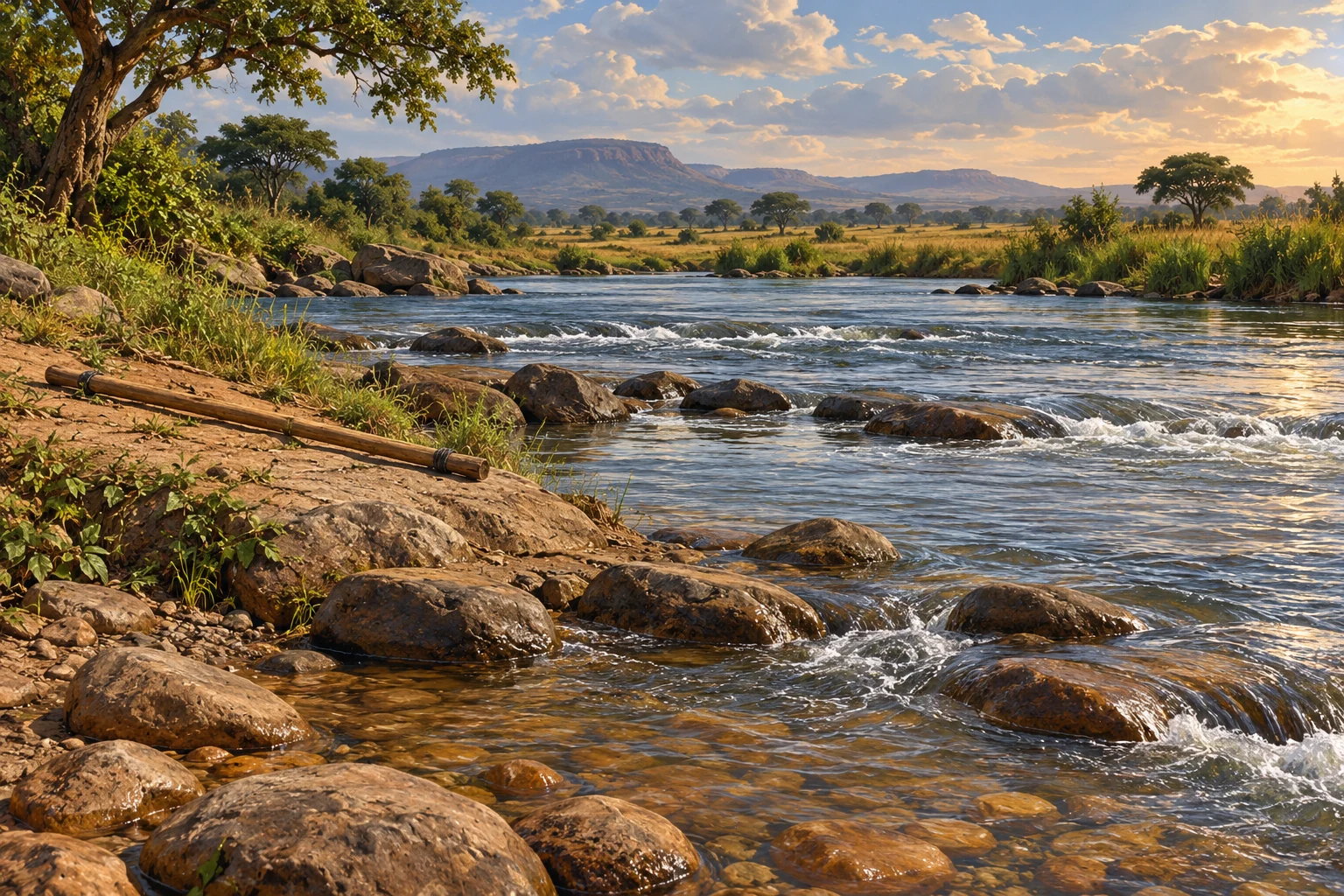
River-crossing accounts associated with Aganjú bring a powerful image into view: the strength of the carrier is tested by the person or burden being carried. Particular versions differ in the passengers, recognition and consequences. An independent contemporary reading can follow the question without presenting a composite retelling as a verified ancient text.
Carrying another person can be an act of generosity, an obligation, a profession or a way of securing power over them. The outward effort does not tell us which relationship is being formed. A helper may begin to believe that the receiver’s gratitude must never end. Another may refuse assistance because receiving it has previously meant losing freedom.
3. Endurance and the right to set a limit
Endurance is valuable, but it can be exploited. People known for strength may be given every difficult task until their exhaustion becomes invisible. They may also participate in the pattern by treating a request for help as evidence that they have failed to be themselves.
The contemporary question is not whether a strong person should become weaker. It is whether strength can remain connected to discernment. What belongs to me to carry? What should be shared? Which burden has continued only because no one has named a limit? The answer can make strength more durable and less dependent on the performance of invulnerability.
4. Religious identity and the scope of this study
Aganjú requires a distinct religious portrait even where traditions place him close to Ṣàngó. Getty's authority record identifies a deified warrior king and preserves alternatives in their relationship. The difference between brother and father is part of the evidence, rather than an editorial error that needs correction. Cuban Agayú and Brazilian Aganjú also belong to particular histories. The Museum of Miami supplies an explicitly Cuban volcanic association; it does not authorize an African biography built around a volcano.
The Human Soul manuscript has no dedicated Aganjú chapter. Its Ṣàngó chapter offers a short geological-fire interpretation and explicitly recognizes distinct standing in some traditions. That is a legitimate point of departure for the author's symbolic method, but the larger psychological analysis here is a new application. It should be labeled accordingly.
The existing Academy core's carrying theme can now be given a more exact source boundary. Mária Dornbach's historical Havana fieldwork reports a river-carrying association, but not the full dramatic burden sequence circulating elsewhere. This research therefore retains crossing and responsibility without inventing a passenger, rescue or divine revelation. The sacred relation comes first; reflection then asks what kind of strength can bear a real burden without claiming omnipotence.
5. Knowledge that gives the figure depth
5.1 What is established about the carrying association?
What can actually be said about carrying across a river? Dornbach's report associates Argayu with rivers and savanna and briefly mentions carrying a divine child. Her account is situated in Havana research in the early 1970s. It does not establish one pan-Yoruba story, and its compact report is insufficient for reproducing a detailed dramatic sequence. The Academy's existing theme of a carrier tested by what is carried can remain a named interpretive frame, with that gap visible.
Contemporary extension: crossing is a relational achievement. A passenger must reach a destination, a carrier must understand the terrain, and the burden changes the carrier's freedom of movement. Strength alone does not tell the helper what the passenger needs or whether the route is safe. Someone can exert great effort while carrying a person in a direction they never chose.
This gives the theme ethical precision. Before accepting a responsibility, ask what is actually being undertaken, whose purpose the effort serves and what limits must be known. In family life, help with an adult child's transition can enable independence or become a reason to govern every later choice. In work, a specialist can make a passage possible while still needing cooperation. Assistance deserves respect without becoming ownership of the assisted life.
Evidence: Maria Dornbach, Gods in Earthenware Vessels: Gods and their Representation in the Afro-Cuban Santeria Religion — Actual pp. 18–20 of digital republication: Cuban Argayu rivers/savanna and child-carrying association; Saint Christopher; differing receipt/initiation modes reported by particular informants; Asoyano named.
5.2 Why localize the volcanic image?
Why keep the volcanic image local? The Museum of Miami names Aganjú in a volcanic domain within its Afro-Cuban presentation. The Human Soul author takes up geological force as a symbol of pressure beneath apparently settled ground. These are different uses of the image: one is a museum's account of a religious association; the other is an interpretation of what that association can disclose about power.
Contemporary extension: pressure may develop while outward performance remains competent. A caregiver can complete every task while accumulating resentment because nobody asks whether the arrangement can continue. A team can deliver projects through invisible overtime until one additional demand makes the system fail. The eventual eruption should not make the earlier conditions disappear from view. Nor does concealed pressure excuse every action taken when it breaks.
The image becomes useful when it directs attention to scale, accumulation and consequence. What has been treated as inexhaustible? Which warning was dismissed because the burdened person still seemed capable? What support would change the conditions instead of merely demanding renewed endurance? The distinctive Aganjú application concerns weight and sustained force rather than Ṣàngó's public judgment. It does not establish that anger, exhaustion or suppressed emotion identifies a person as Aganjú's devotee.
Evidence: The Museum of Miami, At the Crossroads: Afro-Cuban Orisha Arts in Miami — Specifically Afro-Cuban arts; table identifies Oya with tempests/marketplace, Aganju with volcano, Dada and Bayani with unborn children. Table is not universal Yoruba doctrine.
5.3 Royal comparison without substitution
How can Aganjú belong to royal comparison without becoming a substitute Ṣàngó? Getty records both relationship and difference: a warrior-king identity with more than one kinship account. The book likewise presents an associated current while acknowledging separate deity status. Neither source supports a single genealogy assembled from every tradition. A careful article can teach the reader to follow the location and speaker of each account rather than make all alternatives simultaneous.
Interpretive extension: family resemblance can be a resource and a burden. A person succeeding a prominent relative may be expected to reproduce their style, while any difference is treated as inadequacy or rebellion. Strength might then be expressed through exaggeration: louder force, greater endurance or refusal to receive help. Another person may renounce all authority to avoid comparison. Both remain governed by the inherited image.
Keeping Aganjú distinct makes room for a different question: what does this particular power carry, and through what medium? Crossing, territorial weight and geological pressure are not the same relations as thunderous public command. The comparison can therefore illuminate differentiated responsibility. In contemporary life, a strong organizer, a carrier of difficult practical work and a public spokesperson need not be one person. Recognizing distinct contributions can protect both effectiveness and dignity.
Evidence: Getty Research Institute, CONA Iconography record 901002589: Aganju — Deified warrior king; brother/father alternatives concerning Shango; Cuban Santeria association with Saint Christopher. Authority record, not a full ethnography.
6. A depth-psychological reading
Interpretive basis: A contemporary application of the wider interpretive framework in Babá Tilo de Àjàgùnnà’s The Orishas and the Human Soul, especially “Ṣàngó”, “Before the Òrìṣà Become Archetypes”, “Water, Wind, Dust, Mud, and the Elemental Atmospheres of the Psyche”. No dedicated Aganju chapter exists. The short Shango references and concrete elemental method support a new, labeled application; the carrying association is external historical ethnography, not a recovered book chapter.
6.1 Strength that permits reciprocal help
Contemporary psychological interpretation: the identity of being the strongest can become a prohibition against dependence. A person is praised for carrying the family through difficulties. Over time, every request for help feels like evidence that they have lost the quality that made them valuable. They may refuse rest, conceal uncertainty and insist that others could not cope without them. What began as generosity becomes a closed system in which the helper must remain indispensable.
The carrying image offers a concrete alternative. A carrier needs footing, knowledge of the route and an accurate estimate of the load. Admitting a limit is information about the passage, not a collapse of personhood. The ability to ask another person to share weight can preserve the original commitment more effectively than a private performance of invulnerability.
An illustrative household has one member coordinating transport, finances and care for an elderly relative. Their exhaustion does not mean love has ended. But resentment grows if they reject offers that would distribute the work because only their own method seems acceptable. Reflective inquiry can examine both the unequal arrangement and the person's investment in remaining its sole pillar. This is a new application of the book's relational method, not a received Aganjú personality profile. It gives strength a developmental task: remain useful while allowing relationship to include reciprocal support.
6.2 Gratitude, indebtedness and freedom after passage
Contemporary psychological interpretation: the helper's desire for gratitude can obscure the receiver's freedom. Carrying someone through a difficult stage produces real costs. It can also create an expectation that the helped person will never oppose the helper. The receiver then faces an impossible choice: either deny the value of the help or accept permanent supervision as its price. The most demanding ethical question is whether assistance ends when the passage is complete.
An illustrative mentor supports a younger colleague through qualification. Afterward, the mentor interprets an independent career decision as betrayal. The earlier gift has silently become a contract for loyalty. A different mentor can acknowledge mixed feelings, recognize their contribution and permit the colleague to move beyond them. Their importance does not depend on keeping the other person unfinished.
The crossing theme is particularly exact here because destination matters. A successful passage should change the relationship; the passenger is no longer in the same dependency. That change can provoke grief in someone whose identity rested on being needed. Reflective work can name the grief without treating it as a claim over the other person. In devotional context, such reflection should remain answerable to the community's actual understanding of Aganjú. The image is used to study the ethics of carrying, not to attribute a mythical motive or diagnose a devotee's attachment pattern.
6.3 Pressure, silence and the history before eruption
Contemporary psychological interpretation: pressure becomes destructive when a person cannot distinguish endurance from silence. Someone may say yes because they are capable, because refusal feels disloyal or because the moment of agreement is easier than the conversation about limits. The consequences arrive later as withdrawal, explosive complaint or bodily exhaustion. The volcanic image can help describe accumulation, but it should never be used as a clinical explanation of symptoms.
The reflective task is to trace the sequence. When was the burden accepted? What conditions were assumed? What changed? Which conversation was postponed? This prevents the eventual eruption from being treated as an inexplicable temperament. It also protects the person affected by the eruption from being told they simply failed to understand a sacred kind of anger.
An illustrative project leader quietly compensates for absent resources. Their competence convinces others that the staffing level is adequate. When the leader finally refuses, colleagues experience a sudden change while the leader experiences the end of a long, invisible history. Both perceptions contain information. Constructive force makes that history speak before another crisis becomes necessary. The book's geological metaphor and its wider distinction among forms of heat support this application. Aganjú's distinct study can therefore examine the weight beneath the surface, while retaining the ethical demand that force remain proportionate to the actual situation.
7. What this relationship means for a person
7.1 In an established devotional or initiatory relationship
For someone with an established relationship to Aganjú or Agayú, the relevant house determines the religious form of belonging. It is especially important here not to infer a universal head-initiation pattern. Dornbach's historical Cuban report describes a particular mode of reception rather than initiation among her informants. That observation demonstrates variation; it cannot be turned into a current rule for all communities. The person's own lineage supplies the standing and obligations of their relationship.
Reflective development can then ask how strength is lived over time. Does the devotee accept responsibility with knowledge of its terms? Can they distinguish a genuine duty from the familiar feeling that only they can do the work? Are they able to receive care without treating it as loss of dignity? Such questions can deepen religious life without making every event a confirmation of an already chosen identity.
The crossing and pressure images offer two complementary reviews. The first asks whether the person being helped reaches a freer position. The second asks what the helper has absorbed without acknowledgment. Together they make reciprocity more visible. A devotee might discover that the next faithful action is sharing responsibility, renegotiating a promise or completing an obligation steadily instead of staging another demonstration of capacity.
This is a contemporary companion to an existing sacred relation. It offers neither ritual details nor claims about what Aganjú always demands. The mature question is how religious commitment changes actual carrying: its purpose, limits, consequences and openness to help.
7.2 When the figure becomes relevant in consultation
A consultation involving Aganjú should be read through the actual question and the diviner's explanation. The mention of a powerful carrier does not by itself establish a personal deity, permanent identity or initiation requirement. It may bring attention to a burden, passage or relation whose meaning has to be understood in that specific encounter. We can assist interpretation afterward by giving carefully delimited questions, not by supplying an alternative reading from a general list.
For a person already carrying too much, the relevant development may be admitting the load and requesting cooperation. For someone promising support too readily, it may involve understanding a commitment before accepting it. Another client may need to carry a real duty they have repeatedly avoided. These possibilities should remain distinct. Strength is not always expressed by accepting more, and limit-setting is not always the appropriate answer.
The Odù orientation can help identify the configuration of the situation while the Òrìṣà relation makes a mode of force or responsibility palpable. That does not make the two identical or turn the sacred power into an inward trait alone. The burden may be social, material and inherited as well as emotional.
A concrete follow-up is to identify who depends on the proposed action, what successful passage would look like and what resources are actually available. Unclear religious obligations should return to the practitioner who conducted the consultation. Neither volcanic imagery nor a Saint Christopher comparison supplies authority to decide another person's spiritual status.
8. Nature, materials and human knowledge
Aganjú's documented associations need several scales. Getty's warrior-king description concerns a human and royal field. Miami's volcanic domain belongs to a Cuban presentation. Dornbach's rivers and savanna belong to a particular Havana ethnographic report. The Human Soul geological image adds an interpretive scale: force beneath an apparently stable surface. Keeping these frames visible is more informative than combining them into a universal element chart.
Contemporary extension: carrying takes place in resistant conditions. Weight, distance, current and footing remind a reader that good intention is not sufficient. This material exactness can make a discussion of responsibility less abstract. A person helping a relative move must consider timing, money, access and the receiver's choices; a community sustaining an institution needs more than admiration for a single strong individual.
The book's elemental method also distinguishes kinds of heat. Aganjú's geological force should not become Ṣàngó's public lightning, Ọya's driven wind or Ògún's craft fire simply because all involve intensity. Different relations produce different ethical questions. Here the useful modern question concerns how sustained capacity meets resistance, what has accumulated unseen and how the work of passage can be shared. These are interpretive relations, not newly asserted universal ritual correspondences.
9. Diaspora, comparison and syncretism
The Saint Christopher correspondence has a specific verified scope: Getty identifies it in Cuban Santería. Dornbach's Havana report also places Agayú beside Saint Christopher and a carrying motif. The sources support a Cuban comparison. They do not prove that every African or Brazilian appearance of Aganjú is the same figure under a Catholic disguise.
Interpretive extension: the image of a carrier can create recognition across religious languages because burden and passage are physically intelligible. Yet resemblance does not erase different narratives, sacred relationships or institutions. An editor should say which source makes the comparison and leave its limits visible. The likeness can open study while the differences keep study alive.
This is also a place to avoid repairing one source with an incompatible story from another. Dornbach's brief divine-child report and a more elaborate burden narrative do not automatically have the same passenger or sequence. A combined retelling would appear fuller while being less accountable. The modern reflection on carrying can proceed without that fabrication. It asks how a helper recognizes that the carried person exceeds the helper's understanding, and how service can remain generous without becoming self-deification. That is an interpretive question invited by comparison, rather than a claim that the saint's story supplies Aganjú's complete theology.
Evidence: Getty Research Institute, CONA Iconography record 901002589: Aganju — Deified warrior king; brother/father alternatives concerning Shango; Cuban Santeria association with Saint Christopher. Authority record, not a full ethnography; Maria Dornbach, Gods in Earthenware Vessels: Gods and their Representation in the Afro-Cuban Santeria Religion — Actual pp. 18–20 of digital republication: Cuban Argayu rivers/savanna and child-carrying association; Saint Christopher; differing receipt/initiation modes reported by particular informants; Asoyano named.
10. Questions for a fuller understanding
10.1 Is endurance always mature strength?
Is endurance always the sign of mature strength? No. Endurance can sustain a duty, but it can also conceal fear of disappointing others or an attachment to being indispensable. The carrying image invites a more exact test: is the load understood, is the destination agreed and does continuing in this manner still serve the people involved? Asking for assistance may preserve a commitment better than silently exceeding one's capacity. Conversely, naming a limit should not become a slogan for avoiding every difficult responsibility. The reflection concerns discernment in a real relation. It does not establish spiritual identity from a person's work habits, nor claim that Aganjú's devotees all share one psychology.
10.2 What is uncertain about the river narrative?
What remains uncertain in the river narrative? Independent material here verifies that Dornbach recorded a carrying association in historical Havana fieldwork, while the opening discussion preserves a broader theme of a carrier tested by the burden. The detailed sequence, passenger and recognition scene have not been securely established from a full scholarly narrative source in this bounded pass. An editor can responsibly discuss crossing and the ethics of carrying while withholding invented dramatic detail. That limitation does not empty the image of meaning. It keeps the reader able to distinguish documented religious relation, the Academy's established narrative frame and a new contemporary interpretation. A richer future retelling should identify its actual author, edition and local setting.
11. Correlations to life dimensions
| Dimension | A question for reflection |
|---|---|
| Responsibility | Have I understood the burden before agreeing to carry it? |
| Care | Does my help preserve another person’s freedom? |
| Work | Which task needs collective responsibility rather than another act of endurance? |
| Identity | Can I ask for support without believing that strength has disappeared? |
12. A connected study
Ògún provides a different examination of useful force. Odùdùwà opens questions of royal inheritance. Your house’s own account should determine how these relationships enter a personal religious path. A public study offers a clearer beginning when it lets strength carry questions as well as praise.
13. Sources for the expanded interpretation
Interpretive basis: A contemporary application of the wider interpretive framework in Babá Tilo de Àjàgùnnà’s The Orishas and the Human Soul, especially “Ṣàngó”, “Before the Òrìṣà Become Archetypes”, “Water, Wind, Dust, Mud, and the Elemental Atmospheres of the Psyche”. No dedicated Aganju chapter exists. The short Shango references and concrete elemental method support a new, labeled application; the carrying association is external historical ethnography, not a recovered book chapter.
-
Getty Research Institute. CONA Iconography record 901002589: Aganju. Deified warrior king; brother/father alternatives concerning Shango; Cuban Santeria association with Saint Christopher. Authority record, not a full ethnography. Public institutional text inspected; scope limited to stated claims.
-
The Museum of Miami. At the Crossroads: Afro-Cuban Orisha Arts in Miami. Specifically Afro-Cuban arts; table identifies Oya with tempests/marketplace, Aganju with volcano, Dada and Bayani with unborn children. Table is not universal Yoruba doctrine. Public institutional text inspected; scope limited to stated claims.
-
Maria Dornbach. Gods in Earthenware Vessels: Gods and their Representation in the Afro-Cuban Santeria Religion. Actual pp. 18–20 of digital republication: Cuban Argayu rivers/savanna and child-carrying association; Saint Christopher; differing receipt/initiation modes reported by particular informants; Asoyano named. Original Acta Ethnographica Academiae Scientiarum Hungaricae 26 (1977), 285–308; digital republication by African-Hungarian Union. Historical Havana fieldwork 1971–1973; outdated framing and universal claims elsewhere are not adopted.
Historical source has dated generalized language and is used only for the named passages. A detailed burden narrative and universal personal-head initiation are not established.