
Ìròsùn Ìwòrì is a mixed Odù in Ifá’s 256-part corpus. Ìrosùn Ìwòrì links carriers and stevedores with two selected encounters involving movement and unequal resources. A poor man finds a prince’s lost cloak and improves his position by returning it. Agayú refuses a child passage until a change in the request lets him carry the boy, whose growing weight reveals Odùduwà. Both accounts make a seemingly ordinary object or passenger disclose an obligation larger than its first appearance.
A question to carry through the study: When do the terms of a service prevent you from seeing the person who needs it?

This Academy reads the right column first, then the left. Each row carries a single or double mark.
Where this Odù belongs
Ìròsùn Ìwòrì belongs to the Ìròsùn family in this Academy’s study sequence. It is a mixed Odù, distinct from Ìwòrì Ìròsùn. The order matters. Its teaching is approached through its own narratives, rather than by adding two general descriptions of the principal signs together.
Key Òrìṣà and sacred relationships
The figures below are selected for their roles in the accounts discussed here. They offer connected reading paths through the tradition.
-
Ọ̀rúnmìlà. Òrúnmìlà directs the poor man toward the forest encounter, where finding and returning the cloak becomes a route to a reward rather than an excuse to keep royal property.
-
Aganjú. Agayú is the river carrier who insists on tribute but agrees to carry the unnamed child on his shoulders. His effort and changing burden are the center of the encounter.
-
Odùdùwà. Odùduwà appears as an unnamed poor child and becomes increasingly heavy during the crossing. The revelation changes the meaning of Agayú’s service and ends with a grant of river authority.
Key myths and their meanings
The cloak returned to its owner
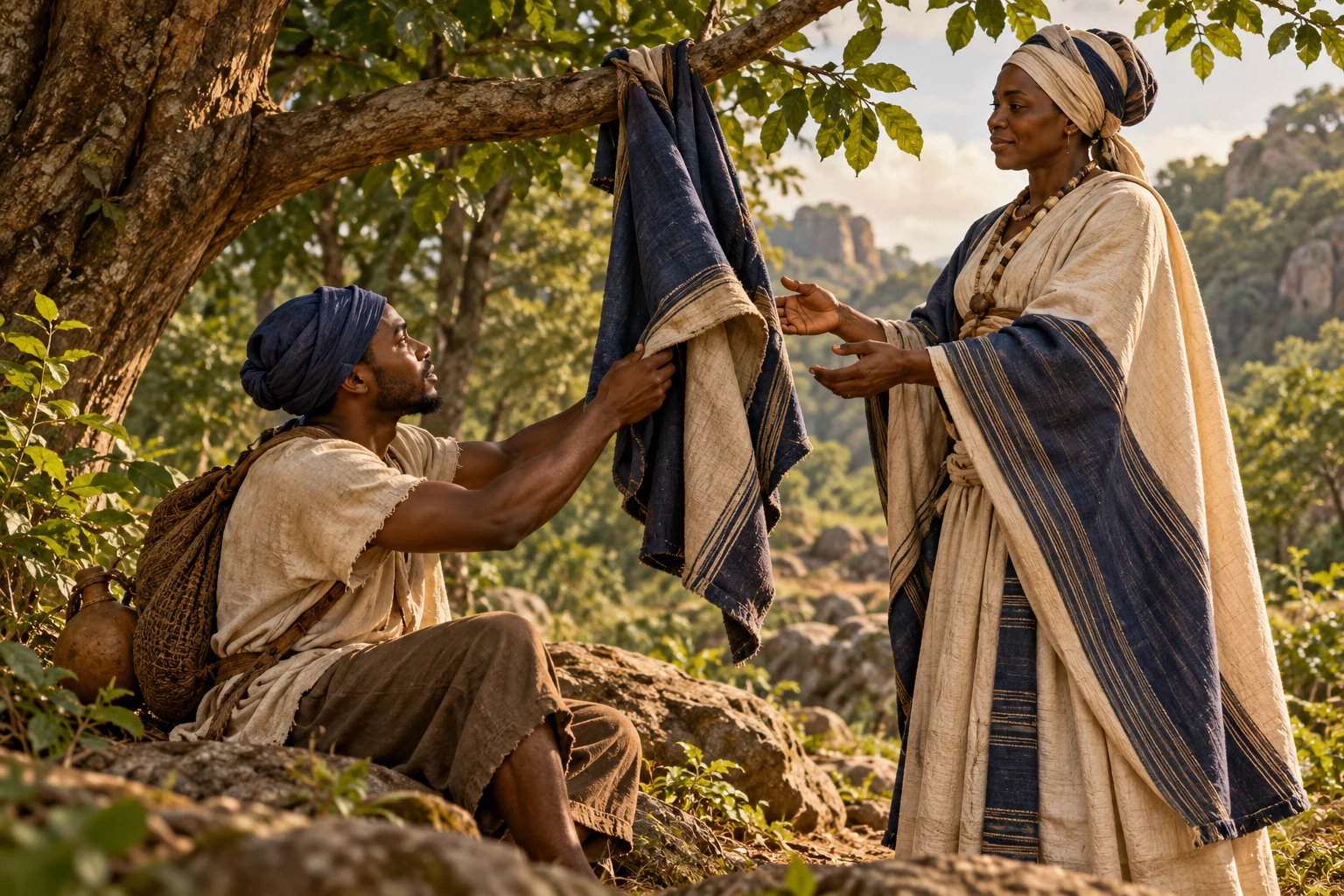
A man in hardship consults Òrúnmìlà and goes to the forest. A prince hunting nearby loses a ceremonial cloak when it catches in a tree during pursuit of a deer. The seated man notices it and takes it back to town. Hearing that a reward is offered, he returns the cloak promptly and receives compensation that alters his material situation.
The object’s value is realized through rightful return rather than secret appropriation. The story’s chance encounter still requires attention and a decision about what to do with what was found. We can consider how an unexpected opportunity tests conduct, while avoiding a promise that honesty will always produce a reward or that poverty is resolved through a single lucky discovery.
Narrative setting: Spanish Cuban-style account.
The unnamed child on the carrier’s shoulders
Agayú requires names, origins, and tribute before ferrying travelers. A poor boy who wants to see his mother has neither a name nor payment. Refused the ferry, he asks to be carried on Agayú’s shoulders, a service for which no fee has been established. Agayú agrees. During the crossing the child grows unbearably heavy, reveals himself as Odùduwà, and grants the carrier authority over the river.
The request exposes how rigid terms can exclude someone whose need is intelligible. Yet the child’s escalating weight also makes the service difficult rather than sentimental. A useful reading asks how compassion and the real burden of labor can be considered together. The reward remains a sacred explanation of authority, not a claim that unpaid service is always obligatory or ultimately profitable.
Narrative setting: Account explicitly labeled Cuba.
The people ask to leave earth before the world’s good condition is achieved
Òrúnmìlà prepares through consultation for questions people will bring. A mixed gathering, including wrongdoers, asks to escape earthly hardship and take refuge in heaven. He replies that they must first attain the good condition assigned to human life. Asked what that means, he describes a world of knowledge, joy, security, and freedom from destructive fears. Wisdom, good character, care for people in need, and increasing the world’s prosperity belong to that work. Theft remains accountable before divine powers. The account also describes repeated movement between earth and heaven until the good condition is attained and heavenly benefits become available on earth.
The answer redirects an escape from earth toward responsibility for the world’s condition. Heaven is not denied, but its relation to earthly life is more demanding than a refuge from unfinished obligations. The account gives conduct a religious horizon: harm is answerable before Odùduwà and benevolent heavenly powers, and human return continues within a larger movement toward a good world. Contemporary interpretation can discuss collective responsibility, but should not reduce this cosmology to a modern development program. Nor should the described freedom from fear become a promise that good character prevents every illness or accident.
Read beside the Iwoye practitioner’s renewal, the new witness places a local return within a much wider question about what return is for. One person resumes an effective practice through inherited relations; humanity is called toward a condition that cannot be achieved by an isolated individual’s comfort alone. Their different scales preserve both the spiritual order and the work of actual conduct.
Narrative witness and setting: Epega Afolabi, explicitly introduced account of Òrúnmìlà answering humanity
A practitioner renews his practice at the inherited home
A practitioner associated with Iwoye spends his active life in Ifé, where his work begins to decline. He consults another Awó rather than treating his earlier skill as sufficient explanation. Counsel directs him back to Iwoye and toward a gathering of available practitioners there. They prepare a religious renewal involving his ikín and his own embodied participation. He follows the response and returns to Ifé, where his work becomes fruitful again. Later he invites his diviner to a thanksgiving feast and praises both the counsel and the Iwoye practitioners whose contribution made the renewal possible.
The return is not simply a permanent retreat from the place where he works. He goes to an inherited or originating relation, receives renewal, and returns to the active setting in Ifé. Within the source, ikín and the gathered Awó are spiritually consequential, so the journey should not be reduced to revisiting childhood memories or refreshing a business strategy. Its religious movement also differs from the people’s request to leave earth: the practitioner returns to Iwoye in order to resume work, while humanity is told that earthly responsibility remains unfinished.
Agayú’s crossing adds another relation between carrying and recognition, and the cloak account connects an unexpected object with a legitimate return. Across them, a route has meaning through the relation it establishes rather than through departure alone. The thanksgiving preserves multiple contributors, resisting an account in which the restored practitioner produces all later success through intrinsic talent. Renewal remains a received relation whose effects continue beyond the gathering itself.
Narrative witness and setting: Account under a heading rendered Ecromwell Osamaro
What was born in this Odù
“Born” can name an explicit traditional origin association or what emerges through a story: a capacity, relationship, practice or order of life. Interpretations drawn from a narrative are labelled below, so their basis remains clear.
Carriers and stevedores
Selected traditional source association.
The explicit origin list names people who carry and load goods. The selected narratives develop weight, passage, and movement, but the association should not become a claim that every person connected to the sign must take up those occupations.
Passage beyond the price
Contemporary interpretation from the selected myth.
As a contemporary interpretation, the child’s crossing suggests the emergence of accessible service when customary terms exclude a person. The motif does not require unpaid labor universally and is not claimed as a traditional born-list item.
Correlations to life dimensions
These questions bring the selected stories into contemporary life. They are interpretive invitations for study.
Work and resources
Agayú’s task involves real exertion, while his payment rules create an exclusion. The account can support examining fair compensation and accessible service together, without assuming that one must erase the other or that workers should absorb every unmet need.
Reflect: How can a service remain fair to both worker and traveler?
Relationships and family
The boy’s desire to reach his mother supplies the human stakes of passage before the divine revelation occurs. His need is already understandable while he appears unnamed and poor, without later prestige making him deserving retrospectively.
Reflect: Would you recognize the same need without a prestigious identity?
Character and inner life
The finder returns the cloak after learning whose it is. The account places conduct at the moment when an unplanned possession could be treated as personal luck, giving a concrete question about entitlement and stewardship.
Reflect: What found advantage still belongs to someone else?
Community and responsibility
A river crossing is a shared necessity controlled by one service provider. The narrative invites attention to the power created by a bottleneck, including who is excluded by requirements that seem neutral to those who can easily satisfy them.
Reflect: Which requirement makes passage impossible for the least resourced?
A deeper reading of the sacred relationships
Return participates in a religious order larger than memory
Epega’s people move between earth and heaven until the good condition is attained, while the Iwoye practitioner returns to an originating community before resuming work elsewhere. These are distinct religious movements. The first locates human conduct within a cosmological purpose involving Odùduwà and heavenly powers; the second renews a concrete relation with ikín and gathered Awó. Neither is adequately explained as nostalgia or a change of attitude. Contemporary interpretation can ask what a return makes possible, but should preserve the different scales and actual sacred relations. An article cannot infer a reader’s previous lives or prescribe a journey merely because these witnesses give return a consequential place.
The good condition includes others rather than only personal relief
The people ask to stop suffering, and Òrúnmìlà answers through the condition of the world. Wisdom must be capable of governing well, assistance must reach those in need, and the desire to increase prosperity must exceed the desire to destroy. The Iwoye thanksgiving similarly remembers a diviner and a community of practitioners rather than crediting the beneficiary alone. Contemporary comparison can ask whether relief has been defined so narrowly that its supporting relations disappear. The account’s expansive ideal should not be used to shame someone for needing rest or immediate help. Its theological horizon concerns humanity’s unfinished work, not a demand that one exhausted individual repair the whole world.
Knowledge requires acknowledgment of what is not yet understood
The gathering asks what the good condition means and admits a need for knowledge. The experienced practitioner also consults when his work declines instead of treating previous competence as sufficient. Agayú’s hidden passenger and the cloak finder’s unexpected object add other encounters in which an initial view does not exhaust what is present. These stories differ, but each makes understanding relational rather than a permanent possession. Contemporary interpretation can examine how a question becomes possible without assuming that ignorance makes a person worthless. Within the witnesses, divination and divine identity remain real sources of disclosure. Their contribution should not disappear into a generalized celebration of curiosity detached from responsibility.
Questions that deepen the study
Does the account tell suffering people that they do not deserve relief?
The gathering’s desire for refuge initiates an explanation of humanity’s larger work; it does not establish that every individual must remain in an intolerable situation. Òrúnmìlà describes a good world that includes security, joy, and freedom from destructive fear, so relief is part of the aim. The distinction is between a private departure and a shared condition still to be attained. Contemporary interpretation should not use that horizon to dismiss immediate needs or blame people for illness. The account’s repeated earthly return is a religious claim within this witness, not evidence that a reader personally chose or deserved present suffering.
Why does the experienced practitioner need the Awó of Iwoye?
The account locates renewed efficacy in a relation with an originating community and sacred instruments, rather than in talent alone. His diviner directs the return, other practitioners participate, and the final thanksgiving acknowledges them. Experience is therefore not an exemption from receiving religious assistance. Epega’s gathering adds a larger parallel by admitting the need for knowledge before the good condition can be explained. Contemporary reflection can ask whose help remains necessary even after a person becomes competent. The actual renewal, however, belongs to the witness’s religious practice; an article cannot reproduce it as a general procedure for readers whose work has become difficult.
Is the good condition only an individual’s successful life?
The described condition includes how the world is governed, how harm is answered, and whether those in need receive help. Its scale exceeds one person’s money or comfort. The account also connects that condition with divine powers and repeated earthly return, so it is more than a secular social ideal. Contemporary interpretation can discuss responsibility for shared conditions while distinguishing that discussion from the witness’s cosmology. The Iwoye practitioner’s restored work remains a smaller but meaningful outcome sustained by others. Comparing the two prevents personal success from being mistaken for completion of humanity’s task or collective responsibility from erasing particular people’s needs.
What the four narratives reveal together
The additional Ìrosùn Ìwòrì witnesses connect renewed capacity with the purpose of return. Osamaro’s practitioner goes to Iwoye, receives help through ikín and gathered Awó, and resumes work in Ifé. Epega’s humanity asks to leave earth but is directed toward a good condition of the world that includes wisdom, character, security, and care for those in need. The earlier cloak and Agayú accounts add different encounters in which recognition changes what a journey means.
These stories should not be flattened into one lesson about personal growth. Their religious scales differ, from a concrete renewal to divine accountability and repeated earthly return. Contemporary interpretation can ask what a received capacity is for and whose contribution sustains it. It should preserve immediate human needs, avoid diagnosing suffering as deserved, and distinguish a shared theological horizon from any one individual’s obligation to repair the world alone.
Living with this Odù
A continuing life or initiatory relationship
A received relationship with Ìròsùn Ìwòrì can sustain reflection on passage as a responsibility toward what one carries. The man returning the ceremonial cloak does not confuse finding an object with becoming entitled to it. Agayú’s agreement with the unnamed child begins where his established categories of identity and payment do not fit. The crossing then exceeds the carrier’s expectation and discloses Odùduwà’s particular agency. These are different relations to value, rather than one general promise of reward for generosity.
Epega Afolabi’s account of humanity’s question adds a collective timescale: departure from hardship is set beside work toward the world’s good condition. The Iwoye practitioner introduces renewal through an inherited place and other practitioners, followed by return to active work elsewhere. Across a life, reflection may concern honesty with an entrusted thing, the limits of a familiar service arrangement, responsibility toward earthly life, or the need to refresh an established competence. The sign does not condemn migration or make every overwhelming burden a hidden divinity. It invites character that can receive help, acknowledge contributors, and distinguish carrying another person from controlling the whole meaning of the passage.
A particular consultation and its question
In consultation, Ìròsùn Ìwòrì can distinguish a passage requiring integrity from one requiring reconsideration of the terms. The cloak’s finder knows that the object has an owner; his action concerns a clear relation. Agayú’s carrier agreement instead begins outside the established ferry fee and becomes unexpectedly heavy. A present resemblance cannot identify a vulnerable traveler as Odùduwà or guarantee that an onerous task will yield authority.
The humanity witness asks whether escape is being imagined as the whole answer to hardship while responsibilities toward a better earthly condition remain. Its religious cosmology is larger than a modern injunction to work harder. The practitioner returning to Iwoye adds another possibility: renewal may require movement toward inherited relations before fruitful work elsewhere can continue. These are not universal instructions either to stay or leave. A careful interpretation can ask what is being carried, who else contributes, and whether earlier competence has been treated as permanently sufficient. The actual divinatory context determines relevance. It does not announce an unknown client’s spiritual identity, judge their reason for migration, or convert this consultation into a lifelong assignment to bear every burden presented to them.
Constructive and adverse possibilities
Constructive unfolding may include an honestly returned object, a passage undertaken with attention to its actual relation, and renewed competence supported by acknowledged practitioners. The return to Iwoye does not erase the person’s working life in Ifé; it changes the relation that sustains it.
Adverse unfolding can involve confusing possession with ownership, assuming that a familiar fee system contains every human need, or treating departure as exemption from responsibility for earthly conditions. A specialist may also become isolated by believing that earlier accomplishment removes the need for renewal. These directions remain distinct from the sacred events themselves: Odùduwà’s crossing and the humanity account’s movement between worlds have particular religious scope. No result here proves that burdens must always be accepted, rewards will follow honesty, or a real consultation occupies a given state. The question is what the specific passage asks and permits.
An illustrative situation in everyday life
In a hypothetical example, an experienced teacher relocates to a new city and finds that familiar methods are no longer effective. She considers abandoning the work entirely, feeling that returning to earlier mentors would prove failure. The Iwoye account distinguishes renewal from retreat, while the humanity witness asks what a desired departure would leave unresolved in the present world. A colleague’s temporary assistance also raises the cloak-like question of what has been entrusted rather than given outright. She might seek specific renewal, acknowledge the contribution, and return to her work with clearer limits. The example is not a promise of professional restoration. It illustrates how movement toward a sustaining relation can support further participation instead of canceling an earlier journey.
Sources and reading context
The first two narrative witnesses
The cloak account is Spanish Cuban-style and the Agayú account is explicitly labeled Cuba. The latter’s opening has unusual and potentially confused character identifications, so only the clear crossing episode is selected. One explicit born association gives partial origin coverage.
Narrative motifs are summarized independently. The life-dimension reflections are contemporary interpretation. How these reference studies are built explains the wider source approach and the distinction between a reference article and personal divination.
Additional named witnesses
-
Epega Afolabi. Explicit heading introduces the gathering that asks Òrúnmìlà to leave earth and receives an account of the good condition.
-
Ecromwell Osamaro. Heading is spelled this way in the section; only the unambiguous Iwoye renewal is selected from it.
-
Cuban narrative sequence. Earlier cloak and Agayú encounters remain separately situated; the latter is marked Cuba.
The Akogun episode was excluded because its consultation literally names Ìrosùn-Òyèkú despite placement here. Epega’s good-condition account is unambiguous within this section. Repeated earthly return is presented as this witness’s theology, not a diagnosis of a reader’s prior lives or suffering. No renewal procedure is supplied.
Bibliographic identification
-
C. Osamaro Ibie. Ifism: The Complete Work of Orunmila. Lagos; multivolume publication beginning 1986. Library catalogue record. Related bibliographic record for the named narrative witness. Exact volume, edition and page of the transmitted account have not been independently matched.
-
Afolabi A. Epega and Philip John Neimark. The Sacred Ifa Oracle. San Francisco: HarperSanFrancisco, 1995. Library catalogue record. First-edition bibliographic record. The particular edition underlying the narrative witness has not been established.
Read the source method and wider scholarly context.
The catalogue links identify published works and their authors. They are separate from proof of an individual episode’s wording or attribution. Contemporary comparisons and the synthesis above are editorial interpretation. The author’s books and Academy companions below provide further study; their sales links are separate from the source references.