
Ìròsùn Òdí is a mixed Odù in Ifá’s 256-part corpus. Ìrosùn Òdí’s selected stories juxtapose an impoverished couple’s disagreement with an attack concealed inside ordinary domestic space. The wife’s repeated counsel leads her husband to consult, and her later care of a royal child transforms the household’s position. In the second account, Òrúnmìlà survives hidden attackers through actions centered on his mat and food preparation. The source connects love and herb gathering with this sign, giving care and practical perception a common setting.
A question to carry through the study: Whose repeated practical counsel have you dismissed because you are frustrated?
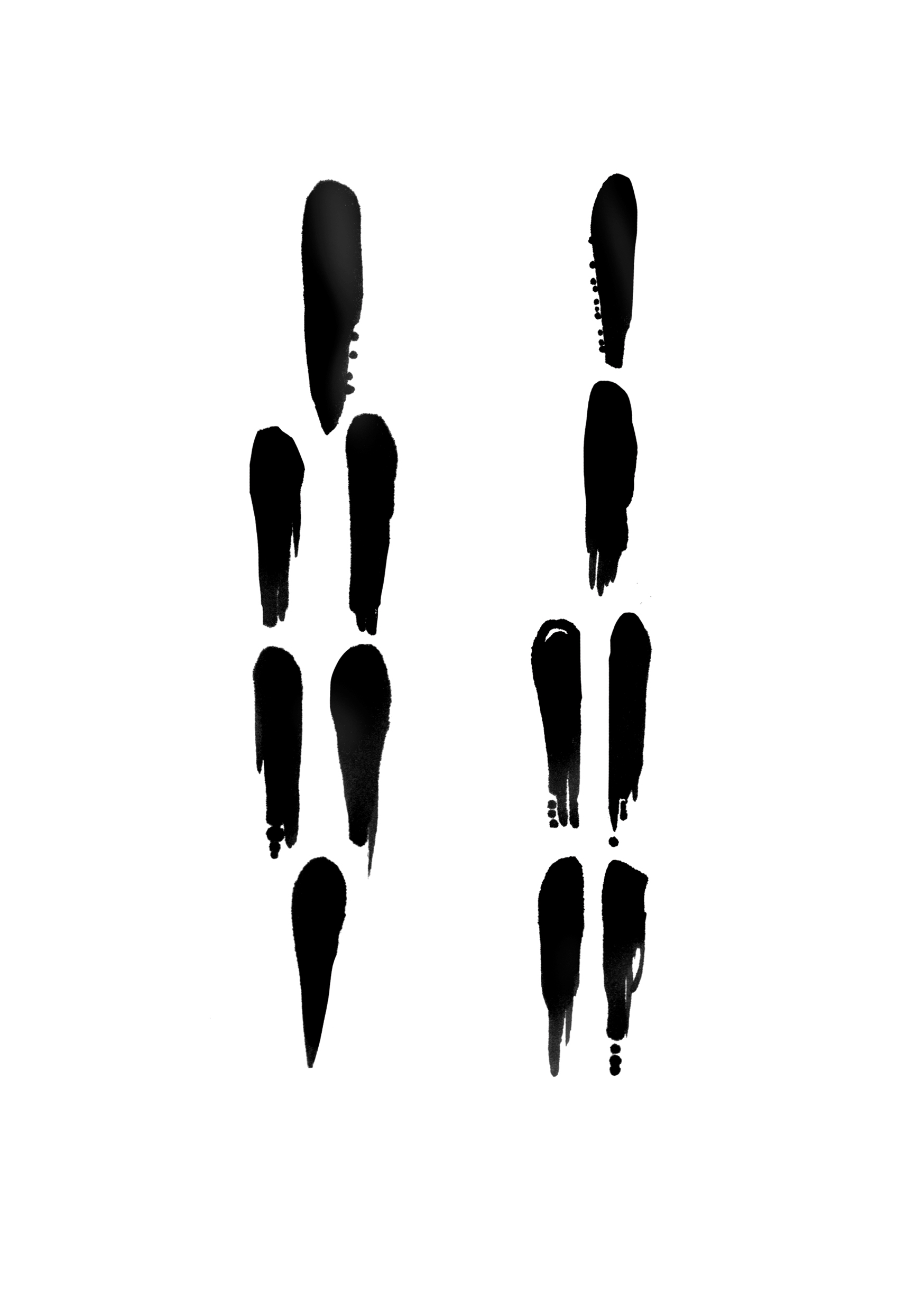
This Academy reads the right column first, then the left. Each row carries a single or double mark.

Where this Odù belongs
Ìròsùn Òdí belongs to the Ìròsùn family in this Academy’s study sequence. It is a mixed Odù, distinct from Òdí Ìròsùn. The order matters. Its teaching is approached through its own narratives, rather than by adding two general descriptions of the principal signs together.
Key Òrìṣà and sacred relationships
The figures below are selected for their roles in the accounts discussed here. They offer connected reading paths through the tradition.
-
Ọ̀rúnmìlà. Òrúnmìlà receives the poor husband’s consultation and is the targeted householder in the second account. These roles join counsel with attention to danger inside familiar surroundings.
-
Èṣù. Eleguá receives attention in the first version of the concealed-attack account. His association is reported within that particular response, without turning the story into protective instructions.
-
Òṣun. Òṣun is named in the same version of Òrúnmìlà’s response to the hidden attackers. Her association is local to this passage and not expanded into an invented appearance or dialogue.
Key myths and their meanings
The wife whose counsel was heard late
A poor couple survives partly on gathered edible plants. The husband resents his circumstances and rejects his wife’s repeated suggestion to consult Òrúnmìlà because they lack money. He eventually listens. When his wife and a princess give birth on the same day and the princess dies, the ruler arranges for the poor wife to raise his grandchild. Her care brings housing and support to the household.
The husband’s advancement depends on work performed by his wife, whose judgment he initially discounts. The story’s upward turn should not obscure bereavement or make another family’s death into a simple success device. Its concern is how emotional frustration blocks useful counsel, and how histories of prosperity often credit a public office while overlooking the care that made it possible.
Narrative setting: Spanish Cuban-style household account.
Danger beneath the familiar mat
Enemies recruit a serpent and another creature to kill Òrúnmìlà. The serpent hides beneath his mat while the other watches for an opportunity to enter. Òrúnmìlà consults and continues preparing food in a way that defeats the hidden serpent. A further obstacle at the entrance defeats the second attacker. The narrative presents the house’s ordinary working space as a site where concealed intention becomes visible through consequence.
The selected version combines household routine with religious protection, but should not become a procedure for harming suspected enemies. Its useful tension concerns the difference between familiar appearance and actual safety. Domestic competence is not passive scenery: food preparation and attention to entry are part of the account’s agency. Variant versions identify the second creature differently, so its name is deliberately left open.
Narrative setting: Spanish Cuban-style animal account.
The promised meal leaves cat carrying mouse’s danger
Cat, mouse, and fish receive different consultations. Cat and mouse do not complete all that is advised, while fish follows its response and becomes difficult to seize in water. Mouse promises cat a substantial meal if it catches fish. Cat attempts the task despite not being able to swim, fails to hold the slippery fish, and struggles back exhausted after swallowing water. It then demands the promised compensation. Mouse replies that no fish means no payment. Cat attacks mouse, whose offspring escape. The account explains a continuing predatory relationship through an agreement that shifted risk without establishing a mutually accepted outcome.
The promise draws cat into another being’s problem by making a desirable reward more vivid than the task’s actual conditions. Fish’s protection is also religiously specific: its relation with Ifá changes what its body can do in the water. That agency should not disappear into a purely commercial reading of a failed contract. Cat’s divided response to consultation likewise matters because the source distinguishes attention to the head and guardian from attention to Èṣù, rather than treating any religious act as a substitute for every other.
Compared with the earlier poor wife’s counsel, mouse’s proposal is advice serving its own appetite rather than the household’s continuation. The hidden attackers under Òrúnmìlà’s mat supply a further difference, since their aim is harm from the outset. Contemporary analysis can ask who bears risk when help is requested, but the violent ending must not become a model for enforcing a disputed promise. The story leaves the agreement itself inadequately shared before retaliation destroys it.
Narrative witness and setting: Account explicitly headed Revelações de Cromwell Osamaro
Jika-Jiku loses the vessel that connects his work to heaven
Jika-Jiku restores the dead through a remedy received from heavenly companions and becomes wealthy because people continually seek him. Akala enters an intimate relationship with him in order to discover the secret. By accompanying his work, she learns where its power is kept. While he is away at the farm, she takes his instruments and leaves. Called to another death, he reaches into his bag and finds the necessary vessel missing. He cannot locate Akala because he never learned where she came from. The account concludes that his earthly work is finished, and he dies before the next morning.
The capacity is not simply private cleverness: it derives from heavenly companions and remains materially located in a vessel and instruments. Losing that connection changes what the practitioner can do, even though his public reputation and wealth remain. This religious mechanism gives the narrative more specificity than a general warning about trusting a partner. The witness makes Akala an intentional deceiver, but does not justify treating women or intimate knowledge as inherently dangerous. The earlier poor wife’s persistent, useful counsel is an important counterexample within the same sign.
The hidden-attack story also shows that a household can contain risks unrelated to romance. A contemporary comparison can ask how knowledge, provenance, and responsibility are maintained, while the source’s resurrection remains a spiritual reality inside its own account rather than a medical claim. The ending is severe and underexplained: the loss of instruments becomes the completion of an earthly vocation, not merely the loss of income. That distinction should be retained without inventing a further judgment or cause of death.
Narrative witness and setting: Account explicitly headed Revelações de Cromwell Osamaro
What was born in this Odù
“Born” can name an explicit traditional origin association or what emerges through a story: a capacity, relationship, practice or order of life. Interpretations drawn from a narrative are labelled below, so their basis remains clear.
Love
Selected traditional source association.
Love appears explicitly in the origin list. The couple’s story gives a concrete setting of patient counsel and sustaining care, without defining love as unlimited endurance or requiring agreement with every partner’s advice.
Herb gathering
Selected traditional source association.
The origin list names the herb gatherer. In the couple’s story, gathered plants also belong to survival labor, allowing a distinction between practical gathering and unsupported medicinal or ritual claims.
Correlations to life dimensions
These questions bring the selected stories into contemporary life. They are interpretive invitations for study.
Work and resources
The wife’s care of the royal grandchild is the mechanism of the family’s changed position. A precise reading credits the labor rather than only the husband’s military title, and notices how care work can reorganize access to resources.
Reflect: Whose care work is missing from the story of your advancement?
Relationships and family
The husband’s frustration makes him reject his wife’s counsel before considering it. Her persistence is important in this account, but should not become a requirement that partners absorb anger until someone agrees to listen. Her practical judgment deserves hearing before the crisis.
Reflect: How can frustration be expressed without dismissing a partner?
Character and inner life
Òrúnmìlà’s household account makes a familiar mat conceal something dangerous. The interpretive question is careful attention rather than generalized suspicion: what evidence actually changes an assessment of a place or relationship that has felt ordinary?
Reflect: What concrete evidence would justify revising your sense of safety?
Community and responsibility
The ruler’s response supplies housing and support for raising a bereaved child. The story makes care a collective arrangement rather than a private sacrifice undertaken without resources, an aspect worth retaining when discussing responsibility for dependent children.
Reflect: What support must accompany a request for someone’s care?
A deeper reading of the sacred relationships
Efficacy belongs to a relation, not reputation alone
Fish’s bodily protection follows a particular religious response; Jika-Jiku’s extraordinary work depends on a heavenly gift remaining available through its material vessel. The earlier Òrúnmìlà household also acts through divination rather than ordinary watchfulness alone, while the poor couple’s change follows counsel the husband initially rejects. These witnesses therefore do not treat reputation, confidence, or economic success as sufficient spiritual resources. Each capacity has a specific relation through which it operates. A source-conscious study can explain those relations without reproducing preparations or turning them into guaranteed methods. Contemporary reflection on stewardship can follow, but should not replace the source’s actual account of divine or heavenly agency and the responsibilities attached to receiving it.
Intimacy can transmit counsel or conceal an intention
The poor wife repeatedly directs her husband toward help; Akala gains access to Jika-Jiku in order to remove his instruments; mouse makes a reward attractive enough to recruit cat. These are different uses of proximity and speech. Their comparison prevents the Akala episode from supporting a universal suspicion of partners. It also prevents the helpful wife from becoming proof that every close person’s advice should be accepted. What the narrative actually establishes about intention, knowledge, and the other party’s need matters. The hidden attackers add another relation altogether, with deception embedded beneath ordinary domestic routine. Contemporary interpretation can ask how trust remains answerable to conduct without claiming that an article can identify anyone’s concealed spiritual motives.
Material custody can outlast an apparent success
Jika-Jiku’s wealthy practice does not remove the need for the vessel through which it works. Fish’s water is likewise not a generic setting but the environment where its changed body can evade capture. Cat’s return exposes another material condition: a promised reward cannot make swimming competence appear. The poor wife’s later care work brings housing and resources, reminding the reader that a prosperous title depends on activities easily left outside the final account. These details support a contemporary distinction between recognition and the conditions sustaining it. They also keep the sacred stories concrete, since instruments, bodies, water, and care remain part of how the religious relations become active rather than ornamental scenery around an abstract moral.
Questions that deepen the study
Does Akala’s deception cancel the value of sharing knowledge?
The episode describes a particular intention to steal an effective vessel, not a universal result of teaching or intimacy. The earlier wife’s counsel shows a close relationship improving access to religious help, while fish’s protection is given through a practitioner’s knowledge. A careful account can therefore distinguish transmission, stewardship, and appropriation. Jika-Jiku’s failure to know Akala’s origin becomes consequential when he needs to find her, but should not become an instruction to distrust every partner. Within the narrative, the heavenly gift’s material custody is central. Contemporary reflection can ask what responsibilities accompany access without making secrecy the only possible form of protection.
Why is cat’s refusal to accept failure not the same as justice?
Cat has genuinely risked itself, but the promised terms are not understood in the same way by mouse. One expects compensation for the attempt and danger; the other makes payment depend on bringing fish. The source’s religious account also places both inside neglected counsel, while fish’s completed response changes the encounter. Killing mouse resolves none of the disagreement proportionately. Contemporary analysis can name the unfair transfer of risk without endorsing violent collection. The story’s continuing animal relationship is a sacred fable outcome, not a rule that an unsuccessful helper may seize whatever recompense seems adequate or punish a client without agreed terms.
What connects the resurrection vessel to the hidden mat?
Both make a household’s visible familiarity insufficient to explain what is happening. A mat can conceal attackers, and a practiced bag can lack the vessel its owner assumes remains inside. Their religious mechanisms differ: one encounter is disclosed through divination and defeated in domestic action, while the other concerns a heavenly gift removed through deception. The comparison can support careful attention to conditions of a practice without reducing the tales to security advice. The poor wife supplies a necessary contrast, showing the household as a source of counsel and care as well as risk. Familiar space is neither inherently safe nor inherently hostile in these witnesses.
What the four narratives reveal together
The added narratives deepen Ìrosùn Òdí through the conditions that make help effective or dangerous. Cat accepts a promised reward without securing a shared understanding of risk; fish’s sacred response changes the body the plan assumes it can seize. Jika-Jiku’s reputation cannot replace the material relation through which a heavenly gift operates. The earlier useful wife and hidden attackers keep those concerns from becoming one-sided suspicion of intimacy or household life.
Across the four accounts, counsel may preserve a life, a promise may recruit another’s vulnerability, instruments may carry a vocation, and familiar space may conceal an intention. The religious world remains primary: divination, Èṣù, guardian relations, and heavenly companions are effective within the narratives. Contemporary questions about trust and custody can develop beside them, while the severe endings and uncertain details remain limits rather than invitations to invent a universal doctrine.
Living with this Odù
A continuing life or initiatory relationship
For someone whose received life or initiatory history includes Ìròsùn Òdí, listening and protection require discrimination about the relation involved. The poor husband initially dismisses counsel carried by his wife; later support enters through her real caregiving capacity. The hidden attackers give a different picture of proximity, where an ordinary household surface conceals danger. Neither marriage nor familiarity can therefore settle whether openness is appropriate in every setting.
Cat’s failed attempt to earn a promised meal adds risk shifted through an agreement whose outcome the parties understand differently. Jika-Jiku’s loss brings intimate access into relation with a vessel connecting his work to heavenly companions. The account does not justify treating women or partners as inherently deceptive. It makes a particular neglected knowledge of the other consequential. Across a life, reflection may involve hearing a partner before dismissing a path, checking the terms of a risky undertaking, or understanding the access one has granted. The person is not fixed as suspicious or gullible. The sign invites a continuing capacity to distinguish trustworthy counsel, concealed hostility, and an incomplete agreement while retaining the actual religious agency through which each witness understands protection and loss.
A particular consultation and its question
In consultation, Ìròsùn Òdí can help distinguish an unheard partner from an unsafe proximity. The wife’s counsel is constructive within one household, while the mat conceals an actual narrated attacker in another. The client’s present relationship cannot be classified from resemblance alone. A careful discussion asks what has been said, what access exists, and which evidence supports concern rather than assuming either universal trust or universal danger.
Cat and mouse introduce an agreement whose language shifts risk toward the less capable party. The question may be whether the task, payment, and consequence of failure were genuinely shared. Jika-Jiku’s account adds a more specific loss: his vessel connects his practice to heavenly companions, so it is not merely a misplaced tool or a warning about romantic choice. That sacred relation remains within its witness. The actual consultation may concern listening, terms of service, domestic exposure, or entrusted knowledge. It does not announce an intimate betrayal, explain a death through spiritual theft, or prescribe a protective procedure. A present result opens questions about this configuration; it cannot make the client’s received sign a permanent identity of suspicion, poverty, or failed protection.
Constructive and adverse possibilities
Constructive unfolding can include a partner’s knowledge heard before desperation, a household protected in relation to its actual exposures, and an agreement whose risks and outcomes are intelligible to both parties. The poor wife’s caregiving is a substantive capacity, not an incidental reward for her husband’s eventual compliance.
Adverse unfolding may involve resentment making useful counsel inaudible, proximity mistaken for safety, or promised compensation withdrawn after another has carried the danger. Cat’s violence remains a destructive outcome, not proof that its grievance authorizes predation. Jika-Jiku’s heavenly relation also resists reduction to a generic security lesson. These contrasts describe possible developments of trust and exposure without assigning hidden motives to a real partner. They do not make an illness evidence of attack, guarantee support through caregiving, or determine an actual consultation’s constructive or adverse condition.
An illustrative situation in everyday life
Imagine a hypothetical freelancer promised a substantial payment for a task outside her experience. The client calls it easy but later insists that unsuccessful completion means no compensation, although considerable costs were incurred. Her partner had suggested clarifying those terms, and she dismissed the advice because accepting it felt like admitting weakness. Cat’s promised meal and the unheard wife distinguish the external risk arrangement from her inward resistance to counsel. Reviewing the agreement and acknowledging the partner’s contribution address different parts of the problem. The illustration does not justify retaliation or imply that every client conceals an attack. It uses the sign’s distinctive structures to ask when trust requires clearer terms and when pride has made relevant knowledge difficult to receive.
Sources and reading context
The first two narrative witnesses
These selections are Spanish Cuban-style narratives. Several versions of the attack vary the second animal; the ambiguity is retained. The diagnostic origin item concerning dwarfism is excluded, and the two retained associations are not made universal.
Narrative motifs are summarized independently. The life-dimension reflections are contemporary interpretation. How these reference studies are built explains the wider source approach and the distinction between a reference article and personal divination.
Additional named witnesses
-
Cromwell Osamaro. The explicit heading covers the cat/mouse/fish agreement and Jika-Jiku’s heavenly remedy.
-
Spanish Cuban-style narrative sequence. The earlier household counsel and concealed attack accounts are separate selections.
Pronouns and species terms vary in translation. Jika-Jiku’s resurrection gift is religious narration, not clinical evidence. The Akala episode is not generalized to women, and no preparation, personal taboo, or accusation about a reader’s household is supplied.
Bibliographic identification
- C. Osamaro Ibie. Ifism: The Complete Work of Orunmila. Lagos; multivolume publication beginning 1986. Library catalogue record. Related bibliographic record for the named narrative witness. Exact volume, edition and page of the transmitted account have not been independently matched.
Read the source method and wider scholarly context.
The catalogue links identify published works and their authors. They are separate from proof of an individual episode’s wording or attribution. Contemporary comparisons and the synthesis above are editorial interpretation. The author’s books and Academy companions below provide further study; their sales links are separate from the source references.