
Òdí Ìròsùn is a mixed Odù in Ifá’s 256-part corpus. The selected Òdí Ìrosùn narratives explore damaged companionship through two different endings. Excluded Èṣù Alawana becomes a source of disorder until his relationship with Azojuano is recognized and given a place. In an animal friendship, repeated ridicule ends in predation rather than reconciliation. The source’s images of breathing and cerebral division accompany a broader concern with what remains active beyond another person’s immediate attention.
A question to carry through the study: Which excluded relationship needs recognition before resentment becomes destructive?
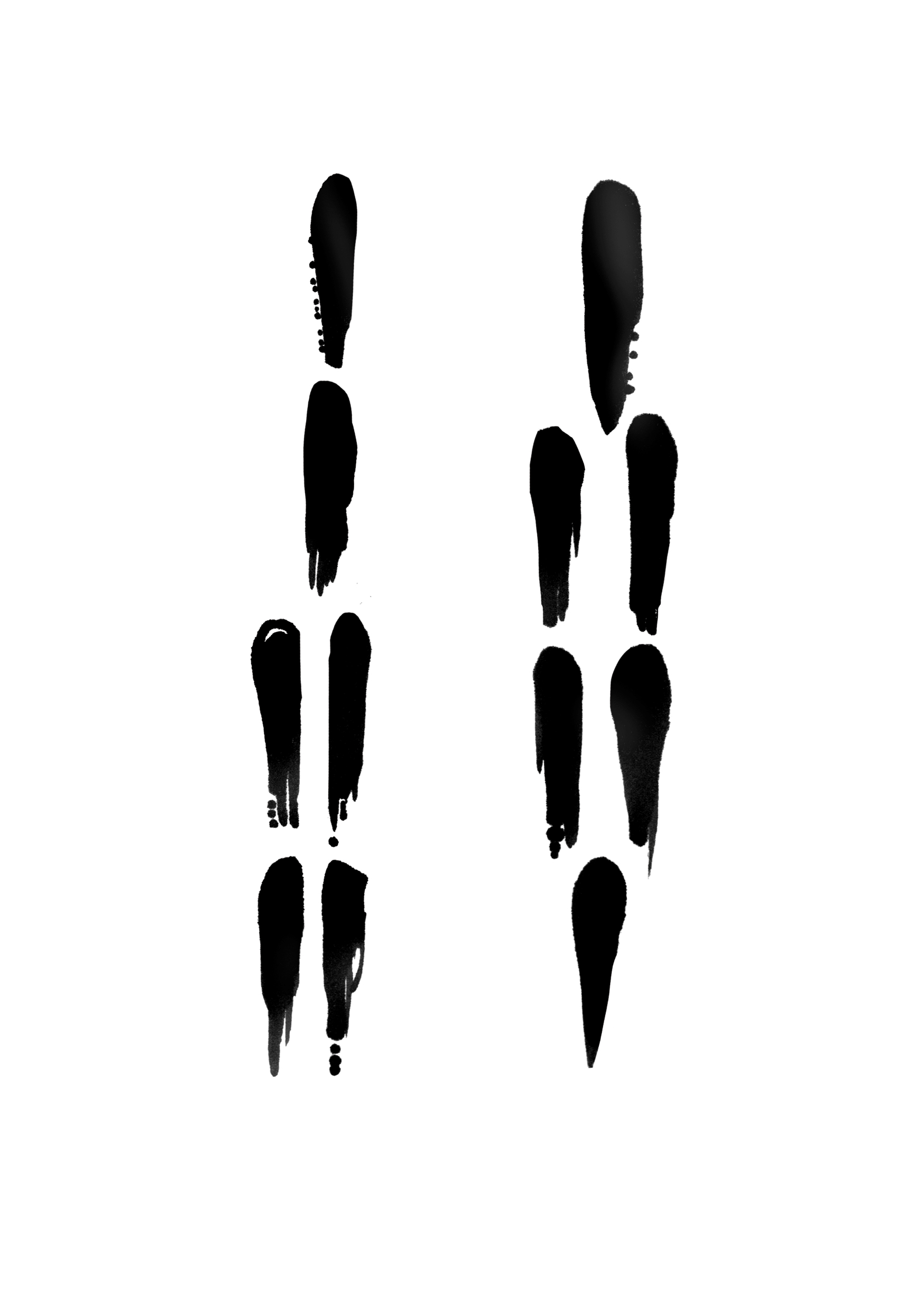
This Academy reads the right column first, then the left. Each row carries a single or double mark.
Where this Odù belongs
Òdí Ìròsùn belongs to the Òdí family in this Academy’s study sequence. It is a mixed Odù, distinct from Ìròsùn Òdí. The order matters. Its teaching is approached through its own narratives, rather than by adding two general descriptions of the principal signs together.
Key Òrìṣà and sacred relationships
The figures below are selected for their roles in the accounts discussed here. They offer connected reading paths through the tradition.
-
Èṣù. As Alawana, Èṣù seeks his former companion and disrupts a household that excludes him; the settlement gives him an acknowledged protective place at its threshold.
-
Asojano. Azojuano has neglected his earlier helper after forming a household with Òṣun. His recognition of continuing obligation is essential to the story’s settlement.
-
Òṣun. Òṣun shares Azojuano’s household and initially rejects Alawana’s presence. She also initiates the consultation that makes their previously unrecognized conflict intelligible.
-
Ọ̀rúnmìlà. Òrúnmìlà interprets the disorder as a neglected relationship and directs its acknowledgment; in the animal story he receives the mocked cat’s complaint.
Key myths and their meanings
A place at the threshold
Azojuano forms a household with Òṣun, while Alawana, his former helper, is left outside their life. Prevented from visiting openly, Alawana enters unseen and creates household disorder. Consultation reveals the neglected connection. Azojuano acknowledges that their relationship must continue and establishes a place for Alawana near the entrance, where the disruptive visitor becomes a guardian.
The resolution changes membership and responsibility rather than merely removing an irritant. It also leaves an asymmetry: the helper is accepted, but at a bounded location shaped by the household’s discomfort. This supports examination of conditional inclusion and the unacknowledged labor that sustains a household. The account’s descriptions of illness and invisible attack remain religious narrative, not explanations of domestic or medical problems.
Narrative setting: Spanish Cuban/Arará-inflected narrative.
Friendship consumed by mockery
Fish, chameleon, mouse, and cat share a friendship, but fish claims superiority and others join in mocking cat. After seeking counsel, cat encounters more ridicule at the lagoon and attacks the land companions. Fish escapes into water, then mistakes a fisherman’s bait for another source of food. The story ends by explaining cats’ predation on those animals.
This is not a model of proportionate justice. Its force comes from the complete collapse of a relationship in which humiliation has become entertainment. Fish’s advantage in one setting becomes helplessness in another, while cat’s grievance does not produce restraint. The unresolved tension is how a community can take ridicule seriously without interpreting retaliatory violence as the proper confirmation of dignity.
Narrative setting: Spanish animal patakín in the same sequence.
Porcupine’s head opens the mound
A porcupine preparing to open a termite mound receives divination. The response distinguishes attention to its own head from the general act of complying with counsel. After doing so, the animal succeeds, and the account credits its head with opening the way. Explanatory notes identify the animal through variant names and describe the head as the soul governing a person’s destiny. The feeding behavior is therefore placed inside an account of agency and sacred responsibility. The episode does not say that physical force alone, or possession of a strong body, explains the animal’s access to its food.
This witness brings Orí into sharper focus than the earlier stories of the excluded Alawana and the mocked cat. The head is not simply an image of cleverness: the source’s own note makes it a destiny-bearing spiritual relation requiring recognition. The animal’s action and its head’s agency are not competitors; the successful act is narrated through their conjunction. That logic should remain intact before drawing a contemporary comparison about preparation. The mound also matters because it is a particular obstacle concealing nourishment, not an abstract enemy whose destruction is intrinsically good.
Read beside the cat story, the episode offers a quieter account of attaining what one needs without making public humiliation the principal source of agency. It does not promise that honoring Orí guarantees a person’s intended outcome or identify a ritual for readers to perform. Its unresolved tension is how personal effort, a destiny-bearing inner head, and an external opportunity are understood to cooperate rather than being reduced to a single cause.
Narrative witness and setting: Passage explicitly attributed to William Bascom, numbered 55–1
The meeting emptied by predatory double meanings
Animals and birds gather to discuss shared wellbeing, but the tiger repeatedly proposes resolving matters through an unnamed, defenseless participant. The snail eventually recognizes the description and consults Òrúnmìlà, then stops attending. The tiger next asks birds to obtain fire for roasting water. Consultation leads them to compare what fire does to water and to a feather, exposing whom the proposal really concerns. They leave too. The remaining tortoise arranges a setting from which it can escape. Finally, the tiger is left with water, which it cannot consume in the intended way, and the assembly dissolves.
The gathering uses the language of common wellbeing while organizing another participant’s consumption. Its danger lies in the gap between the announced purpose and what the stronger member expects to obtain. Yet the religious response is not merely a modern exercise in detecting manipulation: consultation with Òrúnmìlà and attention to Èṣù establish the route through which hidden intention becomes intelligible and departure becomes possible. The simple tests with water and feather give that revelation a material demonstration. This complements Alawana’s household story without yielding the same direction.
Alawana’s exclusion is repaired by finding a recognized place at the threshold; the snail and birds survive by leaving a place falsely advertised as collective. The earlier cat’s grievance instead ends through violent rupture. These alternatives prevent the sign from becoming a single injunction about joining or avoiding groups. The actual question is what kind of relationship a gathering sustains, and whether its strongest participant allows others to remain subjects rather than resources.
Narrative witness and setting: Passage separately labeled Osamaro in the compilation
What was born in this Odù
“Born” can name an explicit traditional origin association or what emerges through a story: a capacity, relationship, practice or order of life. Interpretations drawn from a narrative are labelled below, so their basis remains clear.
Breathing
Selected traditional source association.
Breathing is explicitly named in the origin list and nearby commentary distinguishes the resting body from continued respiration. It supplies an image of sustaining activity beyond conscious notice, without supporting a medical or psychological claim.
Cerebral hemispheres
Selected traditional source association.
The source places the brain’s hemispheres among origin associations. This is a local cosmological claim and should not be expanded into neuroscience, personality typing, or an assertion about the sign causing mental illness.
Correlations to life dimensions
These questions bring the selected stories into contemporary life. They are interpretive invitations for study.
Work and resources
Alawana’s earlier service is forgotten when a new household arrangement appears successful. The story makes prior labor part of the present economy, asking how recognition and resources reach someone whose contribution is no longer publicly visible.
Reflect: Whose earlier work still supports your present comfort?
Relationships and family
Azojuano’s new partnership does not cancel an older bond. The settlement requires the household to address conflicting loyalties and establish a place for the excluded figure, though the limits of that welcome deserve scrutiny. Recognition changes the threshold’s meaning for the household.
Reflect: What would a fair place for an old obligation look like?
Character and inner life
The animal story traces a grievance that becomes murderous. It gives good reason to examine repeated humiliation while leaving room to criticize a response that destroys the possibility of friendship altogether. The shared lagoon becomes a site of irreversible rupture.
Reflect: How can you defend dignity without reproducing contempt?
Community and responsibility
Observers join fish’s mockery instead of interrupting it. Their participation makes the conflict collective before the final attack. Responsibility includes noticing the moment when a group turns another member’s distress into a shared amusement. Their laughter helps convert an individual grievance into catastrophe.
Reflect: When should a bystander interrupt the group’s laughter?
A deeper reading of the sacred relationships
Orí and disclosed danger are distinct spiritual relations
Bascom’s note explicitly identifies the head with destiny-bearing spiritual agency, while the Osamaro-labeled narrative gives divination a role in revealing the tiger’s concealed purpose. These relations should not be collapsed into one modern language of intuition. Porcupine’s access to food involves honoring the head through which a life finds its way; the assembly’s members require counsel about a danger they have not fully recognized. Alawana’s grievance adds another relation, the neglected continuing bond between Azojuano and his former companion. The stories therefore name different obligations rather than one generic act of faith. A source-conscious explanation can preserve Orí, divination, and reciprocal attendance as spiritually consequential while leaving contemporary applications explicitly interpretive.
Belonging is measured by the relation it permits
Alawana wants access to a household that has excluded a longstanding companion. The snail and birds need distance from an assembly whose language conceals predation. The cat belongs to a friendship in name but receives humiliation within it. Porcupine, by contrast, faces no narrated group at all; its access depends on head and mound. These distinctions make membership an inadequate measure of wellbeing by itself. Entering, remaining, or leaving acquires meaning through the actual exchange taking place. Contemporary reflection can ask whether a setting recognizes someone’s agency, but should not turn that question into an unfounded warning that all assemblies are dangerous or that every exclusion can be repaired simply by attending more faithfully.
Material demonstration clarifies an ambiguous utterance
The birds do not receive only an accusation that the tiger has bad intentions. Their consultation produces a comparison they can encounter: water extinguishes fire, while a feather burns. This changes their understanding of the apparently impossible cooking request. The earlier animal friendship also turns on unequal environments: fish can escape cat in water, but becomes vulnerable outside it. In each case, material conditions interrupt a claim to superiority or an apparently innocent statement. Porcupine’s mound adds a different material relation, where the head opens what blocks food. None of these details should be treated as detachable symbols with fixed meanings. Their contribution is to make interpretation answerable to what the narrated bodies and settings actually permit.
Questions that deepen the study
Does honoring Orí mean believing every plan will succeed?
The porcupine account credits the head with a specific successful passage into a termite mound. It does not establish that any desired plan must be a person’s destiny, or that a failed attempt proves neglect. Orí is described in the note as spiritually governing destiny, which makes the relation more substantial than confidence. That very distinction limits a simple success formula: personal desire and destiny cannot be assumed identical merely because someone wants an outcome. A contemporary reader can ask about responsibility toward the life they carry, while the actual religious practice belongs to a consulted tradition rather than an improvised instruction extracted from a short synopsis.
Why do some excluded figures need inclusion while others need departure?
Their situations are not equivalent. Alawana has a continuing relationship that the new household has failed to recognize; the settlement grants him an acknowledged role. The tiger’s assembly offers no comparable recognition, because its apparent common purpose conceals the consumption of weaker participants. Departing interrupts that arrangement rather than destroying a genuine mutual commitment. The mocked cat introduces yet another failure, where grievance produces a destructive response. The comparison is useful because it does not assign belonging an automatic value. It asks what is being restored or escaped, whose agency the arrangement permits, and whether a proposed reconciliation changes the actual terms of relation.
What makes the birds’ consultation more than a lesson in suspicion?
It gives them a particular test and a reason for reassessing a particular statement. Suspicion without evidence can grow indefinitely; the narrative instead moves from an impossible proposal to a material distinction and then a decision. Within the source’s religious logic, Òrúnmìlà’s counsel makes the hidden danger legible. A contemporary interpretation may value careful verification, but should not remove that divine mediation or claim that the story proves someone’s actual associates intend harm. The birds leave a narrated predator whose purpose has been disclosed. That is different from encouraging readers to search for secret enemies behind ordinary disagreements or unfamiliar social customs.
What the four narratives reveal together
The two added witnesses deepen Òdí Ìrosùn through different forms of disclosed relation. Porcupine’s success belongs to Orí and the opening of a specific obstacle; the assembly’s collapse belongs to divination revealing what predatory speech conceals. Together with Alawana and the mocked cat, they produce four different responses to a threatened life: recognition, violent rupture, spiritually supported access, and departure. Their differences matter more than a generic theme of overcoming enemies.
The source world includes real ancestral and divine relations, not merely characters illustrating modern social advice. Contemporary reflection can still examine group membership, verification, and the ethics of grievance, provided those reflections remain beside that religious logic. The selection also shows why one object should not control interpretation: water shelters fish, exposes the tiger’s false proposal, and forms part of Alawana’s wider religious setting without becoming a single universal symbol.
Living with this Odù
A continuing life or initiatory relationship
For a person carrying Òdí Ìròsùn as part of a received life or initiatory history, belonging can remain a question of what a relationship actually permits. Alawana’s recognition changes an excluded helper’s place within Azojuano’s household. The predatory assembly leads threatened participants in the opposite direction: leaving protects them because its language of common wellbeing conceals another’s consumption. These accounts cannot be joined into an unconditional duty to include, reconcile, or remain.
The mocked cat adds the importance of humiliation without making violent retaliation its proper resolution. Porcupine’s recognition of its own destiny-bearing head introduces an agency that does not depend chiefly on defeating a public insult. Orí’s role is sacred within the Bascom witness, not simply confidence recast in religious vocabulary. Across changing circumstances, the person may need to acknowledge overlooked support, examine a group’s actual purpose, or pursue nourishment without making injured pride the center of action. The sign does not fix them as excluded or suspicious. It invites attention to the relation among standing, safety, and agency, while preserving the Cuban/Arará specificity of Azojuano and Alawana rather than replacing them with a standardized cast of divine names.
A particular consultation and its question
A consultation involving Òdí Ìròsùn needs to distinguish a relationship requiring acknowledgment from one requiring changed exposure. Alawana’s household position becomes protective after recognition; the snail and birds survive by withdrawing from an assembly whose stated purpose conceals predation. Familiarity, collective language, and a claim of shared benefit cannot by themselves settle which configuration exists. The actual question and divinatory context must do that work.
The cat narrative allows the effects of ridicule to be heard without making anger proof of justified retaliation. Porcupine’s head adds another inquiry: what relation between effort, destiny-bearing personhood, and external opportunity has been left out of the client’s account? In that witness, recognition of the head participates in opening the mound; contemporary interpretation cannot reduce the whole event to self-belief. A useful discussion may examine whose contribution is unrecognized, what access a gathering demands, and whether the client is seeking what they need or chiefly trying to reverse humiliation. These are possibilities, not declarations about the client or anyone around them. A situational result does not establish a permanent identity as victim, aggressor, or guardian, and the sign’s religious narratives do not authorize naming an unknown person as secretly predatory.
Constructive and adverse possibilities
Constructive unfolding may include a recognized place for a sustaining relationship, a destiny-bearing head acknowledged alongside action, and a collective purpose that allows participants to remain persons rather than resources. Within the assembly witness, Òrúnmìlà’s consultation and attention to Èṣù make concealed intention intelligible; the religious relation remains consequential.
Adverse unfolding can occur through conditional inclusion that leaves dependence unexamined, ridicule used as entertainment, or a powerful participant defining common wellbeing around another’s consumption. The cat’s retaliation shows that suffering humiliation does not automatically produce restraint. Fish’s escape also fails to provide permanent immunity. These contrasts keep protection specific to conditions and relationships. They do not identify the state of any actual consultation, make every exclusion unjust, or imply that a threatening gathering must be repaired rather than left. The quality of belonging requires examination, not assumption.
An illustrative situation in everyday life
In a hypothetical example, a small cooperative calls every member a partner while one person controls decisions and repeatedly asks the least resourced members to absorb losses. An older member complains that a former helper is no longer acknowledged, so the group treats every criticism as the same problem of inclusion. Alawana and the predatory assembly help distinguish them. An overlooked contributor may need recognition; a member being consumed by the arrangement may need a different boundary or departure. The inner conflict is loyalty to the cooperative’s generous self-description. Examining actual costs and decision-making can make that loyalty more truthful. This illustration neither labels a real person an enemy nor substitutes financial procedures for the sacred mediation contained in the narratives.
Sources and reading context
The first two narrative witnesses
The Alawana account uses Azojuano and Cuban/Arará religious vocabulary. It is not collapsed into Soponna or generic Babalu-Aye. Selected origin assertions are contextual only; stigmatizing diagnostic and sexuality claims elsewhere in the section are excluded.
Narrative motifs are summarized independently. The life-dimension reflections are contemporary interpretation. How these reference studies are built explains the wider source approach and the distinction between a reference article and personal divination.
Additional named witnesses
-
William Bascom. Explicit attribution and numbered notes support the porcupine and head episode.
-
Osamaro. The compilation labels the snail, birds, and tiger narrative Osamaro; no fuller identity is inferred from that abbreviated heading.
The Bascom translation is rough, and the second witness has only the abbreviated attribution Osamaro. A nearby version changes participants and sequence; it is not merged into the selected account. Its blanket personal warning against meetings is not reproduced as reader guidance.
Bibliographic identification
-
C. Osamaro Ibie. Ifism: The Complete Work of Orunmila. Lagos; multivolume publication beginning 1986. Library catalogue record. Related bibliographic record for the named narrative witness. Exact volume, edition and page of the transmitted account have not been independently matched.
-
William Bascom. Ifa Divination: Communication between Gods and Men in West Africa. Bloomington: Indiana University Press, 1969. Library catalogue record. University library record for the named scholar’s Ifá study; citation does not imply a verified page for every narrative summarized here.
Read the source method and wider scholarly context.
The catalogue links identify published works and their authors. They are separate from proof of an individual episode’s wording or attribution. Contemporary comparisons and the synthesis above are editorial interpretation. The author’s books and Academy companions below provide further study; their sales links are separate from the source references.