
A familiar domain can conceal a distinct religious history. Asojano enters the Academy through an Arará-Cuban field associated with affliction and sacred care. Beginning there helps a reader avoid treating every earth- or illness-related name as an exact synonym for a figure they already know.
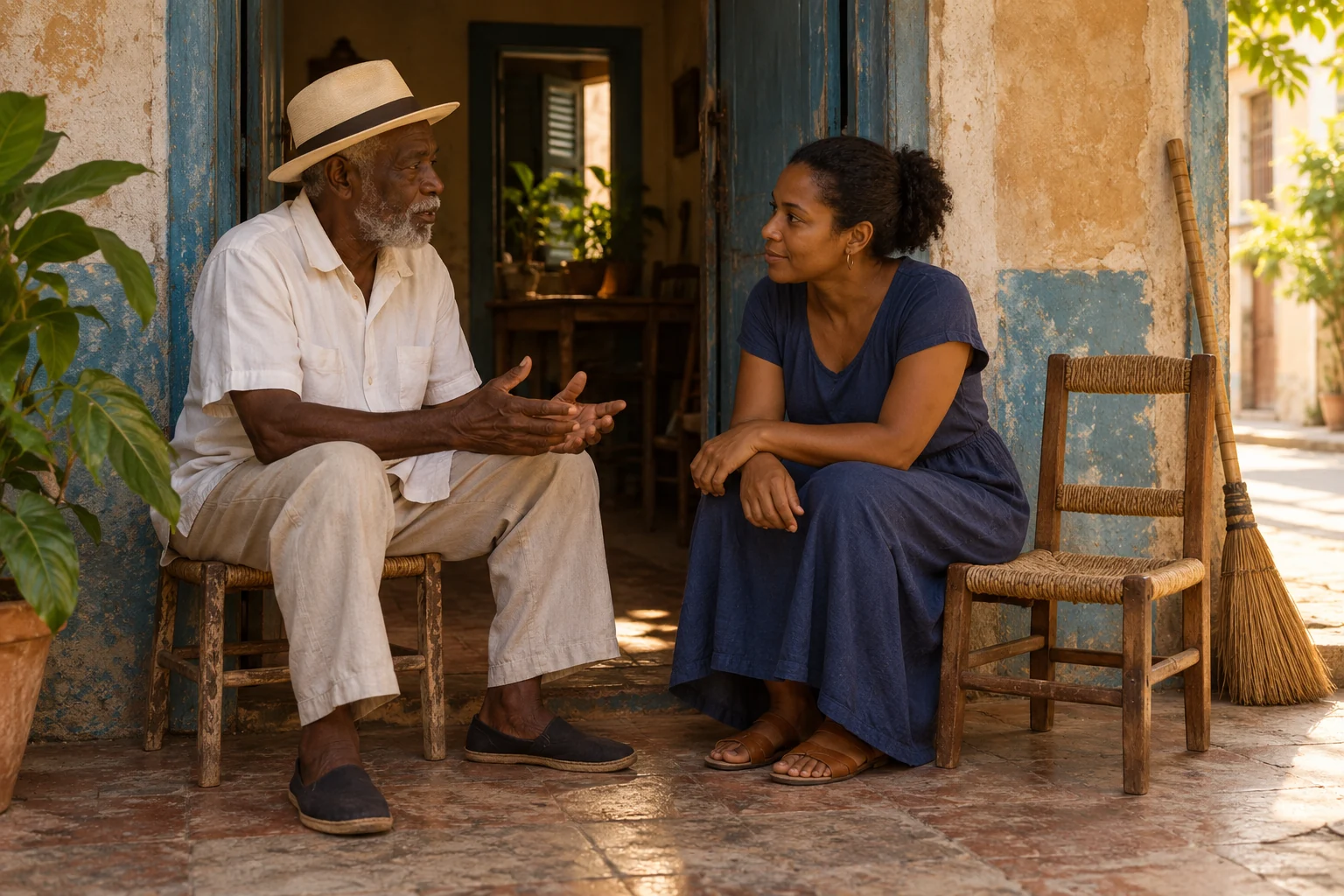
The broom recalls documented Arará-Cuban material associations while the study keeps care and belonging in view.
1. Material evidence and a particular context
The Duke Sacred Arts catalogue’s ensemble of broom, bracelet and necklace and its Asojano-named necklace provide concrete Afro-Cuban references. They locate the name within a material devotional world rather than a purely abstract list of qualities.
Relationships with Babalú Ayé and Sakpata are discussed in particular Cuban and Arará accounts. They should not be converted into a claim that Ṣọ̀pọ̀nná, Asojano, Omolu and every related presence are the same institution everywhere. Similarity of domain is the beginning of a question, not its answer.
2. Key theme: the afflicted person remains a person
Narratives and devotional imagery associated with affliction-related figures invite reflection on humility, exclusion and the possibility of receiving care. The contemporary question is how people respond when another person’s vulnerability disturbs their own sense of safety or success.
It is easy to offer respect to a powerful figure and avoid a vulnerable neighbor. A serious ethical reading brings those acts into conversation. Reverence becomes more demanding when it asks us to notice whose body, pain or poverty has been made socially inconvenient.
3. Humility without humiliation
Humility can mean acknowledging dependence and the limits of one’s control. Humiliation is something else: reducing a person’s standing so that they cannot ask to be treated well. A reference article should not make suffering into proof that someone deserves to be humbled.
The distinction matters in care. A receiver may need assistance without surrendering dignity. A helper may need to recognize that good intentions do not give them ownership of another person’s story. The relationship improves when help can be offered without making gratitude an endless debt.
4. Religious meaning and healthcare
Healing-related language describes a religious field. It is not evidence that a particular ritual or article can diagnose, prevent or treat an illness. Devotion and appropriate medical care can belong to the same person’s life without being confused as identical forms of knowledge.
For a personal religious question, the Arará or other relevant house context is essential. A comparison with a better-known figure can assist orientation, but it cannot replace the training and relationships through which a practice is carried.
5. Religious identity and the scope of this study
Asojano enters this study through a Cuban religious field whose Arará relationships deserve their own explanation. The University of Alaska Anchorage's collaborative project locates Arará in histories of Ewe and Fon displacement and Cuban religious rebuilding, emphasizing variation among Matanzas communities. Asojano's specific name is materially documented in Duke's Cuban necklace catalogue and in its account of the Babalú Ayé ensemble. Those sources establish a connected field without making every African or Brazilian affliction power the same institution.
The Human Soul manuscript has no dedicated Asojano chapter. Its Omolu / Bàbálú-Ayé chapter briefly acknowledges related Asowano and Azojuano expansions, then offers a broader psychology of vulnerability, hidden dignity and care. That method can be newly applied here, with the distinction stated plainly. It is not a recovered Arará chapter or independent verification of every sacred narrative.
Contemporary interpretation concentrates on humility without humiliation, the authority of situated knowledge and receiving help without losing personhood. Sacred logic remains primary. Asojano is not merely the name of a feeling of shame, nor a generic symbol attached to any illness. The reader begins with the community, name and material relation, then asks what conduct and inward development these relations can help illuminate.
6. Knowledge that gives the figure depth
6.1 What the Arara context changes
What does the Arará setting change? The UAA project describes a Cuban historical formation rather than an unchanged West African label. It also stresses variation among communities, so the term should not suggest one completely uniform ritual system. This gives the article a more accurate starting point than saying that an unfamiliar name is simply a translation of a familiar Yoruba one.
Interpretive extension: names carry histories of people learning how to remain a community under changed conditions. A label can conceal that labor when it appears as a neat entry in a pantheon chart. Religious rebuilding involves memory, relationship, material forms and differences within the community itself. Preserving this complexity does not make the study inaccessible. It helps explain why a person cannot learn every obligation from a general name.
The contemporary parallel concerns inherited belonging after displacement. Families may preserve a language, object or remembered relation in altered circumstances. Later generations can feel pressure either to claim perfect continuity or to dismiss everything changed as inauthentic. A more exact account can recognize both survival and transformation. This is a new application of the Human Soul relational method. It does not claim that Arará identity is a modern psychological condition, nor that all displaced people share the same religious history.
Evidence: University of Alaska Anchorage, Secrets Under the Skin project, Jill Flanders Crosby and collaborators, Historical and Ethnographic Background — Arara as a Cuban historical formation related to Ewe/Fon displacement; variation across Matanzas; fieldwork at Perico and Agramonte; San Lazaro with comparisons to Sakpata, not uniform identity.
6.2 Necklace, visible belonging and limits of recognition
What does the necklace establish? Duke's bunched necklace record explicitly includes Asojano among its names and locates the object in Cuban Ocha. The catalogue's own comparison of bead colors with Brazilian Nanã demonstrates why appearances cannot be read through one universal chart. The same visible combination may participate in a different named relation elsewhere. The object documents an actual material setting, while its title alone cannot settle every theological distinction.
Contemporary extension: belonging can be carried publicly without the observer understanding it. Clothing, jewelry, hairstyle and ceremonial objects may be immediately visible while the relationships authorizing them remain unknown. Admiration for an object is therefore not yet knowledge of its significance. The book's crafted-matter method makes this difference especially important: materials become meaningful through relation, use and community, not merely through their physical appearance.
An illustrative observer recognizes a necklace and begins explaining the wearer's identity before listening. Even a technically plausible account can become an act of possession if it denies the wearer and community their own explanation. The stronger response is attentive inquiry with appropriate reserve. A reference can teach that habit by limiting its claim to the actual object and source. Material beauty then becomes an opening toward religious knowledge rather than a substitute for it.
Evidence: Duke University, Sacred Arts of the Black Atlantic Project, Bunched Necklace (Collar de Mazo) of San Lazaro/Afimalle/Asojano/Babalu Alle, B344 — Cuban Ocha object explicitly including Asojano; beadwork; catalogue compares Cuban bead colors with Brazilian Nana rather than asserting an identical color system.
6.3 Connected names without universal equivalence
How can connected names remain distinct? Duke's ensemble catalogue describes Asojano within a Babalú Ayé road framework. The UAA material, meanwhile, foregrounds the historical and local complexity of Arará and San Lázaro. These accounts serve different purposes. One catalogues an ensemble; the other follows communities and their narratives. Neither should be made into a universal judgment that every use of the name has exactly the same institutional status.
Interpretive extension: the reader needs a grammar of relation rather than an equals sign. A sacred power can be encountered through overlapping names, images and histories while particular houses preserve decisive distinctions. Saying that relationship exists is not the same as saying nothing differs. The Academy's separate Asojano entry can make that discipline practical.
The same method improves human understanding. A person belongs to a family, profession and religious community without being fully explained by any one category. A label can be accurate and still incomplete. In care, incompleteness becomes ethically consequential because an observer may presume to know what another person needs before that person speaks. Keeping Asojano's context visible therefore supports a contemporary inquiry into recognition. It does not invent an Arará myth to make the point; it follows the actual limits and relationships of the sources available.
Evidence: Annabelle Yang, Duke University Sacred Arts of the Black Atlantic Project, Sacred Broom (Ja), Bracelet (Cacha) and Necklace Ensemble for San Lazaro/Babalu Aye, B120 — Actual catalogue description: Cuban Ocha, named Asojano road, exile/affliction and royal narratives, San Lazaro beggar comparison, palm/burlap/bead materials. Procedures in source deliberately not reproduced; University of Alaska Anchorage, Secrets Under the Skin project, Jill Flanders Crosby and collaborators, Historical and Ethnographic Background — Arara as a Cuban historical formation related to Ewe/Fon displacement; variation across Matanzas; fieldwork at Perico and Agramonte; San Lazaro with comparisons to Sakpata, not uniform identity.
7. A depth-psychological reading
Interpretive basis: A contemporary application of the wider interpretive framework in Babá Tilo de Àjàgùnnà’s The Orishas and the Human Soul, especially “Omolu / Bàbálú-Ayé”, “Before the Òrìṣà Become Archetypes”, “Metals, Tools, Fire, Cloth, Stones, and the Crafted Body of Power”. No dedicated Asojano chapter exists. Actual brief broad-field references and detailed affliction passages supply method, not independent Arara history. All psychological scenarios are contemporary applications; external objects and community research establish scope.
7.1 Humility without reduced standing
Contemporary psychological interpretation: humility recognizes dependence without accepting diminished worth. A person may discover that they cannot control an event, complete a task alone or maintain the body they expected to inhabit. That discovery can make relationship more honest. Humiliation occurs when others use the same vulnerability to decide that the person no longer has standing to disagree, refuse exposure or make choices.
The book's affliction and stigma passages provide a framework for examining this difference. Applied to the Asojano field, the question is what kind of relation is formed around need. Does assistance recognize a person whose preferences matter? Or does it create a hierarchy in which helpers become morally superior and receivers owe permanent obedience?
An illustrative adult receives financial and practical support during a difficult period. Their family begins discussing private details as though help granted collective ownership of the story. The person may feel that objecting would prove ingratitude. Reflective development can involve naming both truths: the help matters, and privacy remains legitimate. For the helper, humility includes acknowledging that goodwill does not make every action welcome. This interpretation is contemporary and relational, not a personality description of Asojano's devotees. It gives the religious study ethical precision by asking whether reverence for vulnerability actually changes the power dynamics of care.
7.2 Receiving help without losing agency
Contemporary psychological interpretation: receiving can be harder than giving when self-worth depends on usefulness. A person may offer extensive care yet become angry or ashamed when they need it. Receiving exposes the fact that they are not outside the shared condition they have served. They may respond by minimizing need, directing every detail or rejecting assistance before its terms are known.
The book's broad discussion of endurance and hiddenness helps make this tension visible. A new Asojano application can examine the moment when dignity has been confused with self-sufficiency. The alternative is not passive surrender. Receiving well can involve asking clearly, retaining agency and acknowledging another person's contribution without turning it into an unlimited debt.
An illustrative community volunteer becomes temporarily unable to perform familiar tasks. Others offer help, but the volunteer keeps apologizing and promises to repay everything immediately. The anxiety reveals how narrowly belonging has been organized around service. Development may include allowing companionship that has no ledger, while making practical arrangements that remain fair to those assisting. This does not idealize dependence or deny the risks of controlling help. It asks whether a relation can support both agency and need. The interpretation follows the book's attention to body, shame and community; it makes no claim that a sacred object or devotional article produces clinical recovery.
7.3 Reserve, stigma and the burden of reassuring witnesses
Contemporary psychological interpretation: stigma can make a person become the custodian of everyone else's comfort. They anticipate recoil, simplify their story and reassure listeners before describing what they need. Over time, the effort can hide anger and make ordinary contact feel like a performance. The person is welcomed only when their vulnerability remains easy to witness.
The book's hidden-face analysis invites a distinction between chosen reserve and enforced invisibility. Privacy can protect dignity. Silence can also reflect the expectation that the world will not receive a more difficult truth. Neither should be judged from outside without listening. The relevant question concerns the conditions under which disclosure becomes possible and whether disclosure is even what the person wants.
An illustrative member of a religious community avoids gatherings because every conversation turns into an inquiry about their condition. A friend may help by offering ordinary company and a practical invitation without requiring an update. Another person may want their difficulty spoken of openly and resent being treated as fragile. Care becomes exact through attention to those differences. This is a new contemporary application, not an assertion that Asojano possesses one fixed psychological meaning. It also avoids appropriating Arará history as a metaphor for any outsider's discomfort. The religious community retains its own life while the interpretive lens asks how human recognition can become less conditional.
8. What this relationship means for a person
8.1 In an established devotional or initiatory relationship
For a person with an established relation to Asojano in an Arará or another relevant Cuban house, the community's explanation governs the religious form of belonging. The public material documents overlapping names and locally varied institutions. It does not establish one universal initiation route. A sustained devotional relation, receipt of a sacred object and a specific initiatory office should not be assumed to mean the same thing simply because a public catalogue uses a shared title.
The Human Soul framework can nevertheless deepen reflection within that existing relation. Humility can be examined through how the devotee asks, listens, receives assistance and treats someone with less public standing. Hidden dignity can be examined through confidentiality and the refusal to make another person's suffering an exhibit. Care becomes observable when it changes what people actually do for one another.
Concrete development might involve receiving correction from an elder without treating it as personal annihilation, or declining an intrusive request while remaining respectful. A devotee who provides care can ask whether help increases another person's agency. A devotee receiving care can ask whether they are allowed ordinary disagreement. These questions need not reduce the sacred relation to interpersonal ethics; they allow ethics to become one field in which the relationship is lived.
This interpretation retains Arará specificity and leave restricted knowledge with its custodians. It offers neither an invented lineage account nor instructions derived from museum descriptions. Its purpose is a deeper language for conduct inside an already established relation, with uncertainty carried honestly.
8.2 When the figure becomes relevant in consultation
If Asojano appears in consultation, the name should be heard in the practitioner's actual religious context. The client should not immediately translate it into every other affliction-related name or infer a permanent personal deity. A consultation may disclose a relation or responsibility specific to the question presented. The article's role is to support careful understanding afterward, not provide a second divination assembled from internet summaries.
Contemporary reflective questions can distinguish several possibilities. Is the client mistaking humility for acceptance of humiliation? Is help being refused because dependence feels unbearable? Has a person's privacy been sacrificed to the helper's wish to appear generous? Is a community neglecting ordinary care while speaking reverently about sacred healing? Each situation asks for different conduct, and none can be selected solely from the name.
The book's Odù orientation can help clarify the configuration of circumstances while the sacred presence makes a mode of relation and power vivid. This distinction does not remove the body, community or material world from inward development. A client may need resources, an honest conversation or a clarified obligation as well as reflection.
A concrete follow-up is to state what was actually said, what action is being considered and which part remains uncertain. Questions concerning affiliation or liturgical responsibility belong back with the practitioner and house. An illness-related name is not itself a diagnosis, a prediction or a warrant to assign a spiritual cause to another person's suffering. The developmental invitation may be greater dignity in giving and receiving care.
9. Nature, materials and human knowledge
Asojano's material ecology is visible through Cuban beadwork, vessel and ensemble records, but these objects need their actual contexts. Duke's named necklace is especially valuable because it makes the Asojano connection concrete. The broader ensemble description brings palm material, burlap, cowries and crafted adornment into the devotional field. These should be discussed as materials within identified objects, not converted into a public recipe for constructing or using sacred implements.
The book's crafted-matter method asks what a material relation makes visible. Roughness, covering, bodily contact and ornament can carry dignity, reserve and recognized belonging. Their meaning does not arise from texture alone. A plain material may participate in a profound relation, while a beautiful imitation may have no comparable standing.
Contemporary extension: care also has a material body. A chair placed so someone can participate, a meal delivered with attention to preference or time made available without demands can change the social meaning of vulnerability. These acts are ordinary ethical examples, not ritual equivalents. They show why humility should not be confused with deprivation and why luxury should not be assumed to indicate worth. An ecological reading follows the actual relations among body, object, community and memory while allowing sacred meanings to exceed the modern analogy.
10. Diaspora, comparison and syncretism
The documented Cuban material explicitly joins San Lázaro, Babalú Ayé and Asojano in particular catalogue naming. The ensemble's author describes related roads and compares sacred narratives with the afflicted beggar San Lázaro. That is a real correspondence within the source's Cuban framework. It does not make Asojano, Yoruba Ṣọ̀pọ̀nná, Jeje Sakpata and Brazilian Omolu institutionally identical.
The UAA project adds an important corrective by locating Arará relationships in distinct communities and histories. A broader comparison should therefore retain place and form: which name, which object, which house and which account? The presence of a Catholic name may be part of a religious relationship without explaining that relationship completely. It also does not settle every distinction between public popular devotion and a particular initiated community.
Contemporary interpretive significance concerns the temptation to receive people only through familiar labels. A name may assist orientation while concealing the specific history that deserves attention. Keeping the correspondence scoped teaches the reader to recognize relation without claiming mastery. The Academy can offer the actual Cuban object, acknowledge its named connections and then identify the newly developed reflection on humility and care. That method makes the subject accessible while preserving the religious differences that a universal synonym chart would erase.
Evidence: Annabelle Yang, Duke University Sacred Arts of the Black Atlantic Project, Sacred Broom (Ja), Bracelet (Cacha) and Necklace Ensemble for San Lazaro/Babalu Aye, B120 — Actual catalogue description: Cuban Ocha, named Asojano road, exile/affliction and royal narratives, San Lazaro beggar comparison, palm/burlap/bead materials. Procedures in source deliberately not reproduced; Duke University, Sacred Arts of the Black Atlantic Project, Bunched Necklace (Collar de Mazo) of San Lazaro/Afimalle/Asojano/Babalu Alle, B344 — Cuban Ocha object explicitly including Asojano; beadwork; catalogue compares Cuban bead colors with Brazilian Nana rather than asserting an identical color system; University of Alaska Anchorage, Secrets Under the Skin project, Jill Flanders Crosby and collaborators, Historical and Ethnographic Background — Arara as a Cuban historical formation related to Ewe/Fon displacement; variation across Matanzas; fieldwork at Perico and Agramonte; San Lazaro with comparisons to Sakpata, not uniform identity.
11. Questions for a fuller understanding
11.1 How is humility different from humiliation?
How does humility differ from humiliation in this study? Humility acknowledges limits and dependence while retaining dignity. Humiliation reduces a person's standing and may require obedience as the price of assistance. The difference is visible in whether the receiver can express preferences, keep privacy and disagree. This is a contemporary application of the book's broad affliction framework, not a claim that all Asojano traditions use these psychological terms. It can help an established devotee examine conduct within their relationship, or a client consider what the consultation actually raised. The sacred presence remains more than the concept. The reflection is useful when it changes the quality of giving and receiving, rather than simply praising modesty.
11.2 Why preserve a separate Asojano study?
Why keep an Asojano entry alongside Babalú Ayé? A separate entry can preserve the Arará-Cuban question and the actual named material that would disappear in a generic affliction article. Duke documents Asojano within a connected Cuban field, while UAA research demonstrates local complexity in Arará institutions. Those facts support comparison, not automatic equivalence. The Human Soul manuscript's related names provide a framework for interpretation but no dedicated Asojano chapter. The editor can therefore teach three levels clearly: what the source actually names, how a specific community situates it and what the Academy newly interprets. That separation prevents both isolation from related histories and absorption into a better-known name.
12. Correlations to life dimensions
| Dimension | A question for reflection |
|---|---|
| Care | Can I offer help without taking possession of the person’s story? |
| Dignity | Am I mistaking humility for the obligation to accept humiliation? |
| Community | Whose vulnerability has become easier to avoid than to acknowledge? |
| Study | What does the Arará-Cuban setting change in my understanding of the name? |
13. Related paths
Ṣọ̀pọ̀nná provides a different historical study; Nanã Buruku opens earth, age and tender care. The linked Babalú Ayé book offers broader narratives with their contexts. It is a route into comparison rather than proof that every tradition preserves one uniform identity.
14. Sources for the expanded interpretation
Interpretive basis: A contemporary application of the wider interpretive framework in Babá Tilo de Àjàgùnnà’s The Orishas and the Human Soul, especially “Omolu / Bàbálú-Ayé”, “Before the Òrìṣà Become Archetypes”, “Metals, Tools, Fire, Cloth, Stones, and the Crafted Body of Power”. No dedicated Asojano chapter exists. Actual brief broad-field references and detailed affliction passages supply method, not independent Arara history. All psychological scenarios are contemporary applications; external objects and community research establish scope.
-
University of Alaska Anchorage, Secrets Under the Skin project, Jill Flanders Crosby and collaborators. Historical and Ethnographic Background. Arara as a Cuban historical formation related to Ewe/Fon displacement; variation across Matanzas; fieldwork at Perico and Agramonte; San Lazaro with comparisons to Sakpata, not uniform identity. Public institutional text inspected; scope limited to stated claims.
-
Duke University, Sacred Arts of the Black Atlantic Project. Bunched Necklace (Collar de Mazo) of San Lazaro/Afimalle/Asojano/Babalu Alle, B344. Cuban Ocha object explicitly including Asojano; beadwork; catalogue compares Cuban bead colors with Brazilian Nana rather than asserting an identical color system. Public institutional text inspected; scope limited to stated claims.
-
Annabelle Yang, Duke University Sacred Arts of the Black Atlantic Project. Sacred Broom (Ja), Bracelet (Cacha) and Necklace Ensemble for San Lazaro/Babalu Aye, B120. Actual catalogue description: Cuban Ocha, named Asojano road, exile/affliction and royal narratives, San Lazaro beggar comparison, palm/burlap/bead materials. Procedures in source deliberately not reproduced. Public institutional text inspected; scope limited to stated claims.
-
Duke University, Sacred Arts of the Black Atlantic Project. Beaded Vessel Altar for San Lazaro/Babalu Aye, B056. A named material object; glass; manufacture March 2014. Sparse record does not establish universal theology. Public institutional text inspected; scope limited to stated claims.
UAA page does not itself name Asojano; it supports Arara context. Duke names Asojano but is an object catalogue, not a complete Arara initiation ethnography. No universal initiation or identity claim is established.