
Ìrẹtẹ̀ Ìròsùn is a mixed Odù in Ifá’s 256-part corpus. The selected Ìrẹtẹ̀ Ìrosùn narratives join care with difficult judgment. Ògún expels an elderly guest after a sexual relationship with his daughter, while Ṣàngó later offers the man help without denying the breach. Elsewhere a moving staff alerts Ọ̀rúnmìlà to a hidden attack beneath his house, and he answers the perpetrators’ confession with access to learning. Both episodes ask whether accountability can leave room for continuing humanity and changed relationships.
A question to carry through the study: What response could acknowledge a serious breach while still preserving the person’s basic dignity?

This Academy reads the right column first, then the left. Each row carries a single or double mark.
Where this Odù belongs
Ìrẹtẹ̀ Ìròsùn belongs to the Ìrẹtẹ̀ family in this Academy’s study sequence. It is a mixed Odù, distinct from Ìròsùn Ìrẹtẹ̀. The order matters. Its teaching is approached through its own narratives, rather than by adding two general descriptions of the principal signs together.
Key Òrìṣà and sacred relationships
The figures below are selected for their roles in the accounts discussed here. They offer connected reading paths through the tradition.
-
Ògún. Ògún initially offers an unwell elder shelter and appoints his daughter as caregiver, then expels the guest after learning of their relationship; the narrative reflects his household’s honor framework.
-
Ṣàngó. Ṣàngó seeks the expelled elder, asks whether the accusation is true and provides care after hearing acknowledgment; that action explains the shared-food association in this telling.
-
Asojano. Asojuano is the elderly guest whose intimacy with the caregiver breaks the host’s trust; after exile he acknowledges the conduct and links future offerings to Ṣàngó’s continuing care.
-
Ọ̀rúnmìlà. Ọ̀rúnmìlà recognizes the staff’s warning, uncovers a fire beneath his floor and responds to the attackers’ admission by inviting them into knowledge rather than choosing retaliation.
Key myths and their meanings
Care continues after the guest is expelled
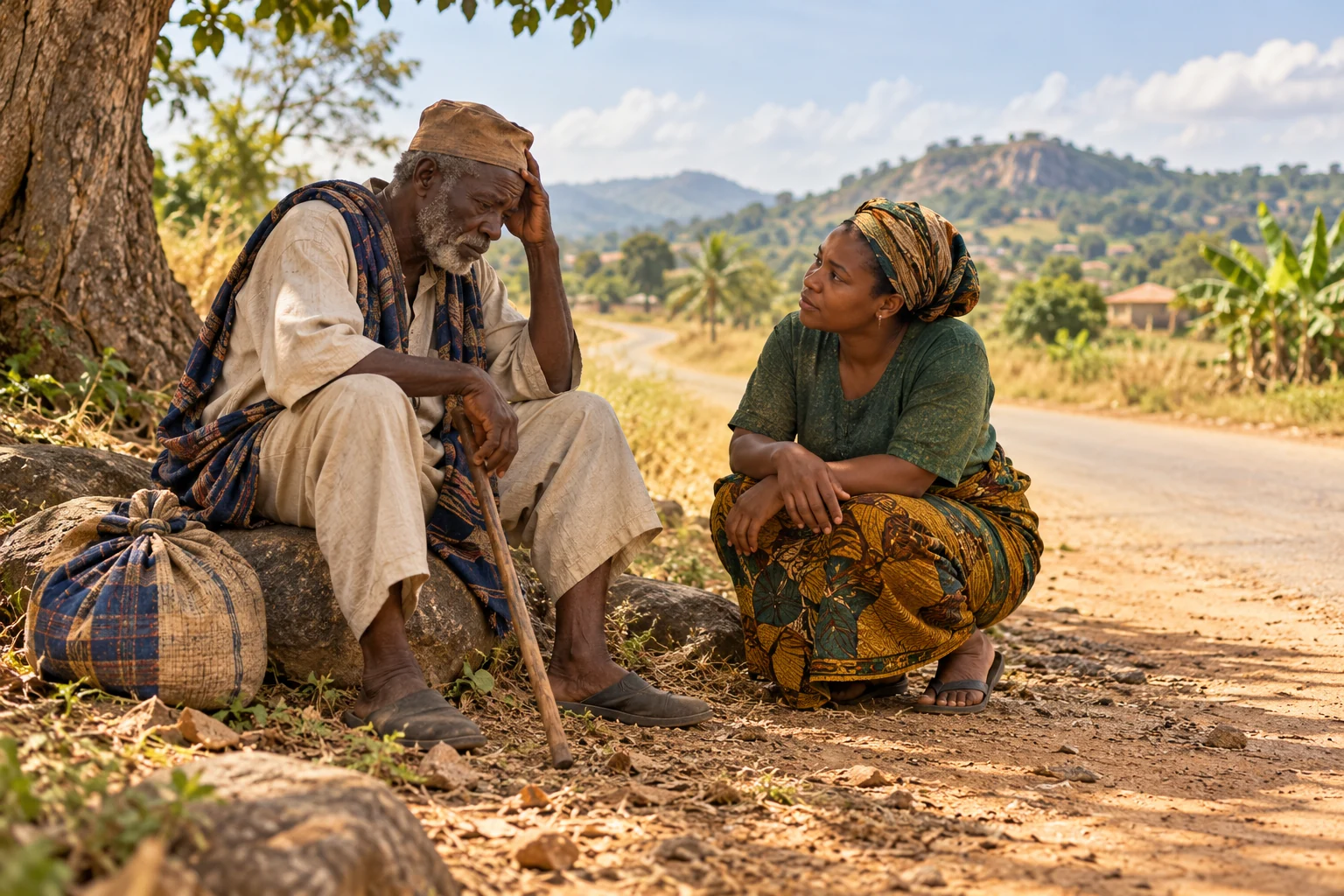
Ògún receives a struggling elderly traveler and asks his daughter to care for him. A sexual relationship develops between guest and caregiver, and her pregnancy exposes it. Ògún understands the event as a betrayal of hospitality and sends the elder far away. Ṣàngó later follows, confirms what happened and still assists him. The grateful elder establishes their continuing association in the religious account.
The tale distinguishes offering care from declaring someone innocent. Ṣàngó asks about the breach before helping, while Ògún’s account emphasizes dishonor more than the daughter’s own description of affection. A careful reading should keep her voice present and recognize the unequal caregiving arrangement. The story’s medical details and the claim of enduring shared offerings remain contextual, without becoming advice or a universal rule.
Narrative setting: Cuban compilation, Ṣàngó and Asojuano episode.
A staff notices danger the expert misses
Enemies secretly tunnel beneath Ọ̀rúnmìlà’s wooden house and prepare a fire under the place where he sits. Heat moves the staff beside him. He notices that movement, consults and finds the hidden danger before it destroys the house. After he survives, the perpetrators admit their act and submit to punishment. Instead of retaliating, he invites them to undertake Ifá so they may learn what he knows.
The expert survives because he responds to a material sign outside his initial awareness. This makes attention and interpretation complementary, rather than portraying knowledge as effortless omniscience. The ending offers education as an alternative to vengeance, but it does not show whether the attackers repair the damage or change their conduct. Those missing terms should remain questions rather than invented reconciliation.
Narrative setting: Cuban compilation, Osun as Orunla’s staff episode.
Three market sellers remain where their husbands believe them lost
Ọ̀rúnmìlà receives pre-earthly counsel concerning powerful women and later struggles to meet the next preparation’s full cost. A partial offering and promise establish the beginning of a relation with Èṣù. Three sellers, wives of Death, a magical power and Illness, come from heaven with goods. Directed to his house, they wait, share food and remain overnight, entering new intimate relations there. When their husbands search, further sacred preparation and Èṣù’s arrangements make the men believe the women have been lost to death. The search ends, and the source presents the resulting household as the beginning of renewed prosperity.
The plot makes household formation depend on sacred exchange, material signs and an intermediary’s management of perception. Èṣù’s role is active in changing what the searching husbands believe, not a decorative name for ordinary persuasion. The earlier partial preparation also remains a promise rather than the completion of every obligation at once. Yet the account follows the diviner’s fortune much more closely than the women’s independent wishes. Their hunger, delayed payment and intimacy are narrated, but a later choice about the new household is not separately explored.
A reference should preserve that limit instead of inventing consent or treating the women only as prizes. Compared with the earlier Asojuano episode, hospitality again becomes entangled with intimacy, though the direction of care and authority differs. Compared with Osun’s movement beneath the burning house, a material sign here misleads an observer rather than revealing danger. Sacred efficacy therefore does not make every reading of appearances straightforward.
Narrative witness and setting: Portuguese African narrative in the section explicitly credited to Cromwell Osamaro.
The fisherman asks beyond the office the river has given
A poor fisherman seeks counsel about prosperity and establishes sacred relations with Olókun, Èṣù and the river sustaining his work. His circumstances improve. A later consultation opens a path to kingship through a speaking fish that asks to be released. Once installed, the former fisherman is urged to seek a place next to divine authority itself. This time Ọ̀rúnmìlà offers no further sacred operation to secure the request. The man returns to the fish anyway and receives an answer he interprets as fulfillment. At home he finds the earlier poverty restored, and the account leaves him confronting the consequences of an unbounded demand.
The important boundary is not between wanting anything and wanting nothing. Relief from hardship and a recognized office have already been granted through the account’s sacred relations. The next demand changes the scale of the claim, and divination explicitly refuses to provide an operation for it. That refusal makes the story more than a warning to pay for every successive wish. The source gives the wife substantial influence and later recommends separation, but the fisherman also chooses to repeat and pursue the request.
His violence against her afterward is not a remedy the reference should endorse. The fish’s answer is another interpretive difficulty: a phrase received as elevation precedes a return to dependence. Compared with the earlier care for an expelled elder, limitation here concerns ambition rather than withholding basic dignity. Compared with the staff warning, the man seeks an affirmative meaning instead of attending to the limit already communicated through consultation.
Narrative witness and setting: Portuguese African narrative explicitly credited to Cromwell Osamaro.
What was born in this Odù
“Born” can name an explicit traditional origin association or what emerges through a story: a capacity, relationship, practice or order of life. Interpretations drawn from a narrative are labelled below, so their basis remains clear.
Religious images and statues
Selected traditional source association.
The origin list names religious images and statues as objects of reverence. This supports attention to mediated presence and public recognition in the compilation, without asserting that a single divination sign historically created image-based worship.
Monuments to martyrs
Selected traditional source association.
The list specifically includes making statues for martyrs. Its distinction from general images concerns memory of a person’s suffering or sacrifice; the source does not establish a historical chronology or imply that every tradition shares the same commemorative forms.
Movement of Osun
Selected traditional source association.
The source names Osun’s dance and develops the staff’s movement as warning. Here Osun is the staff associated with Orunla, kept distinct from Ọ̀ṣun the river deity; no automatic prediction is attached to an object falling or moving.
Correlations to life dimensions
These questions bring the selected stories into contemporary life. They are interpretive invitations for study.
Relationships and family
The hospitality story assigns a daughter a caregiving role and later interprets her relationship through paternal honor. Her own account complicates that frame. We should ask who defines a breach when care, dependence and intimacy occupy the same household.
Reflect: Whose account of a relationship has been overshadowed by the household’s reputation?
Community and responsibility
Ṣàngó provides basic care after confirming wrongdoing, while Ọ̀rúnmìlà offers learning after an attempted killing. These responses allow discussion of humanity after harm without assuming forgiveness removes the need for continuing accountability or meaningful repair.
Reflect: What repair would still be required if care is offered?
Character and inner life
The staff’s movement interrupts certainty in a familiar room. The episode makes noticing a small anomaly decisive, while showing that the meaning of an anomaly requires inquiry. It should not become encouragement to read every ordinary event as a threatening sign.
Reflect: What small discrepancy deserves a practical check before a dramatic interpretation?
Work and resources
The attack comes through the structure supporting the expert’s daily work. Its image invites examination of neglected foundations and maintenance, alongside the ethical choice to answer hostile competition through learning rather than merely defending superior status.
Reflect: Which unnoticed foundation makes your ordinary work possible?
A deeper reading of the sacred relationships
Divination can identify a limit rather than authorize every desire
The fisherman’s sequence includes effective sacred exchanges and then an explicit refusal of another operation for a changed demand. Religious efficacy is therefore not depicted as an unlimited mechanism for acquiring rank. In the three-seller account, a promised relation to Èṣù develops through further preparation and divine agency, but the outcome remains specific to that household. The earlier staff’s movement also requires interpretation, while Ṣàngó’s care for the expelled Asojuano preserves a relation without declaring the prior breach innocent. These are different forms of spiritual discernment. A contemporary reflection on moderation may be useful, but should retain the source’s claim that consultation can distinguish what a sacred relationship permits from what a person merely wants.
A sign may reveal, misdirect or be read through desire
Osun’s movement alerts Ọ̀rúnmìlà to a concealed fire. The searching husbands encounter signs arranged through Èṣù that turn them away from the women. The fisherman hears a speaking fish through the expectation that another wish has been granted. These are not equivalent acts of reading. A reference can distinguish a warning, an intentional misdirection and an interpretation shaped by desire without assuming that every material sign has one immediately transparent meaning. The religious accounts give objects and speech real efficacy, while also making the relation between appearance and knowledge difficult. Contemporary interpretation should therefore ask who arranges the sign, who receives it and what other counsel is being ignored.
Continuing a relation does not erase its unresolved conditions
Ṣàngó cares for Asojuano after confirming the breach of hospitality, rather than making care depend on denial. The arsonists are invited toward knowledge, though the source does not narrate all practical repair. The new household of three sellers is celebrated without returning equally to each woman’s perspective. The fisherman’s restoration of poverty leaves responsibility contested within the marriage. These endings sustain or end relations in different ways. A contemporary reader can ask what acknowledgment, repair or independent voice remains necessary after the principal outcome. The sources’ spiritual efficacy should be preserved without using a successful intervention to certify every condition that surrounds it as resolved or just.
Questions that deepen the study
Does the fisherman lose everything simply because he wanted a better life?
No. The narrative first grants improved circumstances and then kingship. The final demand is different: it seeks a position next to divine authority after consultation has said there is no further operation for that aim. A reference should preserve those stages instead of treating poverty relief as greed. Within the religious account, a legitimate relation has limits that desire cannot simply override. The wife’s influence is part of the plot, but the man’s decisions remain visible, and his later violence is not endorsed. The episode offers no personal prediction about wealth or a rule that ambition itself is always wrong.
Why do the three husbands stop searching?
Èṣù arranges encounters that make the materials before them appear to confirm the women’s loss. Their interpretation is effective inside the plot, ending the pursuit and allowing the new household to remain. This is a religious account of mediated perception, not an ordinary legal transfer or a complete account of the women’s consent. The source does not return to each woman’s independent choice in the same detail it gives the diviner’s prosperity. A contemporary analysis can name that omission while preserving the spiritual agency that changes the husbands’ understanding. The operative arrangement itself need not be reproduced to explain the narrative.
How does the staff episode help distinguish the new stories?
The staff’s movement leads to inquiry that reveals a concealed fire, so the sign directs attention toward a danger actually present. The new husbands’ encounters instead produce a mistaken conclusion arranged through divine mediation, while the fisherman interprets a response according to the elevation he wants. These differences prevent a generic instruction to follow every sign from replacing careful interpretation. Within the religious witnesses, sacred objects and speech remain efficacious, but their relation to an observer’s knowledge varies. A reference can explain that variation without reducing the staff to coincidence or suggesting that every misfortune should be read as a hidden supernatural message.
What the four narratives reveal together
The African-attributed additions bring sacred limits and mediated perception into the earlier Cuban concern with care and warning. The three sellers’ household is established through a developing relation with Èṣù and a changed understanding among the pursuing husbands. The fisherman’s ascent, by contrast, reaches a point where consultation refuses another operation for his demand. The earlier Osun staff reveals concealed danger, while Ṣàngó’s care for Asojuano continues after a breach is acknowledged.
Together these witnesses distinguish efficacy from innocence, interpretation from wish and care from unqualified approval. Their spiritual mechanisms remain active realities, not merely examples of modern decision-making. Contemporary questions about agency, proportion and repair should then be explicit as further readings. The reference should preserve the limits of each ending, including voices the source does not follow, rather than make every fortunate or punitive outcome a complete moral settlement.
Living with this Odù
A continuing life or initiatory relationship
A received life or initiatory relation with Ìrẹtẹ̀ Ìrosùn can invite continuing reflection on care that does not erase accountability and success that does not remove limits. Ṣàngó helps an expelled Asojuano after hearing about the breach, distinguishing assistance from a declaration of innocence. The staff's movement reveals a threat outside Ọ̀rúnmìlà's initial awareness, showing expertise receiving correction from material evidence. Across changing circumstances, a bearer can ask whether pride makes a warning harder to hear and whether wrongdoing has become an excuse to deny all dignity.
The market sellers' household adds hospitality entangled with intimacy and unequal narrative attention, while the fisherman reaches a limit that divination explicitly declines to help exceed. None of these accounts predicts a reader's illness, betrayal or lost prosperity. Asojuano remains the Cuban named figure, and Osun remains the staff rather than the river deity. Sacred signs, Èṣù's arrangements and the speaking fish retain their religious roles. Contemporary inner development can examine the desire to obtain an affirmative answer, the burden assigned to caregivers and the difference between compassion, consent and exoneration. It should also resist celebrating reconciliation where the actual terms of repair remain unreported or blaming the fisherman's wife for the decisions he himself pursues.
A particular consultation and its question
In consultation, Ìrẹtẹ̀ Ìrosùn can help distinguish a need for care from a claim to innocence, and a genuine warning from an appearance arranged to mislead. The moving staff directs the practitioner toward concealed danger; material signs in the sellers' account instead shape a husband's false conclusion. Those opposite functions prevent a universal rule that appearances either reveal or deceive. The fisherman raises another distinction: a received benefit does not mean every further wish has an authorized path. A practitioner can ask what the actual limit is, whose voice has been omitted and whether an offer of education includes concrete safety and repair.
The attackers' invitation to Ifá does not establish their changed conduct. Likewise, the women sellers' new household should not be narrated as fully consensual where their later wishes are not explored. These are contemporary ethical questions alongside active religious causation, not a replacement for it. Receiving the sign in one consultation does not confer permanent identity or identify actual illness, pregnancy or deceptive kin. Its situational strength lies in discriminating among warning, persuasion, mercy and unbounded demand, allowing the question to be clarified without treating every disappointing answer as an obstacle to overcome through another request.
Constructive and adverse possibilities
Constructive unfolding may involve hearing a small warning, providing care without denying a breach and respecting a limit communicated through consultation. Adverse unfolding includes interpreting every answer as permission, using hospitality to obscure unequal terms or assuming an educational invitation completes reconciliation. The fisherman chooses to pursue the further demand even after no sacred operation is offered, and later violence toward his wife is not a remedy. Actual iré or òṣogbo remains within the reading's context. Religious efficacy in the household story does not supply the missing account of the sellers' independent consent. Ṣàngó's continued care also does not make the original intimacy blameless.
Contemporary interpretation can keep compassion and accountability together by asking what each response actually changes. A successful warning prevents one harm; restoration of trust and repair require other conditions. The sign's stories give reason to distinguish those achievements instead of gathering every favorable ending under a single promise of reconciliation.
An illustrative situation in everyday life
In a hypothetical household enterprise, a guest breaches the terms of care but still needs basic support after being expelled. A mediator confirms the breach before helping. Elsewhere, a technical warning interrupts an expert's confidence, while an impressive success encourages a manager to seek authority beyond any agreed role. The narratives separate compassion, evidence and limits rather than prescribing either unconditional approval or total abandonment. The people assigned caregiving must also be heard, since their labor and consent cannot be assumed from the host's account alone. This is an illustrative modern interpretation, not a medical claim or a promise of spiritual detection. Its practical question is what assistance preserves dignity while addressing responsibility, and when a desired next step has already received a meaningful refusal rather than merely insufficient encouragement.
Sources and reading context
The first two narrative witnesses
The Cuban telling names Asojuano and is not generalized to Soponná or Babalú Ayé. Osun is a staff, not the river deity. The guest’s illness and daughter’s pregnancy are narrative circumstances without diagnostic or treatment claims. The source’s honor assumptions are contextualized, and the reconciliation’s practical terms remain unknown.
Narrative motifs are summarized independently. The life-dimension reflections are contemporary interpretation. How these reference studies are built explains the wider source approach and the distinction between a reference article and personal divination.
Additional named witnesses
- Cromwell Osamaro. The named African section supplies the three sellers’ relation with Ọ̀rúnmìlà and the fisherman’s successive petitions to divine and river powers.
The Portuguese is especially unstable in its instructions and the fisherman’s final exchange, so no operative reconstruction or fixed interpretation of every pronoun is imposed. Osun remains the staff in the earlier Cuban account, not Ọ̀ṣun the river deity. Coercive and gendered elements are identified without becoming relationship advice or personal prognoses.
Bibliographic identification
- C. Osamaro Ibie. Ifism: The Complete Work of Orunmila. Lagos; multivolume publication beginning 1986. Library catalogue record. Related bibliographic record for the named narrative witness. Exact volume, edition and page of the transmitted account have not been independently matched.
Read the source method and wider scholarly context.
The catalogue links identify published works and their authors. They are separate from proof of an individual episode’s wording or attribution. Contemporary comparisons and the synthesis above are editorial interpretation. The author’s books and Academy companions below provide further study; their sales links are separate from the source references.