
Ìrẹtẹ̀ Òdí is a mixed Odù in Ifá’s 256-part corpus. The selected Ìrẹtẹ̀ Òdí stories expose contests whose costs fall beyond the competing speakers. Ọ̀sányìn and Ọ̀rúnmìlà turn a dispute over knowledge into a test involving their children; a boastful goose later becomes the object selected to compensate Yemayá’s exclusion. The material asks how pride changes the use of expertise and how an apparently triumphant outcome can conceal coercion, vulnerable bystanders and a dangerous narrowing of possible responses.
A question to carry through the study: Who carries the risk when you turn a disagreement into a test of your own superiority?

This Academy reads the right column first, then the left. Each row carries a single or double mark.
Where this Odù belongs
Ìrẹtẹ̀ Òdí belongs to the Ìrẹtẹ̀ family in this Academy’s study sequence. It is a mixed Odù, distinct from Òdí Ìrẹtẹ̀. The order matters. Its teaching is approached through its own narratives, rather than by adding two general descriptions of the principal signs together.
Key Òrìṣà and sacred relationships
The figures below are selected for their roles in the accounts discussed here. They offer connected reading paths through the tradition.
-
Ọ̀rúnmìlà. Ọ̀rúnmìlà counters Ọ̀sányìn’s challenge through preparation and assistance, but also agrees to a contest that places children at risk; the narrative requires ethical scrutiny as well as recognition of his ingenuity.
-
Òsanyìn. Ọ̀sányìn asserts superior knowledge and attacks Ọ̀rúnmìlà’s standing; his eventual defeat leads to subordination under their wager rather than an account of equal reconciliation.
-
Èṣù. Èṣù first alerts Ọ̀rúnmìlà to the continuing attacks and later obstructs the opponent’s means of completing the contest, making him a partisan agent in the outcome.
-
Yemọja. Yemayá receives nothing at the gathering and is then granted a compensating choice, which falls on the goose; her local association with Ashabá is noted without generalizing the episode.
Key myths and their meanings
A wager that makes children the proof
Ọ̀sányìn repeatedly attacks Ọ̀rúnmìlà and boasts that his knowledge exceeds everyone else’s. The conflict eventually becomes a wager before Obatalá about returning their buried children alive after several days. Ọ̀rúnmìlà secures hidden support through a river connection and Èṣù’s intervention against his rival’s mechanism. He wins the test, and a prior agreement places the defeated specialist in a subordinate position.
Ingenuity is inseparable from the troubling terms of the contest: children become instruments in an adult rivalry. The source’s victory does not make that choice ethically neutral. We can distinguish knowledge used to protect vulnerable people from knowledge used to prove status. The passage also does not demonstrate that the defeated party freely accepts a lasting relationship of mutual respect.
Narrative setting: Cuban compilation, Ọ̀rúnmìlà and Ọ̀sányìn conflict episode.
The boastful goose and an excluded guest
Osí receives advice to restrain his speech and stop claiming that nobody can catch or harm him, but continues boasting. At a gathering, the divine figures take what they can while Yemayá receives nothing. Olofin then permits her to ask for what she wants. She chooses the goose, and the account makes Osí’s fate the consequence of refusing the earlier counsel. A following note connects this local episode with Yemayá Ashabá.
The story joins two different problems: a speaker’s claims of invulnerability and a guest’s exclusion from distribution. Its compressed causality should not erase the latter. A useful reading asks how a community repairs unequal treatment and whether its repair simply transfers harm to another vulnerable figure. The outcome remains religious storytelling, not a personal warning or a universal dietary rule.
Narrative setting: Cuban compilation, Osí goose episode.
Refuse becomes the beneficiary of a quarrel among related beings
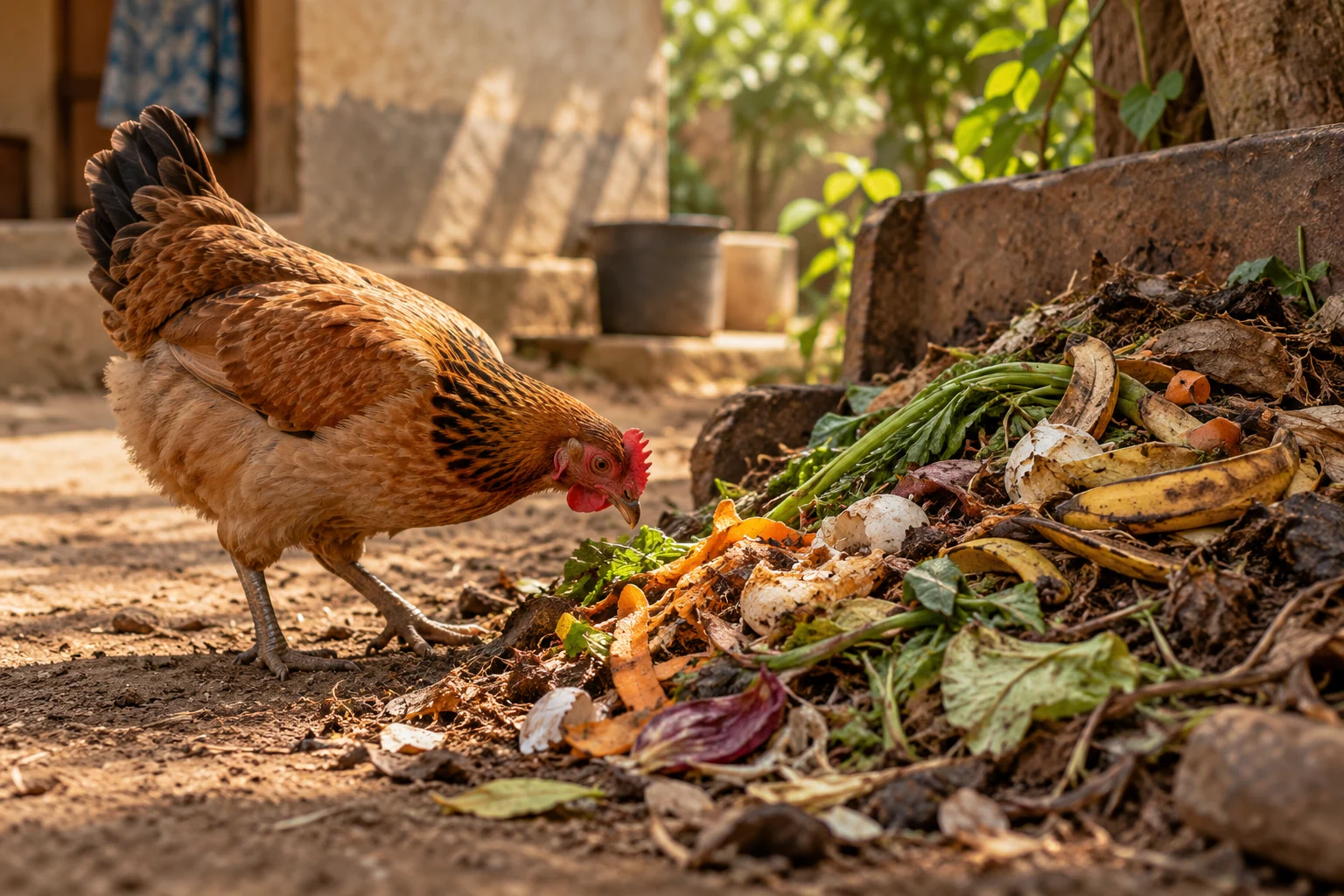
A community of related beings receives counsel before conflict develops. Refuse alone completes the advised sacred exchange. Hen and Refuse then agree to share food that Hen causes to be discarded from a household, but Refuse consumes it without the promised division. Hen searches the heap and eats its young. Other quarrels among related natural powers produce further damaged things that arrive at the same place. The account ends with Refuse continuing to prosper from what others lose, while Hen’s attacks disturb only the surface. Kinship and a cooperative agreement have not prevented a continuing war of access.
The story does not award success to an actor whose conduct is transparently fair. Refuse honors the sacred preparation but fails the agreement with Hen, and the ending still favors its accumulation. That distinction matters: ritual efficacy and a contemporary judgment about equitable sharing cannot simply be treated as identical. The account also imagines a material order in which the aftermath of many conflicts becomes one being’s nourishment. Its relation to waste is therefore active and cosmological, not an empirical explanation of decomposition.
Compared with the earlier specialists’ wager, the costs spread beyond the original competitors and return through dependents. Compared with the excluded Yemayá’s compensating choice, an initial omission becomes a repeated pattern rather than a single redistributed portion. A reference can ask who benefits when others quarrel while preserving the particular sacred explanation for Refuse’s resilience. It should not turn the ending into permission to exploit either kin or discarded resources without responsibility.
Narrative witness and setting: Portuguese African narrative in the section explicitly credited to Cromwell Osamaro; its list of sisters is textually unstable.
Wind, water and earth cannot complete the rival diviners’ attack
Before earthly arrival, Ọ̀rúnmìlà consults diviners associated with Wind, Water and Earth and completes the preparation they identify. On earth he combines trade with divination and receives substantial gifts. During a journey, local rivals try to turn weather and terrain against him. Rain, a violent wind and an opening earth each become a separate threat. His spiritually effective responses invoke the relation between protected creatures and their coverings. The forces withdraw rather than consume him. Earth finally acknowledges the relation and establishes a form of contact through which offerings will become effective. He reaches home without the rivals’ intended destruction.
The encounter is not merely a demonstration that words can express bravery. The account makes a pre-earthly preparation and the invoked relations among beings effective against environmental powers mobilized by others. The forces can be addressed, distinguish what they will receive and enter a continuing arrangement. Earth’s final response is particularly important because it turns an attempted attack into an origin for a sacred relation, rather than leaving the terrain as a defeated enemy. The earlier wager also uses a hidden relation through water to protect children, but its competitive terms put those children at risk.
Here the protected traveler is the practitioner whose prosperity has drawn hostility. Compared with Refuse’s accumulation, Earth’s receiving function is differently situated: contact is acknowledged as part of efficacy rather than merely a place where losses gather. A contemporary interpretation can examine envy and resilience without reducing personified elements to weather psychology or prescribing the account’s ritual contact as a public method.
Narrative witness and setting: Portuguese African narrative explicitly credited to Cromwell Osamaro.
What was born in this Odù
“Born” can name an explicit traditional origin association or what emerges through a story: a capacity, relationship, practice or order of life. Interpretations drawn from a narrative are labelled below, so their basis remains clear.
Odùduwà Ikalambe
Selected traditional source association.
The origin list names a particular Odùduwà manifestation. It establishes a specific association with the sign, but these selected episodes do not supply its biography; an editor should resist filling the gap with generic Odùduwà traits.
Kole Mosa, the dragon
Selected traditional source association.
A dragon figure named Kole Mosa appears among the listed beginnings. Its presence can be recorded as mythic imagery in the compilation, without inventing a complete story, a cross-cultural identification or a universal symbolism for dragons.
Correlations to life dimensions
These questions bring the selected stories into contemporary life. They are interpretive invitations for study.
Relationships and family
The wager makes children’s safety depend on their fathers’ professional rivalry. That displacement of risk is the narrative’s central ethical difficulty. A contemporary interpretation can ask how family members become proof of success in contests they did not choose.
Reflect: Who has not consented to the stakes of your disagreement?
Work and resources
The specialists’ competition concerns reputation and followers as well as technique. Winning produces domination rather than a shared standard of competence. This supports scrutinizing what professional rivalry rewards and whether a proof actually serves the people expertise is meant to help.
Reflect: Would winning this contest improve the service people receive?
Character and inner life
Osí’s repeated claim of invulnerability narrows the room for learning. The problem is a declaration that rules out ordinary limits before circumstances are examined. We can discuss the difference between confidence in a skill and pretending no vulnerability exists.
Reflect: What limit could you acknowledge without surrendering your confidence?
Community and responsibility
Yemayá’s exclusion reveals a failure of distribution before the goose is chosen. The narrative allows attention to how gatherings recognize participants and repair omissions, without assuming compensation is just merely because an authority permits it.
Reflect: How can an overlooked participant be recognized without making another person pay for the omission?
A deeper reading of the sacred relationships
Earth receives through an established sacred relation
The traveler’s encounter ends with Earth recognizing a form of contact that makes offerings effective. That is an account of agency and agreement, not just a symbol of being grounded. Refuse also receives the aftermath of other beings’ conflicts, but its sacred preparation gives that accumulation a different religious basis. The earlier river-assisted wager and Yemayá’s compensating choice add further relations through which materials and recipients matter specifically. These witnesses therefore require attention to who receives, what kind of relation authorizes receiving and what changes afterward. Contemporary interpretation may ask about resource flows, but it should not erase the spiritual logic by treating every act of reception as the same material transaction.
The costs of competition move beyond the competitors
The specialists make children the stakes of a wager. Hen’s agreement with Refuse leads to attacks on dependents within the heap. The other related beings’ conflicts likewise send losses to a beneficiary elsewhere. The traveling diviner’s rivals try to use environmental powers as instruments of their own grievance. These are distinct forms of displaced cost, not one uniform moral fable. A contemporary reader can ask who was not party to the original dispute and yet becomes exposed through it. The religious accounts remain specific about sacred preparation and the agency of waters, earth and recipients; acknowledging those realities does not require declaring every resulting advantage fair to everyone affected.
A boundary may protect a living whole rather than assert dominance
The traveler invokes creatures with their coverings, making the integrity of a whole consequential to what the elements may do. That differs from the earlier boastful goose, whose declaration of invulnerability provokes a narrative of failed limits. The wager’s hidden support preserves life through a different material arrangement, while Refuse’s surface can be disturbed without ending its deeper accumulation. These images distinguish protection, boast, continuity and asymmetry. A reference should describe which relation keeps something intact rather than equating every successful boundary with domination. Contemporary questions about resilience can follow, but the sources give particular agencies and sacred preparations the power to establish those boundaries.
Questions that deepen the study
Does Refuse prosper because it treats Hen fairly?
No. The narrative explicitly describes a failed agreement: Refuse consumes the food instead of sharing as promised. Its resilience is attributed to sacred preparation, which is not the same as an endorsement of every action it takes. That tension should remain visible rather than being repaired by inventing a fair settlement. A contemporary interpretation can ask who benefits from conflict and how a successful arrangement might still be unjust. Within the source’s religious logic, an efficacious relation explains an outcome; it does not automatically answer every later ethical question a reader may bring to that outcome.
Are Wind, Water and Earth only names for ordinary obstacles?
The account gives them agency, a role in pre-earthly consultation and the capacity to receive an address. Their withdrawal and Earth’s final acknowledgment are part of an actual sacred encounter inside the narrative. A contemporary reader may compare the journey to resilience under pressure, but that comparison should not replace the source’s spiritual causation with a psychological explanation. The prepared relations involving creatures and coverings also matter, rather than functioning as decorative examples of confidence. The reference can explain that efficacy without offering the words or actions as a practical technique for controlling weather or terrain.
How do the additions change the earlier concern with pride?
They show that the problem is not only a boastful individual being humbled. Refuse prospers within a system of related beings’ quarrels, while the traveler is endangered by the envy of other practitioners and protected through established sacred relations. The earlier specialists also expose children to their competitive claims. These differences make the distribution of agency and consequence more important than a generic warning against arrogance. A contemporary study can examine the confidence that disregards limits, but should also identify who arranges the contest, who gains from it and whose life is placed at risk without choosing the terms.
What the four narratives reveal together
The African-attributed additions place the earlier Cuban rivalry and goose episodes within a wider field of related beings, sacred receiving and protected integrity. Refuse gains from quarrels even while failing an agreement, separating efficacy from an uncomplicated judgment of fairness. The traveler’s relation with Wind, Water and Earth turns attempted destruction into a continuing sacred acknowledgment. The older wager protects children through one relation while making them instruments of another, and Yemayá’s compensation exposes a different failure of distribution.
Together the witnesses resist reducing the sign to a single warning against pride. They ask how a power receives, what relation makes a boundary effective and where the costs of conflict go. Contemporary analysis can clarify those questions while preserving the agency of elements and sacred recipients rather than translating the stories entirely into competition over ordinary resources.
Living with this Odù
A continuing life or initiatory relationship
For someone whose received life or initiatory Odù is Ìrẹtẹ̀ Òdí, these stories can sustain an ongoing examination of success whose supporting conditions remain troubling. The specialists' wager turns children into evidence of adult standing, so a religiously effective defense does not make the contest's terms harmless. Refuse benefits from sacred preparation while breaking an agreement with Hen, exposing a difference between efficacy and equitable conduct. Across a life, a bearer can ask who becomes the proof of one's competence and whose losses supply an apparently flourishing position.
The excluded Yemayá adds a distribution failure whose repair transfers harm to another figure. The elemental account offers a different movement: addressed powers withdraw and Earth establishes a continuing sacred relation instead of remaining merely defeated terrain. The witnesses do not predict rivalry, child danger or protection from environmental harm. Èṣù, divination and personified elements retain their active religious roles. Contemporary inner development accompanies them by examining boastfulness, grievance and the wish for unquestionable status while refusing to let a favorable principal outcome erase dependents, excluded participants or damaged surroundings. A lifelong relation can deepen accountability precisely by allowing the question of what counts as victory to remain open after one has succeeded.
A particular consultation and its question
In a consultation yielding Ìrẹtẹ̀ Òdí, the actual question determines whether the relevant relation concerns rivalry, exclusion, contested access or environmental powers mobilized against a traveler. The adult wager should not become a generic encouragement to demonstrate mastery; its children bear a risk they did not choose. Refuse's accumulation likewise cannot be read simply as reward for fair sharing, because the promised division with Hen is not honored. The goose episode asks how a gathering repairs unequal distribution and whether the remedy displaces injury onto someone else.
A practitioner can examine beneficiaries, costs and the terms of a proposed contest without announcing danger to an unknown client's children or a personal enemy. The elemental account's preparations and invoked coverings remain spiritually effective within that witness, not a public method or a claim that confident speech controls actual weather. Receiving the sign once does not establish permanent identity. Its reflective contribution is to distinguish protection from status competition and restoration from redistributed harm. It can also ask whether an initially hostile relation may become an acknowledged continuing one, as Earth does, instead of assuming that every obstacle must either consume the person or be destroyed without remainder.
Constructive and adverse possibilities
Constructive possibilities include recognizing excluded participants, preserving vulnerable lives and turning confrontation toward an acknowledged sacred relation. Adverse possibilities include boasting of immunity, making dependents the stakes of a rivalry or profiting from conflict while refusing an agreed share. Refuse's favored outcome does not certify its fairness, and Ọ̀rúnmìlà's effective protection does not neutralize the wager's child endangerment. Actual iré or òṣogbo belongs to the reading. The four narratives give different forms of efficacy and cannot be merged into a promise that the prepared person always wins justly.
Religious agency remains explicit while contemporary ethics asks who can benefit from the resolution. Hen's attacks on young and Yemayá's compensating choice show harm moving beyond an initial breach. A more exact account of constructive unfolding therefore includes the durability and terms of relation, rather than celebrating accumulation, victory or restored status as sufficient evidence that everyone has been protected.
An illustrative situation in everyday life
Imagine a hypothetical professional rivalry in which two leaders propose testing their methods on dependents who have no meaningful choice. A third organization profits from every failed project by acquiring discarded materials, despite breaking a sharing agreement with a partner. At a public event, an excluded participant is offered compensation taken from another vulnerable person's resources. The narratives distinguish effective performance, fair terms and repair that merely shifts harm. A leader's anxiety about standing may explain willingness to compete, but does not authorize using dependents as proof. This is an illustrative modern interpretation, not a report of ritual protection or an allegation about a real institution. Its question is whether the chosen resolution creates an acknowledged sustainable relation or simply relocates the cost beyond the principal winner's view.
Sources and reading context
The first two narrative witnesses
The Cuban compilation supplies the rivalry and goose episodes. Child endangerment, enslavement and the fatal conclusion are identified as ethical problems rather than endorsed. The source’s personalized advice, ritual details and prohibitions are excluded. Named origins remain local entries without unsupported expansion of their biographies.
Narrative motifs are summarized independently. The life-dimension reflections are contemporary interpretation. How these reference studies are built explains the wider source approach and the distinction between a reference article and personal divination.
Additional named witnesses
- Cromwell Osamaro. The named African section supplies the related-beings/Refuse conflict and Ọ̀rúnmìlà’s encounter with Wind, Water and Earth.
The list and count of sisters are unstable in Portuguese, so the synopsis follows the clear Hen–Refuse sequence and broader kin-conflict motif without reconstructing a taxonomy. The traveler’s words and operative contact are not reproduced as instructions. The earlier wager’s child endangerment and enslavement remain ethical complications rather than exemplary methods.
Bibliographic identification
- C. Osamaro Ibie. Ifism: The Complete Work of Orunmila. Lagos; multivolume publication beginning 1986. Library catalogue record. Related bibliographic record for the named narrative witness. Exact volume, edition and page of the transmitted account have not been independently matched.
Read the source method and wider scholarly context.
The catalogue links identify published works and their authors. They are separate from proof of an individual episode’s wording or attribution. Contemporary comparisons and the synthesis above are editorial interpretation. The author’s books and Academy companions below provide further study; their sales links are separate from the source references.