
Òdí Ìrẹtẹ̀ is a mixed Odù in Ifá’s 256-part corpus. Òdí Ìretè’s selected stories examine consequences that begin with apparently helpful conduct. Òrúnmìlà’s intimate disclosures to a client provoke her husband’s violent misunderstanding. An ox helps a dog but rearranges the task for easier conversation, exposing its strength to a farmer who yokes it. The accounts do not support a blanket rejection of helping others; they ask how speech, boundaries, and unintended visibility can change the risks attached to assistance.
A question to carry through the study: What boundary would let you help without taking on an obligation you cannot freely leave?

This Academy reads the right column first, then the left. Each row carries a single or double mark.
Where this Odù belongs
Òdí Ìrẹtẹ̀ belongs to the Òdí family in this Academy’s study sequence. It is a mixed Odù, distinct from Ìrẹtẹ̀ Òdí. The order matters. Its teaching is approached through its own narratives, rather than by adding two general descriptions of the principal signs together.
Key Òrìṣà and sacred relationships
The figures below are selected for their roles in the accounts discussed here. They offer connected reading paths through the tradition.
-
Ọ̀rúnmìlà. Òrúnmìlà’s disclosures in the machete account display knowledge but also create danger through their reception. In the animal account he is the consultant whose instructions are casually altered.
-
Èṣù. Èṣù appears in the second version of the machete account as part of the practitioner’s preparation. The attribution is limited to that variant rather than given as the unseen cause of the whole episode.
-
Orí. Orí, the inner head, is the focus of Òrúnmìlà’s protective attention in the machete versions. It is indexed as inner head, not treated as an Academy deity entry.
Key myths and their meanings
Knowledge misunderstood as intimacy
Òrúnmìlà tells a woman intimate facts about her body and household. She repeats the disclosures to her husband, who interprets the knowledge as proof of sexual betrayal. He goes to attack the diviner with a machete. Òrúnmìlà is above the ground attending to his head; the attacker falls while climbing and is killed by his own weapon. The narrative resolves danger through the aggressor’s failed approach.
The husband is responsible for violence, but the account also makes professional speech consequential. Demonstrating private knowledge is not the same as explaining how that knowledge should be understood. A careful reading can discuss discretion, client trust, and the danger of possessive jealousy without endorsing the attacker’s suspicion or treating intimate access as evidence that violence was somehow provoked or deserved.
Narrative setting: Spanish Cuban-style account with a nearby variant.
The ox made visible to the yoke
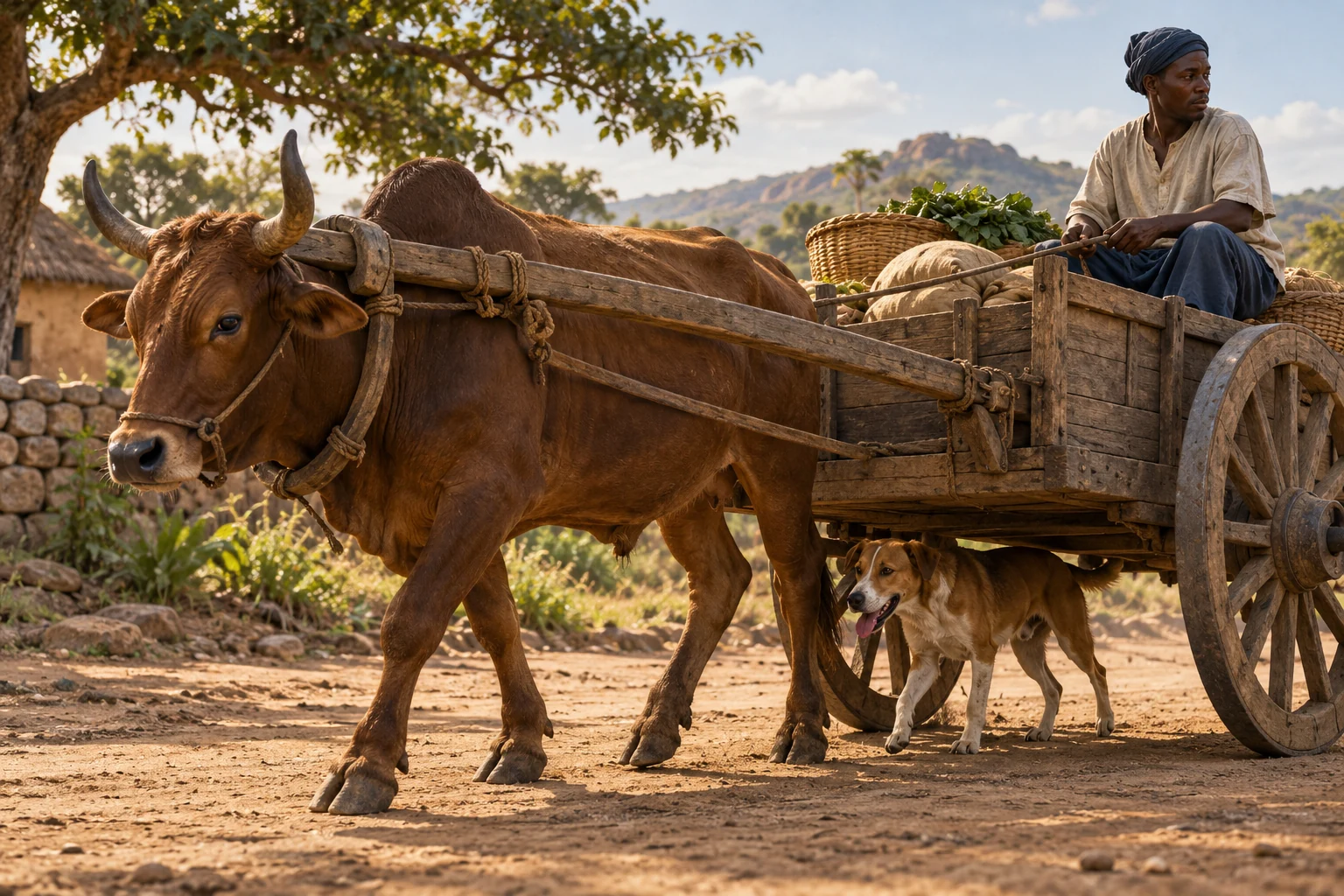
An ox takes its troubled dog friend to Òrúnmìlà. During the task that follows, the animals are not to speak, but the ox suggests putting the load on its horns so conversation can continue. The sticky burden will not come free. Watching its powerful attempts to remove it, a farmer recognizes its usefulness and captures it. Thereafter the ox pulls the cart while the dog moves freely underneath.
The helpful animal becomes bound through a change made for convenience. The story’s final warning against favors is broader than its narrated evidence supports. A more precise reading concerns taking over a task without assessing its conditions, and the way someone else may convert observed ability into compulsory labor. Assistance remains valuable, but consent and a clear way to withdraw matter to its fairness.
Narrative setting: Spanish animal origin account.
The missing royal rooster exposes a fabricated conviction
A man warned about false accusation does not complete the advised response. A palace rooster disappears after Èṣù hides it, and checkpoints are established. The man checks a trap and carries away a severed wild bird’s head, but Èṣù substitutes a rooster’s head in his bag. Officials take it as proof of theft and condemn him. Granted a final visit home, he attends to the neglected sacred relation. Èṣù releases the living palace rooster, which returns publicly and disproves the conviction. The man is freed, receives recognition, and completes further responsibilities toward his head and Ifá.
The account makes Èṣù consequential in both the damaging appearance and its removal. This is not a simple fable in which a wholly external villain creates false evidence while a benevolent power merely uncovers it. Within the religious logic, the neglected relation changes how the man’s passage through an accusation unfolds. That complexity should be explained without telling a reader that actual wrongful conviction proves ritual neglect. The officials’ inference is also specific: a severed head is treated as conclusive evidence that the missing rooster is dead and the carrier responsible.
The living bird’s return overturns both assumptions. The earlier machete story supplies another case of intimate knowledge being mistaken for incriminating proof, while the ox’s capture turns displayed strength into someone else’s asserted claim. Together they distinguish what is observed from what others decide it entitles them to do. The sacred reversal does not erase the extremity of the original sentence, whose procedure remains open to scrutiny.
Narrative witness and setting: Account explicitly headed Revelações de Cromwell Osamaro
An imagined bead becomes a child’s actual danger
A man with two wives receives counsel about jealousy reaching a child, but does not act on it. One wife sells meat and buys waist beads, giving a strand to the other. Rivalry turns the gift into a challenge to reproduce the achievement. The second wife’s daughter imagines the beads her mother might buy and argues over how she would wear them. An angry blow kills the child within the story, although neither the mother’s hoped-for meat nor the imagined beads has been obtained. The father returns to divination; Èṣù intercepts the child on the way to heaven and brings her back.
The episode’s sharpest detail is the sequence of unrealized possessions producing a real injury. The desire to match another household member becomes urgent before the hoped-for gain even exists. Sacred counsel identifies the danger before the event, and Èṣù’s intervention at the heaven–earth passage supplies the narrated return. That spiritual action is more than a lesson about managing envy, but it does not require making the child’s injury an acceptable teaching method. The adult who strikes retains agency within the scene, and the father’s earlier omission is not a substitute for naming it.
Compared with the ox and dog, the story presents another imbalance around a transferred object: a favor or gift changes obligations and exposes someone with less control to the consequences. The ending restores life but does not describe how the household repairs its rivalry afterward. The source’s subsequent labels for the wives simplify that problem, so they should not replace attention to the unresolved relations.
Narrative witness and setting: Account explicitly headed Revelações de Cromwell Osamaro
What was born in this Odù
“Born” can name an explicit traditional origin association or what emerges through a story: a capacity, relationship, practice or order of life. Interpretations drawn from a narrative are labelled below, so their basis remains clear.
The ox yoked by its horns
Origin motif within the selected narrative.
No separate born list is given in the inspected opening. The animal narrative explicitly explains the origin of the ox’s cart labor and the dog’s contrasting freedom; this is a fable association rather than agricultural history.
Professional discretion
Contemporary interpretation from the selected myth.
As a contemporary interpretation, the machete account raises the emergence of responsibility for how private knowledge is disclosed. This is an analytical reading of speech and its reception, not an addition to a traditional origin list.
Correlations to life dimensions
These questions bring the selected stories into contemporary life. They are interpretive invitations for study.
Work and resources
The farmer sees strength and translates it into labor for his own use. The ox’s capacity becomes someone else’s resource without a negotiated agreement, making the episode useful for examining exploitation disguised as recognition of talent.
Reflect: When has praise for your ability become a demand for unpaid labor?
Relationships and family
The husband treats disclosure as proof of possession being violated. The story shows how jealousy can convert uncertainty into a violent certainty, and why private facts require careful handling without accepting coercive control as ordinary care.
Reflect: How do you respond when uncertainty touches a close relationship?
Character and inner life
The ox rearranges the task because it wants to keep talking. A small convenience changes its exposure dramatically. The useful concern is awareness of conditions before improvising, rather than fear that every spontaneous choice will be punished.
Reflect: What condition are you dismissing because it feels inconvenient?
Community and responsibility
A practitioner’s words move beyond the consultation and enter another relationship. Professional responsibility includes anticipating plausible misunderstandings and explaining context, while responsibility for threats and violence remains with the person choosing them. The client’s repetition carries those words into another household.
Reflect: How might your words be repeated without the context you intended?
A deeper reading of the sacred relationships
Sacred responsibility changes passage through an ordeal
The rooster account connects a neglected response with a frightening encounter, then a renewed relation with Èṣù changes the outcome. The bead account similarly places consultation before harm and a divine intervention at the passage to heaven afterward. These are specific religious explanations, not merely metaphors for better judgment. The earlier machete versions also attend to the inner head, while the ox’s altered task disregards a condition given in consultation. A careful study can therefore explain why the accounts treat preparation and continuing responsibility as real before drawing modern comparisons. It should avoid making their narrated causality a test of actual innocence, disability, bereavement, or deservingness in another person’s life.
A small object can carry an outsized social conclusion
A head in a bag becomes a capital accusation, an imagined strand of beads becomes a household contest, intimate bodily details become a husband’s violent certainty, and a sticky load on horns becomes a farmer’s claim over an ox. The objects differ materially and religiously, so they are not interchangeable symbols. Their common analytical interest is the leap from an encountered detail to a larger entitlement or judgment. Sometimes that leap is false, sometimes it exploits a real capacity, and sometimes it intensifies a rivalry already present. Contemporary interpretation can ask what conclusion the evidence actually supports without reducing the sacred action that gives each account its particular turn.
A restored outcome need not complete relational repair
The rooster’s return disproves the accusation and restores the man’s standing. The child’s return restores life, but the passage supplies little about rebuilding trust between the wives or addressing violence. The earlier machete account ends with the aggressor’s death, while the ox’s new labor arrangement remains in force. These outcomes should not be described as four versions of uncomplicated harmony. Their differences matter to an honest account of what the source actually settles. Religious intervention can be affirmed within a narrative while further ethical questions remain: whose account is heard, what a household remembers, and whether a change in external circumstances has altered the conduct that produced the danger.
Questions that deepen the study
How should Èṣù’s double role in the rooster account be explained?
The witness itself makes him hide the rooster, alter the object carried by the man, and later release the bird after the neglected relation is addressed. Omitting the first actions would make the story easier but less faithful. The religious logic concerns a power whose cooperation affects how a person encounters consequence, not a modern investigator independent of the problem. That does not authorize attributing an actual injustice to Èṣù or telling an accused person they caused it spiritually. The specific narrative can instead be explained on its own terms, while contemporary analysis separately examines why the officials treated an ambiguous object as final proof.
What is distinctive about the daughter’s argument over beads?
The possessions around which the second argument turns have not yet been acquired. A future success imagined in rivalry becomes immediate pressure inside a parent–child exchange. That sequence distinguishes the episode from a simple fight over an object already held. The religious account places the event within neglected counsel and a later return through Èṣù’s intervention, while contemporary reflection can examine how comparison projects adult expectations onto a child. Neither perspective makes the blow inevitable or justified. The story’s restored life should not become a promise about actual bereavement, and the wife labels appended afterward do not adequately describe the work a household would still need to repair its relations.
Does the ox story imply that every favor should be refused?
Its attached warning is broader than the narrated action. The ox helps a friend, alters a condition for convenience, and becomes visibly useful to someone who captures it. The new bead story adds a gift that becomes a rivalry rather than an uncomplicated benefit. Together they support attention to the terms surrounding help, not a universal rejection of generosity. The religious conditions in the ox’s task are part of the account’s own explanation, while contemporary interpretation can ask about consent, withdrawal, and unintended exposure. A favor can remain valuable if the actual obligations and risks are understood; these stories do not establish that care itself is a mistake.
What the four narratives reveal together
The added witnesses sharpen Òdí Ìretè’s concern with an action becoming something its participant did not expect. A carried head becomes supposed proof of a royal theft; an imagined ornament becomes a real danger to a child. The earlier disclosure and ox narratives give different versions of the same larger problem without repeating its mechanisms. The religious explanation remains specific in each case: consultation, attention to the inner head, and Èṣù’s interventions change what passage and consequence become possible.
Modern scrutiny of evidence, rivalry, and exploitative claims can accompany that logic, but must not be substituted for it or used to diagnose another person’s misfortune. The endings also resist one formula. The accused man is cleared, the child returns, an aggressor dies, and an ox remains bound. Their differences make it necessary to distinguish a decisive intervention from a complete account of justice or repaired relationship.
Living with this Odù
A continuing life or initiatory relationship
A received relationship with Òdí Ìrẹtẹ̀ can sustain exactness about speech, evidence, and the consequences of helping. Òrúnmìlà’s intimate knowledge is interpreted as proof of betrayal without that inference being examined. The ox’s assistance becomes captivity when a convenient alteration makes its body available to another’s use. These accounts do not require suspicion of every confidence or refusal of every friend. They ask how an intended benefit enters an arrangement with effects the helper has not considered.
The royal rooster adds a fabricated public conviction, keeping accusation distinct from truth even when an apparently decisive object is produced. Èṣù’s agency both creates and reverses the false appearance within the witness. The imagined beads introduce another danger: rivalry over something not yet possessed reaches a child who cannot control the adults’ competition. Across a life, the task may be to clarify a consequential inference, assess how service changes exposure, or stop imagined status from determining present conduct. The person is not destined for false accusation or dangerous jealousy. The sign invites judgment that can slow down when evidence, convenience, and desire appear to point in the same direction but actually belong to different relationships.
A particular consultation and its question
In consultation, Òdí Ìrẹtẹ̀’s accounts help separate knowledge from the inference made about its source. Intimate information does not by itself prove a particular relationship, and an apparent object of evidence does not establish how it arrived. The machete and rooster narratives therefore sharpen the need to hear an accusation’s construction without announcing that any real accusation is fabricated. The actual question and divinatory setting supply the relevant facts.
The ox story adds the possibility that help changes a person’s position in ways they did not anticipate. Convenience for a companion may make the helper’s capacity visible to someone seeking control. The bead narrative examines a different route: a hypothetical gain becomes emotionally real enough to endanger someone now. A practitioner might distinguish a concrete threat from rivalry organized around an imagined future, while refusing to make a child responsible for adult conflict. Èṣù’s restoration in the narrative remains sacred agency, not a promise that actual harm can be reversed. Consultation can clarify what is known, what is assumed, and who bears the consequence of acting before that distinction is made. It does not confer a permanent identity as victim, betrayer, or rescuer.
Constructive and adverse possibilities
Constructive unfolding may involve a claim examined before violence, a helper able to understand changing exposure, and adults refusing to make a child carry rivalry over imagined status. The rooster’s public return makes the conviction’s apparent certainty collapse through Èṣù’s action within the witness.
Adverse unfolding can involve treating disclosure as proof of intimacy, confusing material appearance with an established chain of events, or choosing convenience without considering capture. The beads sharpen the difference between a future fantasy and an actual dependent life. The narratives’ reversals do not make injury harmless, and the aggressor’s failed approach cannot become an instruction for staging another’s punishment. These are possible directions in the relation among evidence, speech, and power. They neither settle a real dispute nor assign constructive or adverse status to the consultation of an unknown reader.
An illustrative situation in everyday life
In a hypothetical example, a skilled employee offers to take over a colleague’s task so they can finish a conversation. Management observes her speed and permanently adds the work without discussion. At the same time, a rumor about her access to confidential information is treated as proof of favoritism. The ox and intimate-knowledge narratives distinguish two issues: a voluntary convenience has changed the allocation of labor, and an inference has been mistaken for a fact. Her wish to seem generous may make both harder to question. Clarifying the original agreement and the actual evidence offers different responses to each problem. This illustration predicts neither captivity nor violence; it uses the stories to make exposure and accusation more intelligible.
Sources and reading context
The first two narrative witnesses
The inspected introduction has no distinct born list. One explicit animal-origin explanation is retained, so origin coverage remains partial. The machete narrative has variants; they are identified as variants rather than combined into an invented unified account.
Narrative motifs are summarized independently. The life-dimension reflections are contemporary interpretation. How these reference studies are built explains the wider source approach and the distinction between a reference article and personal divination.
Additional named witnesses
-
Cromwell Osamaro. The explicit heading covers the royal rooster accusation and the two-wife bead episode.
-
Spanish Cuban-style narrative sequence. The earlier machete variants and ox/dog account remain distinct witnesses in the same sign section.
The translation is unstable about bird species and some pronouns. The child’s return is retained as religious narration without a claim about actual death or treatment. No ordeal method, offering list, personal warning, or stigmatizing label for the wives is reproduced.
Bibliographic identification
- C. Osamaro Ibie. Ifism: The Complete Work of Orunmila. Lagos; multivolume publication beginning 1986. Library catalogue record. Related bibliographic record for the named narrative witness. Exact volume, edition and page of the transmitted account have not been independently matched.
Read the source method and wider scholarly context.
The catalogue links identify published works and their authors. They are separate from proof of an individual episode’s wording or attribution. Contemporary comparisons and the synthesis above are editorial interpretation. The author’s books and Academy companions below provide further study; their sales links are separate from the source references.