
Òdí Ọ̀ṣẹ́ is a mixed Odù in Ifá’s 256-part corpus. Òdí Òṣé’s selected material brings abuses of knowledge into focus. A ruler uses Osanyin’s power to control people’s minds, then restores them carelessly when scrutiny arrives. A hunter reports a speaking severed head but cannot reproduce the event before the community. The first concerns leadership that violates individuality; the second concerns the peril of an extraordinary assertion becoming a public test. Both leave responsibility distributed beyond the person who speaks most visibly.
A question to carry through the study: What responsibility comes with a claim others cannot independently verify?

This Academy reads the right column first, then the left. Each row carries a single or double mark.
Where this Odù belongs
Òdí Ọ̀ṣẹ́ belongs to the Òdí family in this Academy’s study sequence. It is a mixed Odù, distinct from Ọ̀ṣẹ́ Òdí. The order matters. Its teaching is approached through its own narratives, rather than by adding two general descriptions of the principal signs together.
Key Òrìṣà and sacred relationships
The figures below are selected for their roles in the accounts discussed here. They offer connected reading paths through the tradition.
-
Òsanyìn. Osanyin’s power is appropriated by the ruler to seize people’s brains. This is the narrative’s account of misuse, not a statement that Osanyin’s knowledge is intrinsically coercive.
-
Obàtálá. Obatalá is sent to investigate and restores people after the ruler’s indiscriminate attempt to conceal wrongdoing. His intervention concerns differentiation and repair rather than an abstract preference for uniformity.
-
Ọ̀rúnmìlà. Òrúnmìlà is present in the adjacent hen account and the section’s explanatory notes, but is not made the hidden actor of the two selected stories; this association is limited to the selected source.
Key myths and their meanings
The ruler who mixed people’s minds
Oluwo Bombo Shekete becomes ruler after the previous practitioner dies. Using power associated with Osanyin, he takes the people’s brains for his own benefit and stores them together. A visiting messenger notices their condition and reports to Olofin. As Obatalá approaches, the ruler hurries to return what he has taken but confuses whose brain belongs to whom. Obatalá repairs the disorder, and the ruler loses office.
The attempt to conceal abuse repeats its central error: people are treated as interchangeable material. Repair requires attention to each person rather than simply returning a quantity of what was seized. The account can illuminate manipulation and institutional accountability, but its imagery of brains must not be turned into medical explanation, gender stereotype, or a claim that neurological difference reveals supernatural interference.
Narrative setting: Spanish Cuban-style governance narrative.
A private marvel becomes a public test
A frustrated hunter finds a severed head and hears it say that speech caused its death. He later tells others what happened. A group accompanies him to test the claim, but the head remains silent. Taking its silence as proof that he lied, the villagers condemn him to death. The hunter’s extraordinary experience becomes impossible to establish within the public procedure he has entered.
The story warns about speech, yet the community’s response is itself severe and poorly reasoned. Failure to reproduce an event does not prove deliberate deception, and an assertion does not become reliable merely because it is sincerely held. The productive tension concerns proportionate judgment: speakers should distinguish experience from proof, while listeners should avoid converting uncertainty into a punitive certainty.
Narrative setting: Spanish speaking-head fable.
A house cannot begin above the ground
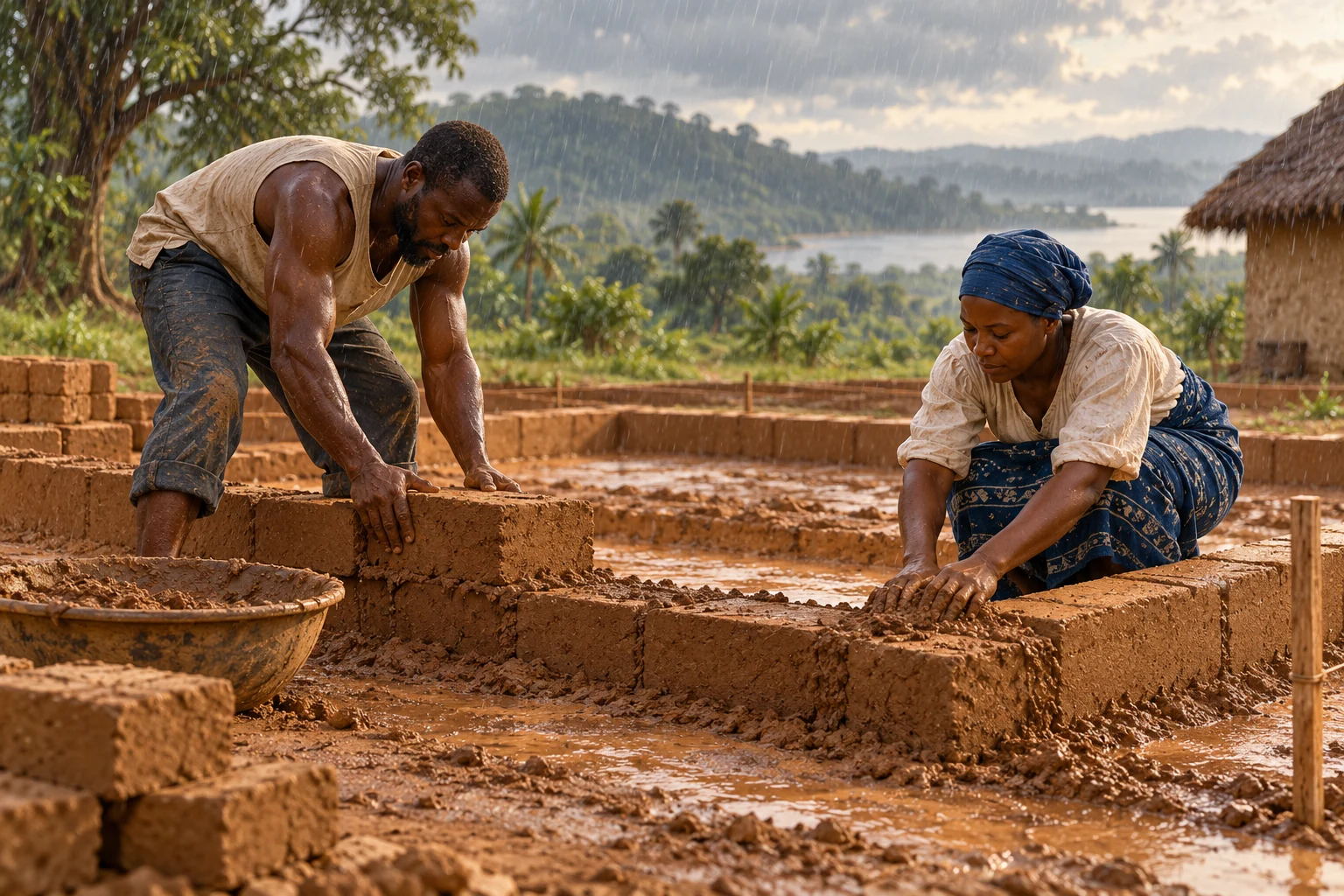
Orisa-Nla calls the divinities to build a house in the dry season, requiring hard clay to be worked without added water. Òrúnmìlà is absent because Èṣù detains him over an unfulfilled obligation. After the others disperse, he must undertake the task alone. Renewed cooperation with Èṣù brings rain to soften the clay. A further demand requires the foundation to begin from above. Èṣù directs Òrúnmìlà to invite the owner to lay the first portion, according to the owner’s established role. Repeated attempts fall to the ground, so construction begins there and the other divinities later return to complete it.
The house’s impossible conditions become workable through two different interventions. Rain changes the material, while the owner’s required first act reveals where a foundation can actually remain. Within the source, Èṣù’s cooperation follows an addressed sacred obligation; his earlier obstruction and later assistance belong to the same consequential relation. The episode is therefore not merely a story of a clever worker embarrassing an unreasonable client. It concerns how divine participation makes construction possible and how ownership carries an initiating responsibility rather than only the power to demand.
Read beside the earlier brain-hoarding ruler, it also shows an authority’s instruction encountering a limit outside its assertion. The speaking-head fable supplies another kind of limit, where an extraordinary statement cannot be reproduced publicly. These comparisons can support modern questions about evidence and practicability, but should not remove the source’s spiritual order. The final building is collective again: a successful intervention restores others’ participation instead of proving that a single diviner should permanently do everyone’s work.
Narrative witness and setting: Account explicitly headed Revelações de Cromwell Osamaro
Imesi-Pola’s departed good things come home
The people of Imesi-Pola experience prosperity as something that has left their settlement and seek divination about its return. They complete the response together. The narrative then describes several forms of renewed life: crops flourish, generation resumes, new children arrive, and money again moves through the town. The ruler organizes a public thanksgiving rather than treating recovery as a private achievement. The account presents good conditions as returning presences whose relation to a place can be repaired. Its action is brief but communal, connecting cultivation, family continuity, exchange, and an acknowledged religious response in a single settlement.
The good things do not function only as statistics in the witness. Their departure and return describe a religious relation through which a community understands flourishing. That language should not be replaced entirely by modern indicators of economic recovery, although the named manifestations remain concrete. Thanksgiving also matters as a second moment: receiving renewal is followed by publicly recognizing its source. This gives a different response to collective difficulty from the earlier ruler who seizes people’s brains for private gain.
There, authority treats persons as interchangeable material and must lose office; here, the community acts and its ruler leads acknowledgment after the return. The house account adds a third pattern in which divine cooperation makes a blocked common task possible. The stories do not promise every town an identical outcome or assign infertility to communal neglect. Their comparative force lies in how a place’s wellbeing involves several relations at once, none reducible to the ruler’s possession of power.
Narrative witness and setting: Account explicitly headed Revelações de Cromwell Osamaro
What was born in this Odù
“Born” can name an explicit traditional origin association or what emerges through a story: a capacity, relationship, practice or order of life. Interpretations drawn from a narrative are labelled below, so their basis remains clear.
Apetebí ceremony
Selected traditional source association.
The explicit origin list associates this sign with the apetebí ceremony and role. Its significance belongs to a particular religious setting; it should not be expanded into a universal account of women’s relationship to Ifá.
Discontent with one’s guardian affiliation
Selected traditional source association.
The list associates the sign with wishing for a different guardian deity. This records a local concern about acceptance and belonging; it is not a basis for prescribing a reader’s affiliation or diagnosing spiritual dissatisfaction.
Correlations to life dimensions
These questions bring the selected stories into contemporary life. They are interpretive invitations for study.
Work and resources
The ruler converts specialized knowledge into control over a population. The account invites scrutiny of who benefits when a professional capacity becomes opaque to the people affected, especially when oversight arrives only after visible harm.
Reflect: Who can challenge how your expertise is being used?
Relationships and family
The brain narrative makes individual identity something authority must respect. Care cannot be reduced to fitting people into convenient categories, even when the person doing it claims to be restoring order after a mistake. The ruler’s hurried repair repeats the original disregard.
Reflect: Where are you treating different needs as interchangeable?
Character and inner life
The hunter’s certainty concerns an experience he cannot demonstrate. The story can support disciplined speech that preserves the distinction between what one encountered, what one inferred, and what others have adequate grounds to believe. The listeners also need room to acknowledge uncertainty.
Reflect: How can you describe an uncertain experience precisely?
Community and responsibility
The villagers punish failed verification with death. Their response should remain open to criticism rather than being accepted as deserved. A responsible community needs procedures that can hold uncertainty without humiliating or destroying the person making the claim.
Reflect: What would a fair response to an unverified claim require?
A deeper reading of the sacred relationships
Sacred cooperation makes a common undertaking possible
In the building account, Èṣù’s relation with Òrúnmìlà changes from detention to assistance after a neglected obligation is addressed. Rain and the owner’s first act then make a common building possible. Imesi-Pola’s people likewise respond collectively before flourishing returns, and thanksgiving recognizes that renewal as received rather than self-generated. These are theological explanations of cooperation, not simply motivational stories about teamwork. The earlier mind-seizing ruler stands in contrast because he appropriates another power’s knowledge to control the population. A source-conscious interpretation can explain the difference between participation in a sacred relation and a claim to monopolize its force, while avoiding ritual directions or guarantees for a reader’s own circumstances.
Authority is limited by the conditions of what it asks
Orisa-Nla’s demand that a foundation begin above ground encounters what the clay can do when the owner performs the initiating act. The mind-seizing ruler’s restoration fails because he ignores individual identities. The speaking-head fable’s public test fails because the head does not repeat its speech. These limits differ: material, personal, and evidentiary conditions cannot be merged into a single rule. Yet all three prevent an assertion of authority from making an outcome true by itself. The town’s thanksgiving adds a gentler relation to authority, with a ruler recognizing a benefit rather than ordering reality to conform. Contemporary reflection can ask how responsibility responds when a command meets a condition it cannot simply override.
Collective flourishing has more than one visible form
The return at Imesi-Pola includes fields, generation, children, and circulating money. Its breadth prevents prosperity from being equated only with a ruler’s wealth or an isolated commercial result. The house account likewise ends with other divinities returning to complete a shared structure, not merely with one character winning an argument. The earlier brain narrative shows the opposite distortion, where public capacity is diverted toward a leader’s benefit. A contemporary comparison can therefore examine what counts as evidence that a community is doing well. The source’s language of returning good presences remains religiously specific, and its account of generation should not be used to measure the worth of childless people or explain actual reproductive difficulty.
Questions that deepen the study
Does the foundation episode dismiss Orisa-Nla’s religious authority?
The account brings the owner back into the act that begins the house, using a recognized obligation attached to that position. It does not say that no sacred authority is valid. Instead, the request is tested through the owner’s own initiating action, and the result changes how construction proceeds. Èṣù’s counsel is essential, so the outcome remains inside a divine order rather than becoming a purely secular victory of practical reason. A contemporary interpretation can ask whether an authority shares the conditions imposed on others. The narrative’s final return to collective construction matters: correction makes the task possible rather than simply ending the relationship in humiliation.
What is the purpose of thanksgiving after prosperity returns?
It marks the difference between receiving changed conditions and recognizing the relationship through which the community understands them. The town’s fields, households, and exchanges are already improving before the ruler gathers people to give thanks. The public act therefore does not create the first benefit in the sequence; it acknowledges that the benefit is more than a ruler’s achievement. Within the witness, this belongs to sacred reciprocity, not merely public relations. A contemporary reader may ask how a community remembers the contributions behind recovery, but should not replace the religious addressee with an abstract idea of gratitude or assume that celebration proves every underlying difficulty has disappeared.
How do these witnesses change the speaking-head fable’s lesson?
They prevent speech from being judged by one failed public repetition alone. The house story includes counsel that materially changes what can be built, while the Imesi-Pola account gives public thanksgiving a role after a religious response. Words can therefore guide, test, acknowledge, or fail to establish a claim, depending on their relation to action and sacred authority. The hunter’s sincere experience is not automatically public proof, but the villagers’ violent certainty is not vindicated simply by the head’s silence. The new accounts make room for a more differentiated discussion of speech without abandoning the religious world in which divination and addressed acknowledgment have consequence.
What the four narratives reveal together
The additions broaden Òdí Òṣé’s earlier concern with minds and speech into the conditions of collective action. A blocked building becomes possible through renewed cooperation with Èṣù, changed material conditions, and an owner performing his own initiating duty. A town receives the return of good presences and publicly acknowledges them through thanksgiving. These accounts differ from the ruler who seizes minds and the hunter whose extraordinary experience becomes a fatal public test.
Their comparison preserves a world in which divine agency, consultation, and sacred reciprocity are effective, while showing that authority cannot be understood only as the power to command. Materials, individual identities, witnessed events, and received benefits each require a fitting response. Contemporary reflections on practicability and public wellbeing can grow from those differences, but should not replace the source’s theological account or turn its prosperous endings into a universal formula.
Living with this Odù
A continuing life or initiatory relationship
For someone carrying Òdí Ọ̀ṣẹ́ within a received spiritual history, authority and speech remain answerable to the persons they affect. Bombo Shekete treats people’s minds as material he can collect for himself. The speaking-head witness gives a different problem: an extraordinary private experience becomes impossible to verify through the public test that follows. Neither story makes a person’s inner life automatically available to institutional control or public proof.
The difficult house adds an external test of demands that cannot be fulfilled as stated. Òrúnmìlà’s renewed cooperation with Èṣù changes both material conditions and the relation to the owner’s role. Imesi-Pola’s recovery then locates flourishing in a whole settlement’s addressed religious relation, not in one hero’s mastery. Across changing circumstances, reflection can concern how one uses authority, which claims require evidence, whether a demand can actually be carried out, and how collective recovery is acknowledged. The sign does not define a person as irrational or unusually gifted. It invites a character able to respect distinct minds, speak with proportion, and distinguish a shared world’s actual conditions from the confidence with which a powerful person describes them.
A particular consultation and its question
In consultation, Òdí Ọ̀ṣẹ́ can sharpen the distinction between the truth of an experience and what a public procedure can establish. The speaking head’s silence does not retrospectively describe what the hunter heard, yet the villagers treat failure of demonstration as proof of lying. A present consultation cannot decide an unknown extraordinary claim from this resemblance. It can ask what evidence is available and whether the proposed consequences exceed what the procedure can know.
The ruler’s handling of minds raises the separate issue of authority overriding personhood. The house narrative adds an impossible specification and a way of making the owner encounter its implications. Rain, Èṣù’s cooperation, and the owner’s expected contribution remain actual religious and social relations in that witness. Imesi-Pola’s thanksgiving further asks whether improvement is understood collectively or claimed by one participant. A practitioner may distinguish disputed testimony, coercive authority, unworkable demands, and communal recovery within the client’s actual question. These are different configurations, not one warning about talking too much. The result concerns the present circumstances and does not authorize diagnosis, a permanent spiritual identity, or punishment for a claim whose public verification remains uncertain.
Constructive and adverse possibilities
Constructive unfolding may protect the integrity of distinct persons, bring a demand into contact with material reality, and recognize a settlement’s recovery through shared thanksgiving. In the house witness, renewed relation with Èṣù participates in rain and in exposing what the requested foundation entails.
Adverse unfolding can involve authority taking what belongs to another’s personhood, public judgment outrunning evidence, or confidence used to conceal an impossible requirement. The speaking-head story is especially exact: a failed demonstration becomes fatal because the observers assume it proves more than it does. These contrasts do not make every unusual claim true or every institution oppressive. They ask how knowledge and authority remain proportionate to what is actually known. Imesi-Pola adds that beneficial conditions may concern cultivation, family life, and exchange together rather than one narrow indicator. No actual reading’s state follows automatically.
An illustrative situation in everyday life
Consider a hypothetical project in which a director demands a result that the team cannot produce with the available materials, then interprets every objection as disloyalty. One worker reports a problem seen privately but cannot reproduce it during a demonstration. The house and speaking-head accounts distinguish an impossible demand from uncertain public evidence. The worker’s inner fear of appearing incompetent may tempt her to claim more certainty than she has. A proportionate response would examine conditions and limit consequences to what the inquiry supports. The director could also participate in testing the specification rather than merely repeating it. This illustration does not validate an extraordinary claim or translate Èṣù into a management technique; it explores the narratives’ distinct questions of demand and proof.
Sources and reading context
The first two narrative witnesses
The accounts are Spanish Cuban-style material without a securely identified author. The speaking-head motif is widely circulated; its wider route is not established here. Origin associations remain local, and stigmatizing claims in neighboring paragraphs are excluded.
Narrative motifs are summarized independently. The life-dimension reflections are contemporary interpretation. How these reference studies are built explains the wider source approach and the distinction between a reference article and personal divination.
Additional named witnesses
-
Cromwell Osamaro. The explicit heading covers the divine house-building account and Imesi-Pola’s returned prosperity.
-
Spanish Cuban-style narrative sequence. The mind-seizing ruler and speaking-head accounts remain distinct earlier selections.
The source has rough pronouns and a contradictory verb around rain; the clear narrated outcome is rain softening clay. The return of fertility is contextualized as a sacred communal motif, not medical causation. No construction miracle or prosperity promise is presented as historical verification.
Bibliographic identification
- C. Osamaro Ibie. Ifism: The Complete Work of Orunmila. Lagos; multivolume publication beginning 1986. Library catalogue record. Related bibliographic record for the named narrative witness. Exact volume, edition and page of the transmitted account have not been independently matched.
Read the source method and wider scholarly context.
The catalogue links identify published works and their authors. They are separate from proof of an individual episode’s wording or attribution. Contemporary comparisons and the synthesis above are editorial interpretation. The author’s books and Academy companions below provide further study; their sales links are separate from the source references.