
Ọ̀ṣẹ́ Òdí is a mixed Odù in Ifá’s 256-part corpus. The selected Òṣé Odi stories contrast a city that changes an approaching enemy’s relationship to it with a diviner who recognizes the future utility of neglected objects. Oyá becomes a guardian after an encounter with a city prepared to receive her, while Òrúnmìlà’s collection of weapons complicates the relation between foresight and profit. Both narratives ask how judgments change when immediate appearances no longer define a situation.
A question to carry through the study: Which overlooked practical need should you examine before joining everyone else’s pursuit of visible rewards?

This Academy reads the right column first, then the left. Each row carries a single or double mark.
Where this Odù belongs
Ọ̀ṣẹ́ Òdí belongs to the Ọ̀ṣẹ́ family in this Academy’s study sequence. It is a mixed Odù, distinct from Òdí Ọ̀ṣẹ́. The order matters. Its teaching is approached through its own narratives, rather than by adding two general descriptions of the principal signs together.
Key Òrìṣà and sacred relationships
The figures below are selected for their roles in the accounts discussed here. They offer connected reading paths through the tradition.
-
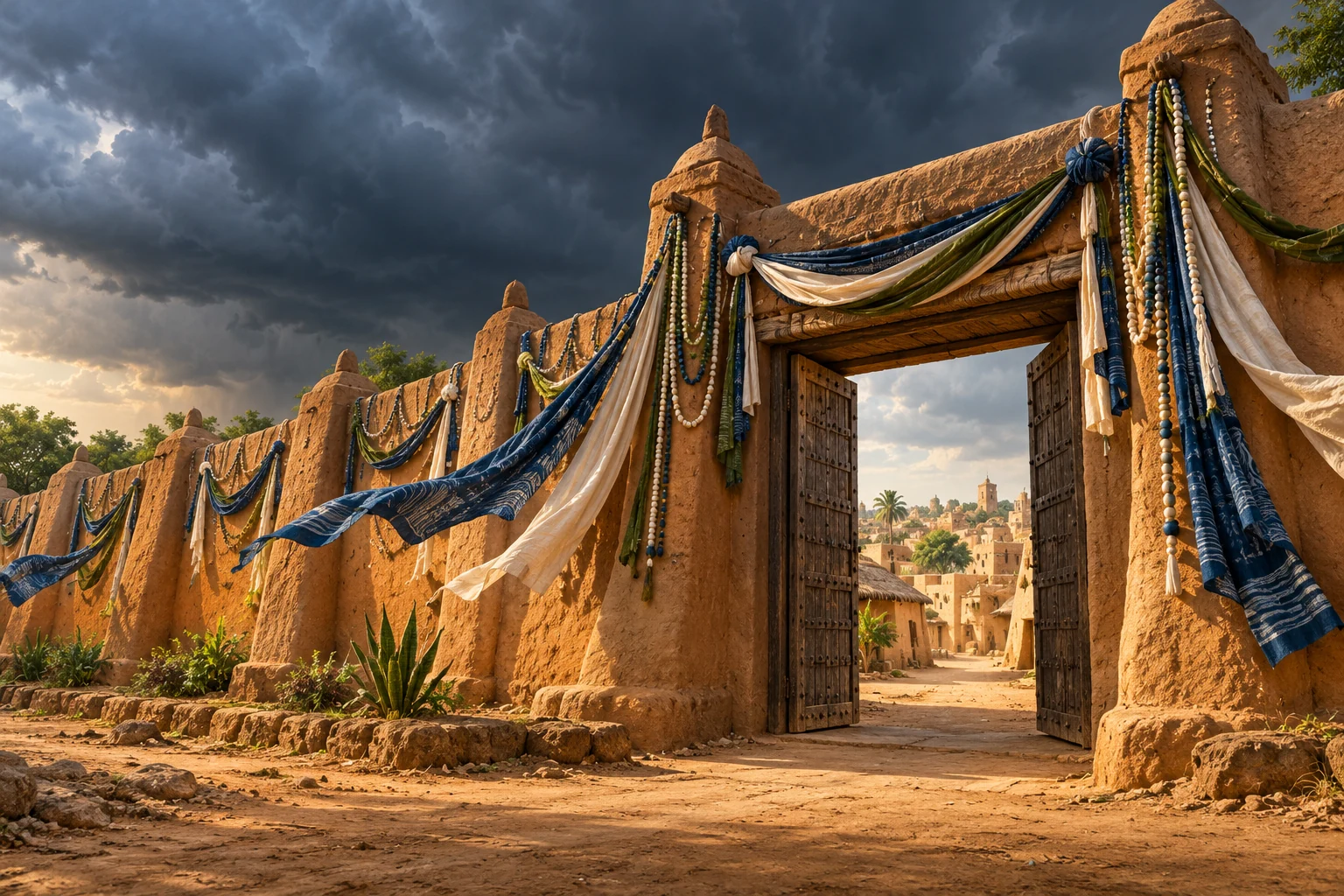
Ọya. Oyá approaches Ilofla as an attacking ruler but responds to the city’s preparation and becomes its guardian; her change establishes the narrative’s emblem of decorated scarves.
-
Ọ̀rúnmìlà. Òrúnmìlà advises the threatened city and, in the rain narrative, notices the future utility of weapons that the crowd leaves untouched while collecting portable wealth.
Key myths and their meanings
A city receives the approaching whirlwind
Oyá rules another territory and prepares to attack Ilofla. Its ruler learns of the danger and consults Òrúnmìlà. The city’s preparations include honoring Oyá and decorating its walls with scarves and beads. When she arrives, the sight pleases her and the anticipated assault changes into a protective relationship. The account explains the association of particular decorative scarves with her in this religious setting.
The city does not meet the threat with a symmetrical display of force. Instead it recognizes the approaching power and creates another role for it. The transformation is striking, but it remains a mythic encounter rather than a general method for handling violence. We can examine imaginative diplomacy, symbolic recognition, and protective alliances without suggesting that people facing aggression are responsible for appeasing an aggressor.
Narrative setting: Cuban/Lukumí patakín identified in the selected account; no individual narrator is named.
The rain everyone leaves behind
Olofin sends successive rains containing precious objects, money, and finally weapons. The crowd gathers the apparent riches and ridicules Òrúnmìlà for ignoring them. He instead gathers what falls in the last rain, which others consider useless. When war follows, people purchase his collection and he becomes wealthy. A nearby version adds farming tools, widening the neglected category of practical implements.
The central distinction is between attractive value and use that emerges under changed conditions. Yet the ending is ethically unsettled because foresight is rewarded through other people’s insecurity. A strong reading should preserve that problem: preparedness can serve common defense, but it can also become profitable dependency. The farming-tool variant matters because it makes practical labor visible alongside conflict instead of reducing usefulness entirely to weapons.
Narrative setting: Cuban/Lukumí patakín identified in the selected account; no individual narrator is named.
The ram searches after neglecting his companion
The Salami unit addresses a ram identified as the husband of a ewe. He is warned against treating his wife with disregard or indifference. The situation continues until he neglects the relationship and the ewe leaves. He then searches, while others participate in trying to identify someone resembling the absent companion. The translation’s later lines about showing and taking away a possible match are unclear, so they do not establish a completed reunion. The ending describes belated praise for the diviners whose counsel he now recognizes. It is a compact account of disregard becoming absence.
The ewe’s departure gives the neglected relationship an agency the ram failed to acknowledge while it remained available. His later search cannot simply restore the earlier situation by increasing desire; the surrounding community now becomes involved in what private indifference has made publicly difficult. Within the verse, the diviners’ counsel already named responsibility before loss, so the belated praise changes his understanding without proving that the relationship has been repaired. This is not a warrant for making a spouse’s presence conditional on obedience, nor does the text narrate the wife’s reasons in enough detail to supply a complete marital history.
Its most precise dilemma is temporal: recognition arrives after the other person has acted. A contemporary reading can ask what attention means before a departure, while preserving the source’s religious understanding that counsel discloses an obligation the recipient is answerable for inhabiting rather than merely hearing.
Narrative witness and setting: Passage explicitly labeled Ayo Salami, with Yoruba verse and Spanish translation in the supplied compilation.
Owá dismisses a father who remains spiritually present
A second Salami unit places Olánlègè in the role of diviner to Owá. Earlier announcements concerning wealth, partners, children, and a house establish a history of counsel and its acknowledged fulfillment. Owá is later directed to care for his father’s tomb. He dismisses the concern because the father died long before, refusing the response requested. The father subsequently appears in a dream, and Owá weeps and recognizes the counsel he rejected. The passage’s central reversal concerns a relationship believed to have ended, rather than a newly discovered living adversary or an inherited object.
The account cannot be reduced to nostalgia without losing its religious claim. Owá’s father is not present only as a psychological memory; within the witness, the dead remain capable of an encounter that makes neglected responsibility consequential. The earlier fulfillments also matter, because Owá trusts counsel when it concerns desired acquisitions but questions it when it directs attention toward an obligation beyond immediate gain. His tears recognize more than the accuracy of a prediction: the father’s continuing place in his life becomes newly undeniable.
At the same time, the verse does not provide a full doctrine of ancestorhood, state that every dream carries such a message, or narrate an elaborate punishment. Those additions would exceed the short witness. A contemporary reflection can examine selective listening and remembrance, provided it does not replace the account’s sacred encounter with a claim that the dream is merely an expression of guilt.
Narrative witness and setting: Passage explicitly labeled Ayo Salami, with Yoruba verse and Spanish translation in the supplied compilation.
What was born in this Odù
“Born” can name an explicit traditional origin association or what emerges through a story: a capacity, relationship, practice or order of life. Interpretations drawn from a narrative are labelled below, so their basis remains clear.
Gendered dissatisfaction in the origin catalog
Selected traditional source association.
The only explicit beginning in this section describes dissatisfaction through a stereotype about women and partners. It can be documented as a source limitation and a motif of discontent, never as a factual description of women or readers.
A former threat becomes a guardian
Contemporary interpretation from the selected myth.
The city’s encounter with Oyá can be read as the emergence of a protective role from an expected attack. This is contemporary interpretation of the narrative’s reversal, not a claim that every lineage lists guardianship as this sign’s beginning.
Correlations to life dimensions
These questions bring the selected stories into contemporary life. They are interpretive invitations for study.
Work and resources
The rain narrative asks how value changes with circumstance. We can distinguish storing what serves real needs from simply accumulating visible tokens of wealth, then examine whether the owner shares those capacities fairly when conditions worsen.
Reflect: What would become useful if circumstances changed suddenly?
Relationships and family
Oyá’s movement from attacker to guardian illustrates how a relationship can acquire another form through recognition. The story does not erase the original threat, so any analogy should retain questions of safety, consent, and durable trust.
Reflect: What would make a changed relationship trustworthy over time?
Character and inner life
Òrúnmìlà tolerates ridicule while choosing differently from the crowd. The trait worth examining is independent judgment tied to concrete observation, alongside the need to question whether a private gain has become the sole measure of good judgment.
Reflect: Can you explain your choice without relying on the crowd’s approval?
Community and responsibility
The two tales offer different community outcomes: protection from an attacker and the costly purchase of defense. Comparing them raises the question of whether preparedness should create broad security or place others at the mercy of one resource holder.
Reflect: Who can access the protections your community prepares?
A deeper reading of the sacred relationships
Counsel binds desired goods to religious responsibility
The Salami units understand divination as more than information about future events. Counsel names obligations toward a spouse and a deceased father, locating favorable life within relationships that require response. Owá accepts earlier announcements about goods but resists the ancestral responsibility, while the ram understands the warning only after his companion leaves. The prior Oyá narrative similarly changes a city’s relation to a powerful visitor through religious recognition, and the rain story gives Òrúnmìlà a different understanding of what has arrived. Across these witnesses, knowing is consequential because it asks how a disclosed relation will be inhabited. A modern lesson about listening may follow, but does not replace that sacred accountability.
The different times of recognition
The four accounts distribute understanding across different moments. The city recognizes an approaching power before the expected attack; Òrúnmìlà attends to future utility while the crowd values immediate riches; the ram recognizes a spouse’s importance after departure; Owá understands a father’s continuing presence through a dream after refusing counsel. Timing therefore changes what recognition can accomplish. It can prepare a different encounter, preserve an overlooked resource, expose an absence, or reopen an obligation. These are not interchangeable examples of foresight. Their comparison asks when attention is still able to alter a relationship and when it must instead become repair, acknowledgment, or a changed account of what has already happened.
Absence is not a single condition
The ewe’s absence follows a living decision to leave, while the father’s absence through death does not cancel spiritual relationship in the verse. The rain story introduces another kind of apparent absence: practical value is present but unrecognized until circumstances change. Oyá’s city encounter then shows an absent protective role being established through a new relation. Keeping these forms distinct prevents easy advice about reclaiming everything lost. A departed partner is not an object awaiting retrieval, an ancestor is not simply a former acquaintance, and unused implements are not equivalent to either. The sign’s depth emerges through these different kinds of presence and the responsibilities each makes possible.
Questions that deepen the study
Does the ram’s search show that remorse repairs neglect?
The selected translation does not establish a completed reconciliation. It shows search, communal participation, uncertain identification, and belated acknowledgment of counsel. That is enough to distinguish remorse from repair: the ram’s changed understanding does not automatically oblige the ewe to return. Within the religious account, recognizing the diviners’ words matters, but it does not supply the wife’s unreported consent. A contemporary reader can ask how sustained attention would differ from urgent pursuit after loss. The narrative’s uncertainty is useful because it prevents a reference entry from promising that a dramatic declaration will restore a relationship whose history has changed.
Why does Owá accept counsel about prosperity but reject counsel about his father?
The contrast is explicit even though the verse does not explain his entire inner life. Earlier announcements concern things he wants and later receives; the ancestral direction asks him to acknowledge a relationship he assumes has no present claim. His dismissive response makes that difference visible. A religious reading understands the dream as an encounter with continuing spiritual presence, not simply a lesson engineered by a human adviser. A contemporary application may examine the temptation to accept guidance only when it promises acquisition. That application remains distinct from assigning a hidden ancestral debt to a reader or interpreting every dream as instruction.
How can foresight remain valuable without becoming control over others?
The city’s preparation changes its relation with Oyá, and Òrúnmìlà gathers overlooked implements before their value becomes obvious. Those acts differ from controlling a spouse’s choice or eliminating the father’s spiritual claim by dismissing it. The comparison suggests that foresight is most useful when it prepares a responsible response to reality, rather than requiring reality or another being to conform to one’s preferred ending. This is a contemporary synthesis, not a doctrine stated identically in every witness. It should retain the troubling profit from war in the rain story and the unresolved reunion in the ram verse instead of smoothing either away.
What the four narratives reveal together
The two Salami units bring Òṣé Odi’s concerns into relationships that cannot be secured by position or anticipated utility alone. The ram learns that a present companion can leave; Owá learns that a deceased father can remain spiritually consequential. These differ from the earlier city’s transformation of threat into guardianship and Òrúnmìlà’s preservation of neglected practical resources. Together the four stories give recognition a temporal and religious depth: some responses prepare an encounter, others acknowledge what neglect has already changed, and ancestral presence exceeds the assumption that death ends every obligation.
Their distinct forms should remain visible. A spiritually accurate entry can affirm the witnesses’ sacred realities while identifying its present-day reflections about attention, repair, and selective listening as interpretations. It need not force a completed marital reunion, a universal dream code, or an uncomplicated moral verdict on the wealth gained through war.
Living with this Odù
A continuing life or initiatory relationship
For someone whose received life or initiatory Odù is Ọ̀ṣẹ́ Òdí, these witnesses distinguish attention before an event from recognition after another being has already acted. The city’s response to approaching Oyá changes the relation before attack; the ram notices his companion’s importance only after departure. Long-term development therefore concerns timing as much as sincerity. A late realization can matter without restoring the former arrangement or cancelling another person’s agency.
Owá’s father introduces a different presence: death has not ended the sacred relation in that Salami witness. It should not be confused with the absent ewe, whose departure is a living decision. The rains add value present but dismissed until circumstances alter its usefulness, with the farming-tool variant preserving labor alongside warfare. Over time, a person may need to recognize an approaching responsibility, attend to someone already near or acknowledge a relation they wrongly treated as finished. Ifá’s counsel and the dream encounter remain religiously consequential. The sign does not turn everyone into a forecaster, promise profitable foresight or require people facing aggression to appease it. Its continuing question is what form of presence has been overlooked and what response is still possible.
A particular consultation and its question
In consultation, Ọ̀ṣẹ́ Òdí helps examine which moment of a relationship the client actually inhabits. Is there time to establish a different encounter, as in the city’s recognition of Oyá? Has another party already withdrawn, making repair different from prevention? Is an apparently useless resource waiting for changed circumstances? The accounts should not be compressed into one instruction to reclaim what was lost.
The ram’s witness does not establish reunion, and uncertainty in its translated ending should remain visible. Owá’s dream concerns a spiritually present father within a particular narrative; it cannot identify the meaning of every client’s dream. His selective acceptance of counsel also raises a specific question about receiving desired goods while refusing the obligations disclosed alongside them. The consultation’s actual question determines whether that tension applies. Olofin’s rains and Oyá’s changed relation retain sacred agency rather than becoming a generic forecasting exercise. A result encountered for a particular issue is not permanent identity. Reflection can ask what was heard, what was dismissed and whether the next response involves preparation, acknowledgment or respect for another party’s decision, without announcing an unknown reader’s circumstances.
Constructive and adverse possibilities
Constructive possibilities include recognition arriving while it can alter an encounter, practical value being retained without contempt for others and counsel being inhabited before absence becomes the only teacher. Owá’s acknowledgment also makes room for a relationship he wrongly regarded as completed. Within the sources, divine and ancestral presences act; they are not passive symbols of his emotions.
Adverse possibilities include belated attention that tries to override a departed partner, accepting guidance only when acquisitions are promised or using foresight to create profitable dependency during insecurity. The war-rain ending deserves that ethical question even when Òrúnmìlà prospers. The city’s successful encounter is no assurance that recognition prevents real violence. These alternatives help assess the actual relationships of a reading without assigning its state in advance or making one plot the sign’s compulsory life pattern.
An illustrative situation in everyday life
Hypothetically, a project team ignores a quiet coordinator until she resigns. Managers then offer dramatic praise and expect her immediate return. Her departure has changed the situation: acknowledgment cannot erase her new commitments. The ram’s search helps distinguish recognizing value from possessing the right to restore an earlier arrangement. A constructive response could include addressing the conditions that led her to leave and respecting her decision, even if she declines. The rains add another question about useful work that was visible but undervalued before a crisis. This is an illustrative comparison about timing, presence and responsibility. It does not equate a worker with an animal figure, claim that the source narrates a reunion or infer a consultation result about anyone.
Sources and reading context
The first two narrative witnesses
This study concerns Cuban/Lukumí narrative variants. Only one explicit origin entry is given, and its sexist formulation is retained solely as a critical limitation. Weapons and war remain narrative themes; no practical violence guidance or personal prediction is offered. The added emergence motif is explicitly interpretive where marked, rather than a traditional origin-list claim.
Narrative motifs are summarized independently. The life-dimension reflections are contemporary interpretation. How these reference studies are built explains the wider source approach and the distinction between a reference article and personal divination.
Additional named witnesses
-
Ayo Salami. The ram-and-ewe unit and the Owá ancestral-dream unit come from this explicitly named Yoruba-and-Spanish source block.
-
Cuban/Lukumí compilation witness. The earlier Oyá city encounter and the rain narrative remain distinct Cuban witnesses for comparison.
The ram verse’s translation is ambiguous around possible replacements or reunion; no completed return is asserted. The father’s dream is a sacred encounter within the source, not a general dream interpretation method. No family predictions, ritual procedures, or universal ancestor obligations are assigned to readers.
Bibliographic identification
- Ayo Salami. Ifá: A Complete Divination. Lagos: NIDD, 2002 catalogue record. Library catalogue record. Bibliographic identification of the named author and work; the edition behind the transmitted account remains to be matched.
Read the source method and wider scholarly context.
The catalogue links identify published works and their authors. They are separate from proof of an individual episode’s wording or attribution. Contemporary comparisons and the synthesis above are editorial interpretation. The author’s books and Academy companions below provide further study; their sales links are separate from the source references.