
Òdí Òtúrá is a mixed Odù in Ifá’s 256-part corpus. Òdí Òtúrá’s selected accounts turn on what a person can see and what another can be trusted to keep private. Atago seeks help for Obatalá while another servant hopes to inherit his wealth. A sequence about three palms tests whether sons can return their father’s belongings without exposing a confidence. These motifs support a precise discussion of trustworthy service and discretion, while the source’s broader moralizing claims require careful contextual limits.
A question to carry through the study: Can you help someone without making their private vulnerability public?

This Academy reads the right column first, then the left. Each row carries a single or double mark.
Where this Odù belongs
Òdí Òtúrá belongs to the Òdí family in this Academy’s study sequence. It is a mixed Odù, distinct from Òtúrá Òdí. The order matters. Its teaching is approached through its own narratives, rather than by adding two general descriptions of the principal signs together.
Key Òrìṣà and sacred relationships
The figures below are selected for their roles in the accounts discussed here. They offer connected reading paths through the tradition.
-
Obàtálá. Obatalá depends on the loyalty of a cook while another servant anticipates his death for personal gain. His vulnerability reveals how different motives can inhabit the same household.
-
Ọ̀rúnmìlà. Òrúnmìlà interprets Atago’s appeal and directs him toward the forest intermediary who has the relevant knowledge, making consultation a route toward another person’s contribution.
-
Èṣù. Eshu Faun is the forest figure who reveals the plant associated with Obatalá’s recovery. His relationship with the household Eleguá includes obstructed perception, not simple interchangeable manifestations.
Key myths and their meanings
The cook who seeks help
Obatalá is gravely afflicted and has two servants whose hopes diverge. One waits to benefit from his death; Atago, his cook, seeks Òrúnmìlà. The consultation sends him toward the forest and Eshu Faun. There he learns of a plant associated with restoring Obatalá within the narrative. Atago’s active concern makes him a trusted figure in the household afterward.
The conflict concerns motive rather than proximity: both servants are close, but only one uses that access for care. Atago does not pretend to possess the knowledge himself and follows a route through other contributors. We can examine trusted service and conflicts of interest, while excluding plant identification, treatment instructions, and any suggestion that the religious account substitutes for healthcare.
Narrative setting: Spanish Cuban-style account of ewé akikale.
Three palms return a father’s belongings
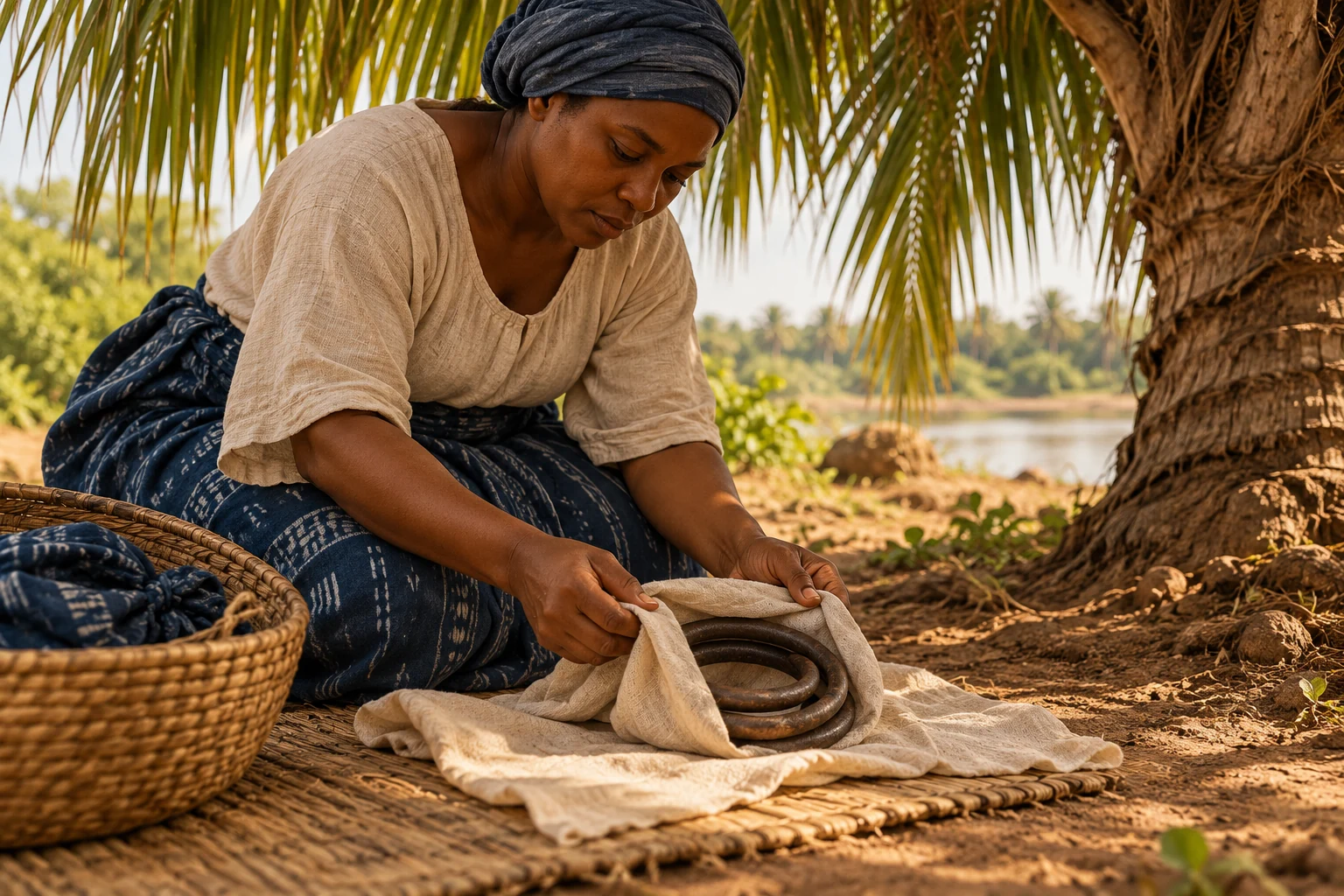
Odi Atauro visits three palm sons and tests their discretion. After private meals, he leaves iron bracelets behind. The date palm and coconut palm return them with public remarks about what he consumed. The ikín palm, advised by its wife, wraps the bracelets and returns them without exposing the confidence. The father rewards this discretion by declaring the palm’s many parts useful to people.
The decisive difference is not whether the sons return property, but how they protect a confidence while doing so. The wife’s practical suggestion is essential, preventing the favored son’s action from appearing wholly self-generated. The account rewards secrecy, yet responsible commentary should distinguish protecting ordinary privacy from concealing harm; its ethical value depends on what is being withheld and whose interests silence serves.
Narrative setting: Spanish sacred origin account.
Arine gives away the help she was meant to carry
During disorder in heaven, divination identifies snails as necessary to a religious response. The wealthy elder daughter Nene refuses the errand, while Arine immediately sets out. God supplies her with several aids but does not explain every use. Eziza, the wind power, appears in successive disguises asking for them, hoping to frustrate her. Arine gives each freely. In the final encounter, the disguised power directs her to abundant snails and helps make a carrying basket. She returns with what the work needs, and Òrúnmìlà restores heavenly order through the response. The sisters’ material fortunes are then reversed.
Arine’s gifts are not presented simply as foolish depletion or as a modern universal rule to give away everything. Their significance belongs to a task initiated by divine consultation and to encounters whose identities she does not know. The wind power begins as an obstructer but becomes a source of direction and transport, making the relation change through the journey. This adds complexity to the earlier palms’ discretion: there, the test concerns preserving a confidence while returning an object; here, the aids given for one task reach their purpose through generosity to apparent strangers.
The faithful cook Atago supplies a third relation, seeking knowledge outside the household on behalf of someone vulnerable. These accounts share neither one automatic attitude toward possession nor one fixed role for the stranger. Arine still must bring the necessary beings home, and the eventual religious work remains Òrúnmìlà’s. The story’s theology is thus a chain of contributions, not simply an individual virtue receiving a cash reward.
Narrative witness and setting: Account explicitly headed Revelações de Cromwell Osamaro
The lost bell returns to its own keeper
A diviner lives alone in an abandoned settlement and dreams of its renewal and his own kingship. Consultation directs attention to his head, Èṣù, and a bell associated with his practice. He later loses his sight, and the bell is stolen. Returning residents learn that whoever recovers the bell should become ruler. After heavy rain, the diviner slips into water and finds the missing object while trying to emerge. The people initially reject his claim because he cannot see. During the ensuing confrontation his sight returns within the account, and they recognize the combined events as divine and ancestral support for his accession.
The story refuses to make the path from consultation to an anticipated outcome smooth. The bell is established in religious practice, lost, and recovered through an event that first appears dangerous rather than royal. Its recovery by its own keeper also unsettles an expectation that another person would win office by solving his loss. The people’s refusal reveals an eligibility rule the narrative does not initially disclose: they assume blindness should bar rule. The subsequent restoration removes that obstacle in this witness, but a contemporary account should not require bodily change before recognizing a disabled person’s dignity or capacity.
Within the source’s own explanation, the people interpret a conjunction of events through God and ancestors, not merely a lucky find. Compared with Atago’s service and the palms’ discreet return, the bell adds public contest over what a fulfilled sign actually obliges a community to acknowledge. The account leaves their prior exclusionary assumption largely unexamined after coronation.
Narrative witness and setting: Account explicitly headed Revelações de Cromwell Osamaro
What was born in this Odù
“Born” can name an explicit traditional origin association or what emerges through a story: a capacity, relationship, practice or order of life. Interpretations drawn from a narrative are labelled below, so their basis remains clear.
Collapse of things
Selected traditional source association.
The origin list names the collapse of things and the description extends it to plans. This can be retained as an image of arrangements losing support, without predicting disaster or attributing actual structural failure to an Odù.
Profanation of sacred trust
Selected traditional source association.
The list names sacred profanation within a strongly moralizing cluster. A careful interpretive use can discuss violation of entrusted responsibility, but must avoid converting the source’s sexual stigma into judgments about contemporary identities or relationships.
Correlations to life dimensions
These questions bring the selected stories into contemporary life. They are interpretive invitations for study.
Work and resources
Atago’s response contrasts care with the anticipated profit of inheritance. The story gives a concrete way to discuss conflicts of interest where someone’s work places them close to another person’s vulnerability and resources. Both servants can see the same prospective inheritance.
Reflect: Where could personal gain distort your care for someone?
Relationships and family
The ikín palm’s wife supplies the discreet method of returning the bracelets. The account makes sound judgment collaborative, even when public recognition later appears to fall chiefly on the son who performs the action. Her contribution changes how the confidence is actually protected.
Reflect: Whose practical advice deserves to be remembered in your decision?
Character and inner life
The palms encounter a tension between returning a possession and announcing the story behind it. The favored response satisfies the practical need while avoiding unnecessary exposure, making restraint a precise action rather than mere silence.
Reflect: What detail can you leave private without withholding necessary truth?
Community and responsibility
Atago moves through consultation to a different source of knowledge. The narrative can support respect for limits of competence and for the people outside an institution’s center who may hold something necessary to its wellbeing.
Reflect: Who has useful knowledge outside your usual circle?
A deeper reading of the sacred relationships
Divine tasks distribute agency through a chain
Arine’s journey begins because heavenly order requires a response, not because she wants a personal prize. God supplies aids, Eziza changes role during successive encounters, Arine carries the snails back, and Òrúnmìlà completes the religious work. The bell account similarly connects a dream, Orí-related responsibility, Èṣù, an object of practice, and public ancestral interpretation. The earlier Atago story adds another chain, where loyalty leads beyond the household to a forest power’s knowledge. This is a religious account of interdependent action rather than a lesson that individual goodwill alone makes an outcome happen. Contemporary interpretation can ask about collaborative responsibility only after preserving these distinct spiritual contributions and the tasks they actually sustain.
Objects can carry different obligations without fixed meanings
The bracelets in the palm account test discretion when an entrusted possession is returned. Arine’s aids reach their purpose by passing into other hands. The bell must return to the keeper whose practice first gave it a place, while the plant in Atago’s journey communicates a specific forest relation. None of these objects therefore supports a universal rule either to keep, give, or recover. Their histories and the obligations around them determine what an action means. A source-conscious study can discuss sacred material life without assembling an arbitrary dictionary of symbols. The comparisons also show why contemporary lessons about generosity or secrecy need a stated context rather than being treated as timeless commands detached from a narrative.
Recognition may lag behind a fulfilled condition
The people receive a clear criterion about the bell, yet resist when the actual finder does not fit their image of a ruler. In the palm account, the father recognizes discretion through how the bracelets return; in the cook account, useful care creates trust after the intervention; Arine’s completed journey produces a changed judgment of the sisters. These are different processes of recognition rather than identical rewards. The bell episode is especially demanding because it exposes the gap between a stated test and an unstated eligibility assumption. Contemporary analysis can ask whether a community will honor a condition when its outcome surprises them, while distinguishing that question from the witness’s specific miraculous restoration and ancestral reading.
Questions that deepen the study
Does Arine’s story recommend giving away every necessary resource?
Its generosity occurs within a particular divine errand and a succession of encounters orchestrated by a wind power. The outcome depends on more than the resources leaving her hands: the final guide reveals where the snails are and helps supply a way to carry them. The narrative can support reflection on trust and responsive giving, but cannot establish that every demand from a stranger is sacred or that generosity always restores what is needed. Its first question is how an apparently obstructed divine task reaches completion through changed relations. A contemporary reader can examine the difference between possessiveness and discernment without borrowing a universal rule the passage does not supply.
Why is the bell’s return not enough for the people?
They apply an additional assumption that the finder must possess sight, even though the stated condition concerned recovering the lost bell. The story then gives a miraculous restoration that makes them accept the diviner, but does not analyze their assumption independently. A critical contemporary reflection can make that limit visible without rejecting the witness’s divine and ancestral explanation. The recovered object is already religiously meaningful through the earlier consultation and practice, so the event is not merely an accidental contest result. The episode asks how a community interprets fulfilled counsel when the person before it does not match an inherited image of eligibility or public authority.
How can discretion and generosity both be valued here?
They answer different obligations. The ikín palm protects a private confidence while returning belongings, whereas Arine responds to apparent need while carrying out an errand whose purpose lies beyond her own possessions. Atago adds loyalty expressed through seeking another’s help, and the bell account concerns restoration of something belonging to a practice. There is no contradiction unless one first assumes that every object and encounter must require the same response. The source’s religious logic is situationally specific through divination and named relationships. Contemporary interpretation can therefore ask what an action serves, who is entrusted, and what must remain protected, rather than choosing one virtue to override every other.
What the four narratives reveal together
The added witnesses make Òdí Òtúrá’s material and relational world more varied. The palms’ bracelets test a confidence, Atago’s journey seeks forest knowledge for a vulnerable household, Arine’s gifts become part of completing a heavenly task, and the bell’s return challenges a community’s unspoken rule of recognition. Each episode organizes a different chain of divine and human contribution. Their religious explanation should remain primary: consultation, Orí-related responsibility, Eziza’s interventions, Èṣù, and ancestral acknowledgment are consequential within the accounts.
Modern reflections on generosity, discretion, and eligibility can deepen the reading but should not replace that order or make the miraculous bodily restoration a condition for contemporary dignity. The differences also prevent one slogan about possession from dominating the sign. Sometimes an object must be returned quietly, sometimes shared, sometimes learned through another’s knowledge, and sometimes publicly recognized after its recovery.
Living with this Odù
A continuing life or initiatory relationship
For someone whose received life or initiatory history includes Òdí Òtúrá, care can require both action and discretion. Atago’s concern moves toward Òrúnmìlà and Eshu Faun rather than waiting to profit from Obatalá’s condition. The palm sons’ different returns distinguish keeping a relationship’s confidence from making one’s helpfulness publicly impressive. Neither action nor silence has a fixed value apart from the relation it serves.
Arine’s journey complicates any simple equation of generosity with safety. She relinquishes aids whose uses she has not fully understood, yet the encounter with Eziza eventually contributes to completing a sacred task. That particular ending is not a lifelong instruction to give away every protection. The bell keeper adds recognition obstructed by assumptions about bodily capacity. His relation to the head, Èṣù, and his practice remains consequential before the public can acknowledge it. Across changing circumstances, reflection may concern faithful service, responsible handling of confidence, discernment during a journey, or the gap between actual capacity and public prejudice. The sign does not promise that every trusting act will be rewarded. It invites attention to the different forms through which help, perception, and recognition become possible.
A particular consultation and its question
In consultation, Òdí Òtúrá’s narratives help distinguish confidentiality from passivity and apparent inability from the absence of a claim. The palm returns make discretion an active way of maintaining relation, while Atago’s search shows that care may require leaving a passive household posture to seek help. The actual question determines whether speaking, withholding, investigating, or acting is relevant. The sign alone cannot select a universal response.
Arine’s encounters add a situation in which the purpose of given aids is not fully explained and another power frustrates the journey. Her generosity becomes part of the account’s resolution, but it does not authorize an interpreter to remove a client’s protections or demand unquestioning giving. The lost bell likewise cannot make actual blindness evidence of hidden kingship. It can sharpen a question about what evidence is dismissed when others have decided who is capable. The religious relations of the head, Èṣù, Eshu Faun, and Òrúnmìlà remain particular to their witnesses. A careful discussion can examine which confidence needs protection, whose active care is overlooked, and what assumptions prevent recognition. These are possibilities for this consultation, not declarations about the client’s permanent character or future reward.
Constructive and adverse possibilities
Constructive unfolding can include service that seeks real assistance, discretion that protects another’s dignity, and recognition able to hear evidence beyond an assumed limitation. Atago’s concern becomes effective through religious mediation, and the bell keeper’s accession belongs to a sacred sequence rather than a general rule that suffering proves election.
Adverse unfolding may involve treating another’s difficulty as an opportunity, making a private confidence into public self-display, or dismissing a claim before examining it. Arine’s narrative adds the uncertainty of a journey whose aids are not fully understood. Its beneficial ending does not make indiscriminate exposure constructive in every situation. These contrasts locate possible developments in care and perception without assigning an actual reading’s condition. They also keep plant restoration within sacred storytelling rather than offering a treatment claim or converting a particular bodily transformation into a prediction.
An illustrative situation in everyday life
Imagine a hypothetical household in which an older relative’s difficulty becomes the occasion for arguments about future inheritance. A cook who sees the daily situation seeks appropriate help, while another relative repeats private details to display involvement. Òdí Òtúrá’s Atago and palm episodes distinguish active concern from opportunism, and discretion from doing nothing. The cook may fear that speaking beyond her role will be considered disloyal; the relative may confuse public attention with care. Clarifying who needs to know what can protect dignity while enabling action. The example does not reproduce Atago’s sacred plant account, identify anyone as a malicious power, or claim that responsible behavior guarantees restoration. It shows why useful help and impressive involvement can diverge.
Sources and reading context
The first two narrative witnesses
These are Spanish Cuban-style passages. The three-palm account names Ifé, Dahomey, and Arará locations within its own sacred geography; this does not establish historical botanical origins. Stigmatizing claims in the separate Loggun Ede account are not used here.
Narrative motifs are summarized independently. The life-dimension reflections are contemporary interpretation. How these reference studies are built explains the wider source approach and the distinction between a reference article and personal divination.
Additional named witnesses
-
Cromwell Osamaro. The explicit heading covers Nene/Arine and the abandoned settlement’s lost bell.
-
Spanish Cuban-style narrative sequence. The Atago and three-palm accounts remain separate unnamed witnesses in the source section.
Eziza is retained as the source’s wind power without an invented equation with another deity. The bell account includes an exclusionary assumption about blindness and a miraculous restoration; neither becomes contemporary disability guidance. Its nickname explanation is not repeated as verified etymology.
Bibliographic identification
- C. Osamaro Ibie. Ifism: The Complete Work of Orunmila. Lagos; multivolume publication beginning 1986. Library catalogue record. Related bibliographic record for the named narrative witness. Exact volume, edition and page of the transmitted account have not been independently matched.
Read the source method and wider scholarly context.
The catalogue links identify published works and their authors. They are separate from proof of an individual episode’s wording or attribution. Contemporary comparisons and the synthesis above are editorial interpretation. The author’s books and Academy companions below provide further study; their sales links are separate from the source references.