
Ìròsùn Ìrẹtẹ̀ is a mixed Odù in Ifá’s 256-part corpus. Ìrosùn Ìretè’s selected accounts bring concealment beside humility. A snail’s initiation is endangered by a fire hidden beneath its bathing vessel, but rain interrupts the trap. A proud ruler rejects a servant’s advice, then loses his crown while entering Òrúnmìlà’s low doorway and must ask his subjects for help. The source’s explicit origins of fire and mist fit a local imagery in which what is hidden or obscured must be approached with care.
A question to carry through the study: What useful counsel are you rejecting because of the position of the person offering it?

This Academy reads the right column first, then the left. Each row carries a single or double mark.
Where this Odù belongs
Ìròsùn Ìrẹtẹ̀ belongs to the Ìròsùn family in this Academy’s study sequence. It is a mixed Odù, distinct from Ìrẹtẹ̀ Ìròsùn. The order matters. Its teaching is approached through its own narratives, rather than by adding two general descriptions of the principal signs together.
Key Òrìṣà and sacred relationships
The figures below are selected for their roles in the accounts discussed here. They offer connected reading paths through the tradition.
-
Ọ̀rúnmìlà. Òrúnmìlà discovers the trap around the snail’s initiation and receives the ruler only when he comes to the consultation. His role exposes concealed danger and challenges status-based entitlement.
-
Yemọja. Yemayá is praised in the snail account alongside Òrúnmìlà as rain extinguishes the hidden fire. The passage supplies this association without a separate speech or appearance from her.
Key myths and their meanings
Rain reaches the concealed fire
A snail is preparing for Osha initiation when enemies hide fire beneath the bathing vessel, intending the water to become fatal. Òrúnmìlà identifies the trap. On the day of the ceremony rain enters the room and puts the fire out. The brief account gives an ordinary environmental event a protective religious meaning and associates it with Òrúnmìlà and Yemayá.
The threat is hidden beneath a setting that is supposed to support an important transition. This makes entrusted preparation and the safety of a vulnerable participant central concerns. A careful reading can discuss oversight around rites without treating opponents as an explanation for every mishap. The rain remains part of the sacred fable, not a guarantee that environmental events will interrupt an actual danger.
Narrative setting: Spanish Cuban-style initiation fable.
The ruler’s low doorway
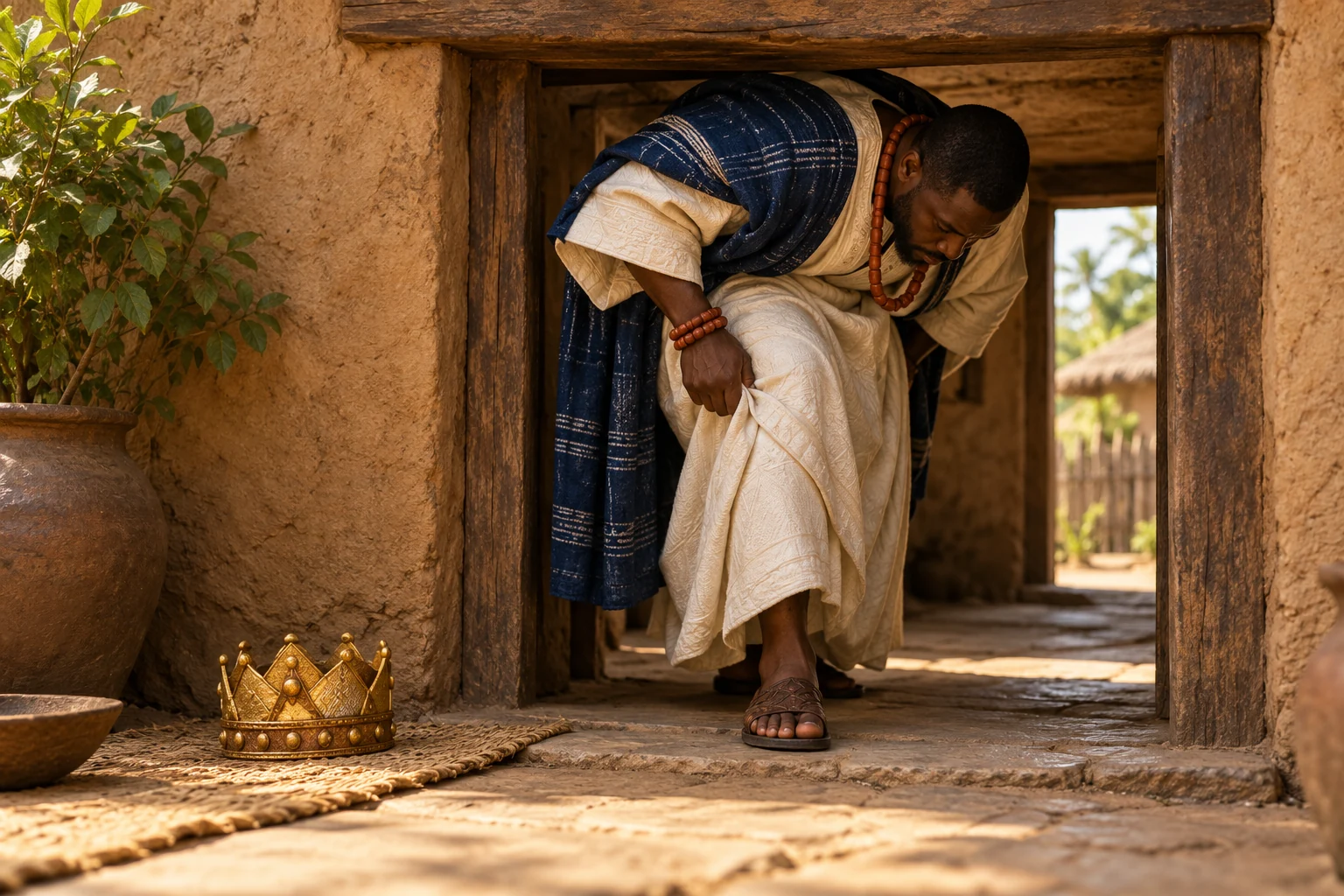
A ruler refuses contact with subjects and dismisses a servant’s advice to consult Òrúnmìlà about his daughter. He eventually goes but strikes the low doorway, losing his crown. Subjects find and hide it, so he must visit them asking for its return. Entering again, he lowers his head and acknowledges that pride has created the humiliation he hoped to avoid.
The doorway gives humility a bodily action: entering requires an adjustment that rank cannot purchase away. Yet the subjects’ concealment of the crown also expresses the social cost of the ruler’s earlier distance. The story should not imply that illness is caused by pride. Its useful concern is how contempt for others’ judgment can delay help and make a person dependent on the very people they excluded.
Narrative setting: Spanish Cuban-style proud-ruler account.
The visitor who cannot be defeated accepts hospitality
A generous practitioner attracts clients by making religious help accessible. Rival diviners complain in heaven, and Elenini is sent to investigate. Ògún and Ṣàngó attempt force against the visitor but are overcome and enclosed among other captured powers. Òrúnmìlà consults, approaches with a peaceful procession, and refuses an invitation into the visitor’s bag until the traveler has shared a meal. Fed and welcomed, Elenini recognizes the practice that makes earth habitable and prepares to return with the other powers. Òrúnmìlà asks for their release because he does not wish to inhabit earth alone. They are freed with a warning.
Elenini’s role cannot be reduced to an uncomplicated evil opponent. The visitor carries a heavenly commission and exposes the inadequacy of powers that treat an inquiry as an occasion for force. Òrúnmìlà’s response recognizes an embodied traveler who can be hosted, even when that traveler can capture divinities. Sacred knowledge appears through consultation, timing, food, and an understanding of how to approach the encounter. His final request deepens the account: vindication would be insufficient if it removed every other power from the world.
The earlier low-door story concerns a proud ruler learning to bend; this episode adds a divine scale on which submission, welcome, and interdependence are different from defeat. A contemporary interpretation may ask whether defending one’s work has become confused with eliminating everyone who opposes it. That question should remain distinct from the witness’s theology, where multiple powers are real participants in earthly habitability and their release matters beyond any moral symbolism.
Narrative witness and setting: Cromwell Osamaro, Elenini’s investigation of an earthly diviner
Ariku nearly discards Ifá before the promised period is complete
Poor Ariku borrows to enter Ifá and is told to allow a defined period for his affairs to change. His creditors demand repayment before that period has elapsed. Consultation advises patience, but the pressure continues. Shortly before the original interval ends, he packs his sacred objects and goes to abandon them. His guardian obtains permission to intervene and appears as a bird, telling him that the expected opening is approaching. Ariku returns home rather than discarding Ifá. During the remaining days, clients arrive, his reputation grows, and a prosperous household connection brings the account to its favorable conclusion.
The timing gives the temptation to abandon Ifá a precise narrative form. Ariku is neither casually impatient nor entirely free to wait: debt places a competing deadline on a promise whose interval has not yet run. The guardian’s intervention addresses that collision rather than demonstrating that economic distress is unreal. The bird also makes the sacred relation active at the point when Ariku considers ending it. Compared with the earlier snail’s rescue from concealed fire, help here interrupts a decision made under pressure rather than an opponent’s direct attempt to kill.
Contemporary interpretation can ask what happens when one commitment is judged by another party’s timetable. It must not turn the story’s specified period into a prediction for readers or tell people to remain in damaging debt because prosperity is imminent. The narrative’s successful ending belongs to Ariku’s religious history in this witness; its value for comparison lies in the tension between tested trust, material pressure, and the limits of present knowledge.
Narrative witness and setting: Cromwell Osamaro, Ariku and the approaching deadline
What was born in this Odù
“Born” can name an explicit traditional origin association or what emerges through a story: a capacity, relationship, practice or order of life. Interpretations drawn from a narrative are labelled below, so their basis remains clear.
Fire
Selected traditional source association.
Fire is explicitly named in the origin list and appears as a concealed danger in the snail account. The local association supports questions about what is happening beneath an apparently safe surface, without supplying ritual or practical instructions.
Mist
Selected traditional source association.
Mist is the second explicit origin association. It can be held as an image of limited visibility alongside hidden danger and misunderstood status, but the selected narratives do not establish a named deity or universal meaning for it.
Correlations to life dimensions
These questions bring the selected stories into contemporary life. They are interpretive invitations for study.
Work and resources
The initiation fable places responsibility in preparation that another person must trust. Hidden conditions under a vessel matter more than its reassuring appearance, supporting a concrete concern with inspecting what a participant cannot readily see or control.
Reflect: What important condition is invisible to the person relying on your work?
Relationships and family
Concern for his daughter eventually moves the ruler beyond his refusal to receive advice. The account makes attachment capable of changing conduct, while showing that a dependent family member may bear the cost of a leader’s pride.
Reflect: Who waits while you defend your status?
Character and inner life
The ruler’s crown does not fit through the doorway without adjustment. The motif asks whether a person can enter another’s place on its actual terms, rather than expecting every setting to expand around their customary display of importance.
Reflect: What would it mean to lower your head without losing dignity?
Community and responsibility
The subjects’ response to the fallen crown reveals damaged trust beneath formal obedience. A leader who never permits access may still depend on the goodwill of people whose advice and presence have been dismissed for years.
Reflect: How can people reach leadership before resentment becomes their only voice?
A deeper reading of the sacred relationships
Earthly habitability depends on a plurality of powers
Òrúnmìlà does not ask Elenini to remove all rivals and leave him alone as the sole effective presence. Once the investigation favors his practice, he pleads for the captured divinities to remain. This is a theological claim about a habitable earth, where successful mediation preserves relationships among powers. Hospitality works because Elenini is a real commissioned visitor within the story, not because food simply symbolizes kindness. Ariku’s guardian provides another form of relational support: help arrives through an existing heavenly relation at a decisive moment. The two accounts make responsibility consequential without presenting Òrúnmìlà or an earthly practitioner as sufficient to themselves.
Debt changes the experience of waiting
Ariku’s approaching completion date matters because creditors shorten his practical horizon. Patience is therefore tested by an actual claim on his resources, not merely by a preference for quick results. The Elenini episode supplies a contrasting pressure: competitors seek a heavenly investigation because accessible practice threatens their position. Both protagonists face judgments shaped by other people’s interests. A contemporary comparison may examine how payment, competition, and urgency affect religious work. It should neither romanticize poverty nor imply that all expensive practitioners are rivals in the story’s sense. The source gives particular antagonists particular actions; it does not establish a comprehensive moral ranking of religious economies.
The strongest response may preserve an opponent
The captive powers survive because the vindicated practitioner asks for their return. In the earlier low-door account, the ruler’s altered posture permits renewed relations with subjects. These outcomes suggest a distinction between winning an encounter and making continued life together possible. Ariku’s near abandonment offers a different limit: ending a relation under pressure would also close possibilities he cannot yet see. Contemporary interpretation can compare decisions made at moments of apparent finality. The stories do not require reconciliation in every harmful relationship. Their narrower contribution is to make the consequences of total exclusion visible, whether that exclusion would empty the world of other powers or end a sacred commitment prematurely.
Questions that deepen the study
Why does Òrúnmìlà ask Elenini to release the other powers?
The account gives his reason directly: he does not want to live on earth alone. That request follows his vindication, so it cannot be explained simply as fear of losing the investigation. His victory includes recognition that other powers belong to the world he wishes to inhabit. The religious significance exceeds a modern lesson about teamwork because the beings released are divinities whose presence helps constitute earthly life. Contemporary reflection can still ask what a victory would destroy if it eliminated every rival. The narrative answers through interdependence while leaving the visitor’s heavenly authority and the specific acts of consultation intact.
Does Ariku’s ending promise that debt will disappear if someone waits?
No general promise follows from this account. Ariku’s circumstances include a specific religious commitment, a defined interval, a guardian’s intervention, and the favorable developments narrated after his return. The creditors’ earlier demand is part of why his decision becomes difficult. A contemporary reader may recognize that pressure can make a commitment seem disproved before its own terms are complete. That observation is different from predicting financial rescue or advising someone to disregard material consequences. The story can support a careful account of trust under competing deadlines without being used to tell a person in hardship what their future must contain.
How do hospitality and patience differ from passivity here?
Òrúnmìlà consults, prepares an approach, stages a procession, invites the visitor to eat, and asks for the prisoners’ release. Ariku also consults and ultimately changes his course after a guardian’s intervention. Neither waits without relation or action. The difference lies in how action addresses the situation: the visitor is approached as a guest rather than attacked, and the commitment is allowed its stated interval rather than discarded under another deadline. These are particular responses within the accounts. Contemporary interpretation may compare the quality and timing of action without declaring that patience or hospitality is always sufficient in every conflict.
What the four narratives reveal together
The new Ìrosùn Ìrẹtẹ̀ selections place a divine investigation beside a debtor’s nearly abandoned commitment. The first broadens victory into responsibility for a world shared with other powers. The second makes waiting difficult by giving it the weight of creditors and competing deadlines. Together with the earlier ruler’s humiliation and the snail’s rescue, they show that an apparent ending can be interrupted by a different relation: a visitor receives hospitality, captives receive advocacy, a guardian receives permission to intervene, or a threatened life receives help.
Their shared concern is not simply positive thinking. Consultation and sacred relations have actual force within the witness. Contemporary interpretation can examine exclusion, urgency, and the conditions of trust while refusing to make Ariku’s outcome a financial forecast or Elenini’s defeat a claim that all opposition should be welcomed without judgment.
Living with this Odù
A continuing life or initiatory relationship
A received relationship with Ìròsùn Ìrẹtẹ̀ can keep humility distinct from humiliation and patience distinct from abandonment. The ruler loses his crown because a low passage requires a bodily adjustment his habitual posture ignores. The snail’s initiation has a different configuration: concealed danger is interrupted through a protective rain given religious meaning. The two events cannot make every difficulty a deserved correction of pride.
Elenini’s visit adds the limit of force and the possibility of hospitality that preserves the agency of others. Òrúnmìlà does not ask to remain alone after the captured powers can depart; coexistence matters to his earthly work. Ariku’s approaching interval introduces pressure from creditors that makes waiting difficult even after a period has been named. Across a life, reflection may concern receiving counsel from a subordinate, distinguishing a threat from a limitation, maintaining company after conflict, or assessing a commitment under material pressure. The sign does not guarantee a last-minute opening or command indefinite endurance. It invites character able to lower a defensive posture without surrendering judgment and to consider what a continuing relationship actually requires of the person and their surrounding world.
A particular consultation and its question
In consultation, Ìròsùn Ìrẹtẹ̀ helps distinguish a necessary accommodation from a concealed threat. The ruler can change his posture to enter the doorway, while the snail requires protection from an intentionally dangerous arrangement. A client’s discomfort cannot therefore be classified automatically as pride or initiation-related danger. The actual question and divinatory account must establish what kind of condition is present.
Elenini’s encounter asks whether greater force will answer the difficulty or only deepen capture. Òrúnmìlà’s consultation, meal, and request for the others’ release retain their religious significance, beyond a generic recommendation to be polite. Ariku adds a temporal question: which commitment has an actual stated interval, and what material pressures make it hard to sustain? The witness’s favorable conclusion cannot verify a date for an unknown reader or justify every creditor’s demand. A practitioner can examine whether patience is grounded, whether a posture prevents hearing, and what coexistence would require after the immediate danger changes. Consultation is a situated relation to those distinctions. It does not identify hidden fire, prescribe hospitality, or make the client permanently a proud ruler or person whose salvation must arrive at the final moment.
Constructive and adverse possibilities
Constructive unfolding may include a posture changed enough to receive counsel, protection that prevents a harmful crossing, and hospitality able to preserve a shared world after force fails. Òrúnmìlà’s request for the captured powers’ release makes relationship part of the beneficial ending rather than a reward of solitary superiority.
Adverse unfolding can involve authority refusing subordinate knowledge, a ceremony’s appearance concealing danger, or material pressure making an already defined process impossible to bear. Ariku’s doubt cannot be reduced to impatience alone, since creditors actively constrain the interval. The guardian’s intervention remains part of the sacred narrative, not proof of a future deadline for the client. These contrasts distinguish threat, correction, and timing without making suffering deserved or assigning the state of any actual reading. Patience and decisive change remain questions of the particular relationship.
An illustrative situation in everyday life
In a hypothetical example, a small publisher agrees that a new book needs six months to reach its audience, then investors demand a full return after two. The editor feels ashamed for questioning the process and considers abandoning it days before a scheduled review. Ariku’s interval distinguishes the agreed timescale from the pressure imposed afterward. The ruler’s doorway adds a separate question about whether the editor has dismissed a junior colleague’s useful suggestion. A response could renegotiate financial expectations while receiving that advice. The comparison offers no promise that sales will arrive or that waiting is always correct. It helps separate external pressure, an inward defense of authority, and the evidence needed to judge the next stage.
Sources and reading context
The first two narrative witnesses
Both selections are Spanish Cuban-style accounts. The snail episode is brief and includes named witnesses in a note that does not establish authorship. The ruler’s daughter’s affliction remains a narrative circumstance, not evidence for supernatural or moral medical causation.
Narrative motifs are summarized independently. The life-dimension reflections are contemporary interpretation. How these reference studies are built explains the wider source approach and the distinction between a reference article and personal divination.
Additional named witnesses
- Cromwell Osamaro. The heading introduces the heavenly investigation and the later Ariku account within the same sign.
The account identifies Elenini as a commissioned investigator and obstacle power; no universal equation with a single evil being is imposed. Ariku’s numerical interval is a narrative detail, not a forecast or debt instruction.
Bibliographic identification
- C. Osamaro Ibie. Ifism: The Complete Work of Orunmila. Lagos; multivolume publication beginning 1986. Library catalogue record. Related bibliographic record for the named narrative witness. Exact volume, edition and page of the transmitted account have not been independently matched.
Read the source method and wider scholarly context.
The catalogue links identify published works and their authors. They are separate from proof of an individual episode’s wording or attribution. Contemporary comparisons and the synthesis above are editorial interpretation. The author’s books and Academy companions below provide further study; their sales links are separate from the source references.