
Ìròsùn Òwónrín is a mixed Odù in Ifá’s 256-part corpus. Ìrosùn Òwónrín’s selected accounts place fire and light beside debt and assistance. Alabueli’s destructive use of Ṣàngó’s teaching makes families unwilling to entrust children to the teacher; an impressive display later wins Ṣàngó authority, but leaves questions about repaired trust. In a shorter account, a struggling smith finds money within a yam through Obatalá’s help. The source’s single origin association is current, which belongs to this local imagery of power and transmission.
A question to carry through the study: What repair is needed after your expertise has caused others to lose trust?

This Academy reads the right column first, then the left. Each row carries a single or double mark.
Where this Odù belongs
Ìròsùn Òwónrín belongs to the Ìròsùn family in this Academy’s study sequence. It is a mixed Odù, distinct from Òwónrín Ìròsùn. The order matters. Its teaching is approached through its own narratives, rather than by adding two general descriptions of the principal signs together.
Key Òrìṣà and sacred relationships
The figures below are selected for their roles in the accounts discussed here. They offer connected reading paths through the tradition.
-
Ṣàngó. Ṣàngó teaches Alabueli control of fire and light and bears reputational consequences when the pupil burns houses. His later performance converts fear into public authority within the story.
-
Ọ̀rúnmìlà. Òrúnmìlà receives Ṣàngó after families refuse him and also advises the impoverished smith. Consultation precedes both an institutional reputation problem and an individual difficulty with debt.
-
Obàtálá. Obatalá secretly places money inside the yam the smith finds in his forge’s ashes. The account makes assistance arrive within the worker’s ordinary setting rather than through public display.
Key myths and their meanings
A teacher’s reputation after the fire
Alabueli learns fire and light from Ṣàngó but burns a village’s houses. Families then refuse to send their children to Ṣàngó, connecting the pupil’s conduct with the teacher’s responsibility. Ṣàngó seeks counsel and gathers people at a feast. A dazzling performance of fire and illumination inspires awe, and they make him ruler. The text relates this event to the electric bulb’s sacred origin.
The narrative’s ending is successful for Ṣàngó, yet awe is not the same thing as evidence that teaching has become safer. That unresolved distinction is editorially valuable. The account should be presented as a modern technological origin motif, not the historical invention of electric lighting. It raises a concrete question about whether public performance can restore confidence without addressing the harm that first damaged it.
Narrative setting: Account explicitly labeled Cuba.
The smith’s yam in the ashes
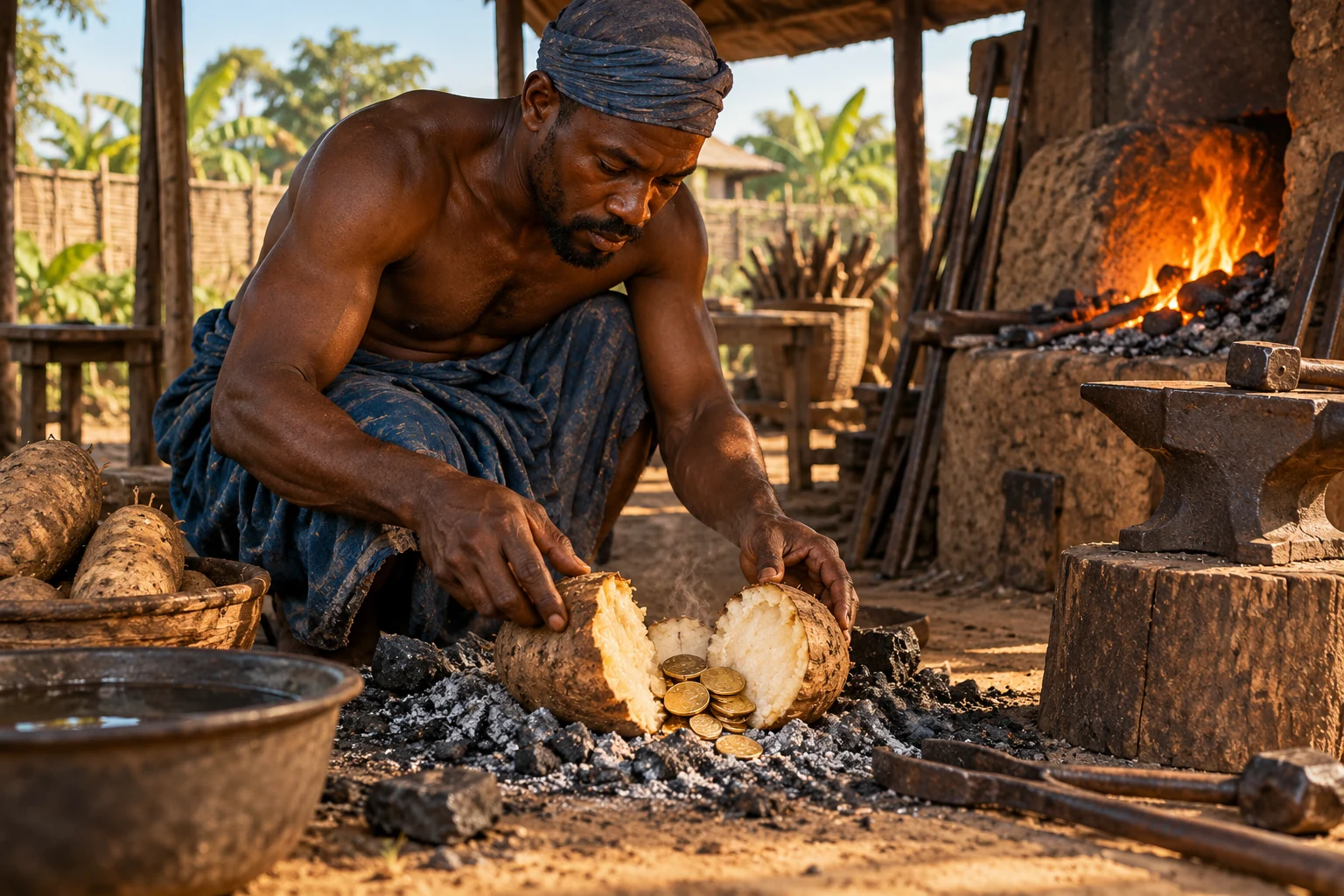
A smith whose affairs are failing consults Òrúnmìlà but cannot afford the prescribed response or settle his debts. He returns to work and lights the forge early. In the ashes he finds a yam and thinks he has at least secured food for the day. When he opens it, he discovers money placed there by Obatalá, enough to meet the obligations that had seemed beyond reach.
The setting keeps ordinary work in view: the smith finds help when he returns to the forge rather than after abandoning his trade. The yam first appears as sustenance and then reveals another resource. This is a narrative of unexpected assistance, not a financial strategy or a guarantee that persistence alone resolves debt. It can prompt a discussion of support that preserves someone’s working capacity.
Narrative setting: Short Spanish Cuban-style account.
An unrecognized visitor becomes a remembered helper
Ugun-Ogege travels to practice among Ilode’s people, but his unremarkable appearance and poor lodging bring little attention. He overhears two women considering departure from childless marriages and invites them to consult. The account narrates successful assistance and a growing reputation that extends beyond those first concerns. The ruler eventually asks him to stay, but he leaves after promising to return. Years later he arrives quietly, and the first person recognizing him spreads the news. The community greets him with joy. His public standing has changed through remembered encounters rather than a new display of impressive appearance.
The witness contrasts an outsider’s first visible presentation with the efficacy attributed to his religious work. It should not be turned into a medical promise or a claim that pregnancy proves spiritual competence. Within the account, Ifá and the practitioner’s knowledge are effective, and the people’s memory follows those encounters. That gives a different route to public recognition from Ṣàngó’s dazzling fire performance in the earlier story. The smith’s hidden money supplies yet another relation between apparently modest surroundings and an unexpected resource.
The return also matters: Ugun-Ogege does not need to restage his initial work before being welcomed, because the community carries its memory. A contemporary reader can examine how a reputation is earned and sustained without making testimonials automatically independent evidence. The source’s striking distinction is between spectacle and remembered care, while leaving open how the practitioner’s own limits or later obligations are assessed once the community is eager to keep him.
Narrative witness and setting: Account explicitly headed Revelações de Cromwell Osamaro
A successful practice meets an earlier promise to heaven
Before earthly arrival, a practitioner promises his guardian a return if he succeeds in Ifá, but a long stay if he does not. He begins in trade, then returns to Ularin when its people seek help. A first intervention succeeds but the community omits the concluding sacred acknowledgment, so the affliction returns. A completed second response establishes acceptance and his reputation grows. Later, the obstacle power recalls his earlier promise and brings him into a dangerous encounter. During a crisis he meets his guardian in heaven and receives permission to complete another response. Back on earth, he leaves professional Ifá practice for trade and agriculture and lives to old age.
The narrative does not describe prosperity as an unconditional good independent of a pre-earthly commitment. Success has become the very condition under which a return to heaven was promised. That theological tension gives the later change of vocation its particular meaning; it is not simply advice to diversify income or avoid a difficult profession. The Ularin sequence also distinguishes an immediate effect from a completed sacred relation. The people consider the final acknowledgment unnecessary because they already feel better, whereas Èṣù states that the exchange has not been accepted.
This is a religious account of completion, not a fee dispute that can be understood entirely through commerce. Contemporary analysis may still ask about the expensive return conditions and unequal need, but should preserve what the witness says the omitted conclusion means. Compared with the fire teacher’s spectacular recovery of authority, this practitioner’s successful ending involves relinquishing a respected role. Not every fulfilled life is narrated through ever-expanding public power.
Narrative witness and setting: Account explicitly headed Revelações de Cromwell Osamaro
What was born in this Odù
“Born” can name an explicit traditional origin association or what emerges through a story: a capacity, relationship, practice or order of life. Interpretations drawn from a narrative are labelled below, so their basis remains clear.
Current
Selected traditional source association.
The explicit origin list gives only current. The adjacent fire-and-light story supports an electrical reading in this compilation, but the terse list itself is broader; no scientific claim or universal technological attribution should be inferred.
Responsibility for transmitted skill
Contemporary interpretation from the selected myth.
As a contemporary interpretation, Alabueli’s destructive conduct makes the teacher’s public responsibility emerge alongside technical power. This is a critical reading of the story, not a canonical origin of educational accountability.
Correlations to life dimensions
These questions bring the selected stories into contemporary life. They are interpretive invitations for study.
Work and resources
The smith’s livelihood remains the setting of assistance. His inability to pay should not be read as personal failure; the account instead shows obligations exceeding immediate means and imagines support arriving without removing his identity as a worker.
Reflect: What support would help someone continue working rather than only survive today?
Relationships and family
Families judge a teacher through a pupil’s harmful conduct. Their refusal is an exercise of responsibility toward children, not merely an obstacle to Ṣàngó’s ambitions, and should remain intelligible even after the story’s spectacular reversal.
Reflect: What would reassure a family beyond an impressive demonstration?
Character and inner life
Ṣàngó’s encounter with refusal interrupts an assumption that expertise deserves automatic trust. The story allows a distinction between possessing power and being entrusted with others, especially when one’s instruction has already produced harm. The pupil’s actions have already changed families’ willingness.
Reflect: Where are you asking for trust before demonstrating responsibility?
Community and responsibility
The community appoints a ruler after an overwhelming display. The account leaves open how awe shapes judgment, making it useful to ask what evidence of safe, sustained service should accompany admiration for extraordinary capacity. The damage preceding the performance still requires attention.
Reflect: What should a community verify before rewarding a powerful performer?
A deeper reading of the sacred relationships
Sacred completion differs from immediate visible relief
Ularin’s people think a concluding acknowledgment can be omitted because the first effect has already arrived. The witness makes Èṣù’s acceptance a separate and necessary condition, so the religious action is not complete merely when participants obtain the benefit they wanted. Ugun-Ogege’s remembered efficacy provides a different relation between result and continuity, while the smith’s encounter with hidden assistance and Ṣàngó’s fire display offer other modes of recognition. A source-conscious study should explain the theological distinction before translating the scene into a modern service transaction. Contemporary questions about cost and accountability remain legitimate, but they do not exhaust the sacred reciprocity through which this particular narrative understands an outcome becoming settled.
Destiny can complicate the pursuit of professional success
The practitioner’s heavenly promise makes success and continued earthly residence pull in different directions. His guardian and Elenini remain real agents in how that condition unfolds, and leaving Ifá practice at the end is a way the account orders his life rather than proof that the tradition has failed. This is distinct from Ugun-Ogege’s growing welcome or Ṣàngó’s public appointment. The juxtaposition prevents a single prosperity narrative from swallowing every witness. A contemporary reader can reflect on whether a prestigious path fits a life, but should not infer their own prebirth contract from this precedent. Its depth lies in the religious relation between vocation, promise, and duration, not a general prediction about successful practitioners.
The community remembers more than appearance
Ugun-Ogege’s initial reception is shaped by how he looks and where he lodges. His later reception is shaped by remembered assistance. Ṣàngó’s audience instead changes its judgment through a brilliant demonstration, while the smith’s help remains largely outside public spectacle. These are distinct ways a reputation can form, and none should be automatically treated as complete evidence of safety or competence. The heavenly-promise account adds another limit, since public acclaim does not settle a practitioner’s relation with his guardian. Contemporary interpretation can therefore distinguish a first impression, a remembered encounter, a performance, and a personal religious obligation. The source’s different routes to recognition contribute depth precisely because they do not converge on one simple measure of greatness.
Questions that deepen the study
Why is Ugun-Ogege’s quiet return important?
It demonstrates that the community’s recognition has become a memory carried by people, rather than requiring a fresh performance at every arrival. The first person who sees him makes the return public, and others respond to a history of encounters. This is a particular narrative account of reputation, not proof that public praise independently verifies every claimed efficacy. Its contrast with Ṣàngó’s fire scene is useful: spectacle can rapidly change allegiance, whereas the visitor’s standing develops through remembered service. A contemporary reader can ask how recognition is sustained without confusing either mechanism with the practitioner’s personal sacred obligations or assuming that gratitude makes all future expectations fair.
Does the unfinished conclusion mean divine help is merely bought?
The source treats the concluding acknowledgment as part of an addressed relationship, not simply a price that becomes irrelevant once a result is delivered. Èṣù’s acceptance matters to whether the action is complete within the religious world. That should be explained without inventing a universal tariff or an offering prescription. At the same time, the practitioner’s demand for substantial compensation before returning remains a distinct ethical question, because the community is in need and has limited bargaining room. Preserving both points is more accurate than either reducing sacred exchange to commerce or using theology to make every human charge beyond scrutiny.
Why can leaving a successful practice be the good ending?
The practitioner’s earlier promise links success in Ifá with a quick return to heaven. The final change of work belongs to that specific religious condition, and the account says he then lives to old age. It is not a universal recommendation that practitioners abandon their vocation when they become prosperous. Ugun-Ogege’s separate story presents a continuing religious role welcomed by a community, so the sign itself contains no single career instruction. A contemporary comparison can ask what commitments success activates rather than assuming all success should simply expand. The source’s guardian and obstacle powers remain necessary to understanding why this particular life changes direction.
What the four narratives reveal together
The added witnesses make Ìrosùn Òwónrín’s public reputation more religiously and temporally complex. A visitor becomes valued through remembered efficacy despite an unimpressive first appearance; another practitioner becomes so successful that an earlier heavenly promise must be confronted. These accounts sit beside Ṣàngó’s spectacular light and the smith’s unexpected hidden resource without repeating their mechanisms. They distinguish appearance, performance, memory, sacred completion, and destiny. The Ularin episode especially requires an explanation of acceptance and concluding acknowledgment from within its tradition, rather than a purely commercial or psychological paraphrase.
Contemporary questions about reputation and unequal bargaining can accompany that explanation. The endings also prevent automatic escalation: one practitioner returns to public welcome, while another leaves a prestigious practice in order to continue earthly life. Their difference is a source of depth, not an inconsistency to be erased by a universal promise of professional success.
Living with this Odù
A continuing life or initiatory relationship
A person carrying Ìròsùn Òwónrín in a received spiritual history can return to the relation between public recognition and the history behind it. Ṣàngó’s performance changes a community’s response after his pupil’s destructive conduct, but awe does not by itself answer every question about damaged trust. The smith’s unexpected resources show a different relation to power: assistance arrives through Obatalá where ordinary work had continued despite constraint.
Ugun-Ogege’s remembered return adds recognition formed through encounters rather than impressive appearance. The earlier heavenly promise adds a harder limit: professional success can activate an obligation whose terms were set before present acclaim. The practitioner’s eventual turn to trade and agriculture therefore cannot be reduced to failure of vocation. Across a life, reflection may concern teacherly responsibility, receiving unanticipated help, remaining faithful to a return, or revising a successful form of work. The sign does not promise either celebrity or hidden money. It invites character able to distinguish public effect from repair, remember the relations that produced trust, and consider whether continuing along a celebrated path still accords with the actual sacred history being carried.
A particular consultation and its question
In consultation, Ìròsùn Òwónrín helps distinguish reputation damaged by another’s conduct from a deeper question about the conditions of continuing work. Ṣàngó is connected publicly to his pupil’s fire, while the successful practitioner later encounters an earlier promise to his guardian. Both involve standing, but the responsibilities differ. A client’s apparent professional difficulty cannot therefore be read simply as a need to restore publicity or abandon the vocation.
The smith introduces constrained resources and assistance that the account explicitly attributes to Obatalá. It does not make an unknown shortage evidence that money will appear. Ugun-Ogege adds a question about how trust has been formed and whether a promise to return still matters after attention has faded. The religious response, including the community’s incomplete concluding acknowledgment in the later witness, remains more than a transaction for success. A careful practitioner can examine what was promised, what harm has been addressed, and which form of continuation is now possible. These questions depend on the actual consultation and its concern. They neither forecast prosperity nor confer a permanent identity as celebrated helper, misunderstood teacher, or person whose work must end.
Constructive and adverse possibilities
Constructive unfolding may include assistance received without turning it into entitlement, trust grown through remembered encounters, and the ability to reconsider a successful path when its conditions change. Ugun-Ogege’s public welcome has a history in specific help and a remembered promise, rather than a new display alone.
Adverse unfolding can involve reputation substituted for repair, an incomplete sacred acknowledgment forgotten once immediate benefit appears, or success treated as permission to disregard an earlier obligation. The guardian’s role in the later account remains religiously consequential; it is not just the practitioner’s private anxiety about achievement. The smith’s gift likewise cannot promise a financial reversal in every shortage. These contrasts illuminate possible directions in public trust and continuity without explaining actual illness, endorsing spectacular rule, or determining the state of a present reading from the sign’s name.
An illustrative situation in everyday life
Consider a hypothetical trainer whose former student causes serious damage while using a skill taught in the program. The trainer stages a brilliant demonstration to restore confidence, and attendance returns. A quieter colleague asks what support affected households actually received and what training responsibilities remain. Ṣàngó’s fire episode helps distinguish impressive public effect from the unfinished question of repair. Ugun-Ogege’s remembered help offers another basis for trust, while the heavenly promise asks what earlier commitments success may conceal. The trainer’s inward fear concerns losing a vocation, but the external issue is more particular. This illustration does not equate the program with sacred fire or predict a divine demand; it makes the relationship between reputation and continuing obligation examinable.
Sources and reading context
The first two narrative witnesses
The fire-and-light narrative is explicitly Cuban and the smith’s story is Spanish in the same compilation. The electric-bulb explanation is mythic, not technological history. A single explicit origin association gives partial born coverage. Attributions remain locally bounded.
Narrative motifs are summarized independently. The life-dimension reflections are contemporary interpretation. How these reference studies are built explains the wider source approach and the distinction between a reference article and personal divination.
Additional named witnesses
-
Cromwell Osamaro. The explicit heading precedes Ugun-Ogege’s Ilode visit and the later pre-earthly promise/Ularin sequence.
-
Cuban narrative sequence. The earlier fire/light account is marked Cuba, while the smith appears in the neighboring Spanish sequence.
The Ularin sequence shifts the practitioner’s name and includes medical claims, which are kept as narrative context rather than clinical evidence. The heading does not establish exact publication provenance. No preparation, bodily treatment, or personal vocational prediction is reproduced.
Bibliographic identification
- C. Osamaro Ibie. Ifism: The Complete Work of Orunmila. Lagos; multivolume publication beginning 1986. Library catalogue record. Related bibliographic record for the named narrative witness. Exact volume, edition and page of the transmitted account have not been independently matched.
Read the source method and wider scholarly context.
The catalogue links identify published works and their authors. They are separate from proof of an individual episode’s wording or attribution. Contemporary comparisons and the synthesis above are editorial interpretation. The author’s books and Academy companions below provide further study; their sales links are separate from the source references.