
Ìròsùn Òbàrà is a mixed Odù in Ifá’s 256-part corpus. Ìrosùn Òbàrà’s selected stories ask how communities recognize authority and unfamiliar persons. A ruler neglects a hungry population while Ṣàngó’s music draws people away from the palace. In another account, Okonte encounters a sea-born youth displaced from his destroyed world; consultation and transformation allow him to enter a land community. The narratives connect public gathering with the obligations that follow it, leaving spectacle and inclusion open to ethical examination.
A question to carry through the study: What care must accompany the recognition your community gives someone?

This Academy reads the right column first, then the left. Each row carries a single or double mark.
Where this Odù belongs
Ìròsùn Òbàrà belongs to the Ìròsùn family in this Academy’s study sequence. It is a mixed Odù, distinct from Òbàrà Ìròsùn. The order matters. Its teaching is approached through its own narratives, rather than by adding two general descriptions of the principal signs together.
Key Òrìṣà and sacred relationships
The figures below are selected for their roles in the accounts discussed here. They offer connected reading paths through the tradition.
-
Ṣàngó. Ṣàngó’s drumming gathers people away from the neglectful ruler and culminates in his claim to the crown. Music functions as a public force that reorganizes attention and allegiance.
-
Ògún. Ògún gives Ṣàngó the drums that enable the public gathering. His contribution places the instruments and their provision within the transfer of political attention.
-
Ọ̀rúnmìlà. Òrúnmìlà advises the ruler and is later called from Ifé to assist the displaced youth, joining a crisis of leadership to a crisis of belonging.
-
Obàtálá. Obatalá is approached in the youth’s acceptance into the land community. His role belongs to this narrated accommodation rather than an abstract claim that every transformation requires the same mediation.
Key myths and their meanings
The feast that loses its audience
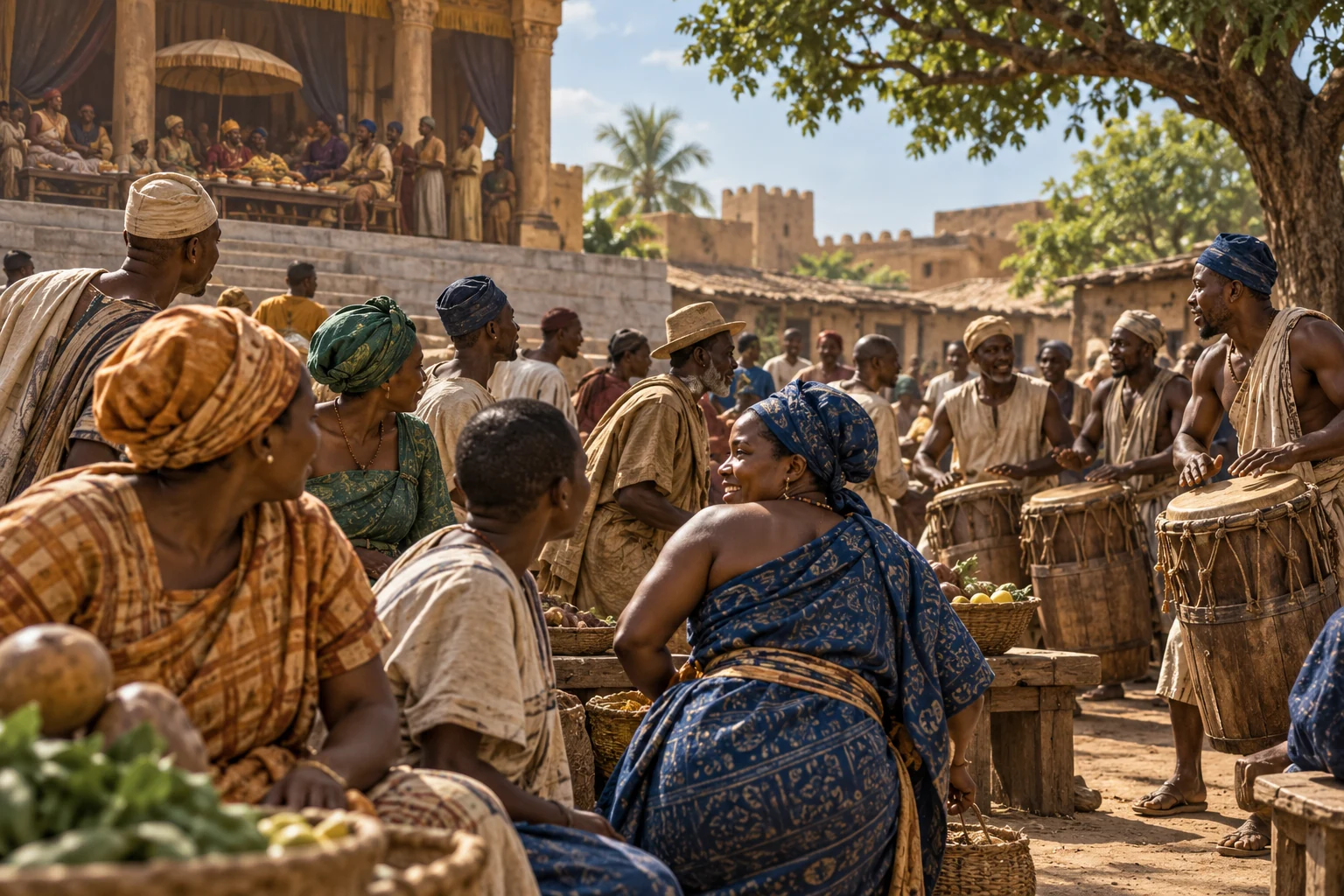
A ruler holds parties while his people endure hunger and misery. Òrúnmìlà warns of approaching conflict and advises a communal feast. Ṣàngó arrives with drums given by Ògún and captivates the people in a public space. The ruler cannot summon them back with trumpets. When he approaches, Ṣàngó places the crown on his own head and declares a different claim to rule.
A population’s refusal to attend the palace exposes a loss of legitimacy that wealth alone cannot repair. Yet the narrative also makes musical charisma central to the replacement. A careful reading can criticize the old ruler’s neglect while asking what accountable care should distinguish a better leader from a more compelling performer. The story establishes a change of allegiance, not a complete record of subsequent government.
Narrative setting: Account explicitly labeled Cuba.
The sea-born youth finds a land community
A youth survives the destruction of his underwater realm but cannot remember his former world or live easily on land. Okonte, a chief’s daughter, seeks him and becomes attached to him. Her community calls for help, bringing Òrúnmìlà from Ifé. Through a religious transformation he gains a human land body, is accepted, marries Okonte, and brings a renewed relationship between the lake and its inhabitants.
The episode centers displacement and the difficulty of inhabiting a new world, but its solution also changes the newcomer’s body to fit the host community. That tension should remain visible. A careful reading can examine welcome without endorsing the source’s diagnostic language or implying that difference must disappear before someone deserves belonging, affection, or support.
Narrative setting: Spanish account of Okonte and Okantomi.
The fruit tree asks for its covering back
Ega, a fruit-bearing presence, seeks children and receives consultation that includes protecting them from human consumption. It completes the response and produces many at once, then asks the diviner to return the garment it had committed. After it is returned, Èṣù clothes the children in several colors and tells human beings that the fruit is good to eat. Ega loses the children to them. The passage links a withdrawn part of an exchange with a changed relation between tree, fruit, and human appetite. Its terminology is broad and does not securely identify one botanical species.
The garment is not merely a symbol of reluctance to be generous. It is part of a sacred response whose purpose includes the continued presence of the tree’s children. Asking for it back changes that completed relation, and Èṣù acts consequentially within the alteration. That religious logic should be explained before a modern interpretation about commitment is offered. The account also makes the fruit’s visible attractiveness part of its exposure, giving a different relation to public appearance from the earlier ruler losing his crown through musical charisma.
The displaced sea youth supplies another bodily transformation, but there change allows entry into a community rather than inviting consumption. A careful comparison should not make all difference or beauty dangerous. It should ask what relation a particular visibility establishes. The story’s personified children remain sacred ecological narration; it does not justify blaming a parent for actual loss or reconstructing a universal rule about which property can be reclaimed after a religious act.
Narrative witness and setting: Account explicitly headed Revelações de Cromwell Osamaro
The loud threat contains only a wooden blade
Adaba attends the birds’ meetings carrying a covered blade and uses threats to obtain more than a fair share of their drink. The others consult about ending the intimidation and complete the response. At a later meeting they allow him to become deeply intoxicated, inspect the case, and discover that the blade is wooden. They replace it and wait. When he next demands the remaining drink, they refuse and invite him to use the weapon. He cannot sustain the threat now that its material condition is known. The account ends his power to dominate the gathering through the appearance of an unquestioned capacity.
The birds’ changed conduct follows divination and a sacred response, not merely a spontaneous decision to become brave. The inspection then gives the knowledge a concrete object. That combination distinguishes religiously disclosed strategy from an abstract celebration of skepticism. It also complicates the earlier crown story, where music gathers a public around a new claimant: an impressive performance can reorganize allegiance, but performance alone need not establish what a claimant can do. Adaba’s concealed blade differs from the sea youth’s unfamiliar body, whose condition calls for care rather than exposure as fraud.
The distinction prevents the collection from turning bodily difference into suspicious appearance. The birds’ use of intoxication remains ethically mixed, so a contemporary study should not turn the episode into practical instructions for disarming an intimidating person. Its particular analytical force is the gap between a threat’s social effects and the actual capacity its cover keeps out of view.
Narrative witness and setting: Account explicitly headed Revelações de Cromwell Osamaro
What was born in this Odù
“Born” can name an explicit traditional origin association or what emerges through a story: a capacity, relationship, practice or order of life. Interpretations drawn from a narrative are labelled below, so their basis remains clear.
Osun’s four columns
Selected traditional source association.
The origin list names the four-column secret of Osun. This is retained as a narrow association with a religious support form, without identifying it with Òṣun or reconstructing its restricted composition.
Unbound pigeon feet
Selected traditional source association.
The origin list associates this sign with leaving a pigeon’s feet unbound in a religious context. Only the motif of unbound movement is recorded; no procedure or universal ceremonial requirement is given.
Correlations to life dimensions
These questions bring the selected stories into contemporary life. They are interpretive invitations for study.
Work and resources
The ruler’s feasting and the population’s hunger occupy the same economy. A proposed public meal arrives after neglect has damaged trust, inviting questions about whether occasional distribution can substitute for an institution’s ordinary responsibilities. The people’s absence makes that failure publicly visible.
Reflect: What recurring need is a grand event failing to address?
Relationships and family
Okonte’s attachment draws her community into care for someone unfamiliar. The story can support attention to relational initiative while asking whether the newcomer’s own preferences remain visible amid the host family’s hopes. Affection should not make his preferences disappear from consideration.
Reflect: How can welcome preserve the newcomer’s agency?
Character and inner life
The youth’s disrupted memory and altered setting are narrative signs of displacement. The interpretive concern is the difficulty of finding continuity after loss, without borrowing the text’s diagnostic claims as descriptions of actual mental health.
Reflect: What part of a lost world needs room in a new life?
Community and responsibility
Ṣàngó gathers the public through music while the youth’s story gathers a community through care. Both leave a question after the gathering: what practices will sustain people when the extraordinary event has passed? Each narrative leaves care to continue beyond spectacle.
Reflect: What happens after attention has been successfully gathered?
A deeper reading of the sacred relationships
A completed exchange carries continuing religious terms
Ega’s returned garment alters an action intended not only to produce children but to protect their continuation. The witness gives Èṣù an active role in what follows, so the relation cannot be reduced to a modern lesson in keeping a promise. The birds’ consultation likewise precedes their new knowledge of Adaba’s threat. The earlier crown and sea-youth accounts add other sacred actions: authority is displaced and a displaced being is transformed for communal entry. A source-conscious account should preserve these distinct mechanisms rather than explaining every result as a change in attitude. Contemporary questions about commitments and knowledge can follow, but no general article can specify what a living religious exchange requires from a particular reader.
Appearance can invite consumption, care, or allegiance
Ega’s colored fruit becomes accessible to human appetite. The sea youth’s unfamiliar body draws Okonte’s attention and a community’s intervention. Ṣàngó’s music attracts a public away from an incumbent ruler. Adaba’s covered implement creates fear before its wooden nature is known. These are four different relations of appearance rather than one opposition between superficial looks and inner truth. Sometimes visibility is a vulnerability, sometimes the beginning of welcome, sometimes a claim to authority, and sometimes an instrument of deception. Contemporary interpretation becomes more exact when it asks which relation is actually being made. The sacred transformations also remain specific, rather than dissolving into a generic account of identity or public image.
The gathering’s judgment depends on what it can know
The birds initially yield to Adaba because the cover makes his threatened capacity difficult to inspect. Their consultation leads to an encounter in which the object becomes known, and later refusal follows that knowledge. The ruler’s public likewise responds to music without a full account of the new claimant’s government, while the sea community requires a practitioner from elsewhere to understand the youth’s condition. Ega’s case supplies a contrasting limit, since the tree cannot control human appetite simply by regarding fruit as kin. These stories show knowledge distributed unevenly among participants. Contemporary reflection can ask how a collective learns responsibly, without presuming that unfamiliarity proves fraud or that a charismatic moment establishes lasting competence.
Questions that deepen the study
Is asking for the garment back merely a failure of generosity?
The source ties the garment to a specific protective response, so the question is more exact than whether Ega is willing to give. Its return changes a sacred relation already completed for the children’s continuation. A modern reader may reflect on commitments that extend beyond an immediate benefit, but should not use the fable to claim that every request to recover property is spiritually wrong. Nor should the fruit’s loss be applied to grieving parents. The account personifies a tree and its harvest within its religious world. Its useful tension is the difference between receiving the first result and maintaining the relation through which that result was meant to continue.
What changes when the birds inspect the blade?
The threat no longer relies on an untested claim hidden by its case. Their later refusal is grounded in a material discovery that follows consultation, not only in a change of mood. The episode distinguishes social intimidation from actual capacity while preserving the religious route by which the birds receive their strategy. Its use of intoxication should remain a narrated method rather than advice for readers. A contemporary comparison can ask what makes an intimidating assertion credible and who can safely examine it. The answer should not be generalized to every loud or unusual person, since the sea-youth story demonstrates an unfamiliar appearance that needs care instead of exposure.
How can the four stories keep care distinct from credulity?
The sea youth is not a fraud simply because his body is unfamiliar, while Adaba’s threat genuinely conceals a different material object. The crown episode makes a public’s attraction consequential without proving every future act of the new ruler, and Ega’s fruit is kin to the tree within a sacred account rather than a false human claim. These differences require attention to each relationship before judgment. Contemporary interpretation can value welcome and verification together, but should not pretend the source offers one universal test for sincerity. Its actual religious interventions disclose different things: a condition, a threat, a shifted authority, and the consequences of changing an exchange.
What the four narratives reveal together
The additions give Ìrosùn Òbàrà a more differentiated account of appearance and continuing relation. Ega’s fruit becomes vulnerable through a changed sacred exchange, while the birds learn that a covered threat lacks the force it claims. The earlier sea youth and crown stories prevent those motifs from becoming a simple suspicion of unfamiliarity or performance. Unfamiliar bodies may call for care, music may gather allegiance, and colored fruit may enter another being’s appetite.
Within the accounts, divination and Èṣù’s action remain effective causes, not interchangeable metaphors for modern judgment. Contemporary questions about commitment, verification, and welcome become more useful when these spiritual mechanisms and material differences are preserved. The witnesses also leave limits: the old ruler’s replacement is not a complete account of government, and Adaba’s exposure does not establish an ethical method suitable to every real conflict.
Living with this Odù
A continuing life or initiatory relationship
For someone whose received life or initiatory history includes Ìròsùn Òbàrà, belonging can be evaluated through the conditions it creates rather than its public appearance. The ruler’s parties coexist with hunger until another claim to leadership draws the audience away. The sea-born youth’s acceptance concerns a more intimate passage into a community through Okonte’s attachment and Òrúnmìlà’s religious transformation. These are different questions of public care and welcome, not one formula about popularity.
Ega’s fruit gives a troubling relation between desired continuity, withdrawn exchange, and human appetite. Its children cannot become a simple metaphor for resources without losing the witness’s personhood and grief. Adaba’s covered blade adds domination sustained by an unexamined material claim. Across a life, reflection may concern whether authority provides for people, how difference is received, what a committed exchange has placed at stake, or how intimidation shapes participation. The person is not destined for an exposed bluff or a crown. The sign invites a character attentive to the actual basis of power and the costs borne by those who depend on it, while keeping the youth’s transformation distinct from any diagnostic account of bodily or social difference.
A particular consultation and its question
In consultation, Ìròsùn Òbàrà can distinguish a failed responsibility of authority from difficulty entering a new environment. The ruler has followers whose suffering he neglects; the sea-born youth lacks a livable relation to land and receives a particular religious transformation. A present client’s exclusion cannot be explained automatically through either scene. The actual question must establish what belonging would require and who can change its conditions.
Adaba’s threat raises the possibility that a claim has acquired power because its basis is never examined. That is not permission to provoke or disarm a real person. It is a question about what evidence supports an intimidating demand. Ega’s story adds a different configuration: the desired benefit and the terms of protecting it are not separable, and the outcome affects beings unable to negotiate. The source does not securely identify one botanical species or provide a modern agreement formula. A practitioner may examine care, access, evidence, and the consequences of a withdrawn commitment within the actual divinatory context. The result does not predict rulership, diagnose the client’s difference, or identify another person’s power as merely a bluff. Consultation is a situated inquiry rather than permanent character classification.
Constructive and adverse possibilities
Constructive unfolding may include authority becoming answerable to lived need, a community receiving a newcomer through a relation that makes inhabitation possible, and intimidation losing its unquestioned hold. The youth’s change remains sacredly mediated; welcome is not merely approval of an unchanged external arrangement.
Adverse unfolding can involve entertainment replacing provision, a demand for recognition detached from care, or a stronger party controlling a gathering through a claim no one can examine. Ega’s loss adds the gravity of consequences falling on children-like beings rather than the sole initiator of an exchange. That narrative cannot become blame against actual parents. These contrasts locate direction in the relations among power, welcome, and vulnerability. They do not declare that public charisma proves legitimate rule, that every threat lacks substance, or that an actual reading is necessarily fortunate or adverse.
An illustrative situation in everyday life
Imagine a hypothetical residential association whose chair organizes elaborate celebrations while basic repairs remain unattended. A newcomer with different access needs is praised as part of the community but cannot use shared spaces. One committee member ends discussion by invoking a regulation that nobody has read. The feast, sea-born youth, and wooden blade distinguish provision, actual welcome, and an unexamined claim to authority. The chair may fear that repair work is less visible than celebration, while members fear challenging the confident speaker. Checking the rule and altering access would address separate conditions of belonging. This illustration does not prescribe confrontation or equate bodily difference with sacred transformation; it asks what the community’s public language makes materially possible.
Sources and reading context
The first two narrative witnesses
The crown account is labeled Cuban; the youth account is Spanish in the same sequence and names Ifé within its sacred geography. Osun is distinguished from Òṣun. The translation’s diagnostic vocabulary is not adopted as an explanation of difference.
Narrative motifs are summarized independently. The life-dimension reflections are contemporary interpretation. How these reference studies are built explains the wider source approach and the distinction between a reference article and personal divination.
Additional named witnesses
-
Cromwell Osamaro. The explicit heading introduces Ega’s garment and Adaba’s covered wooden blade.
-
Cuban narrative sequence. The earlier ruler and sea-youth accounts remain separate translated and Spanish witnesses.
Ega’s botanical identification and Adaba’s species are unstable in translation; neither is guessed. A neighboring tortoise variant is not merged into the selected blade account. No personal food rule, intoxication method, or ceremonial procedure is offered.
Bibliographic identification
- C. Osamaro Ibie. Ifism: The Complete Work of Orunmila. Lagos; multivolume publication beginning 1986. Library catalogue record. Related bibliographic record for the named narrative witness. Exact volume, edition and page of the transmitted account have not been independently matched.
Read the source method and wider scholarly context.
The catalogue links identify published works and their authors. They are separate from proof of an individual episode’s wording or attribution. Contemporary comparisons and the synthesis above are editorial interpretation. The author’s books and Academy companions below provide further study; their sales links are separate from the source references.