
Òbàrà Ìròsùn is a mixed Odù in Ifá’s 256-part corpus. Obara Irosun links concealed activity inside a poor household with a contested transfer of public power. A child’s unexplained spending becomes cooperation only after the parents learn what is happening. In a second story, a richly empowered visitor shares his standing with a disadvantaged local figure and is punished by the authority that sent him. The sign’s sharp tension is between revealing capacity and controlling who may use it.
A question to carry through the study: Who becomes more capable when you share power, and who may resent that change?

This Academy reads the right column first, then the left. Each row carries a single or double mark.
Where this Odù belongs
Òbàrà Ìròsùn belongs to the Òbàrà family in this Academy’s study sequence. It is a mixed Odù, distinct from Ìròsùn Òbàrà. The order matters. Its teaching is approached through its own narratives, rather than by adding two general descriptions of the principal signs together.
Key Òrìṣà and sacred relationships
The figures below are selected for their roles in the accounts discussed here. They offer connected reading paths through the tradition.
-
Ọ̀rúnmìlà. He helps the parents uncover the daughter’s hidden gatherings, allowing an unexplained household burden to become an explicit relationship of support.
-
Ṣàngó. He equips and sends his son into another land, then objects when the son grants capacity to Kayebi rather than retaining exclusive authority.
-
Dàdá. The crown of Dada Banani is named in the origin list. The selected stories do not narrate its manufacture or connect it directly with Kayebi’s clothing.
Key myths and their meanings
The child behind the debt
Poor parents discover growing accounts for food they never ordered. Their daughter, who can change age in the narrative’s abiku world, hosts gatherings while they work. Consultation exposes the hidden activity. When confronted with the parents’ hardship, she and her companions redirect their ability toward helping the household.
The pivotal change is not the discovery of a supposedly troublesome identity but the movement from secret consumption to acknowledged contribution. Preserve the supernatural premise as a religious motif, without labeling actual children through it. The parents’ labor and the merchant’s accounts make the cost tangible before any resolution becomes possible.
Narrative setting: Cuban/Lukumí patakín in a multilingual source compilation; no individual narrator is established.
Clothing another person in authority
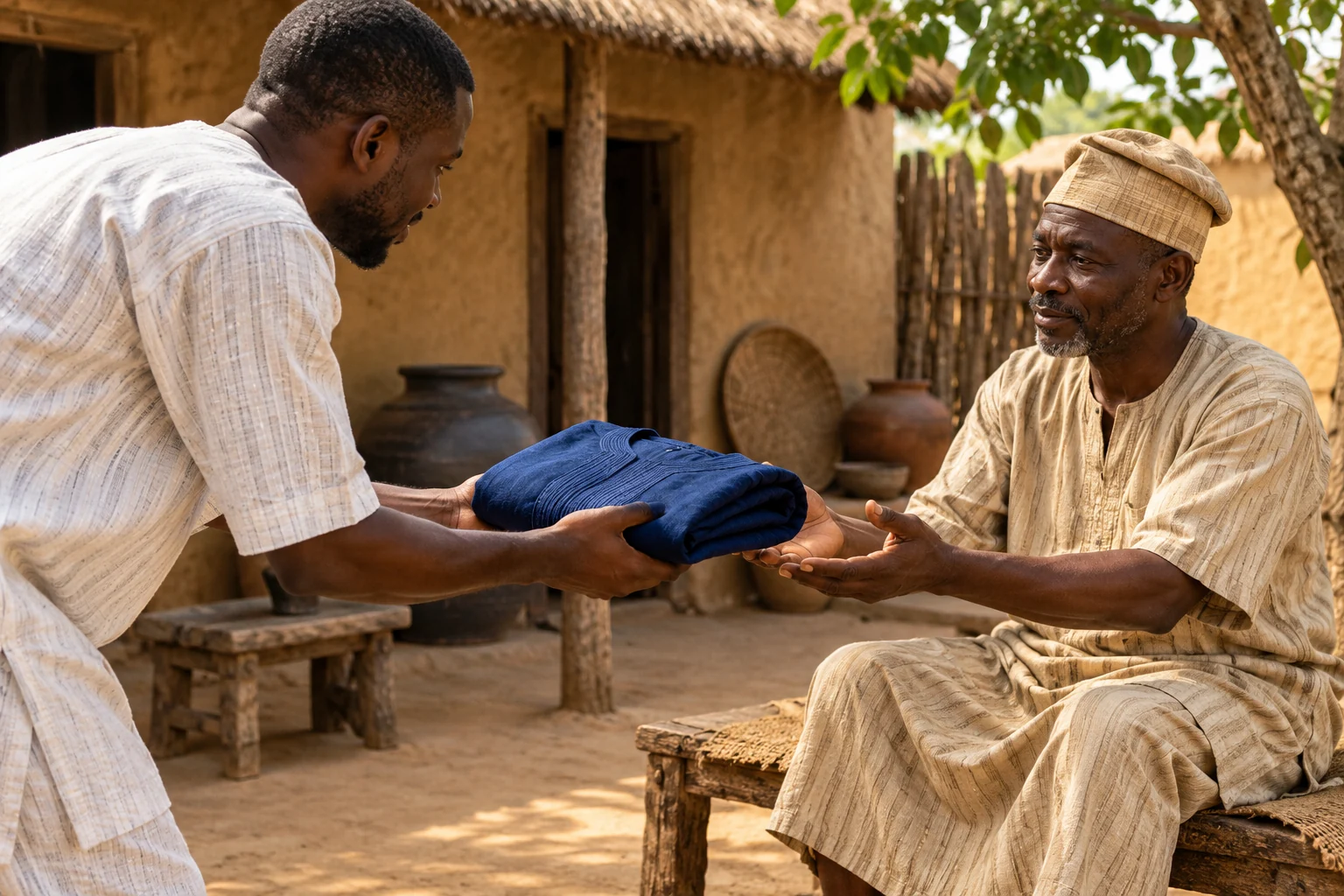
Shango sends a powerful, splendidly dressed son to a poor land. Kayebi hides in shame at the contrast. The visitor finds him, clothes him comparably, and enables him to exercise a public capacity he lacked. Shango disapproves of this unexpected sharing and imposes a continuing hierarchy between them.
The story leaves generosity and obedience in conflict. Sharing status restores Kayebi’s visibility, yet the sending authority interprets it as a failure to rule. An article should retain that contradiction instead of calling the ending a simple triumph. Material appearance, voice, and access to knowledge work together as instruments of inclusion or exclusion.
Narrative setting: Cuban/Lukumí patakín in a multilingual source compilation; no individual narrator is established.
Prosperity’s children become sought-after presences
The narrative personifies prosperity through several children or constituent goods: money, marriage, childbearing, elevation, and other valued conditions. Before entering earth, they consult and each undertakes a differentiated sacred commitment. On arrival, these presences become desirable to rulers and ordinary people alike. A connected passage represents prosperity as something held behind a gate that opens through an appropriate religious approach. These are compact accounts of why valued conditions attract human seeking. They do not describe one individual accumulating every good, and they do not establish that everyone must desire the same family structure, status, or material form.
This witness makes value plural before it makes it personal. Money, relationship, continuity, and position are represented as distinguishable presences rather than synonyms for wealth. Their differentiated preparations suggest that desire is not fulfilled through one undifferentiated transaction. The gate image adds a further question: access has an order and a relationship, not merely a quantity of effort. Read beside Ti Obada’s hidden gatherings, the new episode also asks how goods are distributed within a household. What appears as abundant food to one participant can become a burdensome account to another.
The account of Alara clothing Kayebi then shows that dignity and public capacity may be transferred, while the sponsoring authority resists that transfer. These comparisons should not erase the new witness’s religious ontology: prosperity’s constituents are active participants arriving from a celestial domain. A contemporary interpretation can question whose aspirations dominate, but the story itself explains desire through sacred emergence rather than a psychology of consumer preference.
Narrative witness and setting: Translated excerpt in the multilingual compilation’s expressly attributed Cromwell Osamaro sequence, with Yoruba/Bini-facing material. The compilation’s language is not evidence of a Brazilian tradition.
Stolen instruments do not all return
During a diviner’s absence, three animal servants take different objects associated with his practice. Their acquisitions become incorporated into bodily features or swallowed power in the narrative. After he returns and consults, Ogun acts as a hunter to recover what can be retrieved. Some visible instruments and adornments are recovered, but the power swallowed by the dog remains unavailable even when the animal is later seized. The story ends with an incomplete restitution rather than a full return to the earlier state. Its animal etiologies and sacrificial ending remain religious narrative, not natural history or an instruction for recovering stolen property.
The central distinction is between reclaimable material objects and power that has already entered another body. That makes the loss more than a simple inventory problem. The diviner can act through a religious ally, yet the result has a limit: effective intervention does not restore everything. The earlier Alara episode also turns authority into something transmissible through clothing and blessing, while the abiku household changes from covert consumption to contribution. Across the accounts, transfer can enable, burden, or permanently deprive.
The new story should not be flattened into suspicion of all servants. Its emphasis on entrusted access can support questions about responsibility, but its violent recovery and hierarchy remain difficult features of this particular witness. A spiritually attentive reading should also preserve the nonfungibility of ase: it is not treated merely as an expensive object that can be replaced from a market. The narrative leaves a changed field of power even after the owner’s claim has been asserted.
Narrative witness and setting: Translated excerpt in the multilingual compilation’s expressly attributed Cromwell Osamaro sequence, with Yoruba/Bini-facing material. The compilation’s language is not evidence of a Brazilian tradition.
What was born in this Odù
“Born” can name an explicit traditional origin association or what emerges through a story: a capacity, relationship, practice or order of life. Interpretations drawn from a narrative are labelled below, so their basis remains clear.
The crown of Dada Banani
Selected traditional source association.
The named crown places visible authority among this sign’s associations. It does not authorize a universal reconstruction of Dada’s regalia or an etymological claim about the crown’s name.
The Azowano-linked crown
Selected traditional source association.
The source associates a patterned-skin crown with Azowano’s children. This is a localized ritual identity; the study does not merge Azowano with every disease-related divinity in other traditions.
Correlations to life dimensions
These questions bring the selected stories into contemporary life. They are interpretive invitations for study.
Work and resources
Invisible household expenses matter because the parents already work hard. A sustainable contribution requires knowing where time and provisions actually go.
Reflect: Which recurring cost needs an honest shared account?
Relationships and family
The daughter changes her conduct after the parents explain their hardship. Disclosure allows a relationship to move from suspicion to negotiation.
Reflect: What burden have you assumed someone else already understands?
Character and inner life
Kayebi’s shame leads him to hide, while the visitor’s response gives him public presence. Dignity is supported by practical acts rather than reassurance alone.
Reflect: What concrete act would help someone participate with dignity?
Community and responsibility
The transfer of capacity threatens the hierarchy that sponsored it. Community benefit and a leader’s preference do not always coincide.
Reflect: Would you defend a useful sharing of power if it reduced your status?
A deeper reading of the sacred relationships
Ase is not simply recoverable property
Inside the stolen-instrument account, objects, adornments, and ase have different fates. The hunter can retrieve certain external forms, but swallowed power cannot be recovered by the same act. That distinction matters for religious interpretation: ase is represented as effective, embodied capacity, not only a label for prestige or a material possession. The earlier transfer from Alara to Kayebi likewise changes what a person can do publicly. A contemporary discussion of intellectual property or entrusted resources may draw an analogy, but it should not dissolve these sacred differences. The account gives restitution a spiritual limit, and acknowledging that limit is more faithful than promising that correct intervention makes every loss reversible.
Abundance does not answer the distribution question
The children of prosperity become desirable to many kinds of people, but the account does not narrate an equal distribution among them. The abiku episode makes this omission concrete at household scale: resources circulate while the working parents bear a cost they do not understand. The Alara episode adds a public scale, where an empowered visitor shares capacity with someone whose appearance signals deprivation. These are separate religious situations, yet together they resist equating the existence of wealth with an adequate social arrangement. An editorial study can ask how goods reach people and who may authorize their use, while keeping that question distinct from the source’s cosmogonic explanation of why the goods are sought.
Incomplete endings are part of the evidence
The stolen ase does not return, Shango continues to impose a hierarchy after Alara’s generosity, and the parents’ improved circumstances do not provide a complete future history of Ti Obada. These limits prevent a reference study from promising that disclosure or religious action settles every consequence. The prosperity-gate passage has a more affirmative completion, but its compactness should not be imported into every other episode. Reading the endings at their own scale makes the archive more credible and spiritually richer: divine agency can be effective without each narrative closing every human question. The missing resolution is therefore not a defect an editor should repair by inventing a reassuring final event.
Questions that deepen the study
What does the lost ase add beyond a familiar warning against theft?
It establishes that different losses cannot be restored in the same way. The source distinguishes visible implements from power absorbed into another body and allows only a partial recovery. A contemporary reader may recognize that time, confidence, or an institution’s capacity can remain changed after objects return, but these are analogies rather than replacements for the religious account. Within the witness, ase has its own effective reality. The story’s force lies in the mismatch between a legitimate claim of ownership and the practical or spiritual reversibility of what happened. It does not authorize violence against people suspected of withholding power.
Are all the children of prosperity compulsory goals for a reader?
No. The narrative tells how several valued presences become desirable in its religious and social world; it does not require a present reader to reproduce every listed condition. Marriage, children, money, and public elevation are not interchangeable, and their personification is one reason to preserve their differences. A reader can ask which goods they actually seek and what obligations accompany them. That is a contemporary reflection made beside the account, not a claim that the source secretly endorses every modern life pattern. Respecting the witness and respecting the reader’s particular circumstances are compatible when their levels are stated clearly.
How do the new episodes alter the meaning of Alara’s gift to Kayebi?
They show that giving capacity is more consequential than transferring an attractive object. In the stolen-instrument episode, embodied power changes the giver’s or owner’s future and is not always recoverable. In the prosperity episode, desirable conditions arrive through distinct sacred relations rather than as one homogeneous reward. Alara’s clothing and blessing can therefore be read as a redistribution of effective standing, which helps explain why his father treats the act as politically significant. The source still leaves the father’s punishment morally difficult. The added witness deepens that tension rather than turning it into a simple condemnation or praise of generosity.
What the four narratives reveal together
The new material enlarges Obara Irosun from hidden household activity and shared public dignity to the different forms in which value and power can move. Prosperity’s children arrive as distinct sacred presences; stolen instruments enter animal bodies and do not all become recoverable. The earlier Cuban narratives then gain sharper questions: who bears the costs of circulation, and what changes when one person gives another the capacity to act? A spiritually grounded study should preserve ase as effective power and the celestial arrival of valued conditions as the witness’s own account. Its contemporary analysis may address distribution, stewardship, and irreversible loss, but those lenses remain secondary comparisons. The four stories are strongest when their endings are kept uneven: some relationships improve, some hierarchies persist, and one significant loss remains unrestored.
Living with this Odù
A continuing life or initiatory relationship
For someone whose received life or initiatory sign is Òbàrà Ìròsùn, value can require repeated distinctions among possession, public capacity and the terms of transfer. The working parents' resources are consumed through activity they cannot see; Kayebi receives clothing and authority that alter his ability to participate. These arrangements ask who can use a resource, who carries its cost and who has the power to authorize another's visibility. A person engaging the sign over time need not accept either secrecy or hierarchy as the natural form of every relationship.
The Ibie accounts make prosperity plural and restitution incomplete. Desired goods arrive as distinct sacred presences, not as one uniform package every person must acquire. In the stolen-instrument story, Ogun's effective intervention recovers some things without restoring swallowed ase. Long-term character can include learning to repair what is recoverable while acknowledging that not every loss can be undone. Such recognition is different from resignation or blaming oneself for an imperfect recovery. The narratives preserve divine agency and difficult endings together. They do not identify an actual child as abiku, guarantee restoration of property or make material abundance proof that resources have been fairly distributed.
A particular consultation and its question
A particular consultation yielding Òbàrà Ìròsùn may help clarify what kind of transfer is troubling the situation. Is hidden consumption burdening people who supply the resources? Has another person's participation been restricted through shame or unequal access to public standing? Or does a loss include something that cannot be recovered by reclaiming visible objects alone? The household, Kayebi's clothing and the stolen instruments give distinct arrangements rather than interchangeable examples of wealth.
A practitioner needs to preserve the religious differences. The child's extraordinary activity belongs to the Cuban narrative and cannot classify the unknown client's family. The transfer of public capacity is effective within the sacred account, while Ogun's retrieval has a limit that the source does not erase. The personified children of prosperity also distinguish desired conditions before any contemporary reader chooses among them. A consultation can therefore ask what the client actually seeks, what another participant has supplied and which part of restitution remains possible. It does not determine that a person must accumulate every named good or receive an identical sequence of losses. The result addresses an occasion; permanent personal identity should not be inferred from whichever protagonist currently seems familiar.
Constructive and adverse possibilities
Constructive relations could make a concealed burden visible and redirect capacity toward supporting those who have carried its costs. Kayebi's new standing also shows how sharing can enable participation, even when the sponsoring authority resists. Within the Ibie material, prosperity's constituents and Ogun's action retain their own sacred effectiveness rather than functioning only as symbols of attitude.
Adverse relations include concealed appropriation, hierarchy maintained after an act of generosity and an expectation that recovery must erase every consequence. Swallowed ase does not return with the same action that retrieves external instruments. That limit matters without implying that intervention was useless. These are possible configurations for interpretation, not a verdict on an actual divination's state. The violent ending and the incomplete account of subordinate participants also remain ethically significant; success cannot convert every transfer or recovery into an uncomplicated good.
An illustrative situation in everyday life
In a hypothetical family enterprise, one member has been using shared funds for activities others did not authorize. Disclosure stops the expenditure, but the family then discovers that lost trust cannot be returned as readily as money. The hidden household costs and the distinction between recovered objects and unrecovered power help separate these concerns. Another relative proposes making a previously excluded worker a public partner, which threatens the founder's preferred hierarchy. Kayebi's clothing adds that question without dictating its answer. The example is an illustrative interpretation of resource use, standing and partial repair. It does not classify a relative through the source's supernatural child or claim that modern trust is identical with ase.
Sources and reading context
The first two narrative witnesses
The abiku account is a Cuban religious narrative, not a diagnosis of children. The second story uses Azowano and Oluo Popo vocabulary whose broader equivalences are not assumed here. Local crown associations and later interpretive essays are kept distinct from the selected story evidence.
Narrative motifs are summarized independently. The life-dimension reflections are contemporary interpretation. How these reference studies are built explains the wider source approach and the distinction between a reference article and personal divination.
Additional named witnesses
- Cromwell Osamaro Ibie. The surrounding sequence is expressly attributed to Cromwell Osamaro. These selected episodes are read through the multilingual compilation’s translated renderings; exact edition and original translation chain remain unverified.
The attributed African-facing passages are brief and translated unevenly. Animal features are etiological images, and no claim is made about actual servants, animal biology, or a reader’s hidden enemies. The gate passage is a connected motif, not a disclosed ritual procedure or guarantee of all desired goods.
Bibliographic identification
- C. Osamaro Ibie. Ifism: The Complete Work of Orunmila. Lagos; multivolume publication beginning 1986. Library catalogue record. Related bibliographic record for the named narrative witness. Exact volume, edition and page of the transmitted account have not been independently matched.
Read the source method and wider scholarly context.
The catalogue links identify published works and their authors. They are separate from proof of an individual episode’s wording or attribution. Contemporary comparisons and the synthesis above are editorial interpretation. The author’s books and Academy companions below provide further study; their sales links are separate from the source references.