
Òbàrà Òwónrín is a mixed Odù in Ifá’s 256-part corpus. Obara Owonrin juxtaposes reputational sabotage with a brief account of Obatala’s disregard for the earth. In the first, a jealous brother redirects trust and then transfers blame after a death; public testimony exposes the manipulation. In the second, yam growth becomes unlivable until Elegbara intervenes. Both episodes ask what happens when someone dismisses a necessary relationship, whether with a reliable colleague or with the ground supporting ordinary life.
A question to carry through the study: What evidence would you need before accepting a damaging claim about someone who has helped you?

This Academy reads the right column first, then the left. Each row carries a single or double mark.
Where this Odù belongs
Òbàrà Òwónrín belongs to the Òbàrà family in this Academy’s study sequence. It is a mixed Odù, distinct from Òwónrín Òbàrà. The order matters. Its teaching is approached through its own narratives, rather than by adding two general descriptions of the principal signs together.
Key Òrìṣà and sacred relationships
The figures below are selected for their roles in the accounts discussed here. They offer connected reading paths through the tradition.
-
Èṣù. He observes the jealous brother’s conduct and brings the dispute into a public setting; in the yam episode Elegbara also resolves an overgrowth problem.
-
Obàtálá. He blesses the successful diviner in one episode but dismisses the earth in another, giving him distinct roles that should not be flattened into unqualified perfection.
-
Baba Ẹ̀gún. The deceased boy’s speaking presence functions as a narrative witness who assigns responsibility publicly. This is an ancestral/dead motif rather than a claim about actual testimony.
Key myths and their meanings
A brother redirects trust
A successful diviner repeatedly helps a brother who undermines him. The brother diverts a ruler seeking assistance and, after the ruler’s son dies, blames the first diviner. Esu facilitates a public gathering where the dead child’s testimony exposes the false accusation and the ruler’s choice to follow it.
The focus is professional sabotage and displaced responsibility, not an explanation of a child’s death or a comparison of treatments. The episode shows how a persuasive intermediary can interrupt a trusted relationship. Public correction matters because the accusation circulated socially; private knowledge alone would leave the injured person’s reputation vulnerable.
Narrative setting: Cuban/Lukumí patakín in a multilingual source compilation; no individual narrator is established.
The yam without a respected earth
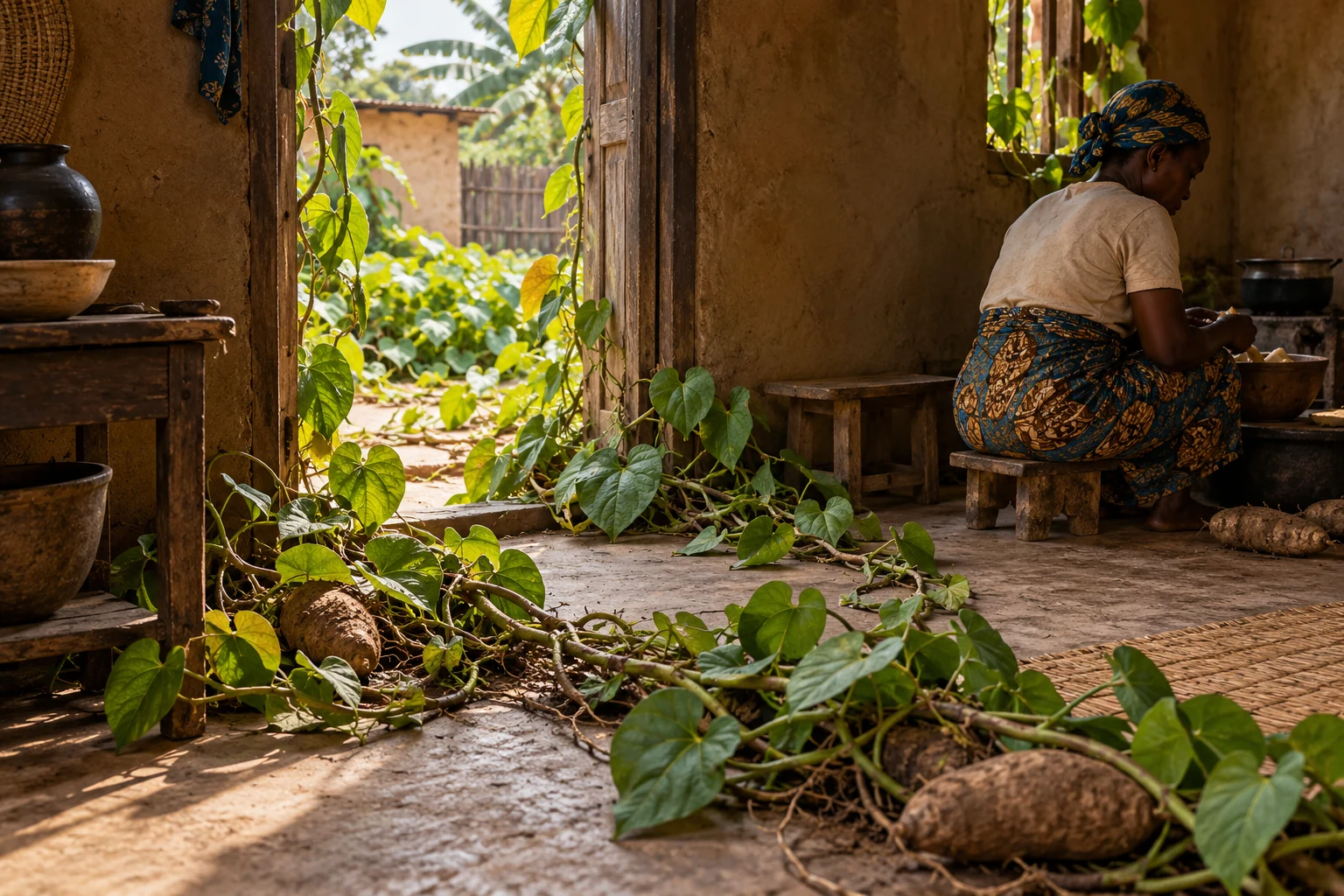
In a short accompanying motif, Obatala dismisses the earth while yam grows above ground. The plant spreads through his dwelling until ordinary life is crowded out. Elegbara, who values the yam, resolves the problem. The compact account offers little further detail about the method or final arrangement.
The image can support discussion of dependence on an undervalued foundation. Something productive becomes disruptive when its place and relationship are disregarded. Because the episode is brief, avoid turning it into a full agricultural history or inventing a missing dialogue. Its force lies in the contrast between contempt for the ground and a house overtaken by growth.
Narrative setting: Cuban/Lukumí patakín in a multilingual source compilation; no individual narrator is established.
The parrot claims a share of the speaking tree
A hunter leaves three trained dogs in a household whose other member does not know their care, and the dogs die during his absence. His wife then establishes a profitable performance in which a hidden parrot makes a tree appear to speak. She keeps the proceeds without paying the bird, which moves into the home to demand its share. Rumor interprets its presence as a sexual relationship. When the hunter returns, the dispute combines animal care, concealed production, withheld compensation, and reputation. He expels his wife and retains the parrot as an informant, leaving the settlement markedly unequal.
The first failure is an unshared system of care: the dogs’ knowledge and needs belong to the absent hunter, and the source gives no indication that his wife received adequate instruction. The later business creates a second asymmetry when the parrot’s necessary contribution is concealed and unpaid. Its move into the house makes a hidden collaborator publicly visible, but the rumor misnames what has happened. The earlier jealous-brother story similarly shows reputation being redirected through a persuasive account detached from responsibility.
This new episode, however, ends without an impartial public hearing. The husband’s power resolves his position while leaving the wife’s motives, labor, and vulnerability insufficiently considered. A careful article can recognize the sacred warning concerning an anticipated dispute while resisting the source’s invitation to make the wife an all-purpose explanation for loss. The parrot is both a claimant for payment and a later instrument of the man’s surveillance, a change that deserves to remain ethically unsettled.
Narrative witness and setting: Translated excerpt in the multilingual compilation’s expressly attributed Cromwell Osamaro sequence, with Yoruba/Bini-facing material. The compilation’s language is not evidence of a Brazilian tradition.
The meal becomes complete later in life
Olobara is represented as enduring a period of deprivation in which he eats pounded yam without the soup that would complete the meal. Consultation frames this condition as an early stage that may give way to a different later life. After the religious commitment, the account describes marriage, children, houses, servants, and a household whose call brings several responses. The narrative is compact: it provides neither a detailed career nor a timetable transferable to another person. Its central images are an incomplete meal and a later abundance that changes domestic and public relations, rather than merely a larger quantity of money.
The image of yam without soup gives scarcity a specific texture. Olobara has something to eat, but not the accompaniment that makes the meal adequate in its own setting. That is different from a generic declaration of absolute lack. The later household is likewise socially organized, not only stocked with objects. A religious reading sees consultation and sacred commitment as part of the transition; a contemporary interpretation can ask how a life is understood across stages without claiming that suffering automatically earns later wealth.
The servants and multiple responders also require attention. Their presence marks status in the source, but it does not tell us whether their conditions are fair. The earlier short yam motif, where disregarded earth is overwhelmed by growth, adds a useful counterpoint: more production is not always the same as a livable arrangement. Thus completion should be examined relationally, rather than defined by the most impressive inventory at the narrative’s end.
Narrative witness and setting: Translated excerpt in the multilingual compilation’s expressly attributed Cromwell Osamaro sequence, with Yoruba/Bini-facing material. The compilation’s language is not evidence of a Brazilian tradition.
What was born in this Odù
“Born” can name an explicit traditional origin association or what emerges through a story: a capacity, relationship, practice or order of life. Interpretations drawn from a narrative are labelled below, so their basis remains clear.
Exile
Selected traditional source association.
Exile is explicitly listed as an origin association. It can frame questions of displacement and social belonging, but the selected narratives do not tell a separate story explaining its first occurrence.
The lightning conductor
Selected traditional source association.
The lightning-rod association introduces protection through redirection. No engineering or deity-origin story accompanies the inspected item, so its function should remain a limited thematic comparison rather than a historical claim.
Correlations to life dimensions
These questions bring the selected stories into contemporary life. They are interpretive invitations for study.
Work and resources
The successful diviner’s work is damaged through reputation rather than lack of skill. Professional trust needs ways to examine claims without automatically rewarding the loudest intermediary.
Reflect: How does your workplace verify damaging allegations?
Relationships and family
Repeated support does not stop the brother’s envy. Family loyalty and professional access need not be identical.
Reflect: What boundary protects a relationship from repeated misuse?
Character and inner life
The ruler’s choice is included in the final attribution of responsibility. Being misled does not erase the need to examine one’s own decision process.
Reflect: Where are you passing responsibility to an adviser?
Community and responsibility
The public setting gives correction the same reach as accusation. Community repair includes restoring standing, not merely discovering facts privately.
Reflect: Who needs to hear a correction for it to repair the harm?
A deeper reading of the sacred relationships
Sacred timing without a personal timetable
The Olobara episode represents deprivation and later provision within a life already addressed by Ifa. Its temporal structure is religious: consultation does not merely predict a detached future but helps constitute a relation through which the life changes. The hunter’s delayed response to counsel provides another temporal problem, since he assumes the needed act can wait until after travel while events continue at home. A modern reading can compare delayed preparation with changing conditions, but should not turn the story into a fixed clock for a reader’s marriage or prosperity. The source has meaningful stages, not dates, and religious responsibility remains active during the interval between consultation and an outcome.
Invisible contributors become inconvenient witnesses
The parrot supplies the tree’s apparent voice, then becomes unwelcome when it demands recognition. The jealous brother in the earlier story manipulates an account of another person’s work, while the dead child’s testimony makes concealed responsibility public. These are not equivalent witnesses: one has an unpaid economic claim, another is a supernatural source of disclosure, and another is a living saboteur. Their comparison turns voice into a question of authority and obligation. Who is allowed to speak, whose presence is explained away, and who gains by changing the meaning of a contribution? The stories give enough detail to ask those questions without inventing a perfectly impartial system of testimony.
Completion is not simply accumulation
Yam without soup is incomplete in a culturally specific way; the later household has a different texture of provision and response. The farmer’s house overwhelmed by yam growth, however, shows that abundance may become obstructive when relationships are disregarded. The parrot business earns money yet contains an unpaid collaborator and a false public appearance. These comparisons prevent an editor from using a single scale of more versus less. An arrangement can be materially productive and ethically incomplete, or modest yet adequate to a particular purpose. The sacred narratives do not all answer that distinction with the same terms, which is why their differences should remain visible in a reference study.
Questions that deepen the study
What was the parrot actually asking for?
The narrated claim concerns a share of proceeds from a performance the parrot helped produce. Its presence in the household is then interpreted through sexual rumor, but that interpretation should not replace the explicit economic dispute. Recognizing the claim allows a more precise reading than simply labeling the episode marital betrayal. The source’s ending still favors the husband, who keeps the bird’s informational service while removing his wife. A contemporary analysis can ask about consent, compensation, and unequal judgment without denying the story’s sacred setting. The useful distinction is between what the participant asks for and what the community says the participant’s presence means.
Does Olobara’s later abundance make his earlier deprivation necessary?
The narrative places the two conditions in sequence, but sequence does not establish that hardship was morally required or beneficial in itself. Within the witness, Ifa addresses the possibility of a changed life through sacred relationship. A contemporary reader can receive that hopeful temporal structure without treating every deprivation as a lesson someone should accept. The account also gives no universal age or schedule for the transition. Its meal image is especially useful because it describes adequacy in relation to a way of living, rather than promising that all difficulties end in a particular number of houses, children, or attendants.
How do the new stories deepen the sign’s concern with truthful testimony?
They distinguish several reasons that a true account may be obscured. In the jealous-brother episode, a rival deliberately transfers blame. In the tree performance, the public does not know who supplies the voice, then misreads the collaborator’s demand for payment. The brief earth-and-yam motif warns that even a powerful figure may dismiss a necessary foundation. Together they require attention to the conditions under which information is produced and interpreted. That is not an instruction to distrust everyone. It is a source-grounded invitation to ask what a claim depends on, which participant can correct it, and who benefits from the prevailing explanation.
What the four narratives reveal together
The added episodes turn Obara Owonrin toward the social and sacred conditions of a complete account. The parrot’s labor is hidden until its unpaid claim becomes an embarrassing public presence; Olobara’s meal becomes adequate only through a change in life that includes relationships as well as possessions. The earlier accounts of slander and disregarded ground remain necessary because they expose how responsibility can be misnamed or a foundation overlooked.
Ifa’s temporal logic and the supernatural witness should be described within their own religious world, while questions about compensation and testimony are offered as contemporary analysis. No single ending resolves all four cases. Public truth restores one reputation, a household dispute ends unequally, and abundance changes status without proving that every subordinate person benefits. Those unresolved distinctions give the study substance beyond a general promise of prosperity.
Living with this Odù
A continuing life or initiatory relationship
For someone who has received Òbàrà Ọ̀wọ́nrín as a life or initiatory Odù, truth can remain a question of relationship and public conditions, not merely private knowledge. The brother diverts trust and places blame on an absent practitioner; the parrot's contribution becomes visible through a demand that rumor then misdescribes. Across a life, these tensions can sharpen judgment about intermediaries, evidence and the conditions under which a damaged account can be corrected. Being certain inwardly does not necessarily repair a reputation injured before others.
The yam motifs prevent the same person from treating every increase as completion. Growth can overwhelm a dwelling when its foundation is disregarded, while Olobara's incomplete meal marks a specific inadequacy rather than absolute emptiness. Within the Ibie witness, consultation and sacred commitment participate in changing provision, but no transferable timetable follows. Long-term character can involve preparing before absence, acknowledging hidden contributors and receiving improved circumstances without ignoring those who sustain them. The sign does not promise delayed riches or make suspicion of family a virtue. It asks how a life becomes more adequately arranged while leaving sacred disclosure, human wrongdoing and unequal endings distinguishable.
A particular consultation and its question
In an actual consultation, Òbàrà Ọ̀wọ́nrín can help distinguish a shortage from an arrangement that is productive yet incomplete. A question about prosperity might concern an absent accompaniment, a disregarded foundation or a collaborator whose labor has been concealed. Olobara's meal, the dwelling overtaken by yam and the speaking-tree business provide different structures. A practitioner should not compress them into advice that more accumulation will settle the matter.
A question involving reputation requires another distinction. The brother's sabotage is answered through supernatural public testimony in the Cuban account, while the parrot's dispute ends through the husband's unequal authority rather than a comparable hearing. Their witnesses and settlements are not equivalent. The source can support inquiry into who speaks, what they know and whose interests an account serves, but it does not establish a modern forensic method. Consultation may also attend to delayed preparation before a journey, preserving sacred counsel as effective within the witness. A result for the present question does not identify the client permanently as a betrayed diviner, an unpaid collaborator or someone destined for later abundance. The actual reading must determine which relationship requires attention.
Constructive and adverse possibilities
Constructive unfolding may include publicly correcting a circulated accusation, recognizing a hidden contributor and making provision adequate to the actual setting. Esu's mediation of the dead child's testimony belongs to the sacred narrative, while Olobara's later circumstances emerge through a different religious sequence. Neither should be reduced to positive thinking.
Adverse unfolding could involve withheld compensation, reputation governed by rumor or an abundance that obstructs ordinary life. The hunter's settlement also protects his position without supplying an impartial account of the wife's circumstances. A later full household cannot prove that everyone's conditions are fair. These contrasts remain possible narrative relations rather than an assignment of ìrè or òṣogbo. They ask whether an apparent completion actually addresses its dependencies and whether a successful ending has left another person's contribution, vulnerability or claim unheard.
An illustrative situation in everyday life
In a hypothetical performance business, a visible presenter receives payment while an unseen technical collaborator supplies the effect audiences admire. When the collaborator demands a share, gossip recasts the dispute as personal misconduct. The presenter wants to suppress the claimant to protect the brand. Reading beside the speaking tree distinguishes the real contribution from the rumor attached to its appearance. The brother's redirected trust adds the need to correct an account where it circulated, rather than merely feel privately vindicated. This example does not treat the stories' supernatural testimony as legal evidence. It asks how a productive venture can become more complete by recognizing labor, payment and a fair opportunity to be heard.
Sources and reading context
The first two narrative witnesses
The selected Cuban accounts include supernatural testimony and a very brief earth-and-yam motif. Neither is presented as forensic evidence or an agricultural explanation. The first two longer stories substantially repeat the same plot, so the distinct yam episode is used as the second motif.
Narrative motifs are summarized independently. The life-dimension reflections are contemporary interpretation. How these reference studies are built explains the wider source approach and the distinction between a reference article and personal divination.
Additional named witnesses
- Cromwell Osamaro Ibie. The surrounding sequence is expressly attributed to Cromwell Osamaro. These selected episodes are read through the multilingual compilation’s translated renderings; exact edition and original translation chain remain unverified.
The Portuguese account contains unstable terms for travel and the speaking-tree performance. Its rumor is not adopted as fact, and its gendered judgment remains open to critique. Olobara’s later household describes the witness’s status vocabulary, not a universal ideal or personal financial forecast.
Bibliographic identification
- C. Osamaro Ibie. Ifism: The Complete Work of Orunmila. Lagos; multivolume publication beginning 1986. Library catalogue record. Related bibliographic record for the named narrative witness. Exact volume, edition and page of the transmitted account have not been independently matched.
Read the source method and wider scholarly context.
The catalogue links identify published works and their authors. They are separate from proof of an individual episode’s wording or attribution. Contemporary comparisons and the synthesis above are editorial interpretation. The author’s books and Academy companions below provide further study; their sales links are separate from the source references.