
The dead do not leave only an absence. They also leave names, habits, obligations and unresolved questions through which the living continue to understand themselves. Baba Ẹ̀gún opens a study of ancestral presence with particular attention to the organized religious communities that carry it. Ancestry is more than an atmosphere of oldness.
Layered fabric recalls the communal making that sustains ancestral relationship.
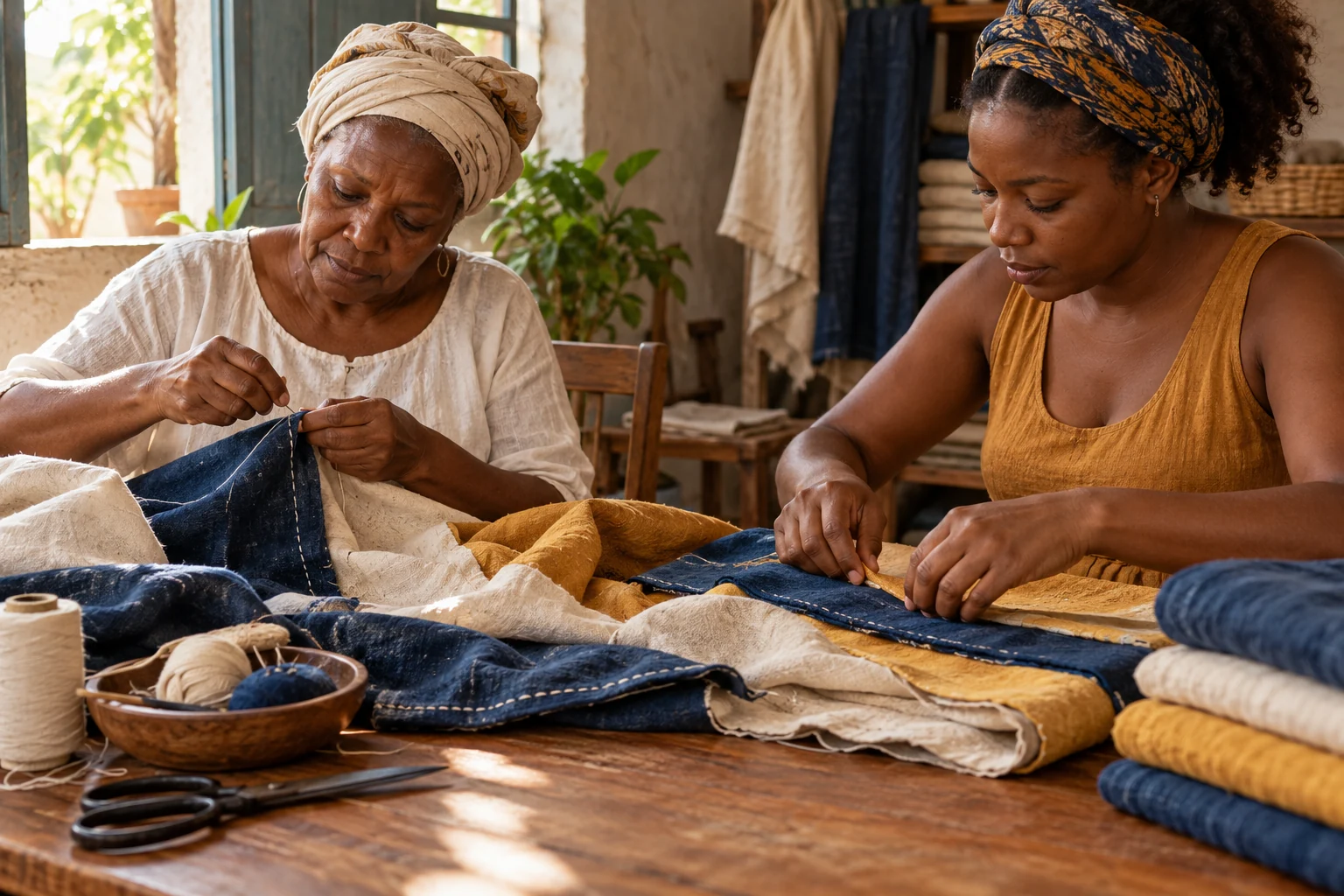
1. Egúngún in a Brazilian heritage setting
Brazilian heritage records recognize the importance of Omo Ilê Agboulá on Itaparica in preserving ancestral worship. The Brazilian ministry’s account and Bahia government record provide concrete institutional context.
Egúngún-related ancestral institutions should not be collapsed into every practice involving a deceased person. Nor does the Academy’s inclusion among sacred figures assert a universal equivalence between Baba Ẹ̀gún and an Òrìṣà. The collection preserves the owner’s teaching sequence while making religious distinctions explicit.
2. Key theme: an ancestor is received through relationship
Ancestral presence is not adequately explained by saying that an old person has died. Names, community recognition, transmission and particular forms of religious authority matter. A public introduction can acknowledge those relations without disclosing restricted procedures or treating an institution as a costume detached from its custodians.
For contemporary reflection, the important question is how a community makes the past present responsibly. Memory is carried through repeated acts, but those acts need people, resources and permission to continue. Heritage is therefore living work, not merely an object whose survival can be announced once and considered secure.
3. Gratitude and correction belong together
Honoring ancestors does not require declaring every inherited pattern good. A family can receive courage and care alongside silence, fear or harm. Mature remembrance can recognize what deserves continuity while deciding that a damaging pattern should end.
The same applies to institutions. Reverence for founders may support continuity, but it should not prevent discussion of the consequences their decisions left behind. The question is how to remain in a truthful relationship with an inheritance rather than choose between idealization and rejection.
4. Grief and public representation
An ancestral institution can be visible in heritage, art and public events while retaining boundaries around religious knowledge. The visitor’s interest does not establish a right to every explanation. Respectful learning includes recognizing that a community can welcome public appreciation without making its entire life available for consumption.
Personal grief also deserves its own attention. A religious account can support remembrance, but no general article should dictate what another person ought to feel or how quickly loss should become meaningful.
5. Religious identity and the scope of this study
Baba Ẹ̀gún opens a sacred field of ancestry rather than a single divine biography assembled from fixed attributes. The author's chapter distinguishes the departed in general from ancestors maintained in recognized relationship, and distinguishes broader Ẹ̀gún vocabulary from the specific institutions and manifestations of Egúngún. Actual usage varies, but the distinctions prevent every encounter with the dead from being placed in one undifferentiated category.
The opening discussion's Brazilian heritage setting should remain central. Omo Ilê Agboulá on Itaparica locates ancestral worship in a community with custodians, history and continuing responsibilities. Nigerian museum evidence offers a related but separately situated view of cloth, performance and lineage. These contexts can illuminate one another without becoming identical institutions.
The psychological development concerns how inherited life is received. An ancestor is neither merely a remembered personality nor an explanation for everything a descendant feels. The book asks how names, prohibitions, talents, silences and unfinished grief contribute to present personhood. Gratitude and differentiation must therefore develop together. Receiving an inheritance can provide grounding; making it unquestionable can suffocate the living. Baba Ẹ̀gún allows this tension to be examined within a religious understanding of continuing relation that exceeds a modern account of memory alone.
6. Knowledge that gives the figure depth
6.1 What does cloth contribute to ancestral presence?
Cloth in Egúngún is not a disguise that can be removed from the meaning of the event while leaving the essential religion intact. It contributes texture, concealment, weight, movement and a visible form through which ancestral relation becomes present. Henry John Drewal's RISD account documents collaboration among sewing, carving, song and performance. Its specificity corrects a solitary image of a masked man representing an individual dead person: an ensemble is made and sustained through communal work.
This does not mean that one can infer the identity of an ancestor from an isolated garment. Smithsonian records warn that costume, music, song and movement matter for identification. A collection object consequently provides partial evidence of a living arrangement. Its form can teach us something, but it cannot replace its custodians' knowledge.
The interpretive implication concerns how memory acquires a body. A lineage survives through repeated contributions that may be unevenly visible. The most dramatic moment depends on people whose work precedes it and continues afterward. A public article should bring that labor into view without pretending to disclose restricted meanings. It can also ask a contemporary community what resources sustain its remembrance: who prepares, teaches, repairs, hosts and carries the obligation when public recognition has moved elsewhere?
Evidence: Henry John Drewal, RISD Museum, Egúngún: Mysteries Concealed in Magical Cloth — Authored museum essay supporting collaborative textile making, performance and lineage context; not universal gender rules for all diaspora houses; National Museum of African Art, Smithsonian Institution, Crest mask, accession96-39-1 — Annual/funerary/special events and warning that costume, music and movement affect identification.
6.2 Why is ancestorhood more than the fact of having died?
The distinction between a deceased person and an ancestor concerns relationship, recognition and transformed status. In the book, ancestorhood is not established by age or death alone. The dead must be situated within a continuing religious and social order. This does not license an outsider to judge which particular deceased people have achieved the status. It explains why an account of ancestors requires more than a list of everyone a person misses.
The distinction also changes the interpretation of mourning. A death ends forms of contact that cannot simply resume, yet the relationship can acquire different forms through memory, obligation and recognized practice. Ancestral presence does not deny the rupture. It gives the changed relation a setting in which the dead can matter without occupying the place of the living.
The chapter discusses burial and subsequent transformation as a broad interpretive field. A reference should not turn that into one universal sequence required by every Yorùbá or Brazilian house. The supported psychological question is narrower and valuable: what has become possible for the living and the departed after a relationship has been acknowledged, named and situated? Unprocessed loss and integrated remembrance can both involve continued bonds, but their effects on a life may be profoundly different.
6.3 How does living custodianship differ from heritage display?
Brazilian heritage recognition locates ancestral institutions in the history of communities that have preserved them under changing public conditions. The opening discussion identifies Omo Ilê Agboulá as an institutional anchor. This should remain an account of a particular terreiro and its custodians, rather than become proof that all practices called ancestral worship share its organization. A state's recognition can make a place more visible while remaining unable to explain the totality of its religious life.
The distinction between heritage and living authority has practical implications. Public appreciation may value an ensemble, a building or a festival while overlooking the ongoing responsibilities through which it remains religiously meaningful. Preservation requires more than announcing that an object has survived. It depends on people continuing to teach, prepare and maintain relationships, including decisions about what can be shown publicly.
The contemporary psychological application concerns the temptation to turn inheritance into display. A family may celebrate its history enthusiastically while leaving the keeper of that history unsupported. An institution may invoke founders while neglecting those carrying their work. Baba Ẹ̀gún's field asks whether reverence has consequences in the present distribution of attention and responsibility. That question deepens the heritage context without appropriating its religious authority or treating a cultural designation as an initiation.
Evidence: Brazilian Ministry of Human Rights, Seppir, Terreiro baiano torna-se patrimônio cultural brasileiro — Government confirmation of Omo Ilê Agbôula, Egungun worship on Itaparica and2015heritage recognition; no full ritual account inferred.
7. A depth-psychological reading
Interpretive basis: The dedicated chapter in Babá Tilo de Àjàgùnnà’s The Orishas and the Human Soul, especially “Baba Ẹ̀gún”, “Before the Òrìṣà Become Archetypes”, “Metals, Tools, Fire, Cloth, Stones, and the Crafted Body of Power”. Dedicated chapter supports ancestral unconscious, transformed mourning, mixed inheritance and moral authority. Specific Nigerian cloth/performance observations come from museums; Brazilian heritage identity remains a separately situated source context.
7.1 When does a continuing bond allow the future to reopen?
A continuing bond can permit mourning to become more truthful rather than prevent it. The chapter challenges a narrow choice between complete detachment and pathological attachment. The crucial question is how relation changes after death. Can the departed be remembered as a particular person whose life has ended, or must the living behave as though nothing can change because the relationship still exists?
An illustrative adult might retain a parent's sayings, recipes or craft while making decisions that parent would not have made. This can be a developed form of continuity. Another might feel unable to experience joy without first obtaining an imagined approval that never arrives. The latter arrangement may keep loss permanently in the position of a present prohibition. The sacred field of ancestry can illuminate the difference without claiming that a psychological account determines an ancestor's spiritual state.
The developmental task is to create room for both grief and future. That requires tolerating emotions that reverence can otherwise conceal: relief, anger, gratitude, disappointment and love may coexist. Idealization often protects a mourner from this mixture by making the dead untouchably good. Total rejection can protect against longing by making them wholly harmful. A more mature bond can acknowledge the whole relationship and still give it a place. Baba Ẹ̀gún's psychological significance lies in this capacity for continuity that does not demand permanent emotional sameness.
7.2 How can loyalty survive the ending of a harmful repetition?
Inherited loyalty is often felt before it is understood. A person may experience success as betrayal of relatives who struggled, or feel obliged to repeat a parent's sacrifice because differentiation seems equivalent to ingratitude. These patterns need no claim of supernatural causation to become psychologically significant. The chapter names an ancestral dimension of the unconscious: a person's emotional world includes expectations and histories that did not begin with them.
The distinction between loyalty and repetition is decisive. Honoring a grandparent's endurance does not require recreating the deprivation through which that endurance became necessary. Receiving a craft may involve changing the conditions under which it is practiced. Ending violence can be an ethical response to an inheritance, even when family solidarity has previously meant silence. The question is what the descendant is trying to preserve: the forebear's dignity, or the precise circumstances of suffering.
An illustrative family business may require every new generation to work without limits because the founder survived through exhaustion. Declining that pattern can initially feel like disloyalty. A Baba Ẹ̀gún interpretation asks whether the inherited value was care for the family or an obligation to remain exhausted forever. This is a contemporary reading, not a message attributed to a particular ancestor. It provides a way to distinguish gratitude for survival from unconscious commitment to repeat its cost.
7.3 How can inherited authority become conscience rather than an inner tribunal?
Ancestral authority can give a person moral depth, but it can also become an inner tribunal whose demands are impossible to satisfy. The chapter distinguishes the ancestral field from the superego while showing how inherited voices contribute to conscience. Ancestors may bless and ground as well as prohibit. Reducing them to punitive law would lose half the relationship and make the past appear only as a source of accusation.
Psychologically, it matters whether an inherited demand can be interpreted. A rigid command may say that a decent person never leaves home, never speaks about injury or never rests. Asking how the command arose can reveal the historical conditions it once served. This does not automatically invalidate it; it makes its present relevance discussable. A prohibition that protected survival in one setting may become coercive in another.
The opposite danger is a thin independence that claims to owe nothing. It can leave a person without access to inherited competence, stories or belonging. The developmental task is therefore selective responsibility, not indiscriminate rebellion. One learns to hear the past without accepting that every older voice has equal authority. In the book's framework, this is a deepening of personhood through relationship: individuality becomes possible within descent, while descent becomes livable through differentiation. Neither the isolated self nor an unquestionable lineage is sufficient to hold the entire person.
8. What this relationship means for a person
8.1 In an established devotional or initiatory relationship
For a person established within an ancestral institution, the relationship is carried by recognized responsibilities, custodians and forms of participation. The reference should name the actual context rather than implying that Baba Ẹ̀gún is a universal personal head Òrìṣà. Membership, religious office and obligations have their own histories. Attraction to ancestral imagery or intense grief does not establish them, while established participation is not reducible to an individual's emotional response.
The book's psychological account can deepen awareness of how the past is being carried. A devotee may distinguish an ancestor's recognized religious place from the internal image of a parent whose demands remain overwhelming. Another may discover that reverence has become inseparable from fear of changing any family practice. These are questions about the living person's relationship to inheritance. They cannot be used to diagnose the sacred presence or to substitute for the institution's account of its own responsibilities.
Continuity also involves practical work that an inward reading can overlook. Teaching, maintenance, hospitality, resources and the preparation of shared events require actual people. A mature treatment therefore connects reflection with the conditions under which ancestral relation survives. The devotee's private insight and the community's obligations are related without being interchangeable. Public education can support both by respecting custodianship, identifying its sources and explaining why a visible manifestation should not be detached from the living institution that makes it possible. Continuity requires maintenance.
8.2 When the figure becomes relevant in consultation
When ancestors enter a consultation, their appearance should be understood through the question and the diviner's identified teaching. It may concern a specific deceased person, a broader lineage relationship or a responsibility interpreted within that religious setting. These possibilities cannot be resolved by a general reference article. Nor does an ancestral concern automatically establish membership in an Egúngún institution or prescribe an initiation.
The psychological contribution is to keep different experiences distinguishable. Bereavement, inherited guilt, family conflict and a recognized religious obligation can overlap, but they are not the same thing. A client who says they are being held back by the past may mean grief, fear of family rejection, an obligation named in divination or several of these together. Careful listening improves the conversation without deciding in advance which mode of truth must replace the others.
An illustrative consultation about repeated family disputes might invite inquiry into a silenced loss. That is one possible application, not a universal meaning assigned to ancestors. The person can ask what exactly has been identified and what the responsible custodians say follows. Ordinary care for grief, factual investigation of family history and accountable religious participation can then be pursued in their appropriate settings. The aim is a more truthful relation to inheritance, rather than a total explanation in which every difficulty becomes the action of the dead. The living must retain room for present causes and future choices.
9. Nature, materials and human knowledge
Ancestral ecology joins bodies, cloth, names, places and repeated gatherings. The cloth of an Egúngún ensemble bears skilled labor and material histories; its movement creates a form of presence that cannot be understood from a still image alone. Smithsonian records explicitly caution that identification depends on the broader performance setting. The book's material grammar supports reading fabric as a bearer of relation rather than a decorative substitute for it.
The household and burial place introduce other relations. A name can locate someone within descent; a familiar place can carry a loss before it can be spoken. These are psychological observations, not claims that every remembered object is a shrine or that every cemetery has the same ritual meaning. Precision requires knowing what has been recognized, maintained and used within a particular community.
The contemporary question concerns the environments that make remembrance bearable. A family may have photographs but no shared language for grief, or narratives but no place where younger members can ask questions. A developed ancestral ecology includes people able to listen as well as things preserved. In this reading, memory requires conditions: a body in which it can be felt, forms through which it can be expressed and relationships able to receive both gratitude and difficult truth.
10. Diaspora, comparison and syncretism
The selected sources do not establish a single saint who is Baba Ẹ̀gún, nor an equivalence between Egúngún and every diaspora practice involving spirits. The Brazilian context in the opening discussion should therefore be preserved as a particular ancestral institution. It should not be merged with Catholic remembrance, Spiritist mediumship or other forms of relationship with the dead merely because these also maintain bonds beyond death.
Comparison remains possible when the question is clearly defined. A reader can ask how different communities name the dead, authorize remembrance, distinguish public events from restricted knowledge or understand the moral responsibilities of descendants. Such questions illuminate differences in religious life rather than claiming a common identity. The author's broader framework supports relational comparison while refusing to reduce sacred presences to a single psychological vocabulary.
A further distinction is needed within ancestral imagery itself. The maternal powers, Ọya's particular relationships with transition, and Baba Ẹ̀gún may be connected in identifiable accounts without becoming one entity. Death is a shared field of concern, not proof that all powers associated with it are interchangeable. The psychological gain from preserving these differences is substantial: grief, inherited authority and fear of change can then be examined precisely instead of being placed under one vague category of ancestral energy.
11. Questions for a fuller understanding
11.1 Must honoring an ancestor mean approving everything they did?
Honoring and approving are different acts. The book describes mixed inheritances: courage and skill can arrive alongside secrecy, violence or fear. A truthful relationship can acknowledge what sustained life while refusing to transmit what damaged it. This does not require a general article to judge a particular ancestor's sacred standing. It asks the living to distinguish gratitude from compulsory imitation. One may preserve a name, tell a difficult history and change an inherited practice. In that combination, memory becomes morally serious because it remains answerable to consequences in the present. Reverence loses depth when it requires descendants to deny what they know happened.
11.2 Can grief continue even when ancestral relation is meaningful?
Yes. A meaningful religious relationship does not restore ordinary bodily contact or make a loss emotionally simple. The chapter's account of continued bonds permits grief to change form without demanding its disappearance. Love, anger, relief and longing may remain unevenly present. Their complexity does not by itself prove religious failure or an unsettled ancestor. Distinguish what a person feels from what custodians have actually identified within practice. A mature relation can support the living while allowing mourning its own time. The reflective question is whether remembrance creates room for life or has become an unending obligation to remain where the first shock of loss left the mourner.
12. Correlations to life dimensions
| Dimension | A question for reflection |
|---|---|
| Ancestry | What deserves gratitude, and which inherited harm should not continue? |
| Community | Who performs the work through which memory remains a living relationship? |
| Grief | Can I honor the dead while allowing the living a future? |
| Learning | Does my curiosity respect the custodians’ right to define appropriate access? |
13. Continue with context
Ìyámi Òṣoronga opens a different field of elder and maternal power. Ọya provides a distinct study of transition in particular traditions. Their connections can deepen religious literacy without merging every ancestral or death-related practice into one universal system.
14. Sources for the expanded interpretation
Interpretive basis: The dedicated chapter in Babá Tilo de Àjàgùnnà’s The Orishas and the Human Soul, especially “Baba Ẹ̀gún”, “Before the Òrìṣà Become Archetypes”, “Metals, Tools, Fire, Cloth, Stones, and the Crafted Body of Power”. Dedicated chapter supports ancestral unconscious, transformed mourning, mixed inheritance and moral authority. Specific Nigerian cloth/performance observations come from museums; Brazilian heritage identity remains a separately situated source context.
-
Henry John Drewal, RISD Museum. Egúngún: Mysteries Concealed in Magical Cloth. Authored museum essay supporting collaborative textile making, performance and lineage context; not universal gender rules for all diaspora houses. Public institutional text verified; source-specific scope applies.
-
National Museum of African Art, Smithsonian Institution. Crest mask, accession96-39-1. Annual/funerary/special events and warning that costume, music and movement affect identification. Public institutional text verified; source-specific scope applies.
-
Brazilian Ministry of Human Rights, Seppir. Terreiro baiano torna-se patrimônio cultural brasileiro. Government confirmation of Omo Ilê Agbôula, Egungun worship on Itaparica and2015heritage recognition; no full ritual account inferred. Public article dated26November2015; direct full text verified, especially lines517–518.
No universal second-burial sequence, spirit diagnosis or Egúngún initiation eligibility rule established. Brazilian government source establishes heritage and institution, not a complete liturgy.