
Òbàrà Òkànràn is a mixed Odù in Ifá’s 256-part corpus. Obara Okanran concentrates on Oya’s capacity to act where other assistance has failed. One account depicts a devastating response to Orunmila’s enemies; another depicts a ruler who refuses to commit resources until crisis forces reconsideration. These narratives support inquiry into delayed decisions and the ethics of protection. They do not justify violence, suggest that illness proves disobedience, or make expenditure a test of a person’s spiritual worth.
A question to carry through the study: What would a protective response look like if it also had to answer for its wider consequences?

This Academy reads the right column first, then the left. Each row carries a single or double mark.
Where this Odù belongs
Òbàrà Òkànràn belongs to the Òbàrà family in this Academy’s study sequence. It is a mixed Odù, distinct from Òkànràn Òbàrà. The order matters. Its teaching is approached through its own narratives, rather than by adding two general descriptions of the principal signs together.
Key Òrìṣà and sacred relationships
The figures below are selected for their roles in the accounts discussed here. They offer connected reading paths through the tradition.
-
Ọya. She takes decisive responsibility in both selected stories: defending Orunmila and confronting a ruler’s refusal. Her effective action also raises questions about scale and consequences.
-
Ọ̀rúnmìlà. He receives Oya’s intervention and later helps the ruler carry out a deferred commitment. His narrative role does not provide medical evidence for ritual causation.
Key myths and their meanings
The ally who ends the conflict
Orunmila faces multiplying enemies despite help from other divine allies. Oya offers a different intervention and brings the conflict to a violent end. Orunmila accepts her account that earlier promises had failed. The story emphasizes both her effectiveness and the destructive scale of what she does.
Protection and devastation appear together rather than being neatly separated. That tension matters: a response can meet the beneficiary’s immediate need while leaving serious questions about proportionality and collective harm. Avoid reproducing the episode as advice for handling rivals, or presenting every obstacle as evidence that a person has hidden enemies.
Narrative setting: Cuban/Lukumí patakín in a multilingual source compilation; no individual narrator is established.
The ruler’s deferred commitment
A ruler refuses Oya’s request to devote saved wealth to a religious obligation. Later, faced with an unexplained crisis, he summons her and Orunmila. The court participates in the renewed commitment, and the narrative ends in restoration. Its movement is from guarded ownership toward collective participation.
The account can illuminate postponement and the meaning of resources held too tightly. Its illness sequence belongs to the religious plot, not to a valid diagnosis or treatment instruction. A contemporary reading should leave room for reasonable questioning of costly demands; the king’s outcome does not establish that every demand framed as sacred deserves acceptance.
Narrative setting: Cuban/Lukumí patakín in a multilingual source compilation; no individual narrator is established.
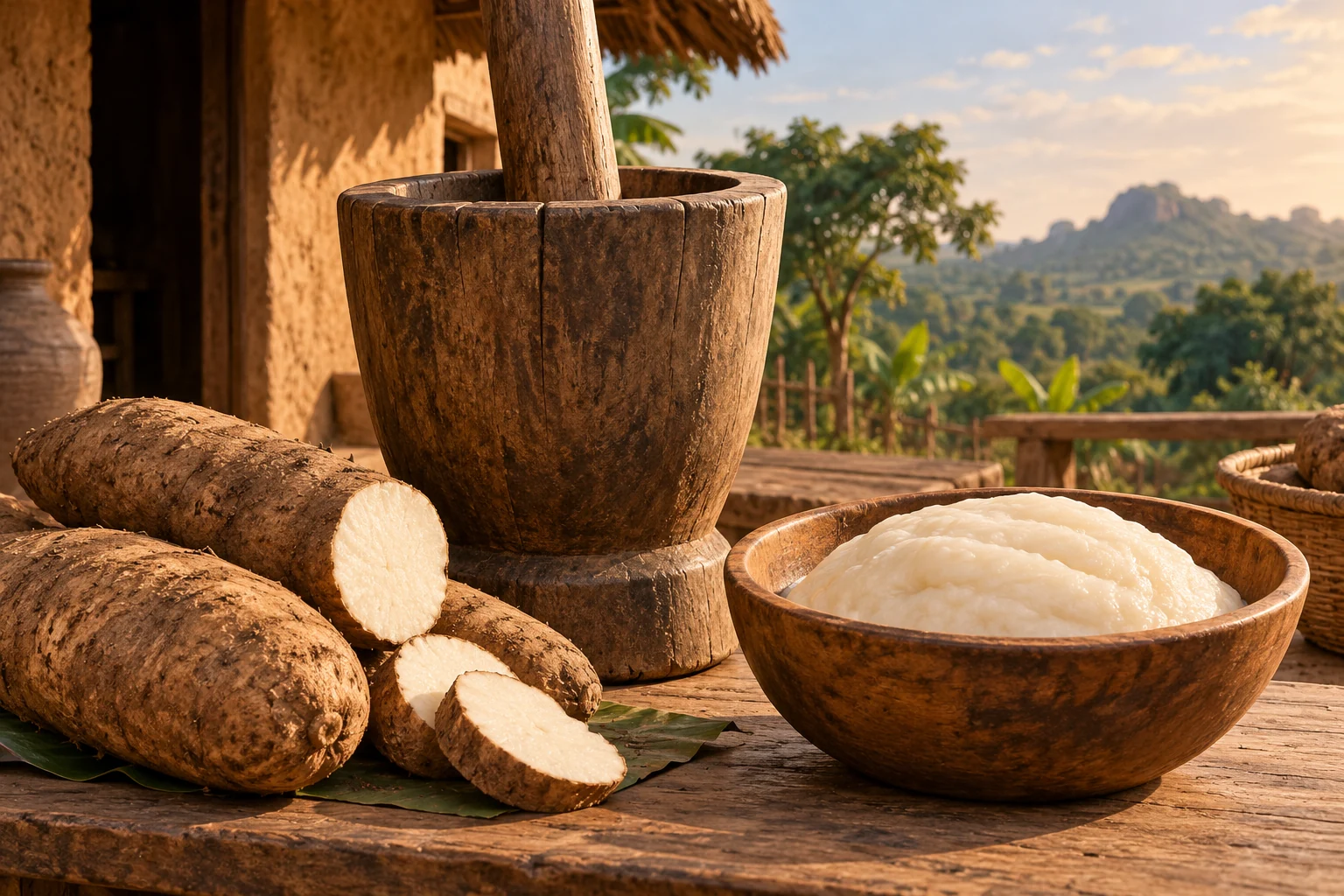
Pounded yam acquires its earthly form
Pounded yam is addressed before leaving the celestial world for earth. The named diviners connect its arrival with an advised religious commitment, but the food does not undertake it. On earth, yam is subjected to the blows of mortar and pestle before acquiring the form and name by which people know it. The account sets this transformation beside images of sounding instruments whose reach is limited between domains. Its later applications concern human dangers, but the selected narrative is a sacred etiology of a food’s preparation and identity. It does not provide a rule that human suffering produces rightful status.
The food’s familiar form is shown as an arrival with a history, rather than an object that simply exists ready for consumption. That religious imagination places even ordinary preparation inside relationships between domains, advice, refusal, and consequence. The transformation is also ambivalent: what becomes useful and recognizable is produced through repeated impact. An editor should not turn that image into a romantic defense of violence against people. The earlier Oya intervention similarly achieves a result through destructive force, while the king episode links restoration with a deferred commitment.
Together they raise a precise question about the account’s relation between efficacy and cost. The yam story does not settle that question by making the food a moral person equivalent to a human victim. Its value lies in allowing sacred emergence and ordinary material practice to remain connected, while contemporary ethical comparison is stated as a separate act of reading.
Narrative witness and setting: Translated excerpt in the multilingual compilation’s expressly attributed Cromwell Osamaro sequence, with Yoruba/Bini-facing material. The compilation’s language is not evidence of a Brazilian tradition.
The refuse mound expects endless gifts
Etitan, represented as a refuse mound and given a Bini counterpart, is advised before earthly life to maintain relations with Esu and Ogun so that flourishing will not repeatedly collapse. It assumes the flow of food and objects from people will never stop and declines part of the commitment. In the earthly continuation, abundance accumulates as expected, but Esu prompts Ogun to burn the mound at the height of fullness. Some remnants survive. The narrator connects this sequence with the repeated burning of a full refuse site, making apparent prosperity and cyclical destruction part of one sacred account of accumulation. It nevertheless honors its guardian in the celestial scene.
The mound confuses an incoming flow with a durable relation to the forces that govern its condition. Receiving something every day does not mean controlling what accumulation will become. Within the witness, Esu and Ogun are active in that difference, and the omitted sacred exchange matters as a neglected relationship rather than a mechanical fee for disaster prevention. A contemporary environmental analogy could consider waste, maintenance, and thresholds, but it must not present the narrative as a safe disposal method or a scientific origin of fire. Comparison with the king’s reserve is particularly strong: both figures trust a material stock while postponing a claim upon it.
Yet their endings differ. The king’s resources are mobilized toward restoration, whereas the mound is reduced and remains within a cycle. The story therefore complicates any claim that having enough is equivalent to being securely established or that one decisive intervention ends every instability. This partial observance matters: the figure has not abandoned sacred relations altogether, but mistakes one acknowledged relation for sufficient attention to a wider field.
Narrative witness and setting: Translated excerpt in the multilingual compilation’s expressly attributed Cromwell Osamaro sequence, with Yoruba/Bini-facing material. The compilation’s language is not evidence of a Brazilian tradition.
What was born in this Odù
“Born” can name an explicit traditional origin association or what emerges through a story: a capacity, relationship, practice or order of life. Interpretations drawn from a narrative are labelled below, so their basis remains clear.
Maternal love described as blind
Selected traditional source association.
The sole explicit born item links maternal love with impaired judgment. Treat this as a localized claim about attachment’s limits rather than a statement about all mothers; the selected Oya episodes do not independently narrate its origin.
Answerable protection
Contemporary interpretation from the selected myth.
A contemporary interpretation finds the problem of answerable protection emerging from Oya’s effective but devastating intervention. This names an ethical question raised by the story, not an additional inherited origin claim.
Correlations to life dimensions
These questions bring the selected stories into contemporary life. They are interpretive invitations for study.
Work and resources
The king protects his reserve without resolving the underlying decision. The story invites examination of what savings are for, while offering no general spending rule.
Reflect: What purpose should guide a difficult allocation of resources?
Relationships and family
Blind attachment is an origin association, not a verdict on a particular parent. Care needs listening and evidence alongside devotion.
Reflect: Where might affection be preventing a necessary question?
Character and inner life
Orunmila’s approval of Oya’s response does not settle its wider ethics. Gratitude toward an ally can coexist with scrutiny of the means.
Reflect: Can you question an ally without denying their help?
Community and responsibility
Other divine helpers’ promises contrast with Oya’s action. Public responsibility requires both follow-through and answerability for consequences.
Reflect: How will you evaluate both results and collateral effects?
A deeper reading of the sacred relationships
Sacred obligations address a field of forces
The yam and refuse mound arrive in an order of divination, obligation, and active divine persons. Preparation gives one recognizable form, while Esu and Ogun shape the other’s recurrent reduction. Oya likewise acts in protection and restoration; she is not merely a mood given a name. Sacred exchange maintains relations of acknowledgment rather than purchasing an automatic result. The instrumental framing adds a precise boundary: earthly resonance is not automatically heard in the celestial scene. A contemporary reader may ask how an earthly act becomes religiously addressed, without inventing a ritual mechanism this passage does not explain. Resource planning offers another analogy, but it should follow rather than replace the witness’s account of effective sacred responsibility.
The threshold at which more becomes precarious
The refuse site is most exposed when it is full; the king’s savings become central when he refuses a claim on them; and Orunmila’s increasing opposition draws a response whose scale exceeds a limited defense. These are not identical thresholds, yet they all prevent quantity from serving as a complete explanation. More resources, more enemies, or more successful force changes the surrounding situation. The yam episode adds a different threshold, where a material changes recognizable state through preparation. A strong reference study can use these exact transitions to ask when an arrangement changes its character, rather than describing the sign with a vague label such as intensity.
Transformation does not give one ethical answer
Yam becomes a valued food, the mound loses accumulated goods, the king recovers, and Oya’s defense leaves widespread destruction. Each outcome is a transformation, but naming the shared movement does not establish that they have the same value. The religious narratives explain how these conditions come about through differentiated relations. Contemporary analysis can then ask what survives, who benefits, and whose costs remain outside the principal figure’s satisfaction. That approach avoids praising any change simply because it is effective. It also preserves the stories’ different scales: food preparation, cyclical disposal, one ruler’s restoration, and a conflict affecting many persons should not be compressed into the same moral example.
Questions that deepen the study
Does the refuse mound represent an ungrateful person?
It is a personified site within a religious etiology, and its assumption of endless incoming gifts is one narrated error. Calling it only an ungrateful person would lose the material specificity of accumulation, fullness, fire, and surviving remnants. A contemporary interpretation may examine entitlement, but should also ask how a system maintains itself when inflow becomes excess. The witness’s religious explanation remains particular: Esu and Ogun act within an obligation that the mound has neglected. It is not a license to identify another person as spiritually corrupt because their finances fluctuate or their possessions are lost.
Why compare a food’s preparation with Oya’s destructive intervention?
The comparison is useful only if its limits remain explicit. Both stories connect a changed condition with force, but the pounded food is not a human population, and usefulness does not justify transferring the mechanism from one to the other. The contrast helps a reader see where an attractive generalization about transformation would become ethically false. Within the narratives, divine and material orders produce specific outcomes. Contemporary analysis asks whether efficacy answers every question about the means. The answer is no: Oya’s success for Orunmila leaves consequences that the yam’s emergence cannot excuse by analogy.
What is the difference between the king’s reserve and the mound’s accumulation?
The king treats saved wealth as something he should not commit, then participates in its redistribution within a restorative religious action. The mound assumes that daily inflow makes its position self-sustaining and discovers a recurring limit at fullness. One story moves toward mobilization and recovery; the other explains repeated reduction with remnants left behind. Both can illuminate the difference between possession and relationship, but neither supports a universal spending rule. A person’s present savings or losses cannot be read from these plots. Their contribution is a source-specific comparison of two material conditions and the obligations each figure fails to recognize.
What the four narratives reveal together
The new witness makes Obara Okanran’s resource and force imagery more exact. Pounded yam receives an earthly identity through a difficult material transformation; the refuse mound mistakes continuing inflow for lasting security and enters a cycle of reduction. The earlier king and Oya narratives then remain distinct cases of deferred obligation and effective protection with a devastating scale. Sacred order is not an afterthought to these events: divination and the actions of Esu, Ogun, and Oya structure the possibilities the figures encounter.
Contemporary interpretations about maintenance, entitlement, or proportionality should be offered beside that religious account. The four stories do not yield one endorsement of force or one rule for handling wealth. Their depth comes from comparing what each transformation produces, what it consumes, and whether the principal figure’s improved position answers the larger question of responsibility.
Living with this Odù
A continuing life or initiatory relationship
For a person whose received life or initiatory sign is Òbàrà Òkànràn, effectiveness and benefit need not remain the same judgment. Oya ends a conflict with devastating force, while the ruler's renewed commitment leads toward restoration. Both are effective in their own religious sequences, but their costs and scales differ. A long engagement with the sign can develop the ability to acknowledge protection without declaring every protective action proportionate. It can also examine postponement without assuming that every demand presented as sacred must be accepted without question.
The refuse mound adds a different vulnerability: a steady incoming flow is mistaken for a permanently secure arrangement. Esu and Ogun remain active agencies in its cyclical reduction; the figure's partial acknowledgment of sacred relations does not cover the whole field. The yam's recognizable form likewise emerges through a specific, ambivalent sequence. Long-term character can therefore involve noticing when quantity changes conditions, when an obligation has merely been deferred and when an achieved result still requires ethical examination. This is not a personality of intensity or a prediction of violent rivals. The received sign keeps several ways of transformation open to judgment while preserving the sacred persons and material settings through which each occurs.
A particular consultation and its question
A consultation yielding Òbàrà Òkànràn can invite attention to the threshold at which a previously useful arrangement changes its character. A reserve can become guarded against every claim, an incoming flow can exceed the conditions that sustain it, or protective force can produce destruction beyond its immediate purpose. The king, the refuse mound and Oya's intervention illuminate different external situations. The practitioner needs the actual question before deciding which tension the result helps examine.
The narratives also separate several forms of delayed response. The king later participates in a renewed commitment; the mound enters a repeated cycle rather than one definitive restoration. The yam becomes recognizable through impact, but its food etiology cannot authorize violence against people. Within the Ibie witness, Esu and Ogun shape material outcomes, while Oya's agency belongs to the distinct Cuban accounts. These relations should remain effective and specific rather than become metaphors for confidence or waste management. Consultation can clarify what has been promised, what has accumulated and who bears the consequences of a proposed response. It cannot diagnose an unknown crisis, identify hidden enemies or make one occasion's result a permanent personal destiny.
Constructive and adverse possibilities
Constructive relations may mobilize resources toward a genuine obligation and restoration, or make the dependencies of an accumulation visible before its fullness becomes precarious. The ruler's changed participation has a different outcome from the mound's recurrent loss. Within each witness, divine agency and sacred acknowledgment are part of the field, not ornamental names for prudent planning.
Adverse relations could involve assuming that gifts will never cease, treating one honored relationship as sufficient for every responsibility or praising destructive force solely because the beneficiary feels protected. The yam's usefulness does not make repeated impact an ethical model for human formation. None of these contrasts assigns the state of an unknown reading. They prevent transformation itself from becoming a positive label and keep the question of cost attached to the particular scale, participants and conditions of each narrative.
An illustrative situation in everyday life
In a hypothetical association, donations increase until leaders assume the incoming flow guarantees security. Maintenance is repeatedly postponed because spending reserves feels like losing protection. When a dispute arises, they propose an expensive intervention that could silence criticism but harm the wider membership. The refuse mound helps distinguish accumulating material from maintaining the relations governing its condition. The ruler's reserve raises a different question about a deferred claim, and Oya's devastating defense keeps efficacy separate from proportionality. This illustrative interpretation supplies no ritual outcome or environmental procedure. It asks whether the association can identify what needs support before fullness becomes instability, and whether a response protects more than the people currently holding authority.
Sources and reading context
The first two narrative witnesses
The inspected born list contains one item only, so no additional origins are invented. These Cuban narratives frame Oya through decisive protection and deferred obligation. Their violence and illness-related sequence remain contextual motifs, with no claim of universal doctrine or personal prognosis. Additional emergence motifs are explicitly contemporary interpretations drawn from the selected narratives, not traditional origin-list claims.
Narrative motifs are summarized independently. The life-dimension reflections are contemporary interpretation. How these reference studies are built explains the wider source approach and the distinction between a reference article and personal divination.
Additional named witnesses
- Cromwell Osamaro Ibie. The surrounding sequence is expressly attributed to Cromwell Osamaro. These selected episodes are read through the multilingual compilation’s translated renderings; exact edition and original translation chain remain unverified.
The compact food etiology and the refuse-site account are translated unevenly. No public recipe, disposal instruction, prognostic claim, or justification of interpersonal violence is inferred. Yoruba/Bini terms identify the witness’s textual setting without establishing a universal equivalence across all traditions.
Bibliographic identification
- C. Osamaro Ibie. Ifism: The Complete Work of Orunmila. Lagos; multivolume publication beginning 1986. Library catalogue record. Related bibliographic record for the named narrative witness. Exact volume, edition and page of the transmitted account have not been independently matched.
Read the source method and wider scholarly context.
The catalogue links identify published works and their authors. They are separate from proof of an individual episode’s wording or attribution. Contemporary comparisons and the synthesis above are editorial interpretation. The author’s books and Academy companions below provide further study; their sales links are separate from the source references.