
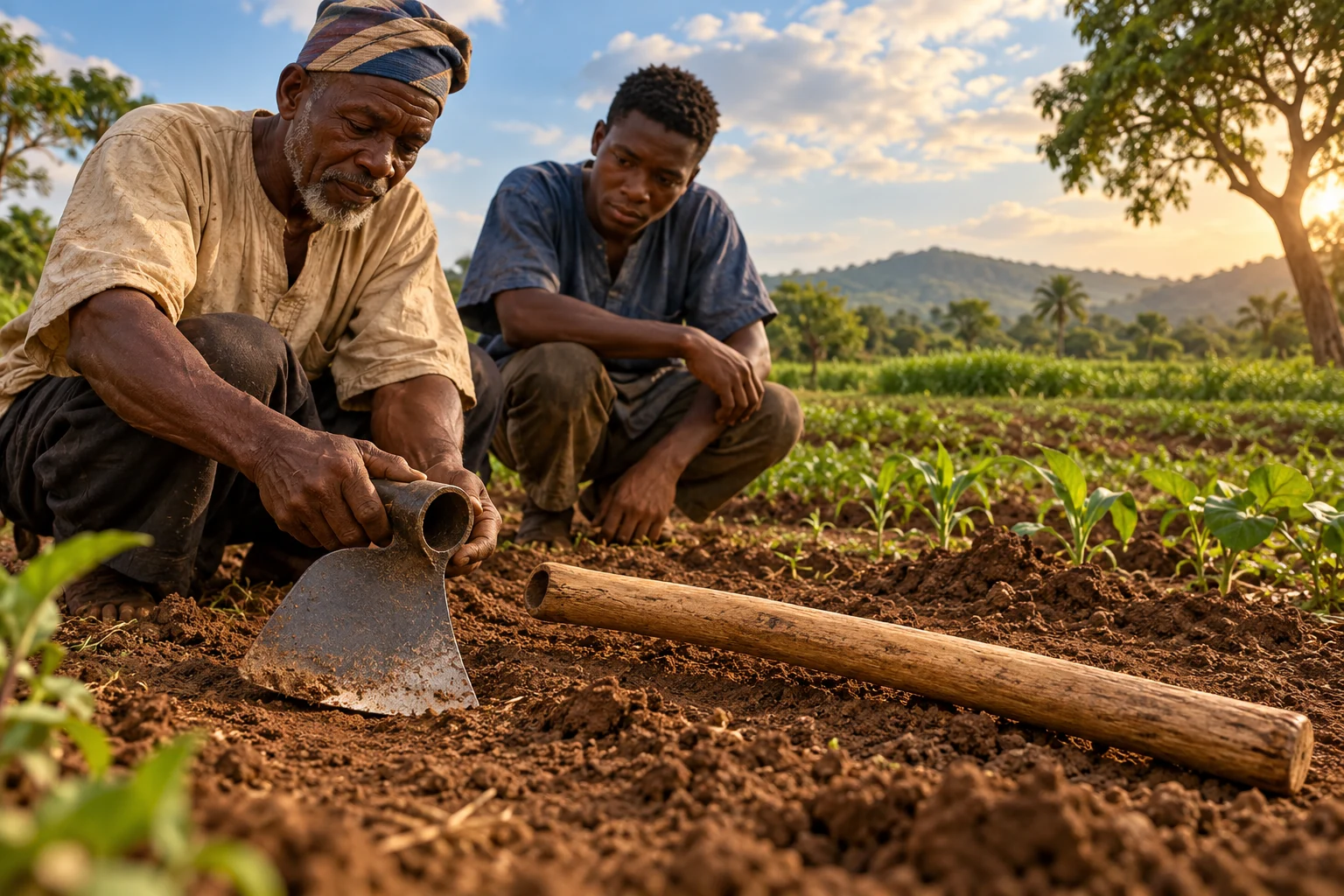
Òbàrà Ògúndá is a mixed Odù in Ifá’s 256-part corpus. Obara Ogunda follows neglected figures who find a recognized place through assistance, and an estranged son whose return intersects with a father’s unfinished work. The paired images are an empty landscape that cannot sustain its inhabitants and a hoe lacking its handle. Contribution matters, but the first story also shows a powerful beneficiary failing to honor his invitation. Usefulness therefore needs reciprocity rather than becoming a condition for basic human worth.
A question to carry through the study: What would fair reciprocity look like after someone has helped you through danger?

This Academy reads the right column first, then the left. Each row carries a single or double mark.
Where this Odù belongs
Òbàrà Ògúndá belongs to the Òbàrà family in this Academy’s study sequence. It is a mixed Odù, distinct from Ògúndá Òbàrà. The order matters. Its teaching is approached through its own narratives, rather than by adding two general descriptions of the principal signs together.
Key Òrìṣà and sacred relationships
The figures below are selected for their roles in the accounts discussed here. They offer connected reading paths through the tradition.
-
Ṣàngó. The neglected brothers shelter him during pursuit, but his later invitation leaves them waiting; eventual recognition comes through another network rather than immediate repayment.
-
Yemọja. She redirects the waiting brothers to Osanyin and later makes their knowledge visible through assistance to Oduduwa’s household.
-
Òsanyìn. His household provides the brothers a place after their failed visit to Shango. The narrative associates their eventual recognition with his botanical domain.
-
Obàtálá. He receives the son with whom he had been estranged when an object the son carries answers an immediate agricultural need.
Key myths and their meanings
Shelter before recognition
Two neglected brothers struggle in a land without provisions. They shelter Shango, who invites them to his prosperous home but leaves them waiting. Yemaya finds another place for them with Osanyin. Their assistance to Oduduwa’s household finally brings acknowledgment and an established place in a wider network.
The story does more than praise service. It exposes the gap between a promise from a powerful guest and the work needed to make that promise real. Yemaya’s practical redirection matters because gratitude alone has not secured a livelihood. The outcome should not be converted into claims that a particular plant cures illness or that marginalized people must earn dignity.
Narrative setting: Cuban/Lukumí patakín in a multilingual source compilation; no individual narrator is established.
The handle between father and son
A son has turned away from Obatala, while the father has land and a hoe without a handle. After consulting Orunmila, the son carries an object that the father can use. Their encounter creates a practical opening for renewed contact, and the father gives him a home.
The missing handle gives reconciliation a concrete form. Each has something the other lacks, so return need not depend entirely on speeches or public shame. The narrative includes affliction and sorcery language, which should remain part of its religious setting. The lesson concerns reconnection through a task, not a causal explanation for actual bodily conditions.
Narrative setting: Cuban/Lukumí patakín in a multilingual source compilation; no individual narrator is established.
Deyi’s prosperous herd leaves the household
Deyi, a cattle owner, summons the diviner while seriously unwell. The visitor postpones consultation until morning, then receives a night visit from powers who connect Deyi’s condition with a neglected religious relationship despite substantial profit. Deyi refuses the proposed commitment, and the diviner leaves. The translated sequence subsequently reports improvement in health, followed by the departure of the birds and livestock into the forest. Deyi calls the diviner again and eventually acts, but the animals are already lost. The account therefore distinguishes remaining alive from retaining the economic world that previously supported the household, with an unresolved causal turn in the translation.
The witness is richer when that awkward sequence is not silently corrected. It does not show a simple equation in which refusal immediately produces worsening bodily symptoms and compliance restores every possession. Deyi improves in one respect and loses in another, while the later act does not return the herd. Within the religious account, profitable ownership remains dependent on relations beyond the owner’s will, including the night powers and the diviner’s mediation. The earlier Ogue brothers also seek a sustainable place after sheltering Shango, whose invitation does not promptly feed them.
Both episodes distinguish a proclaimed relationship from its material support. The father-and-son hoe story supplies a smaller example, where an exact object creates a practical opening for reconnection. Deyi’s outcome should not become a medical claim or a demand on a sick person’s resources. It can instead clarify how a sacred economy treats possession, continued life, and restored livelihood as related but nonidentical conditions.
Narrative witness and setting: Translated excerpt in the multilingual compilation’s expressly attributed Cromwell Osamaro sequence, with Yoruba/Bini-facing material. The compilation’s language is not evidence of a Brazilian tradition.
A bird gives the crocodile a warning
Agbe, a bird named with a Bini counterpart, and Onne, a crocodile, consult as friends before facing human threats. Their religious preparations differ, and the crocodile asks the bird for help because it is being hunted. Agbe promises an audible warning whenever approaching people create danger. When hunters arrive, the bird calls; the crocodile responds by entering the water and using the protection associated with its earlier preparation. The account credits the combined relationship and sacred support with survival. Its claims about immunity to substances in water belong to the religious narrative and are not treated as crocodile biology.
Friendship here is specified through a task the friend can actually perform. Agbe does not offer a vague assurance that nothing bad will happen; it watches from a position the crocodile lacks and communicates in time for a response. The crocodile must still hear and act, so cooperation does not eliminate its agency. Within the witness, material movement and religious preparation are complementary rather than competing explanations. This makes the episode a useful counterpoint to Shango’s unfulfilled invitation in the earlier Ogue story: a promise becomes reliable when it is translated into an appropriate contribution.
It also differs from Deyi’s ownership, where many dependent beings leave and the economic relation collapses. The animal friendship has a narrower and more intelligible obligation. A contemporary analogy about early warning can follow, but the account should retain its sacred protective dimension and should not encourage readers to interpret ordinary neighbors as hunters or assume any ritual makes a body immune to harm.
Narrative witness and setting: Translated excerpt in the multilingual compilation’s expressly attributed Cromwell Osamaro sequence, with Yoruba/Bini-facing material. The compilation’s language is not evidence of a Brazilian tradition.
What was born in this Odù
“Born” can name an explicit traditional origin association or what emerges through a story: a capacity, relationship, practice or order of life. Interpretations drawn from a narrative are labelled below, so their basis remains clear.
Doubt
Selected traditional source association.
Doubt appears in the born list as a named human condition. It can be connected cautiously with unfulfilled promises in the story, without treating uncertainty as a spiritual defect or diagnostic sign.
The attaching fish
Selected traditional source association.
The remora-like fish is specifically named as an origin association. Its attachment can serve as a limited image of relationship, but the selected narratives do not explain its biology or justify calling every dependency parasitic.
Correlations to life dimensions
These questions bring the selected stories into contemporary life. They are interpretive invitations for study.
Work and resources
The hoe and handle illustrate complementary resources. A small missing component can prevent an otherwise capable person from working.
Reflect: What modest contribution would make someone else’s resources usable?
Relationships and family
The father-son encounter creates contact through shared work. Reconciliation can begin with cooperation while larger grievances still need attention.
Reflect: What task could open a conversation without pretending everything is settled?
Character and inner life
The brothers remain active after a powerful host disappoints them. Seeking another route is distinct from accepting indefinite waiting as loyalty.
Reflect: Which promise needs a concrete next step or a new route?
Community and responsibility
Yemaya acts as a connector who sees people waiting outside recognition. Community care includes noticing who has been left between institutions.
Reflect: Who needs an introduction more than another promise?
A deeper reading of the sacred relationships
Protection joins preparation with response
In the Agbe and Onne narrative, consultation establishes a sacred relation, the bird’s promise supplies timely knowledge, and the crocodile’s movement answers the warning. The story does not ask readers to choose between divine protection and practical action; within its world, both belong to the same event. Deyi’s account likewise distinguishes an earlier neglected relation from a later response, but its loss is not wholly reversed. These particulars can explain religious responsibility without disclosing procedures. Preparation is not an inert possession that removes every need to listen, and response is not represented as merely secular effort detached from sacred agencies. The two accounts make different outcomes intelligible through continuing relations.
Promises become credible through their exact contribution
Shango invites the brothers to his house but leaves them waiting; Yemaya notices the gap and connects them with another source of support. Agbe instead promises a definite kind of warning and provides it at the necessary moment. The father-and-son encounter turns on a handle that completes a tool rather than a general declaration of reconciliation. Comparing these details makes reciprocity observable without reducing religion to a contract. The narratives show several forms of contribution: shelter, introduction, information, and a material fitting. An article can ask what a promise actually changes in the recipient’s circumstances, while preserving the divine persons whose relationships give those contributions their sacred meaning.
Survival and restoration are different achievements
Deyi remains alive but loses livestock; the brothers receive a place only after an invitation fails; the estranged son regains a home through a useful object; and the crocodile survives an encounter through a warning. Each ending should be judged at its own scale. A general label such as recovery would obscure whether a body, a livelihood, a relationship, or a position has changed. The religious witness is not weakened by these uneven results. It becomes more exact when an editor describes what the account actually restores and what remains outside the ending. Contemporary readers can then ask an appropriately bounded question rather than expect one spiritual action to settle every form of loss.
Questions that deepen the study
Why preserve the apparent contradiction in Deyi’s recovery?
Because the text reports improvement before the loss of animals, and changing that order would create a more convenient story than the witness supplies. The sequence may reflect a translation problem or an omitted connection, but neither can be repaired without additional evidence. It still supports a careful distinction between bodily improvement and economic continuity. Within the religious setting, neglected obligations affect the larger relation sustaining prosperity. That does not authorize a medical explanation of Deyi’s condition or a prediction for a sick reader. Honest uncertainty is preferable to polishing the account into an automatic rule of refusal, punishment, and complete restoration.
What makes Agbe’s friendship different from simple loyalty?
It has an agreed and situated form. The bird can observe approaching people, communicate early, and give the crocodile time to use its own capacities. Loyalty is therefore not measured by sharing the same danger in the same place. The two friends act differently because their positions differ. The source also joins that cooperation with religious preparation, so the account is not only a modern lesson in information systems. Its spiritual world treats divine support and the friend’s voice as jointly effective. A reader may ask what particular contribution a relationship can sustain without assuming that devotion requires promising total protection.
Does the sign make usefulness a condition of dignity?
The earlier brothers are told to become necessary, and their recognition follows a contribution. Yet their initial homelessness, Shango’s delayed reciprocity, and Yemaya’s care also leave room to question a world that withholds provision until value is demonstrated. The father-son tool image offers mutual need rather than one-sided earning. Deyi’s loss and the crocodile’s support further show that position depends on relations, not solely on personal merit. A responsible contemporary reading can value contribution while rejecting the idea that someone without an immediately useful skill deserves exclusion. That ethical distinction is a reader’s interpretation, not a fabricated universal maxim of the source.
What the four narratives reveal together
The added African-facing episodes give Obara Ogunda a more differentiated account of sustainable relation. Deyi’s case leaves life and livelihood with different outcomes; Agbe and Onne make a protective promise effective through exact, complementary action. The earlier brothers and estranged son continue those questions in Cuban settings, where invitations, introductions, and a missing tool part create distinct routes toward belonging. Religious responsibility remains substantial in the new witness: divination, night powers, and sacred preparation participate in events rather than merely naming moral attitudes.
Contemporary comparisons can examine promises and material support without claiming that usefulness determines human worth. The four stories contribute an important restraint on easy endings: receiving help, surviving danger, regaining a home, and recovering an economic world are not the same accomplishment, and each requires an account of what the relationship actually provides.
Living with this Odù
A continuing life or initiatory relationship
For a person who has received Òbàrà Ògúndá in a life or initiatory setting, the reliability of a relationship can become more important than the grandeur of its promise. The brothers shelter Shango yet remain unsupported after his invitation; Yemaya's redirection changes their actual circumstances. The estranged son, by contrast, brings the precise object through which his father's tool becomes usable. Across changing relationships, these accounts distinguish a declaration of care from the contribution that makes a place livable. They do not require marginalized people to purchase dignity through service.
The bird and crocodile give a third arrangement: friendship supplies timely information, sacred preparation remains effective, and the recipient still has to respond. Deyi's survival without the return of his animals prevents that sequence from becoming a universal promise of full restoration. Long-term character can include listening, practical acknowledgment and honest recognition of what has actually recovered. One may regain bodily stability while facing a changed livelihood or reopen contact without erasing a prior rupture. The received sign therefore offers a field of responsibilities around support and response, not a personality of dependence or a prediction that relatives and patrons will inevitably disappoint.
A particular consultation and its question
In consultation, Òbàrà Ògúndá may help identify which promised support has become materially available. An invitation, a home, a completed tool and a warning change different conditions. The brothers' prolonged waiting cannot be understood simply as insufficient gratitude, and the crocodile's survival includes its own responsive action rather than passive reliance on a friend. A practitioner can examine what the actual situation requires before assigning the same lesson of reciprocity to every relationship.
A question concerning recovery needs equal precision. Deyi's translated sequence includes improvement followed by economic loss, and later religious action does not return the herd. The source should not be corrected into a guarantee that acknowledgment restores everything. Its night powers and the diviner remain agents within the religious setting, while the account supplies no medical explanation for the unknown client. The father and son's handle also shows a particular way renewed contact becomes possible without making every family reconciliation a similar task. A result can illuminate the present difference between survival, livelihood and belonging; it does not permanently identify the seeker as abandoned brothers, a negligent owner or someone whose body is immune through preparation.
Constructive and adverse possibilities
Constructive unfolding may join a clearly defined promise with timely delivery and a recipient able to act. Agbe supplies the warning it can actually give; the crocodile hears and moves within a sacredly prepared field. Yemaya's intervention likewise makes support more concrete, while the handle creates an available opening for renewed contact.
Adverse relations include waiting indefinitely on prestige, mistaking an invitation for provision or expecting later action to reverse every earlier loss. Deyi's remaining alive does not return the economic relations that sustained his household. These contrasts do not assign ìrè or òṣogbo to a real reading. They preserve different achievements and limits, including the translated narrative's awkward sequence. Religious agency can be effective without making outcomes uniform, and a contemporary reading should not turn illness into evidence that a person has failed to acknowledge the right relationship.
An illustrative situation in everyday life
In a hypothetical relocation, a respected colleague promises accommodation but leaves two newcomers waiting while their savings diminish. Another contact finds a workable placement with someone who can use their skills. The brothers' story distinguishes prestige from support that changes daily conditions. The bird's warning adds a second possibility: a friend who cannot supply a home may still offer reliable information that lets the newcomers act in time. They can appreciate that contribution without pretending it meets every need. This is an illustrative interpretation, not a spiritual diagnosis of migration or a forecast about patrons. It asks what each promise actually provides and how the recipients can remain agents rather than indefinitely suspended guests.
Sources and reading context
The first two narrative witnesses
The main figures called Ogue in this Cuban account are not merged with unrelated supported deity entries. Botanical and affliction details remain religious narrative material, with recipes omitted. Only the source’s doubt and fish origin associations are developed here; more sensitive items are not expanded into personal advice.
Narrative motifs are summarized independently. The life-dimension reflections are contemporary interpretation. How these reference studies are built explains the wider source approach and the distinction between a reference article and personal divination.
Additional named witnesses
- Cromwell Osamaro Ibie. The surrounding sequence is expressly attributed to Cromwell Osamaro. These selected episodes are read through the multilingual compilation’s translated renderings; exact edition and original translation chain remain unverified.
The Deyi translation contains an unresolved turn between refusal, improved health, and loss. Agbe’s warning is concrete, while the attributed protective immunity remains religious testimony. No clinical claim, biological assertion, or operational protection procedure is inferred from either account.
Bibliographic identification
- C. Osamaro Ibie. Ifism: The Complete Work of Orunmila. Lagos; multivolume publication beginning 1986. Library catalogue record. Related bibliographic record for the named narrative witness. Exact volume, edition and page of the transmitted account have not been independently matched.
Read the source method and wider scholarly context.
The catalogue links identify published works and their authors. They are separate from proof of an individual episode’s wording or attribution. Contemporary comparisons and the synthesis above are editorial interpretation. The author’s books and Academy companions below provide further study; their sales links are separate from the source references.