
Ògúndá Òbàrà is a mixed Odù in Ifá’s 256-part corpus. Ogunda Obara connects a child’s unexpected defense of his community with a narrative of Ogun furnishing Orunmila’s work. In the first, people cannot imagine that someone young has ended a shared danger until they see the evidence. In the second, metal tools and collective provisioning support religious guidance. The pairing asks whose capacity is overlooked and what material labor makes a respected institution possible, without celebrating the stories’ violence or conquest.
A question to carry through the study: What necessary contribution is being overlooked because it comes from an unexpected person or an unglamorous trade?
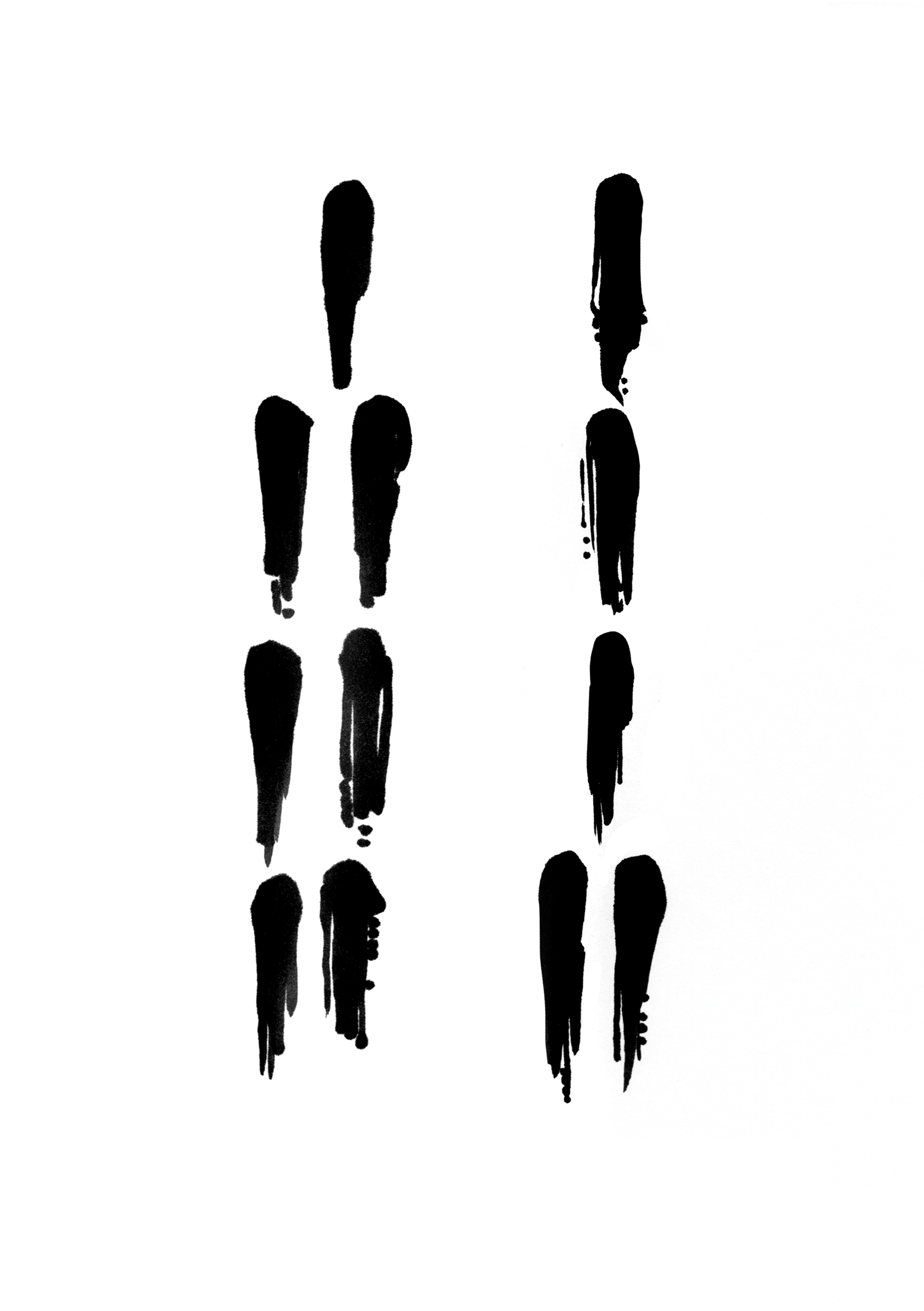
This Academy reads the right column first, then the left. Each row carries a single or double mark.
Where this Odù belongs
Ògúndá Òbàrà belongs to the Ògúndá family in this Academy’s study sequence. It is a mixed Odù, distinct from Òbàrà Ògúndá. The order matters. Its teaching is approached through its own narratives, rather than by adding two general descriptions of the principal signs together.
Key Òrìṣà and sacred relationships
The figures below are selected for their roles in the accounts discussed here. They offer connected reading paths through the tradition.
-
Ògún. He brings metalworking capacity and directs provisions toward Orunmila. The source’s conquest material is part of the narrative but does not make conquest the basis of legitimate craft.
-
Ọ̀rúnmìlà. His religious work is supported through Ogun’s material contributions. The account presents complementarity rather than an independent institution needing no external labor.
-
Olókun. He is named in the closing association of the child’s story, not shown performing a specific act in its plot. That distinction is retained.
Key myths and their meanings
The child the town would not believe
A dangerous creature threatens a settlement and kills a woman gathering fuel. A young relative fears for his own mother and goes to confront it. Music draws the creature’s attention and enables the child’s successful attack. Returning residents initially reject his report, then verify the result at the river.
The child responds to a community need before receiving authority to act. The town’s disbelief exposes an assumption that capacity must match age or status. The episode remains a violent animal tale, not a model for children confronting danger. Its central question concerns how evidence can overcome an inherited estimate of who is capable.
Narrative setting: Cuban/Lukumí patakín in a multilingual source compilation; no individual narrator is established.
Counsel supported by the forge
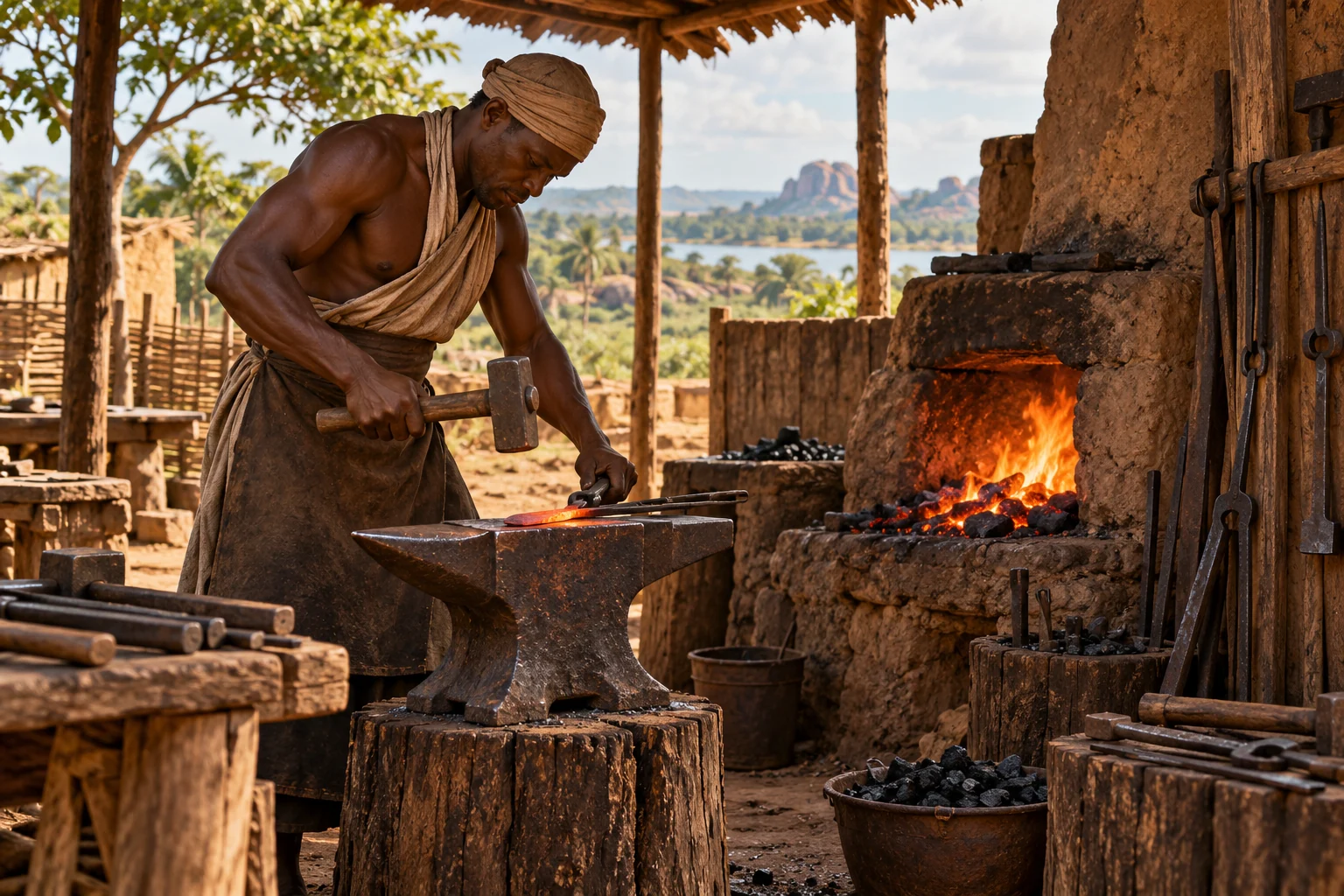
Ogun arrives with the ability to forge tools needed for ordinary struggle and survival. People seek to keep that ability among them and offer provisions. He brings resources to Orunmila and directs attention toward Ifa. The account presents the brothers’ arrival as complementary, with craft sustaining religious guidance.
The relationship makes the material basis of respected knowledge visible. Tools, food, and a working population precede an institution’s apparent independence. The account also describes coercive conquest and unstable translated ritual terms; neither needs to be endorsed or repeated to explain the complementarity. The analysis can credit work without treating force as proof of rightful leadership.
Narrative setting: Cuban/Lukumí patakín in a multilingual source compilation; no individual narrator is established.
Orunmila pays the ostrich’s three debts
An ostrich owes three creditors associated with farming, commerce, and hunting. They gather at its home to demand payment, and the ostrich says it has no money. Their collection becomes a threat to its life. Orunmila intervenes and asks them to spare it, but they answer that sympathy must be made effective through payment. He then pays the debts himself, and the creditors release the ostrich. The account moves from a concrete unpaid claim to a materially costly rescue. Its later divinatory applications are not promises that another person will assume a reader’s debt or that a creditor’s violence is legitimate.
The rescue does not occur through a declaration alone. Orunmila’s compassion becomes effective by taking on a cost the creditors refuse to waive. Within the witness, the divine person acts directly in a human-style economy, rather than only explaining how someone else might obtain prosperity. The creditors’ claims and their threatening means also need separation: an actual obligation does not justify every method of collection. The earlier Ogun-provision narrative similarly makes sacred counsel dependent on material support, while the child’s defense responds to a communal danger without prior public recognition.
The new episode adds a third kind of contribution, an advocate’s own resources. A contemporary interpretation can ask when help requires more than a statement of concern, while refusing to convert the ending into financial advice or a moral demand that every helper must pay every claim. The witness describes a specific act whose material and spiritual significance cannot be reduced to a general slogan about generosity.
Narrative witness and setting: Translated excerpt in the multilingual compilation’s expressly attributed Cromwell Osamaro sequence, with Yoruba/Bini-facing material. The compilation’s language is not evidence of a Brazilian tradition.
The deer’s child does not know the guarded boundary
A farmer seeks help against a deer taking crops. The deer also consults, and the account gives the two parties different counsel concerning a guarded part of the farm. The deer initially avoids the marked place, but a hungry child insists on joining a later visit. The parent does not communicate the relevant limit. The child approaches tempting food and falls into the farmer’s trap, while the parent escapes. The witness gives both opposing participants access to religious counsel and makes a dependent being bear the consequence of knowledge not passed on. It is not an instruction for crop defense or a judgment on actual parents.
The outcome is not explained by the deer having no advice at all. It has enough knowledge to avoid one danger but fails to extend that knowledge to the person now accompanying it. The farmer’s grievance is also real, so the source cannot be reduced to an innocent animal persecuted by a wholly hostile world. Within the religious account, consultation addresses both sides, a feature that complicates an assumption that divine counsel must align only with one protagonist’s interests.
Contemporary analysis can ask about communication, dependence, and the limits of treating another’s resources as available. The earlier young protector acts because ordinary fuel gathering has become dangerous for his mother and others. Both stories therefore make a dependent or less powerful person’s exposure significant, but their endings differ sharply. The new child’s fate is not narrated as an acceptable sacrifice for a parent’s escape or as evidence that any real family’s loss was caused by disobedience.
Narrative witness and setting: Translated excerpt in the multilingual compilation’s expressly attributed Cromwell Osamaro sequence, with Yoruba/Bini-facing material. The compilation’s language is not evidence of a Brazilian tradition.
What was born in this Odù
“Born” can name an explicit traditional origin association or what emerges through a story: a capacity, relationship, practice or order of life. Interpretations drawn from a narrative are labelled below, so their basis remains clear.
Mud
Selected traditional source association.
Mud is explicitly listed as an origin association. It introduces an ordinary mixed material into the sign’s vocabulary, but the selected stories do not explain its formation and no geological origin is invented.
White clothing for initiates
Selected traditional source association.
The source names a clothing practice among the sign’s associations. It can be described as local religious material culture without assigning a universal rule to every tradition or reader.
A balcony and a window
Selected traditional source association.
These architectural features are named as speaking motifs. Their presence may support questions of viewpoint and access, but such symbolism would be interpretive rather than an explicit origin story.
Correlations to life dimensions
These questions bring the selected stories into contemporary life. They are interpretive invitations for study.
Work and resources
The forge narrative gives an institution a material support network. An account of knowledge should include those who provide its tools and daily maintenance.
Reflect: Whose practical labor keeps your work possible?
Relationships and family
The child acts from concern for his mother and others doing necessary fuel work. Care work exposes people to risks a community should recognize.
Reflect: Which ordinary task carries an overlooked burden?
Character and inner life
The residents demand evidence, but their initial disbelief is shaped by age. Verification and prejudice should not be confused.
Reflect: Are you questioning the evidence or the kind of person presenting it?
Community and responsibility
The town benefits from an unexpected contributor. Public recognition can broaden who is allowed to participate without requiring imitation of the story’s dangerous action.
Reflect: How can your community recognize capacity before a crisis?
A deeper reading of the sacred relationships
Sacred persons act within material obligations
Orunmila’s payment resolves a concrete claim, and the earlier Ogun narrative gives religious work a material base through tools and provision. The farm dispute likewise locates counsel within competing claims to a crop rather than an abstract contest between good and evil. A spiritually grounded lens should preserve the divine persons as effective actors in these economies. Modern analysis of advocacy can follow, but should not replace the witness with a purely financial metaphor or promise that a ritual response cancels debt. The source makes assistance costly and relational in different ways. What works for the ostrich, a crop owner, or Orunmila’s institution is not automatically the same form of help.
Possessing knowledge does not communicate it
The deer knows a limit but brings a child who does not receive it. The young protector’s action also begins by recognizing a risk that the wider town has not successfully answered. In the forge narrative, practical capacity becomes shared through tools and provision rather than remaining an isolated skill. These different details support a contemporary inquiry into what another person needs to know or receive for a benefit to be real. A reference study should not make that question an accusation against every parent or expert. The religious accounts remain particular, including the fact that both sides in the farm dispute consult. Their complexity is lost if knowledge is treated as automatically protective for everyone nearby.
Advocacy, defense, and restitution have different costs
The child defends a town through danger, Ogun supplies tools and food, Orunmila pays creditors, and the farmer guards crops through a trap. These are not interchangeable contributions simply because someone benefits. The source-reading task is to identify the claim, the cost, and the person who bears it in each episode. Contemporary ethical reflection can distinguish a real grievance from disproportionate means or a genuine rescue from a guarantee for all. The religious world remains intact when those questions are stated as analysis. It becomes less faithful, not more, if every effective act is made equally virtuous or every favorable result is treated as complete repair.
Questions that deepen the study
What makes Orunmila’s intervention more than reassuring speech?
The creditors refuse to release the ostrich merely because someone asks them to be compassionate. Orunmila pays, giving the intervention a direct material cost. The witness therefore portrays a divine person’s assistance as effective action within the claim being made. A contemporary reader may ask what resources or responsibility a proposed rescue actually supplies. That does not mean every sympathetic person must assume every debt, and it does not justify the creditors’ threat to life. The account distinguishes an obligation from its collection methods while showing one specific response that ends the immediate danger.
Why is the deer’s child central rather than incidental?
The parent has received counsel and initially avoids the danger, but the child enters the later situation without the same information. Its capture shows how a private precaution can fail a dependent being. The source gives no full later outcome for the child, so a study should not add a rescue or call the loss necessary. Within the religious narrative, the advice matters; contemporary analysis can then ask how it is communicated. That is different from blaming an actual parent for harm or treating every child’s vulnerability as the result of spiritual negligence.
Does counsel to both farmer and deer undermine the religious account?
It complicates a simple assumption that the tradition must function as a guarantee for one chosen side. The farmer has a crop claim, while the deer seeks to avoid capture, and each receives particular counsel. The narrative’s later result depends on how those conditions are acted upon, including the child’s uninformed presence. A reference study can describe that complexity without dismissing divination or treating it as detached advice with no efficacy. The comparison with the ostrich also helps: there, the divine actor addresses a shared claim through payment, rather than simply choosing to invalidate one participant’s position.
What the four narratives reveal together
The added witness deepens Ogunda Obara’s material account of care. Orunmila turns advocacy into payment, while the deer’s uncommunicated precaution leaves a child exposed within a real crop dispute. The earlier child defender and forge provision show different costs of keeping a community or institution viable. Sacred agency remains active in these arrangements rather than serving only as a metaphor for generosity or skill. Contemporary interpretation can then ask whose knowledge, resources, and risk make a response effective.
The four stories do not make every successful defense just, every debt collectible by violence, or every family loss evidence of negligence. Their depth comes from distinguishing the claim from the means used to answer it and the principal beneficiary from other affected beings. That specificity preserves the witness’s spiritual world while leaving its unresolved costs visible.
Living with this Odù
A continuing life or initiatory relationship
For a person who has received Ògúndá Òbàrà as a life or initiatory sign, advocacy can require a contribution different from declaring concern. Orunmila pays the ostrich's debts rather than merely asking creditors to release it, while Ogun's forge supplies tools and provision that sustain religious guidance. Across changing responsibilities, these accounts can deepen attention to the material basis of help without demanding that every supporter pay every claim or accept violent collection as legitimate.
The child and deer give different positions of vulnerability. The town initially discounts a young defender's capacity, whereas the deer possesses a warning it fails to communicate to the dependent child accompanying it. Long-term character can include recognizing that knowledge held nearby is not automatically knowledge received. Both sides of the crop dispute consult, so the sacred field cannot be reduced to one purely innocent protagonist and an inherently hostile opponent. The sign does not advise children to confront danger or explain family loss through disobedience. It asks what another person actually needs to know or receive, what evidence establishes a contribution and who bears the cost when a principal figure's success leaves someone else exposed.
A particular consultation and its question
A consultation yielding Ògúndá Òbàrà can help distinguish defense, restitution and material support. A communal threat, an unpaid claim and the provision that sustains guidance require different responses. The young protector, ostrich and forge cannot be compressed into one rule to be generous or courageous. A practitioner should identify the actual claim and the person carrying its cost before drawing the contemporary comparison.
The deer story adds a precise difference between possessing counsel and communicating what a dependent participant needs. The farmer's grievance is real, but the trapped child's loss cannot become a justified sacrifice for the parent's escape. Both parties receive religious guidance within the attributed witness, while Orunmila's payment is a direct divine action in a different economy. Consultation can ask what a statement of concern leaves materially unchanged and whether the proposed recipient can act on the information available. It cannot promise debt cancellation, diagnose a family's loss or make violent collection rightful. The present result does not assign permanent identity as young hero, rescuer or negligent parent; it illuminates the particular relation between help, knowledge and consequence raised by the actual question.
Constructive and adverse possibilities
Constructive relations might make advocacy effective through an appropriate contribution, allow evidence to correct a low estimate of capacity and pass essential knowledge to those now exposed to risk. The forge sustains counsel materially, and Orunmila's payment changes the ostrich's immediate relation to creditors within the sacred witness.
Adverse unfolding could include praising concern that changes nothing, equating an actual debt with permission for violence or assuming one's own knowledge protects every dependent nearby. The child's trap must remain a loss rather than the acceptable price of a parent's survival. These contrasts leave a real reading's state undetermined. They ask what form of assistance fits the claim and whose vulnerability it actually addresses, without promising that sacred action cancels every obligation or making a child's dangerous defense a model for contemporary behavior.
An illustrative situation in everyday life
In a hypothetical training expedition, an experienced participant knows that one area is unsafe but brings a newcomer without explaining the boundary. When the newcomer is harmed, the experienced person's prior knowledge cannot be counted as protection that was actually shared. The deer narrative makes that communication gap exact. Orunmila's payment supplies a different question afterward: what help changes the injured person's material condition rather than merely expressing sympathy? This illustration does not assign ritual blame or reproduce crop-defense methods. It asks who knew the limit, who needed to receive it and what a response now requires, while keeping accountability distinct from the demand that one helper solve every consequence alone.
Sources and reading context
The first two narrative witnesses
The selected Cuban narratives combine community defense with a mythic account of craft and religious provisioning. Olokun’s closing invocation is an association only. The Arara and Ife locations are narrative settings, not independently established histories, and questionable English ritual glosses are not reused.
Narrative motifs are summarized independently. The life-dimension reflections are contemporary interpretation. How these reference studies are built explains the wider source approach and the distinction between a reference article and personal divination.
Additional named witnesses
- Cromwell Osamaro Ibie. The surrounding sequence is expressly attributed to Cromwell Osamaro. These selected episodes are read through the multilingual compilation’s translated renderings; exact edition and original translation chain remain unverified.
The creditors’ threatened violence is not endorsed, and no debt relief is promised to readers. The deer narrative is used without trap construction details or personal parental accusations. Its advice to opposing parties is retained as a genuine feature, not silently simplified into a one-sided protection story.
Bibliographic identification
- C. Osamaro Ibie. Ifism: The Complete Work of Orunmila. Lagos; multivolume publication beginning 1986. Library catalogue record. Related bibliographic record for the named narrative witness. Exact volume, edition and page of the transmitted account have not been independently matched.
Read the source method and wider scholarly context.
The catalogue links identify published works and their authors. They are separate from proof of an individual episode’s wording or attribution. Contemporary comparisons and the synthesis above are editorial interpretation. The author’s books and Academy companions below provide further study; their sales links are separate from the source references.