
Ògúndá Òwónrín is a mixed Odù in Ifá’s 256-part corpus. Ogunda Owonrin questions whether mastery of one domain fulfills every obligation attached to a role. An herbal expert mistakes Ogun’s ordinary request for a test of his status while neglecting other commitments. A traveler then encounters a series of situations in which immediate impressions threaten to misdirect him. These motifs support humility and deliberation, but the longer counsel story includes a disturbing equation between nonintervention and the end of another person’s abuse.
A question to carry through the study: Which part of your role is being neglected because you are very capable at another part?

This Academy reads the right column first, then the left. Each row carries a single or double mark.
Where this Odù belongs
Ògúndá Òwónrín belongs to the Ògúndá family in this Academy’s study sequence. It is a mixed Odù, distinct from Òwónrín Ògúndá. The order matters. Its teaching is approached through its own narratives, rather than by adding two general descriptions of the principal signs together.
Key Òrìṣà and sacred relationships
The figures below are selected for their roles in the accounts discussed here. They offer connected reading paths through the tradition.
-
Ògún. He asks for a plant for his own purpose, while the expert assumes the visit is a disguised examination. His reply exposes the gap between the visitor’s need and the expert’s self-image.
-
Ọ̀rúnmìlà. He provides the traveler’s remembered counsel concerning routes, involvement, and delayed reaction. These instructions have uneven ethical consequences in the narrated situations.
-
Olókun. The origin list separately explains a chain-related association with Olokun. This is not a role in the selected stories or a reason to merge his identity with Ogun’s metalwork.
Key myths and their meanings
The plant request misread as an exam
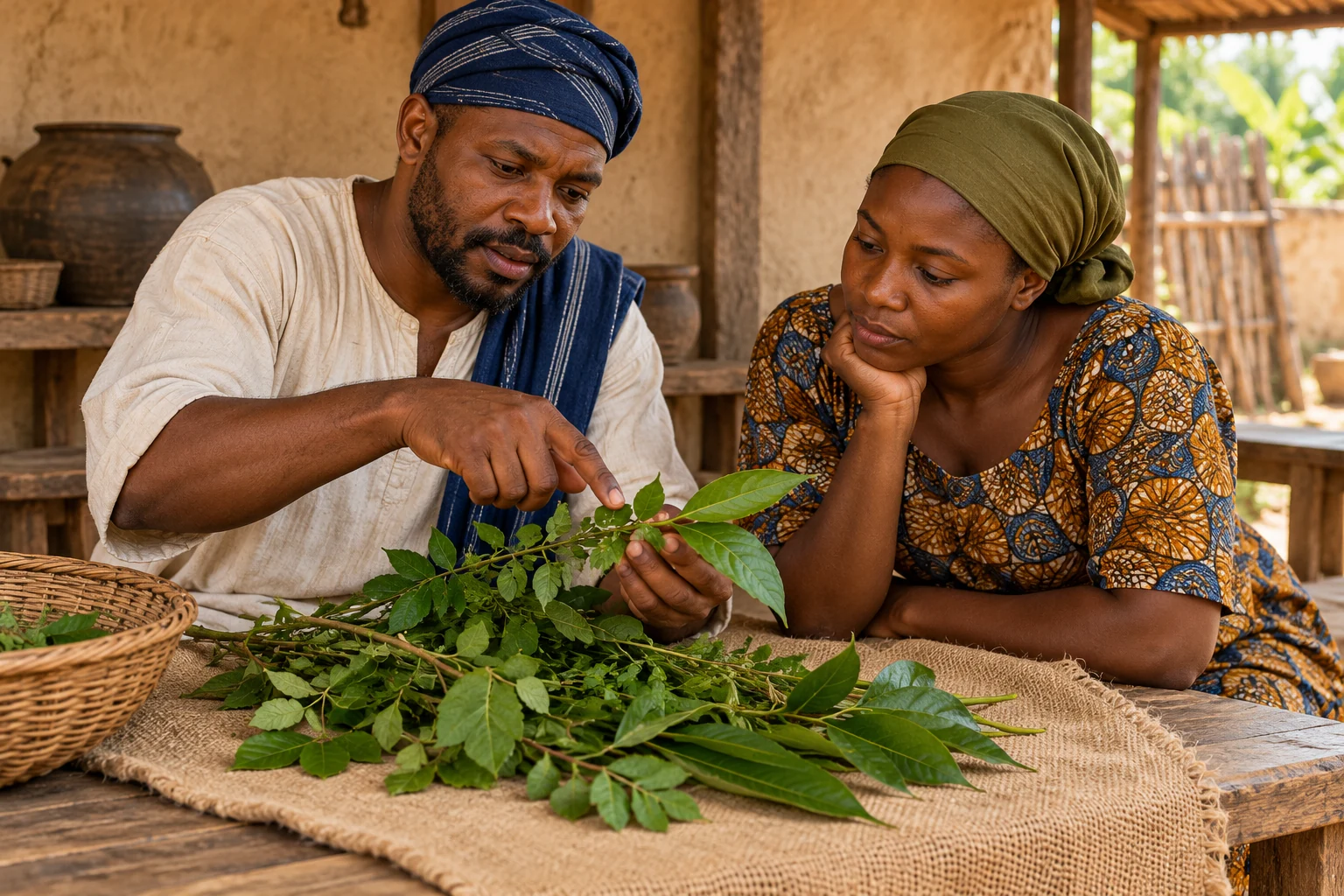
Ogunda Leni knows herbs extensively and believes this fulfills his religious responsibilities, while other commitments receive less attention. Ogun arrives looking for a particular plant. The expert treats the question as proof that higher authority is testing him. Ogun explains that he is simply seeking what he was advised to use and questions the expert’s interpretation.
The mistake is not botanical ignorance but making another person’s ordinary need revolve around one’s own recognition. Specialized knowledge can also become an excuse to neglect a broader role. The story does not establish that herbal practice is inferior to other work; it asks whether the person’s actual commitments match the identity he claims.
Narrative setting: Cuban/Lukumí patakín in a multilingual source compilation; no individual narrator is established.
The traveler pauses before striking
A traveler receives three counsels and resists companions urging a shortcut. A later scene rewards his refusal to join a protest against abuse, a troubling element of the narrative. Near home he sees his wife greeting a man and almost reacts violently, then recognizes the man as the son he has not seen since childhood.
The return scene clearly distinguishes appearance from knowledge, while the tavern episode raises the danger of treating nonintervention as a universal virtue. Preserve the difference. Counsel must be interpreted in context rather than repeated as an unconditional command. The story’s most usable lesson is to interrupt a violent assumption long enough for identification and conversation.
Narrative setting: Cuban/Lukumí patakín in a multilingual source compilation; no individual narrator is established.
The cut seed yam returns as a whole tuber
Seed yam receives counsel concerning what humans will do to it: cut it into pieces and place those pieces in the ground. It undertakes the advised sacred response. The buried parts later grow into complete tubers with further offspring, so an event described from the yam’s perspective as attack becomes a multiplying return. The surrounding passage extends this toward human adversity, but the selected motif remains a personified plant’s sacred biography. It does not establish that injury is beneficial to people, that every loss produces abundance, or that accepting harm is a necessary condition of growth.
The first perspective does not see the later form. Cutting and burial appear to end the yam, while the continuation reveals that this particular material can become productive through that process. Within the witness, sacred preparation is part of how the reversal is understood, not an ornament added to a horticultural observation. A contemporary interpretation can consider incomplete knowledge of a process, but must not generalize the seed’s condition into human abuse or inevitable recovery. The earlier herb expert likewise misreads an ordinary request as a test of his prestige, while the returning traveler almost mistakes his son’s changed appearance.
These are distinct errors of inference, not one rule that every feared event is secretly good. The seed’s transformation has a known result in the story. A reader’s future does not. That boundary allows the religious image to retain hope and specificity without becoming a demand that someone endure avoidable harm. The stated six-month interval also makes the reversal a process within the witness, rather than an instantaneous transformation.
Narrative witness and setting: Translated excerpt in the multilingual compilation’s expressly attributed Cromwell Osamaro sequence, with Yoruba/Bini-facing material. The compilation’s language is not evidence of a Brazilian tradition.
Kosoko’s households flourish through different work
A community and its farmers receive counsel concerning collective provision. The wider population undertakes the religious response, while the farmers decline to join. The account describes a later separation of livelihoods: many inhabitants prosper through trade and other occupations rather than cultivating, while farmers continue to bring produce into the community. Esu’s pronouncement is connected with that arrangement. The narrator also claims that those who remain in farming have a less favored position in this locality. This is a sacred explanation of occupational distribution, not a verified economic survey or an instruction that physical labor can never support a good life.
The community’s prosperity does not mean it has become independent of cultivation. Food still arrives through farmers whose position the account describes less favorably. That difference should remain visible rather than be turned into a simple triumph of effortless wealth. Within the witness, collective sacred response and Esu’s agency explain why livelihoods become differentiated; a contemporary reader may then ask what continuing responsibility exists toward those producing necessities. The earlier herb expert’s narrow understanding of his role gives another occupational question: expertise in one activity does not complete every obligation.
The traveler’s counsels also have uneven ethical effects, especially when nonintervention is rewarded in a contrived abuse scene. Together the four narratives should not be made to prescribe one right occupation or one attitude to effort. They offer different relations among vocation, production, knowledge, and the social arrangement through which another person receives a benefit.
Narrative witness and setting: Translated excerpt in the multilingual compilation’s expressly attributed Cromwell Osamaro sequence, with Yoruba/Bini-facing material. The compilation’s language is not evidence of a Brazilian tradition.
What was born in this Odù
“Born” can name an explicit traditional origin association or what emerges through a story: a capacity, relationship, practice or order of life. Interpretations drawn from a narrative are labelled below, so their basis remains clear.
Three major counsels
Selected traditional source association.
The origin list explicitly foregrounds three counsels, developed in the travel account. Their presence does not make every application ethically sound; the abusive tavern scene requires critical separation from the restraint shown at home.
A Yoruba ceremonial leadership role
Selected traditional source association.
The list identifies a master-of-ceremonies association. The inspected passages do not specify a universal title or procedure, so the role is noted without inventing an institutional history.
Correlations to life dimensions
These questions bring the selected stories into contemporary life. They are interpretive invitations for study.
Work and resources
Specialization can hide incomplete responsibility. A role should be evaluated by the whole set of duties, not only by its most impressive skill.
Reflect: Which obligation lies outside your strongest expertise?
Relationships and family
The traveler has outdated knowledge of his son’s appearance. Intimacy does not eliminate the need to ask when time has changed a situation.
Reflect: What would a direct greeting clarify?
Character and inner life
The expert interprets a request as a referendum on his importance. Attention improves when the other person’s stated need remains central.
Reflect: Can you answer the request without making it about your status?
Community and responsibility
The tavern episode makes silence beneficial within its contrived plot. Real community responsibility requires evaluating harm rather than adopting indifference as a principle.
Reflect: When does restraint protect someone, and when does it abandon them?
A deeper reading of the sacred relationships
Sacred response changes a relation, not only an attitude
Seed yam’s preparation belongs to a transformation in the material world, while Kosoko’s collective response is associated with Esu’s ordering of occupations and provision. The earlier expert is challenged over whether one domain of knowledge fulfills a broader religious role. These are not merely motivational stories about optimism or productivity. Their spiritual logic concerns persons and agencies whose relations make a condition effective. Contemporary interpretation can ask how work is organized or how a process is understood, but should not replace the witness’s sacred explanation. It should also avoid importing the locality’s occupational hierarchy as a universal religious judgment against farmers or people who perform physical labor.
Benefiting from a process does not reveal its whole cost
A household may receive food without cultivating it, and a later whole tuber may conceal the earlier cut pieces in its history. The herb expert’s status can obscure neglected commitments, while the traveler’s safe return does not settle the tavern scene’s treatment of another person. These are separate examples of what a favorable result leaves outside the principal viewpoint. A contemporary study can trace who performs necessary work and what remains unknown, while preserving the differences between plant emergence, occupation, religious duty, and interpersonal harm. The comparison should not become a universal claim that all success is exploitation or every painful stage is productive.
A useful comparison needs a limiting condition
The seed’s fragmentation is fertile because the story supplies a particular plant process and outcome. The traveler’s recognition is corrected by a son’s identity, and the expert’s assumption by Ogun’s stated purpose. Kosoko’s occupational account is explicitly local rather than a result about every economy. These limits keep analogy from becoming an invented law. A contemporary reader can ask what exact fact makes a comparison valid before applying it elsewhere. The religious witness remains substantial because divine agency and counsel have their own place; limiting an application does not mean declaring the spiritual account empty. It means not claiming the source has established more than its own sequence supplies.
Questions that deepen the study
Can the seed yam be used to tell someone that harm is necessary for growth?
No. The account gives one personified plant a specific transformation whose continuation is already narrated. A human reader’s injury is not the same material process, and the future result is not known from the story. A contemporary interpretation may reflect on how a limited view can mistake an unfinished process, but should also affirm that avoidable harm need not be accepted to prove spiritual maturity. Within the witness, sacred response participates in the yam’s emergence. Respecting that religious reality does not require extending its mechanism to every loss, illness, or abusive relation.
Does Kosoko’s story mean cultivation is spiritually inferior?
It describes a particular locality in which a differentiated sacred response precedes different livelihoods. It also shows continuing dependence on farmers who bring food home. That is not evidence that all cultivation is inferior, unprofitable, or incompatible with spiritual life. The earlier herb expert’s work likewise has value even though the account questions his wider conduct. A contemporary reader can ask about the relation between necessary labor and those who benefit from it, without turning the story into career advice. Esu’s local ordering remains part of the witness, while a modern economy would require evidence the passage does not provide.
How do these motifs sharpen the earlier emphasis on judgment?
They require more than choosing a positive interpretation. The expert needs the visitor’s actual purpose, the traveler needs a correct identification, the seed narrative supplies a particular later form, and the community story supplies a local division of work. Each judgment depends on facts appropriate to the setting. A contemporary study can therefore resist both cynicism and automatic reassurance. The religious account contributes consultation and effective sacred relations, but it does not authorize inventing a good ending where none is supplied. The four narratives are most useful when their exact grounds and unresolved costs remain visible rather than being gathered under a generic promise of growth.
What the four narratives reveal together
The added witness gives Ogunda Owonrin a material and occupational dimension beside its earlier questions of expertise and restraint. Seed yam returns whole through a particular sacredly framed transformation; Kosoko’s flourishing is distributed across occupations while dependence on cultivation continues. The herb expert and returning traveler retain different misreadings and ethical limits. Religious agency should remain active in explaining how the witness understands these changes, while contemporary interpretation asks what a favorable outcome conceals and how an analogy is bounded.
The four stories do not establish that suffering is necessary, noncultivation superior, or every restrained response wise. Their depth lies in the exact condition that makes a judgment sound: a visitor’s stated need, a child’s identity, a plant’s narrated emergence, or a locality’s continuing relation to food-producing work. Those conditions should not be replaced by universal advice.
Living with this Odù
A continuing life or initiatory relationship
For someone whose received life or initiatory sign is Ògúndá Ọ̀wọ́nrín, expertise can remain substantial without making every encounter a test of one's prestige. The herb specialist misreads Ogun's practical request, while the returning traveler almost converts an incomplete view into violence. Across changing circumstances, these accounts can develop the ability to hear an ordinary purpose before arranging the event around one's own recognition. One domain of knowledge also does not automatically fulfill every commitment attached to a broader religious role.
The seed yam and Kosoko add different kinds of productive dependence. A particular plant's fragmentation becomes a multiplying return within its sacred biography; households receive provision through farmers whose labor remains necessary. Long-term character can include tracing the process and people behind a favorable result without claiming that all pain is fertile or all physical work is less favored. Esu's ordering and sacred preparation remain effective in the attributed witnesses, rather than labels for optimism. The sign does not demand tolerating abuse, prescribe one occupation or guarantee recovery after injury. It asks what exact fact supports an analogy and whose cost an apparently successful arrangement may have left outside its principal viewpoint.
A particular consultation and its question
In consultation, Ògúndá Ọ̀wọ́nrín can help distinguish a task someone actually requests from the test an expert imagines. Ogun seeks a particular plant; the specialist's assumption about higher recognition changes the encounter without evidence. A practitioner can examine whether a current interpretation rests on the other person's stated purpose or on the need to make one's standing central. The traveler's recognition of his son offers a separate correction, not approval of nonintervention in the source's troubling abuse scene.
The seed and occupational witnesses also require limiting conditions. Seed yam's sacredly supported return has a specific narrated outcome and interval; an unknown person's harm does not. Kosoko's prosperity remains dependent on food supplied by others, and its local hierarchy cannot define every economy or vocation. Consultation may ask which obligation expertise has obscured and what a successful result still depends on. It cannot identify injury as necessary growth or financial difficulty as evidence that the client chose the wrong occupation. The result belongs to its present question and religious context rather than a permanent identity of narrow expert, patient sufferer or effortless beneficiary.
Constructive and adverse possibilities
Constructive relations may let an expert respond to the actual need, suspend a violent inference long enough for identification and recognize a particular process whose later result was not initially visible. Sacred preparation participates in seed yam's return within its witness, without turning injury into a general path to abundance.
Adverse unfolding could involve treating every request as recognition of one's importance, benefiting from cultivation while dismissing cultivators or using a plant image to demand endurance of interpersonal harm. The traveler's safe return also does not settle the abuse scene's ethics. These contrasts do not assign ìrè or òṣogbo to a real consultation. They ask what makes a comparison valid and whose necessary labor or vulnerability remains outside a favorable outcome, while preserving the religious agencies that the attributed accounts regard as effective.
An illustrative situation in everyday life
In a hypothetical specialist practice, a colleague requests one technical item. The expert assumes the request is a prestigious test and responds with a demonstration that does not meet the need. Ogun's stated purpose helps restore the actual question. A successful client community later credits itself with having outgrown manual production, although its daily provision still comes from poorly recognized workers. Kosoko adds that separate dependence. This illustration does not rank professions or explain prosperity through religious compliance. It asks whether expertise is serving the request and whether the account of success includes the labor on which it rests. Neither technical skill nor a favorable result makes the wider arrangement complete.
Sources and reading context
The first two narrative witnesses
The Cuban source places herb expertise beside religious duty without supplying evidence for a hierarchy among all Afro-diasporic practices. The travel narrative is used critically, especially its abuse scene. Personal taboos, medical claims, and the exact wording of the counsels are omitted.
Narrative motifs are summarized independently. The life-dimension reflections are contemporary interpretation. How these reference studies are built explains the wider source approach and the distinction between a reference article and personal divination.
Additional named witnesses
- Cromwell Osamaro Ibie. The surrounding sequence is expressly attributed to Cromwell Osamaro. These selected episodes are read through the multilingual compilation’s translated renderings; exact edition and original translation chain remain unverified.
The agricultural and occupational accounts are local sacred explanations, not claims about all plants or economies. Later instructions to avoid physical work are not adopted. The seed image is not used to justify human injury, and no planting or ritual procedure is supplied.
Bibliographic identification
- C. Osamaro Ibie. Ifism: The Complete Work of Orunmila. Lagos; multivolume publication beginning 1986. Library catalogue record. Related bibliographic record for the named narrative witness. Exact volume, edition and page of the transmitted account have not been independently matched.
Read the source method and wider scholarly context.
The catalogue links identify published works and their authors. They are separate from proof of an individual episode’s wording or attribution. Contemporary comparisons and the synthesis above are editorial interpretation. The author’s books and Academy companions below provide further study; their sales links are separate from the source references.