
Ìròsùn Òyèkú is a mixed Odù in Ifá’s 256-part corpus. Ìrosùn Òyèkú’s selected narratives describe protection that cannot be possessed as an entirely private achievement. Awó Obá Koloye inherits a shadow secret but neglects parts of its transmission and his relationship with Eleguá. An elderly practitioner seeks Amosun rather than relying on the good he has already done. The accounts place changing life, ancestry, technical care, and the acknowledgment of limits within one local religious discussion of mortality.
A question to carry through the study: Which inherited responsibility have you treated as permission to improvise without consultation?
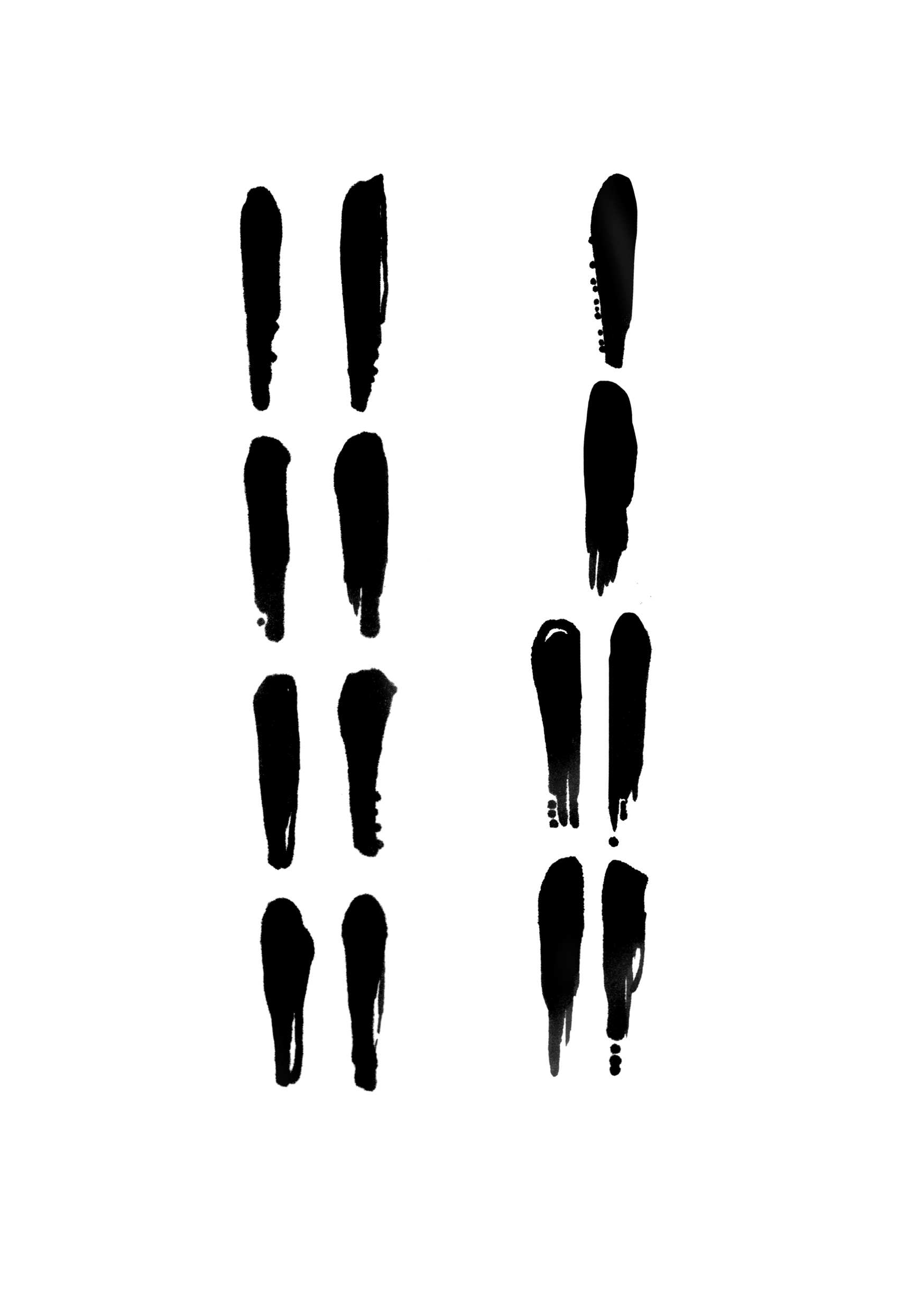
This Academy reads the right column first, then the left. Each row carries a single or double mark.
Where this Odù belongs
Ìròsùn Òyèkú belongs to the Ìròsùn family in this Academy’s study sequence. It is a mixed Odù, distinct from Òyèkú Ìròsùn. The order matters. Its teaching is approached through its own narratives, rather than by adding two general descriptions of the principal signs together.
Key Òrìṣà and sacred relationships
The figures below are selected for their roles in the accounts discussed here. They offer connected reading paths through the tradition.
-
Èṣù. Eleguá’s grievance against Koloye draws him into the dispute with Death. His role shows how a neglected relationship can expose the limits of a practitioner’s apparently exceptional protection.
-
Obàtálá. Obatalá appears within Amosun’s response to the elderly practitioner. The association is part of that narrated intervention and is not developed into a separate universal doctrine of rescue.
Key myths and their meanings
The inherited shadow becomes a negotiated pact
Koloye protects the people of his land through a shadow power inherited from his father. Death cannot find those under it. Eleguá, angered by a previous refusal, helps bring Koloye to a gathering where the father identifies neglected instructions. What appeared to be complete escape from Death becomes a new, witnessed pact. The story connects that agreement with Death accepting animals for the first time.
The account turns exceptional protection into an obligation requiring accurate transmission and maintained relationships. The father does not simply praise his son’s ingenuity; he asks what was omitted and who was disregarded. Its central tension remains the human desire to defeat mortality versus the necessity of negotiating limits. No account of efficacy should be transferred into promises about a reader’s survival or treatment.
Narrative setting: Spanish Cuban-style shadow account.
The elder who seeks another practitioner
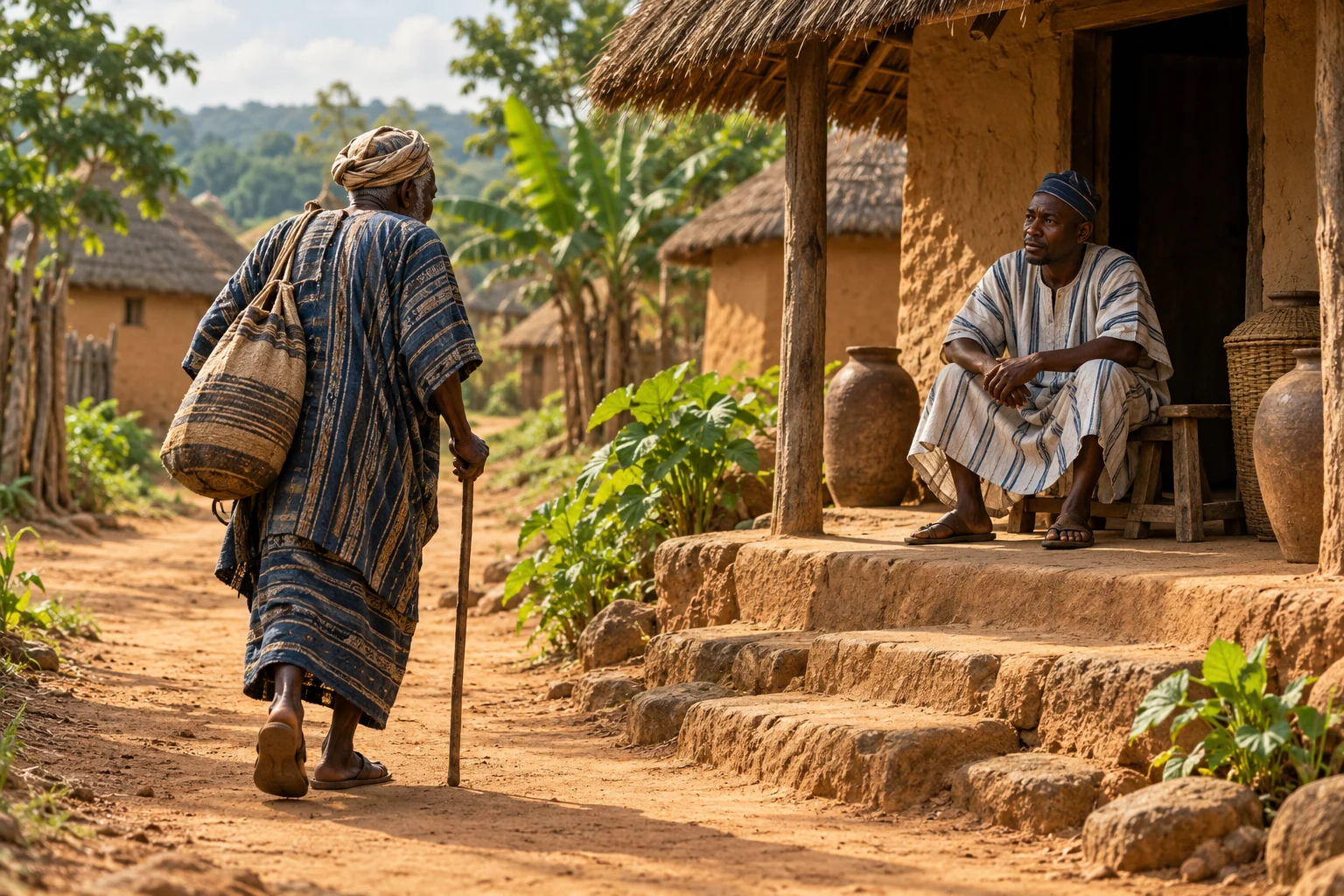
An elderly Awó who has done much good becomes aware that Death is approaching. His own consultation identifies another practitioner, Amosun, as the person to seek. He travels to that village and receives help through an extended religious response involving several presences and a visible support structure. The narrative closes by crediting Amosun with helping him win this particular encounter.
A lifetime of service does not remove the need to receive assistance. The elder retains agency by consulting and traveling, but is not shown proving his worth through solitary endurance. The story can support respect for complementary knowledge among experienced people. Its victory is a narrative ending, not an assurance that virtue, seniority, or correct practice grants control over death.
Narrative setting: Spanish account of Akapan Ganga Orun and Amosun.
Kele is brought home through gentleness
A short marriage precedent places Òrúnmìlà before consultation as he prepares to bring Kele into a household. Its comparisons concern familiar objects whose condition depends on how they are handled: a vessel, a plate, and cloth remain serviceable through care rather than force. The sequence then names gentleness as the way the marriage is brought home. Unlike a lengthy courtship tale, the witness does not describe family negotiations, a rival, or an incident inside the completed household. Its concrete motif is the passage into shared dwelling through a mode of action appropriate to what must remain intact.
The brevity of the witness is part of its meaning and its limit. It gives a precedent for the manner of entry, not a full theory of marriage or a guarantee that a gentle beginning resolves every later conflict. Within the religious setting, Ifá’s utterance links ordinary material relations with a consequential human passage. Care is therefore not merely an added modern preference; it is how the account understands the action becoming possible. Read beside Koloye’s inherited protection, the motif distinguishes possessing a capacity from using it in an appropriate relation.
The elder who seeks Amosun likewise receives help rather than forcing his own authority to be sufficient. Kele’s comparison should not make a partner into a fragile object owned by another person. A contemporary reading can preserve mutual agency while recognizing the source’s concern with force: a shared home is not successfully established simply because someone is powerful enough to impose entry.
Narrative witness and setting: Passage explicitly headed Revelações de Solágbadé Pópóọlá
Oye keeps a returned family connected to its earlier helper
Oye seeks help for her own childlessness and later becomes a priestly helper to other women, working with Òrúnmìlà. Two women receive assistance and bear children. One does not maintain acknowledgment of the earlier helper, though she still visits Oye. When trouble returns through her child, Oye directs her back toward Òrúnmìlà. The encounter includes an accusation about the mother’s spiritual conduct and a promise to release the child, followed by recovery within the account. The passage closes with thanks directed toward Oye, preserving her role in bringing the household back into relation rather than treating her as an interchangeable messenger.
The religious logic concerns a chain of benefaction that does not end when an immediate need has been met. Oye’s own received help becomes a capacity through which she can assist others, but she does not claim to replace Òrúnmìlà when the later situation requires another encounter. That mediation resembles the elder’s journey to Amosun, where experience does not make receiving help dishonorable. The accusation against the mother must remain a claim inside this particular narrative and cannot become a way of diagnosing an actual child’s illness or blaming a distressed parent.
The source’s unstable pronouns also make it unsafe to assign every statement with confidence. The deeper comparison with Kele concerns continuity through a fitting manner of relation: care and acknowledged help maintain a household more subtly than force or a claim to self-sufficiency. Koloye’s inherited protection adds another continuing obligation, though its pact with Death is a distinct religious mechanism rather than the same transaction repeated.
Narrative witness and setting: Account explicitly headed Revelações de Cromwell Osamaro
What was born in this Odù
“Born” can name an explicit traditional origin association or what emerges through a story: a capacity, relationship, practice or order of life. Interpretations drawn from a narrative are labelled below, so their basis remains clear.
Change of life
Selected traditional source association.
The source explicitly associates the sign with changing life. Read within the selected stories, this can concern a changed arrangement or relationship with mortality; it should not become a prediction about when or how a reader’s life will change.
Death accepts animals
Selected traditional source association.
The origin list and shadow narrative associate the sign with a change in Death’s food. The introductory wording varies about the earlier food, so only the shared motif of substitution and altered terms is retained.
Correlations to life dimensions
These questions bring the selected stories into contemporary life. They are interpretive invitations for study.
Work and resources
Koloye inherits a specialized capacity but omits parts of its stewardship. The story distinguishes receiving a resource from maintaining its conditions, making documentation, careful teaching, and acknowledgment of limits relevant interpretive concerns. The father makes those omitted conditions explicit again.
Reflect: What condition of an inherited role have you stopped attending to?
Relationships and family
The father corrects a son whose innovation has exposed others to danger. Their relationship is both familial and pedagogical, so the correction concerns responsibilities extending beyond the private bond between them. Other people rely on the transmission being responsibly maintained.
Reflect: Who else is affected when you change a family practice?
Character and inner life
The elder accepts that another practitioner may know what he needs. The account gives experienced people a way to receive help without treating it as the loss of their standing or the cancellation of their earlier service.
Reflect: Where would receiving help express judgment rather than defeat?
Community and responsibility
The new pact is witnessed by other Awó. A matter affecting the people of a land becomes a public undertaking, suggesting that claims of protective authority need responsibilities that others can recognize and hold in memory.
Reflect: Which promise should be witnessed because others rely on it?
A deeper reading of the sacred relationships
Sacred help creates continuation rather than a completed purchase
Oye receives assistance and later becomes a helper; her intervention returns a household to an earlier religious relationship. Koloye inherits a capacity whose conditions require careful maintenance, while the elder seeks another practitioner instead of treating past service as an exemption from receiving care. Kele’s short precedent adds a fitting manner of entering relation. These accounts do not portray sacred exchange as payment that permanently cancels all further responsibility. They describe forms of continuing attention, acknowledgment, and rightly situated action. That religious logic can be explained without listing offerings or prescribing a reader’s obligations. Contemporary reflections on gratitude are useful, but should not replace the actual powers, practitioners, and institutions through which the witnesses understand continuity.
Gentleness concerns action rather than lack of power
The Kele precedent does not begin by making Òrúnmìlà powerless. It directs the manner in which a desired relationship reaches a household. The material comparisons distinguish force from care through their effects, not through a ranking of people as strong and weak. Oye’s referral similarly exercises judgment without claiming every problem as her own domain. The elder’s journey to Amosun gives another active form of receptivity, while Koloye’s changed pact responds to limits in inherited protection. Contemporary interpretation can therefore distinguish gentleness from passivity: it may involve referral, travel, acknowledgment, or a deliberate refusal to force an outcome. Each action remains grounded in the witness’s religious relationship rather than being treated as a generic temperament.
Mediation should remain visible in an account of help
Oye’s name remains in the final acknowledgment, even though the later encounter occurs with Òrúnmìlà. The elder’s story credits Amosun rather than presenting the elder’s survival as a solitary achievement. Koloye’s father likewise supplies the inherited knowledge whose omissions are later corrected. These details distribute agency across relationships and generations. A contemporary study can ask who is omitted when an outcome is credited only to its most prestigious participant, but should also preserve the kinds of help involved. A father’s transmission, a priestess’s referral, a practitioner’s intervention, and a gentle household passage are not identical services. Their distinctions give the source more authority than a list of interchangeable names surrounding a single hero.
Questions that deepen the study
How much narrative can responsibly be built around Kele?
Only the stated consultation and the emphasis on careful, gentle arrival should be treated as facts. The passage supplies no rival, quarrel, wedding negotiation, or later domestic scene. Its depth comes from the comparisons and from reading them beside the other selected accounts, not from inventing a longer plot. A contemporary interpretation can discuss mutual care while avoiding an equation of a partner with owned property. The spiritual setting remains essential: Ifá’s precedent identifies how the relationship is brought into a household. That is a particular religious claim about manner and relation, not a universal guarantee that gentleness alone resolves every condition surrounding marriage.
Does Oye’s account justify suspecting a parent when a child is ill?
No general inference of that kind follows responsibly from the witness. The accusation and admission belong to a particular religious narrative whose pronouns are also unstable in translation. They may be reported as its spiritual explanation without being applied to an actual family. What the passage clearly contributes comparatively is Oye’s role: she maintains contact, recognizes that another encounter is needed, and receives acknowledgment afterward. Preserving those facts prevents the story from being reduced either to a medical claim or a generic morality tale about gratitude. It also allows a contemporary reader to consider referral and continuing care without accepting an article as authority to diagnose hidden agency.
Why does the elder need another practitioner if he has done much good?
The earlier Amosun account does not make a history of service equivalent to possession of every capacity. The elder’s own consultation names someone elsewhere, and he acts by traveling to receive help. This is consistent with Oye referring rather than monopolizing the later intervention, and with Kele’s precedent preferring a fitting manner over force. Within the religious accounts, such dependence can be an expression of judgment and continuing relation, not a loss of dignity. Contemporary reflection can value that stance without promising control over mortality or turning the stories into professional advice detached from the sacred institutions they actually describe.
What the four narratives reveal together
The two additions give Ìrosùn Òyèkú quieter forms of continuity beside the earlier shadow pact and confrontation with mortality. Kele is brought home through gentleness, and Oye keeps a household connected with a chain of received and renewed help. Neither episode requires power to disappear. They instead distinguish possessing a capacity from using it in a fitting relation. Koloye’s inherited practice and the elder’s journey to Amosun become more legible through that distinction, while retaining their different theology of protection and Death.
A strong comparison preserves the religious reality of consultation, sacred exchange, and mediation before drawing contemporary questions about gratitude or referral. It also respects the limits of the witnesses: Kele is a compact precedent rather than a full domestic plot, and Oye’s accusation is not a diagnostic rule for actual families. Their depth lies in relationships that continue beyond a single successful event.
Living with this Odù
A continuing life or initiatory relationship
For someone carrying Ìròsùn Òyèkú within a received spiritual history, inherited protection need not mean unlimited independence. Koloye’s shadow becomes a witnessed pact when neglected instructions and Eleguá’s intervention make its limits consequential. The elderly Awó’s journey to Amosun offers another relation to competence: a substantial life of service does not make seeking another practitioner unnecessary. Receiving help can belong to mature authority rather than expose it as false.
Kele’s brief marriage precedent gives gentleness a material precision through things that remain intact when handled appropriately. Oye’s continuing role adds another question about who carries acknowledgment between a household and an earlier helper. Across changing circumstances, the person may be inheritor, experienced specialist, partner, or recipient of care. Those positions require different forms of attention. The sign does not guarantee escape from mortality or make another person’s illness evidence of forgotten duty. It invites a long relation to limits, including the capacity to revise an inherited understanding and to maintain ties after the desired benefit has arrived. The sacred pact, the extended religious response, and Oye’s priestly mediation retain their own agency rather than becoming interchangeable metaphors for support networks.
A particular consultation and its question
In consultation, Ìròsùn Òyèkú helps distinguish a protection’s existence from the conditions governing it. Koloye is not simply unprotected; an inherited power has been understood as more complete than the subsequent encounter allows. Amosun’s visitor introduces a different configuration, where the client’s own skill points toward another practitioner. The actual question determines whether an assumption needs revision or assistance needs to be received.
Kele’s precedent asks how the manner of approaching shared life affects what can remain intact. Its brevity does not justify inventing a detailed marriage history. Oye’s account raises the separate issue of continued acknowledgment, but its child-related accusation remains a source-specific religious statement, not a verdict to impose on a parent. A careful discussion can examine what has been inherited, what help has already been given, and whether a relationship is remembered only when another benefit is needed. The witnesses preserve distinct religious agents and exchanges. They do not furnish a medical explanation, promise a victory over Death, or identify an unknown helper’s spiritual status. A consultation concerns this present arrangement and its terms; it is different from declaring a permanent identity based on the sign’s narratives.
Constructive and adverse possibilities
Constructive unfolding may include a protective relation understood more exactly, an experienced person willing to receive competent help, and gentleness fitted to what a shared life must preserve. Oye’s mediation can keep earlier assistance within a continuing relationship instead of letting benefit erase its history.
Adverse unfolding can involve treating inheritance as exemption, experience as self-sufficiency, or renewed contact as a way to obtain care without acknowledging what preceded it. The shadow pact’s religious consequences remain particular; the account’s differing claims about Death’s former food do not support a universal origin rule. Likewise, gentleness does not require enduring coercion or injury to maintain a relationship. These contrasts describe possible directions in dependence and responsibility. They do not declare mortality a failure of preparation, assign blame for actual child loss, or decide the constructive or adverse condition of a real reading.
An illustrative situation in everyday life
Imagine a hypothetical senior practitioner who has long supported a community and assumes that asking a colleague for help would undermine everyone’s confidence. An inherited method no longer addresses the particular problem before her. Amosun’s visitor makes referral compatible with mature competence; Koloye’s pact distinguishes a real inheritance from an unlimited guarantee. Kele’s handling comparisons add a question about how the relationship with the colleague is approached. Her inner conflict concerns maintaining an image of complete capacity, while the external problem requires additional knowledge. A clear request and honest acknowledgment of limits could preserve trust more effectively than concealment. This example does not reproduce a sacred response or promise an outcome; it clarifies the relation between authority and receiving help.
Sources and reading context
The first two narrative witnesses
The selected accounts are Spanish Cuban-style narratives with uncertain author attribution. The source’s contradictory statements about Death’s prior food are acknowledged. Figure associations are kept narrow, and mortality or efficacy claims remain inside religious narrative.
Narrative motifs are summarized independently. The life-dimension reflections are contemporary interpretation. How these reference studies are built explains the wider source approach and the distinction between a reference article and personal divination.
Additional named witnesses
-
Solágbadé Pópóọlá. The explicit heading introduces the Kele marriage precedent and its careful-handling comparisons.
-
Cromwell Osamaro. The explicit heading covers the Oye priestess sequence.
The Kele passage is short and its name is uncertain in translation; no etymology or missing plot is supplied. Oye’s account has unstable pronouns and explicit maternal blame, which remains contextual. Neither Portuguese nor Spanish rendering establishes Brazilian provenance.
Bibliographic identification
-
C. Osamaro Ibie. Ifism: The Complete Work of Orunmila. Lagos; multivolume publication beginning 1986. Library catalogue record. Related bibliographic record for the named narrative witness. Exact volume, edition and page of the transmitted account have not been independently matched.
-
Solagbade Popoola Library Inc. and Awoyinfa Kori Ifaloju. Ifa Dida: An Invitation to Ifa Divination, Volume 1. Asefin Media, 2008; ISBN 9780981001319. Library catalogue record. Library catalogue record for the named author’s work; an exact source edition for the selected narrative remains unverified.
Read the source method and wider scholarly context.
The catalogue links identify published works and their authors. They are separate from proof of an individual episode’s wording or attribution. Contemporary comparisons and the synthesis above are editorial interpretation. The author’s books and Academy companions below provide further study; their sales links are separate from the source references.