
Ìrẹtẹ̀ Òkànràn is a mixed Odù in Ifá’s 256-part corpus. The selected Ìrẹtẹ̀ Ọ̀kànràn narratives distinguish lacking resources from refusing help and exclusion from lasting worth. A hunter cannot afford the prescribed response to his hardship, then receives refuge and material assistance from Obatalá. Shakuana is expelled and silenced in one territory, yet intermediaries help him establish recognition elsewhere. Both stories make access to care central, while the second’s illness language and Lukumí/Arará contrasts remain local religious storytelling.
A question to carry through the study: Whom have you interpreted as unwilling when they may simply lack the means to participate?

This Academy reads the right column first, then the left. Each row carries a single or double mark.
Where this Odù belongs
Ìrẹtẹ̀ Òkànràn belongs to the Ìrẹtẹ̀ family in this Academy’s study sequence. It is a mixed Odù, distinct from Òkànràn Ìrẹtẹ̀. The order matters. Its teaching is approached through its own narratives, rather than by adding two general descriptions of the principal signs together.
Key Òrìṣà and sacred relationships
The figures below are selected for their roles in the accounts discussed here. They offer connected reading paths through the tradition.
-
Ọ̀rúnmìlà. Ọ̀rúnmìlà identifies the hunter’s predicament and later counsels the expelled Shakuana; the first episode shows that receiving advice does not supply the resources needed to act on it.
-
Obàtálá. Obatalá gives the pursued hunter immediate shelter and supplies what he could not afford, making protection material rather than merely repeating the earlier instruction.
-
Èṣù. Eleguá alone offers Shakuana help when others exclude him, leads him to consultation and arranges companionship for the journey; his role bridges social isolation and renewed access.
Key myths and their meanings
The hunter who needed means as well as counsel
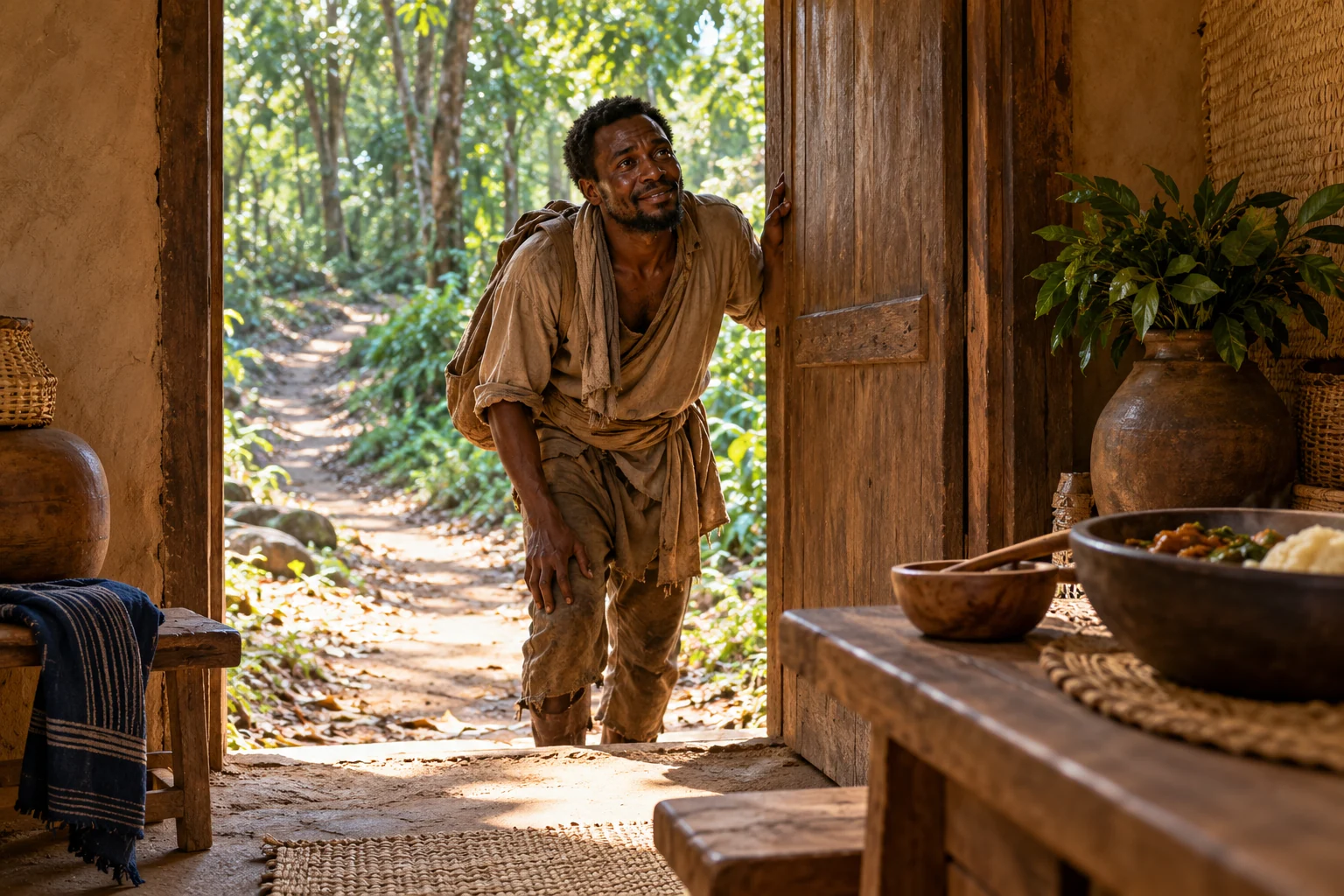
A struggling hunter consults but explains that he cannot afford even food, much less the response proposed. He returns to the forest and is pursued by dangerous animals. Desperate for refuge, he forces open a door that proves to belong to Obatalá. Hearing both the immediate danger and the earlier inability to pay, Obatalá supplies shelter and the missing resources. The narrative then describes the hunter’s circumstances improving.
The passage explicitly makes poverty the barrier; it should not be retold as simple defiance. Obatalá’s response changes the conditions of participation instead of blaming the hunter for failing to act. This gives the story a concrete social focus: guidance can be sound yet inaccessible. The supernatural improvement remains narrative, while the distinction between instruction and material help is directly supported.
Narrative setting: Cuban compilation, hunter and Obatalá episode.
A silenced outsider finds recognition in another land
Shakuana is blamed, expelled and deprived of a recognized religious voice in his former community. Most people refuse assistance, but Eleguá takes him to Ọ̀rúnmìlà. After counsel and preparation, he journeys into an Arará territory whose ruler initially claims absolute authority. The ruler unexpectedly recognizes him and asks forgiveness; others follow. Rain and a transformed landscape mark Shakuana’s establishment there, explaining a renewed religious standing beyond his original home.
The account makes exclusion more than physical banishment: others control whether Shakuana can speak within religious life. His later recognition challenges the assumption that a community’s rejection permanently determines someone’s worth. The source also uses illness and wrongdoing in a stigmatizing causal frame. A careful reading preserves the migration and recognition motif without importing that frame or treating the story as a verified history of traditions.
Narrative setting: Cuban compilation explicitly contrasting Lukumí and Arará territories in the Shakuana account.
Cord returns after its relatives cannot live with its new presence
Cord and a fastening companion receive divinatory counsel, but only the companion completes the proposed sacred exchange. In use, the fastener occupies the upper position that secures what Cord binds. Resenting that subordinate place, Cord returns to the bush among related plants. Humans follow it there, and pulling it away uproots the neighbors. Expelled again, it creates similar difficulty on a farm. After repeated exclusion, Cord returns to consultation and completes what it had declined. The account then gives it a more settled relation to communal occasions, rather than ending with permanent exile from every useful place.
The story makes belonging more complicated than simply returning to one’s relatives. Cord carries a function that draws other beings into its new location, so a private move changes conditions for the plants around it. The initial grievance about hierarchy is real within the account, but escape from that hierarchy does not automatically produce a livable alternative. Sacred participation eventually establishes another relation in which usefulness and recognized place can coexist. This is not merely a lesson that subordinates should accept whatever position they are given.
The source’s broader comments themselves resist servitude, and the narrative allows a return after refusal. Compared with the earlier hunter, material access matters to whether counsel can be acted upon. Compared with Shakuana’s exile, the new place does not immediately recognize Cord’s value; several failed relations precede a changed outcome. A contemporary interpretation can examine mutual effects without turning every disturbed neighbor into evidence that an outsider does not belong. Later recognition establishes a changed relation rather than an untouched past.
Narrative witness and setting: Portuguese African narrative in the section explicitly credited to Cromwell Osamaro; the fastening object’s exact form is uncertain in translation.
Elekolo remembers the warning only after the daughter returns
Elekolo receives counsel concerning a daughter’s proposed marriage and a sacred preparation meant to prevent loss. Intending to act later, the parent postpones until the obligation is forgotten. A suitor from another settlement is accepted, with Èṣù implicated in the forgetting. After arrival in the new household, the daughter becomes gravely unwell and returns to the parental home, where she dies. The warning is remembered only then. Her burial before the house acquires specific restrictions and becomes the basis of a remembered address. The account connects an unfulfilled relation, a journey and a continuing memorial rather than narrating recovery.
The ending gives no second opening comparable to Cord’s return or Shakuana’s recognition elsewhere. That difference should remain visible rather than being softened into a universal promise of repair. The daughter’s own wishes are also scarcely narrated; the decisions and later remembrance center on the parent. A reference can identify that limited perspective without imposing a modern voice the source does not supply. Within the religious account, Èṣù and the postponed preparation are causally active, but the narrative cannot establish that marrying outside a home community causes actual illness or that a parent’s omission explains bereavement.
The earlier Shakuana episode is a particularly important comparison because crossing into another territory there becomes the setting of greatness. The two stories therefore do not support one geographical rule. Their spiritual conditions, actors and outcomes differ, and contemporary interpretation should preserve those distinctions rather than using the tragedy to restrict readers’ movement or relationships.
Narrative witness and setting: Portuguese African narrative explicitly credited to Cromwell Osamaro.
What was born in this Odù
“Born” can name an explicit traditional origin association or what emerges through a story: a capacity, relationship, practice or order of life. Interpretations drawn from a narrative are labelled below, so their basis remains clear.
Gossip
Selected traditional source association.
The origin list names gossip, supporting attention to how reputations and collective exclusion are made through speech. It does not establish that every criticism is malicious or permit assuming that an unwelcome account must be false.
The copey tree
Selected traditional source association.
A particular tree is listed as an origin association. Its presence can be recorded without assigning unsupported medicinal properties, ritual uses or a universal symbolism; the selected stories do not explain its role further.
Sound at the divination tray’s edge
Selected traditional source association.
The list includes sounding the edge of the tray with ikofa. The broader theme is address and attention, but the brief entry supplies no basis for a public procedure or a universal explanation of the practice.
Correlations to life dimensions
These questions bring the selected stories into contemporary life. They are interpretive invitations for study.
Work and resources
The hunter’s lack of money is stated before danger increases. Obatalá’s material contribution closes a gap that advice alone leaves open. This supports asking whether a service is truly accessible to those it is intended to help.
Reflect: What practical cost prevents someone from using the help already offered?
Community and responsibility
Shakuana loses both residence and a recognized voice. The later acknowledgment in another territory makes belonging contingent and remade, rather than a fixed measure of worth. The story invites scrutiny of how communities exclude and whether a route back or onward exists.
Reflect: Who controls whether an excluded person can speak for themselves?
Relationships and family
The source notes that even a close relation refuses Shakuana aid, while an intermediary remains available. This allows reflection on support networks extending beyond expected kinship, without turning abandonment into an inevitable feature of family life.
Reflect: Which unexpected relationship could help bridge an existing gap in care?
Character and inner life
The hunter accepts refuge and explains his circumstances rather than preserving an appearance of self-sufficiency. That detail supports the dignity of naming a material barrier. Shakuana’s journey likewise separates a former community’s verdict from the possibility of another future.
Reflect: What limitation could you state plainly so that help can become more concrete?
A deeper reading of the sacred relationships
Remembering counsel is a continuing sacred relation
Cord’s later consultation reopens an exchange it had declined, while Elekolo’s intention to act is repeatedly postponed until memory returns after loss. The earlier hunter cannot participate because he lacks resources, and Obatalá changes that condition. Shakuana’s journey becomes possible through mediation that survives communal rejection. These cases distinguish refusal, deferral, inability and exclusion rather than treating every incomplete preparation as the same moral failure. Within the religious witnesses, counsel and exchange remain efficacious relations that must be inhabited under particular conditions. A contemporary reflection on follow-through can follow, but should not replace divine agency or justify blaming actual suffering on a person’s imperfect memory or means.
Home and elsewhere do not carry one universal value
Cord returns to relatives but cannot remain because its presence draws disruptive extraction into their space. Shakuana finds recognition in a territory beyond the community that expelled him. The hunter reaches unexpected safety through a door that is not his own. Elekolo’s daughter returns home, but the return does not reverse the fatal course of the account. These are distinct relations to place: refuge, recognition, incompatibility and memorial. A contemporary study can compare what makes a location livable, while refusing to infer that staying or leaving is inherently right. The narratives themselves attach outcomes to particular sacred conditions, not a simple map in which the native village is always safe.
A community may preserve a place through use or memory
Cord’s eventual settled relation is expressed through participation in important occasions. The daughter’s place is preserved differently, through burial and restrictions around a memorial. Shakuana’s recognition establishes another religious standing after exclusion, while Obatalá’s shelter responds to an immediate need without first demanding public rank. These differences show that belonging is not measured only by productivity or residence. A reference can ask what a community recognizes, whom it remembers and what access it provides. Contemporary interpretation should not turn memorial rules into public instructions, but it can explain how the source lets a relationship continue after a life has ended without pretending that remembrance equals the lost person’s recovery.
Questions that deepen the study
Why does returning to relatives not solve Cord’s difficulty?
Its function brings human users into the new location, and pulling it away uproots nearby plants. The relatives therefore experience consequences that Cord’s wish to leave a subordinate role did not anticipate. The account does not simply say that family is unkind; it describes a relationship whose conditions are incompatible until another sacred relation is established. A contemporary reading can examine the effects of a move on others without assuming an outsider is inherently disruptive. The later return to consultation also matters because the source allows a missed exchange to be reopened rather than making the initial refusal the last word.
Does the daughter’s tragedy establish that marriage elsewhere is wrong?
It cannot be generalized that way. The selected witness gives a particular warning, deferred preparation and fatal outcome, while the earlier Shakuana narrative makes another territory the place of renewed greatness. The daughter’s account also contains little of her own perspective. A reference should preserve its religious causation as a local narrative without converting it into medical proof or a rule restricting actual women’s choices. The useful comparison concerns how different sacred conditions and decisions shape a journey within each story, not whether one location is inherently safe for every person.
How does Obatalá’s help prevent the hunter from being read as merely disobedient?
The hunter says that he cannot afford even food. The barrier is material, and Obatalá supplies both refuge and the means previously missing. That distinguishes his case from Cord’s refusal and Elekolo’s postponement. The comparison is important because a generic language of neglect would erase the source’s explicit difference between unwillingness and inability. Within the religious account, the sacred response remains meaningful; practical assistance makes participation possible rather than replacing it. A contemporary reader may ask how guidance becomes accessible, without treating poverty as evidence that someone has failed to care or believe enough.
What the four narratives reveal together
The African-attributed additions make the earlier Cuban themes of refuge and renewed standing more differentiated. Cord’s return to relatives fails before consultation opens a settled relation, while Elekolo’s delayed remembrance ends in a memorial rather than recovery. Shakuana’s recognition elsewhere and the hunter’s unexpected shelter show why these stories cannot yield one rule about home, exile or obedience. Sacred exchange, divine mediation and particular warnings remain active within each witness. Contemporary questions about access, mutual effects and personal agency can then clarify their differences. The reference should distinguish refusal, poverty, deferral and social exclusion instead of making every difficulty a sign of the same spiritual omission. It should also preserve the daughter’s limited voice and the irreversible ending without turning them into a predictive restriction on readers’ movement, marriage or health.
Living with this Odù
A continuing life or initiatory relationship
For someone whose received life or initiatory Odù is Ìrẹtẹ̀ Ọ̀kànràn, participation and belonging can become questions about actual conditions rather than moral labels. The hunter cannot afford the advised response, and Obatalá supplies means as well as shelter. His difficulty should not be remembered as defiance. Shakuana's new standing develops beyond a community that has denied his religious voice, while Cord finds that returning among relatives does not automatically create a workable place. Across a life, a bearer can ask what support makes engagement possible and how one's changed presence affects others.
Elekolo's bereavement offers no reopening comparable with Cord's return, so the stories cannot promise repair after every postponement. The daughter's limited voice also keeps parental responsibility distinct from her own unreported wishes. These narratives do not predict migration, illness or loss. Lukumí and Arará remain the Cuban account's contrasted settings rather than verified histories or interchangeable traditions. Contemporary inner development accompanies Obatalá, Eleguá, Èṣù and sacred exchange by examining shame about need, resentment of hierarchy and willingness to notice material barriers. It can distinguish another chance from return to an untouched past and a changed location from an automatic answer to every unresolved relationship.
A particular consultation and its question
In consultation, Ìrẹtẹ̀ Ọ̀kànràn can distinguish inability to participate from refusal, and exclusion from an unsuccessful attempt to establish a livable alternative. The hunter lacks resources; Cord's grievance concerns position and the effects of its new location; Shakuana is denied standing and later recognized elsewhere. A practitioner should not answer all three with a demand to comply or move away. Elekolo's postponed preparation raises another question about an acknowledged intention never becoming action, but its fatal closure cannot explain a real bereavement or justify restricting marriage beyond a home community.
The actual question and result determine which distinction matters. Useful inquiry can ask what means are missing, who controls recognition and how a proposed change affects neighbors or dependents. Sacred agency remains active within the witnesses, including Èṣù's role in forgetting and the preparation supporting new standing, without establishing personal causation about an unknown reader. Receiving the sign once is not a permanent spiritual identity. Its reflective contribution is to separate access, agency, timing and mutual effects, while preserving the difference between outcomes that reopen participation and an outcome whose memorial marks a loss the narrative does not reverse.
Constructive and adverse possibilities
Constructive possibilities include supplying the means needed for counsel, recognizing a voice previously silenced and creating a changed relation after an unsuccessful return. Adverse possibilities include moralizing poverty, mistaking physical return for mutual fit or letting an acknowledged obligation disappear into indefinite postponement. Cord's neighbors are affected by humans following its function; that detail asks about consequences without proving outsiders inherently disruptive. Actual iré or òṣogbo belongs to the consultation. The tragic daughter's crossing and Shakuana's successful crossing do not yield one rule about movement or marriage.
Religious efficacy remains specific rather than a guarantee of recognition elsewhere. Contemporary reflection can ask what a new arrangement actually requires and whether those affected have a voice. It should preserve the memorial's finality instead of inventing recovery, while refusing to convert the story's illness into evidence that actual parents cause bereavement through a missed spiritual response.
An illustrative situation in everyday life
Imagine a hypothetical trainee who receives sound guidance but cannot afford the tools needed to follow it. A mentor supplies access instead of calling the difficulty disobedience. Another worker leaves a subordinate role but discovers that the new arrangement transfers costs to neighboring teams. A third has been silenced by an institution and may find recognition elsewhere. The narratives distinguish material exclusion, mutual fit and denied voice rather than prescribing one response to all frustration. Shame may prevent the trainee from admitting need, while resentment may prevent the worker from examining consequences. This is an illustrative modern interpretation, not a forecast that leaving brings prosperity or tragedy. Its question is what makes a changed relation livable and which intentions require concrete means or timely action before they can become participation.
Sources and reading context
The first two narrative witnesses
The Cuban compilation explicitly uses Lukumí and Arará as contrasting settings; this does not establish a complete ethnographic history. Shakuana is not silently collapsed into Soponná, Babalú Ayé or Asójanò. Illness, expulsion and miraculous recognition are contextualized without stigma, personal prediction or ritual instructions.
Narrative motifs are summarized independently. The life-dimension reflections are contemporary interpretation. How these reference studies are built explains the wider source approach and the distinction between a reference article and personal divination.
Additional named witnesses
- Cromwell Osamaro. The named African section supplies Cord’s repeated displacement and Elekolo’s deferred preparation before the daughter’s marriage.
The fastening companion is variously rendered as a brooch or peg, so no exact object taxonomy is imposed. The daughter’s illness remains narrative without diagnosis or causal claim for real marriages. Memorial restrictions are not instructions. The earlier Shakuana figure and the Lukumí/Arará settings retain their specific limits rather than being harmonized into a universal geography.
Bibliographic identification
- C. Osamaro Ibie. Ifism: The Complete Work of Orunmila. Lagos; multivolume publication beginning 1986. Library catalogue record. Related bibliographic record for the named narrative witness. Exact volume, edition and page of the transmitted account have not been independently matched.
Read the source method and wider scholarly context.
The catalogue links identify published works and their authors. They are separate from proof of an individual episode’s wording or attribution. Contemporary comparisons and the synthesis above are editorial interpretation. The author’s books and Academy companions below provide further study; their sales links are separate from the source references.