
Òbàrà Òtúrá is a mixed Odù in Ifá’s 256-part corpus. Obara Otura gives melon cultivation two closely related but distinct functions. In one episode fruit refreshes a violent visitor and spares a household; in another an extensive vine blocks entry while hospitality changes an intermediary’s response. The sign therefore brings patience, material preparation, and welcome into contact with coercion. These stories should not imply that people harmed by violence failed to be sufficiently generous or spiritually prepared.
A question to carry through the study: What practical preparation could create time and options before a difficult encounter?

This Academy reads the right column first, then the left. Each row carries a single or double mark.
Where this Odù belongs
Òbàrà Òtúrá belongs to the Òbàrà family in this Academy’s study sequence. It is a mixed Odù, distinct from Òtúrá Òbàrà. The order matters. Its teaching is approached through its own narratives, rather than by adding two general descriptions of the principal signs together.
Key Òrìṣà and sacred relationships
The figures below are selected for their roles in the accounts discussed here. They offer connected reading paths through the tradition.
-
Ògún. He approaches as a forceful agent of punishment in the village episode and directs a hostile visit in the second; hunger and a mediator alter the encounter.
-
Èṣù. He directs the resident toward consultation and later responds to Orunmila’s hospitality, relaying an account that interrupts the planned attack.
-
Ọ̀rúnmìlà. He counsels the cultivation that precedes the village crisis and is himself the threatened householder in the vine episode.
Key myths and their meanings
Fruit before the approaching force
A resident apart from his town’s misconduct seeks counsel and plants melon. When Ogun arrives violently with his followers, the man offers fruit to the hungry, thirsty visitor. The gesture changes his own immediate fate, and the narrative leaves him in possession of the land after the destruction around him.
Cultivation requires time, so the helpful resource exists before danger is visible. Yet the resulting survival is profoundly unequal. Preserve the surrounding loss and resist turning the spared household into evidence of superior worth. The episode can support preparedness and humane response without endorsing collective punishment or promising that food will pacify a real attacker.
Narrative setting: Cuban/Lukumí patakín in a multilingual source compilation; no individual narrator is established.
The vine and the messenger
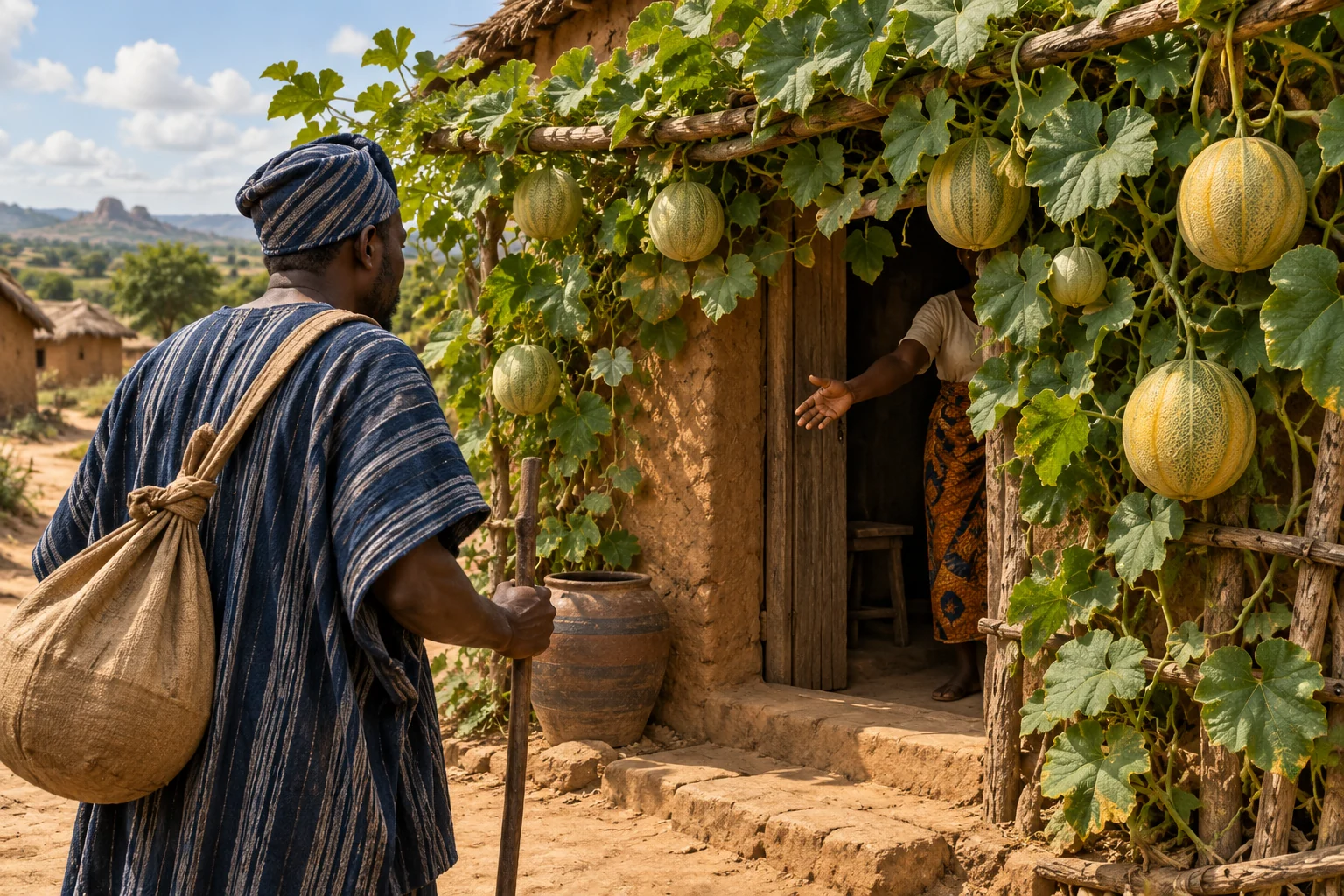
A group approaching Orunmila’s roadside home finds its entrance obstructed by a large melon vine. Ogun sends Elegua to the door. Orunmila welcomes and feeds him, and the messenger returns with an account that averts the attack. A cultivated boundary and a changed relationship work together.
The vine does not settle the conflict alone; it creates a pause in which another interaction becomes possible. Hospitality then changes the messenger’s role. This combination is more specific than a generic message about generosity. It suggests that boundaries can enable dialogue, while leaving unanswered why the hostile group formed and whether the relationship was repaired beyond that day.
Narrative setting: Cuban/Lukumí patakín in a multilingual source compilation; no individual narrator is established.
Ukpe becomes a call that reaches the whole community
A being called Ukpe, rendered as a trumpet in the Portuguese version, seeks recognition through consultation. Its earlier setting is associated with a young palm and multiplication. Esu then brings its sound to Olofin’s attention and demonstrates that it can be heard across separated places, including farm, home, and market. The ruler adopts it for important calls, including sacred gatherings and mobilization in war. The witness explains a public voice through a sequence of preparation, demonstration, and official recognition. Some details of Ukpe’s material identity remain unstable in translation, so the account should not be converted into an authenticated history of a particular instrument.
Ukpe becomes indispensable because its capacity links dispersed people rather than because it simply demands attention. Esu’s demonstration translates a private wish for recognition into a publicly recognizable function. That makes sound an active relation among places. The earlier melon stories use a different material mediation: a vine delays an approach, and food changes an intermediary’s response. Together they show that access can be shaped through provision, obstruction, or a call that gathers people. Within the new religious account, Esu’s agency and Olofin’s adoption make Ukpe’s social standing effective; it is not only a marketing success.
The instrument’s later use in both worship and war also prevents a purely benign reading of reach. A voice that gathers a community can support care, obligation, or coercion depending on the call. The account celebrates recognition without narrating every later use, leaving the responsibility attached to broad communication as an interpretive question rather than a settled answer.
Narrative witness and setting: Translated excerpt in the multilingual compilation’s expressly attributed Cromwell Osamaro sequence, with Yoruba/Bini-facing material. The compilation’s language is not evidence of a Brazilian tradition.
Three brothers carry different kinds of power
Ogun, Osanyin, and Orunmila leave the celestial setting together, represented through strength, medicinal capacity, and truth. Their preparation differs, with Orunmila alone completing the advised relationships. In Ife, a royal household crisis brings the brothers’ capacities into sequence. The narrative resolves the crisis through Orunmila’s divination and confession, increasing his standing and clients. Later, the other brothers renew their preparation and prosper, while a message calls Orunmila back toward a title in his birthplace. The story compares modes of efficacy and movement rather than making one brother’s lack of initial success an irreversible absence of power.
The witness presents distinct sacred capacities within a shared kinship rather than three interchangeable specialists. Orunmila’s priority in this episode follows the narrated relation between preparation, truth, and the royal crisis. The difficult childbirth sequence, however, moralizes an intimate event and must not be repeated as a clinical explanation. Its place in the religious plot can be acknowledged without applying it to an actual pregnant person or demanding confession as care. The later trajectory is also important: Ogun and Osanyin return, act, and flourish instead of remaining permanently condemned.
Their changed fortunes widen the meaning beyond a simple ranking of who is greatest. Comparison with the melon encounters gives a further distinction between physical force and the relational means that can redirect it. Ukpe’s sound adds another effective capacity, collective communication. A contemporary interpretation can therefore ask how different powers meet different conditions, while keeping the account’s sacred truth claims and contested hierarchy explicit.
Narrative witness and setting: Translated excerpt in the multilingual compilation’s expressly attributed Cromwell Osamaro sequence, with Yoruba/Bini-facing material. The compilation’s language is not evidence of a Brazilian tradition.
What was born in this Odù
“Born” can name an explicit traditional origin association or what emerges through a story: a capacity, relationship, practice or order of life. Interpretations drawn from a narrative are labelled below, so their basis remains clear.
Intoxication or poisoning
Selected traditional source association.
The sole listed origin item is a broad Spanish term with more than one possible sense. The selected melon stories do not clarify its origin; avoid choosing a diagnostic meaning or inventing a connection between fruit and a cure.
A cultivated pause in conflict
Contemporary interpretation from the selected myth.
A contemporary interpretation sees a space for dialogue emerge when the vine delays entry and hospitality changes the messenger’s response. This is a narrative-based interpretive motif, not an inherited born-list association.
Correlations to life dimensions
These questions bring the selected stories into contemporary life. They are interpretive invitations for study.
Work and resources
A garden produces a resource with more than one possible use. Prepared material capacity can create options that were not the original reason for cultivation.
Reflect: What ongoing practice could provide several kinds of support?
Relationships and family
The messenger is received as a guest despite arriving from a hostile group. The story distinguishes the person at the door from the group’s initial intention.
Reflect: Can you address an intermediary without surrendering your boundary?
Character and inner life
Both residents prepare rather than simply confront. Agency includes choosing conditions of encounter, not only deciding what to say once conflict begins.
Reflect: Where could a pause improve your next decision?
Community and responsibility
The spared household exists amid communal destruction. Reflection should include responsibility toward loss beyond personal survival.
Reflect: What does safety ask of you toward those less protected?
A deeper reading of the sacred relationships
Truth and preparation as religious efficacy
The three brothers’ names and capacities are organized around a sacred comparison. Orunmila’s truth is not presented only as personal honesty; divination discloses a condition that other forms of power have not resolved in the narrative. His prior preparation sustains relations with Esu, the inner head, and higher authority. The later renewal by Ogun and Osanyin shows that their capacities also remain relational rather than self-sufficient. A contemporary lens on interdisciplinary work can be useful, but it should not replace this theology of effective knowledge. The account’s obstetric mechanism remains a religious and gendered plot, with no claim of medical validity for a present situation.
Material and sonic ways of changing an encounter
The earlier village resident cultivates fruit before violent visitors arrive; Orunmila’s vine creates a pause at the roadside house. Ukpe instead reaches across distance and gathers people, while the three brothers bring differentiated capacities to a royal emergency. These actions do not all involve persuasion in the same sense. Some change the pace of entry, some meet a bodily need, some make a call audible, and some disclose a hidden condition within the sacred account. Reading these exact functions creates more depth than assigning the sign a general talent for communication. It also makes responsibility specific to what an intervention can and cannot change.
Recognition creates a continuing public role
Ukpe’s successful demonstration becomes a permanent function in communal summons. Orunmila’s royal success brings clients and later a title at home. The melon resident receives a changed position after catastrophe, whereas the roadside household survives without a full account of its later relations. These endings differ in the public obligations they imply. Recognition is therefore not simply an external reward; it changes what others may expect the recognized person or thing to do. The source does not narrate every subsequent obligation, so an editor should identify the opening rather than invent a complete institutional history. Contemporary reflection can ask what service accompanies prominence while preserving the sacred agencies that establish it.
Questions that deepen the study
Does the three-brother account say that medicine and strength are useless?
No. They do not resolve the particular crisis before Orunmila’s intervention, but the narrative later allows Ogun and Osanyin to renew their relationships and prosper. The initial contrast is a sacred account of preparation and differentiated capacity, not evidence against medical care or physical skill. The childbirth mechanism is not a clinical claim a reference article should apply to a reader. A careful interpretation can explain why divination is effective in the witness while refusing to replace actual care with that episode. Its richer contribution is that no capacity is portrayed as detached from obligations, setting, and a particular kind of problem.
Why does Ukpe’s fame depend on a demonstration?
The wish for recognition is made answerable to an observable contribution: a sound carries across places and can gather people who are otherwise dispersed. Esu makes that function known, and Olofin assigns it a recognized use. Within the religious account, those persons’ participation is essential rather than decorative. A contemporary analogy about explaining one’s work may follow, but it should preserve the difference between displaying usefulness and merely demanding prestige. The war application also leaves a responsibility: wider reach does not guarantee that every call is beneficial. Recognition gives a capacity a role whose uses still require judgment.
How can the new stories be read alongside the melon accounts without making hospitality solve everything?
The melon encounters show food and cultivated barriers changing specific approaches under threat. The new stories add sound that coordinates distance and sacred knowledge that addresses a particular royal condition. They therefore widen the range of mediation rather than proving that one virtue works everywhere. Hospitality remains meaningful within its own narratives, but it is not a guaranteed safety strategy. The four cases ask what kind of intervention fits the situation and what relationship allows it to work. They also keep divine agency visible: Esu, Ogun, and Orunmila act in different ways rather than merely personifying a general modern communication skill.
What the four narratives reveal together
The new witness shifts Obara Otura from cultivated encounters toward public calling and differentiated sacred knowledge. Ukpe gains a role through a sound that links scattered places; the brothers’ journey compares strength, medicinal capacity, and truth within obligations that can be renewed. The earlier melon episodes remain precise cases where a material pause and provision redirect danger. Their relation is comparative, not a universal recipe for influence. A spiritually grounded study should explain the divine persons and prior commitments that make efficacy intelligible inside each account, while marking a modern interpretation as such.
The translated instrument identity and the gendered childbirth sequence require particular restraint. The four stories contribute most when they show several ways an opening becomes possible and how recognition brings a new public role, rather than promising that one form of generosity or one specialist’s power always settles every crisis.
Living with this Odù
A continuing life or initiatory relationship
For someone who has received Òbàrà Òtúrá as a life or initiatory sign, preparation can create an available response before its eventual use is known. The cultivated melon offers provision during a violent approach; the roadside vine slows entry long enough for another encounter. Neither promises safety from a real attacker, and the spared resident's survival cannot erase the surrounding destruction. Across changing conditions, the sign's narratives invite attention to what a resource actually changes: pace, bodily need, communication or the possibility of another relationship.
Ukpe's public call and the three brothers add capacities whose effectiveness depends on sacred relations. Esu makes the call's reach recognizable, while Orunmila's preparation and truth matter in the attributed royal crisis. Ogun and Osanyin later renew their relations and flourish, so initial difficulty is not a fixed measure of worth. Long-term character can include receiving recognition as a new public responsibility rather than an end to accountability. The sign does not make someone a natural peacemaker or guarantee that truth resolves every emergency. It keeps differentiated forms of power, the costs of success and the duties following prominence available for continuing judgment.
A particular consultation and its question
A consultation yielding Òbàrà Òtúrá can help distinguish several kinds of mediation. Is a boundary needed to interrupt the speed of an approach, a resource needed to meet an immediate demand or a message needed to reach people dispersed across places? The two melon accounts and Ukpe's demonstrated sound answer different external conditions. A practitioner can examine their exact functions before describing the result generally as communication or protection.
The three brothers introduce another question about fitting capacity to circumstance. Their religious relations and the account's claim about truth remain active; the episode is not simply a competition among professions. Its childbirth sequence also supplies no clinical explanation and cannot be applied to an unknown pregnant person. The later prosperity of Ogun and Osanyin prevents a temporary difference from becoming a permanent ranking. A consultation may illuminate a present contribution and the responsibility recognition brings, without forecasting a title or prescribing travel. The person receiving a result for one question is not thereby permanently the spared household, the overlooked instrument or the most effective brother. Each comparison remains answerable to the actual reading and its narrative basis.
Constructive and adverse possibilities
Constructive relations may join an available material with a timely response, or make a useful call audible across separate settings. Esu's demonstration and Olofin's adoption give Ukpe a sacredly constituted public role. The brothers' later renewal also keeps open the possibility that a capacity can become effective under changed relations rather than being dismissed forever after one failure.
Adverse unfolding could involve confusing survival with moral superiority, prominence with completion or broad reach with a necessarily beneficial purpose. A call used in worship can also mobilize war, and the melon resident's spared life follows devastating collective loss. These contrasts do not identify the state of a present reading. They ask what an intervention changes and whose costs remain. Sacred efficacy and contemporary ethical scrutiny can coexist without turning the royal emergency into medical advice or the fruit into a safety guarantee.
An illustrative situation in everyday life
In a hypothetical emergency network, a local organizer develops a communication channel before anyone knows when it will be needed. A later crisis shows that the channel can reach people at home, work and the market, bringing the organizer public recognition. Ukpe's sequence helps distinguish a wish to be noticed from a demonstrated communal function. The melon vine adds a separate question about creating enough pause for a useful exchange. Recognition then requires decisions about what calls the network will carry and whose interests they serve. This illustration does not claim weather, protection or sacred status for the organizer. It asks how a specific capacity becomes effective and what responsibilities follow its expanded reach.
Sources and reading context
The first two narrative witnesses
The single born association is linguistically broad and unsupported by a developed origin episode, so that field remains partial. These Cuban narratives are analyzed for their images of cultivation and mediation. Their violence is contextualized, with no safety guarantee or blame assigned to people who suffer harm. Additional emergence motifs are explicitly contemporary interpretations drawn from the selected narratives, not traditional origin-list claims.
Narrative motifs are summarized independently. The life-dimension reflections are contemporary interpretation. How these reference studies are built explains the wider source approach and the distinction between a reference article and personal divination.
Additional named witnesses
- Cromwell Osamaro Ibie. The surrounding sequence is expressly attributed to Cromwell Osamaro. These selected episodes are read through the multilingual compilation’s translated renderings; exact edition and original translation chain remain unverified.
Ukpe’s material identity is uncertain in the rendering and is not fixed by conjecture. The royal childbirth episode is retained as religious narrative, not a medical explanation, allegation of adultery, or model for care. No instrument chronology, verified dynasty, or universal hierarchy among the three powers is asserted.
Bibliographic identification
- C. Osamaro Ibie. Ifism: The Complete Work of Orunmila. Lagos; multivolume publication beginning 1986. Library catalogue record. Related bibliographic record for the named narrative witness. Exact volume, edition and page of the transmitted account have not been independently matched.
Read the source method and wider scholarly context.
The catalogue links identify published works and their authors. They are separate from proof of an individual episode’s wording or attribution. Contemporary comparisons and the synthesis above are editorial interpretation. The author’s books and Academy companions below provide further study; their sales links are separate from the source references.