
Òfún Òbàrà is a mixed Odù in Ifá’s 256-part corpus. The selected Òfún Obara narratives contrast an intelligent student who inflates a client’s requirements with a rural scholar excluded from urban ceremonies despite superior preparation. In both, public authority has to be judged by conduct and knowledge rather than by access, quick learning, or polished appearance. The origin of the Oyugbona office supplies a specific institutional setting, while the fraud story asks what correction and accountability should require.
A question to carry through the study: What evidence shows that an expert’s advice serves the person seeking help rather than the expert’s advantage?

This Academy reads the right column first, then the left. Each row carries a single or double mark.
Where this Odù belongs
Òfún Òbàrà belongs to the Òfún family in this Academy’s study sequence. It is a mixed Odù, distinct from Òbàrà Òfún. The order matters. Its teaching is approached through its own narratives, rather than by adding two general descriptions of the principal signs together.
Key Òrìṣà and sacred relationships
The figures below are selected for their roles in the accounts discussed here. They offer connected reading paths through the tradition.
-
Ọ̀rúnmìlà. Òrúnmìlà takes interest in a promising student, confronts his misuse of divinatory speech, and later forgives him after correction; intelligence alone does not establish trustworthy practice.
-
Odùdùwà. Odùduwà is the client asked for excessive resources by the ambitious student, making even a powerful figure vulnerable to someone claiming specialist religious authority.
-
Èṣù. Elegbá notices the inflated requirements and alerts the established teacher and visiting elders, bringing the hidden discrepancy into a wider circle of accountability.
Key myths and their meanings
The gifted student inflates the requirement
A quickly learning student attracts Òrúnmìlà’s approval but is also described as self-interested. When the senior diviner is absent, he offers to consult for Odùduwà and asks for more than the situation requires. Observers question the scale of the request, and Elegbá alerts the elders. The student’s misconduct is exposed; the account ends with redistribution of the excess, forgiveness, and a lasting reminder of the breach.
The strongest issue is abuse of interpretive power. A client may be unable to verify whether a requirement comes from the consultation or the adviser’s appetite, making peer scrutiny important. The source dramatizes punishment through bodily affliction, which should not become an explanation for real disability or illness. Its more transferable structure is disclosure, correction of excess, and continuing responsibility after forgiveness rather than trust restored by an apology alone.
Narrative setting: Cuban/Lukumí patakín identified in the selected account; no individual narrator is named.
The rural scholar whom the city forgot
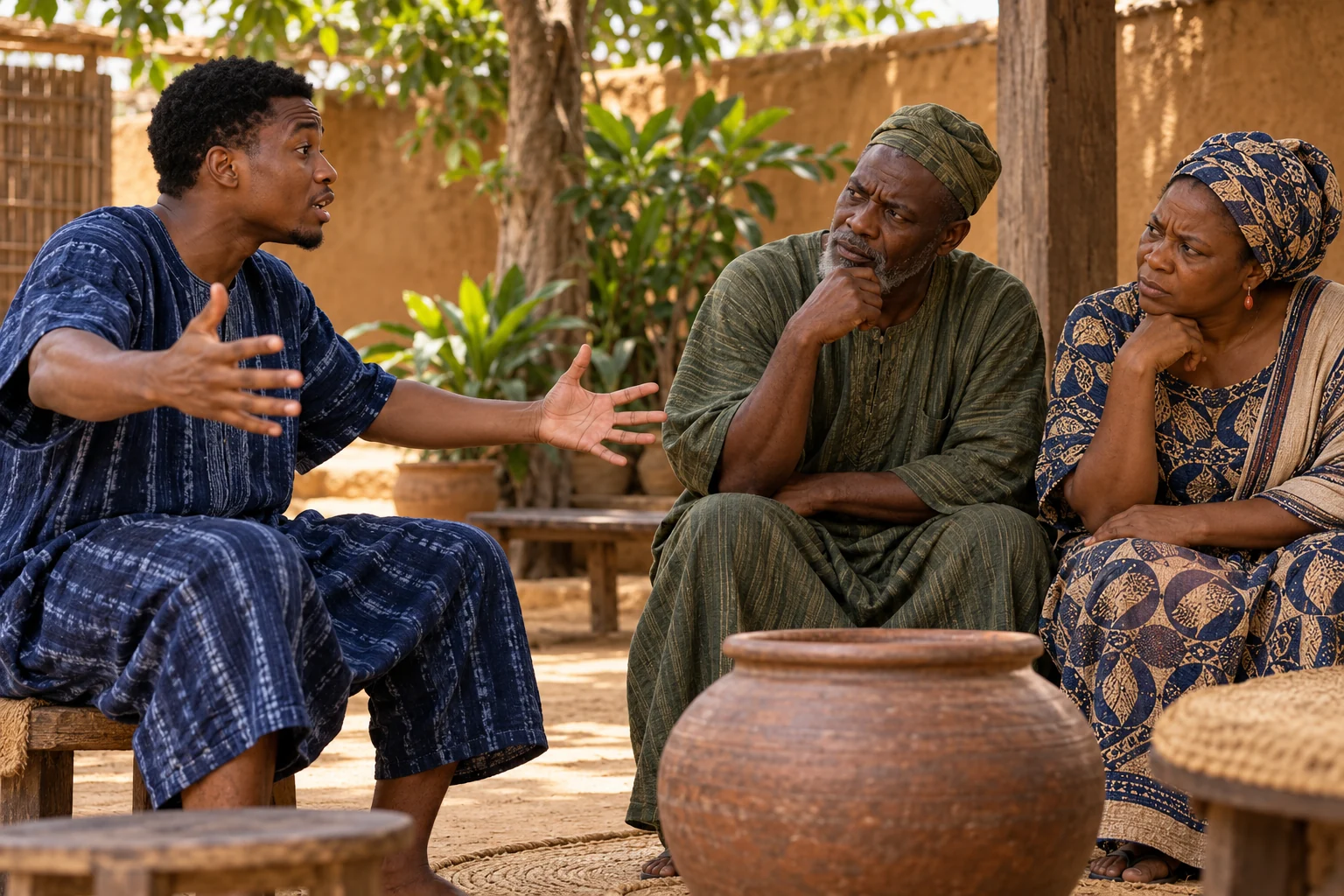
A diviner living outside town studies deeply but receives no invitations to the city’s consecrations. When Olofin needs a suitably prepared person for a major task, the urban group fails his examination. Ifá directs him to the rural scholar, who arrives in clothing marked by field work. The scholar performs the task and tries to return home, but Olofin instead gives him continuing authority and requires his inclusion in future work.
The account separates visibility from competence. The excluded scholar does not become knowledgeable when an authority recognizes him; the study preceded the invitation. Yet the ending also relocates him into a role he did not initially seek, leaving a question about whether recognition includes freedom to choose its terms. An article can examine geographic exclusion, standards of expertise, and institutional repair without turning the story into a universal historical origin for every version of the office.
Narrative setting: Cuban/Lukumí patakín identified in the selected account; no individual narrator is named.
Dove descends toward a life with children
The Salami unit presents Dove moving from heaven toward earth while longing for children. A consultation directs a response, Dove complies, and the verse affirms twins and then many descendants. Its praise moves from the recipient toward Ifá and then Olódùmarè, giving the favorable life a layered sacred acknowledgment. The opening image of a pot darkened by fire belongs to the diviner’s poetic identification rather than a narrated cooking event. The passage does not identify a spouse, a human lineage, or a biological explanation of avian reproduction. Its concrete movement is a heavenly departure received within counsel, response, and a welcomed generation.
The descent gives the longing a cosmological location rather than presenting the recipient only as an earthly household seeking an improvement. Within the witness, divination and response accompany a life entering the world, and praise recognizes more than one relation through which the good becomes possible. The twins also have a particular place in the framing, which asks for attention to them, rather than appearing as a generic symbol of abundance invented by an editor. A contemporary reading can ask how a community welcomes a new generation and acknowledges support, but should not turn the verse into a promise of conception or a standard for measuring every life.
The source’s expansion from twins toward many descendants is poetic religious affirmation, not a demographic record. The unresolved question concerns the continuing care of those descendants, because the unit celebrates their arrival without narrating the labor, disagreements, or teaching through which their lives would be sustained afterward.
Narrative witness and setting: Passage explicitly labeled Ayo Salami, with Yoruba verse and Spanish translation in the supplied compilation.
Ògún mistakes a consecrated silence for contempt
This Cuban account names Ògún as Odùduwà’s son and describes him installing a son called Oniré after a violent conquest. Returning during a consecration in which participants must remain silent, he encounters gestures and empty vessels without understanding the observance. Hungry and thirsty, he interprets the silence as contempt and attacks objects and people. His son brings nourishment, and Ògún’s anger gives way to regret and recognition of the need for rest. The account concludes with his blade placed in the earth and a remembered change in how empty wine jars are positioned. It supplies a local sacred narrative, not a verified political history.
The crucial misunderstanding concerns a religious condition that is active even when the returning warrior does not know it. Silence is not a social absence or a failure to honor him; it belongs to consecration. Ògún’s power therefore encounters a limit in understanding that force cannot repair by intensifying itself. His son’s intervention addresses bodily need and the immediate danger, while the father’s regret acknowledges a different relation to place and rest. A contemporary interpretation can examine entitlement and the effects of fatigue, but should preserve the sacred observance as the actual setting rather than treating it as an arbitrary custom.
The source does not excuse the killings by naming hunger or ignorance, nor does regret restore the people harmed. Its unresolved tension is how a powerful figure remains available as a religious helper after catastrophic violence. The remembered vessel practice gives the event continuing consequence without narrating a complete account of reparation.
Narrative witness and setting: Passage explicitly located among Cuban revelations in the supplied compilation; no individual narrator is established.
What was born in this Odù
“Born” can name an explicit traditional origin association or what emerges through a story: a capacity, relationship, practice or order of life. Interpretations drawn from a narrative are labelled below, so their basis remains clear.
The Oyugbona office
Selected traditional source association.
The source explicitly places this office’s beginning in the sign and supplies the rural-scholar narrative as an explanation. The motif links responsibility to tested preparation and inclusion, without assuming that every lineage gives the office identical duties or origin history.
Leaf preparation as religious medicine
Selected traditional source association.
The source names omiero in its origin associations and connects the section with Inle. This supports a contextual account of religious plant knowledge; no recipe, claimed cure, or clinical substitution is given.
Correlations to life dimensions
These questions bring the selected stories into contemporary life. They are interpretive invitations for study.
Work and resources
The fraudulent student exploits the client’s limited ability to audit specialist advice. Meaningful professional accountability requires ways to question requirements and correct excess without asking a vulnerable client to master the entire field first or local institution.
Reflect: What can a client do when a requirement seems excessive?
Relationships and family
The teacher admires the student’s intelligence but must also hear warnings from others. Trust in someone’s promise should remain open to evidence about their conduct, particularly when affection or pride in their development makes scrutiny uncomfortable.
Reflect: Whose warning becomes harder to hear because you are invested in someone’s success?
Character and inner life
The rural scholar studies without institutional attention, while the urban student converts recognition into personal advantage. This contrast asks whether learning remains oriented toward service when status, access, or quick advancement becomes available within a religious office.
Reflect: What purpose does your learning serve when no one is watching?
Community and responsibility
The city’s exclusion deprives it of needed competence, and the fraud requires intervention from several witnesses. Institutions should cultivate both access to overlooked knowledge and channels through which misconduct can be named and corrected beyond town boundaries.
Reflect: Who remains outside your institution despite having knowledge it needs?
A deeper reading of the sacred relationships
A sacred condition can be present without being recognized
The Dove verse locates a coming life within heavenly departure, Ifá’s counsel, and acknowledgment of Olódùmarè. The Ògún account places a returning power inside a consecration whose silence he misunderstands. These are different sacred conditions, but both exceed what a participant’s immediate desire can define. The earlier fraudulent student likewise cannot make an inflated request true by speaking with religious authority, while the overlooked scholar’s knowledge exists before public recognition. A spiritually accurate comparison should preserve that independence of sacred order from appearance and appetite. Contemporary reflection about humility can follow, but should not replace the religious realities through which the witnesses distinguish genuine knowledge, observance, and effective response.
Recognition has different tests in different institutions
The rural scholar is recognized through preparation and a task that others cannot perform, while the fraudulent student’s claim is exposed through inflated requirements. Ògún’s title and conquering history do not provide understanding of the consecration he enters. Dove’s favorable life is acknowledged through response and praise rather than a competition for office. These cases prevent public status, quick learning, force, or a desired outcome from becoming one universal test of authority. A contemporary reader can ask what kind of recognition a situation actually requires and who is able to evaluate it. The comparison should not turn the rural scholar’s appointment or the warrior’s local genealogy into a generalized history of religious government.
Nourishment can welcome, restrain, or be misappropriated
Dove’s desired generation is welcomed through a sacred response whose continuing care remains unreported. Ògún’s son provides food and drink in a moment that helps interrupt violence. The fraudulent student demands more than the consultation warrants, turning another person’s resources toward private appetite. These are different relations around sustenance and should not be collapsed into a simple rule that giving always restores harmony. A contemporary synthesis can ask whether an exchange welcomes life, meets a need, acknowledges service, or exploits trust. Within the sources, those questions remain bound to Ifá, consecration, and named sacred figures rather than merely to material transactions or interpersonal strategy.
Questions that deepen the study
Why does consecrated silence matter to the Ògún account?
It is the actual reason people do not speak, and the narrative’s disaster begins when the returning figure interprets that condition through his expectation of personal honor. Removing the religious observance would change the story into a generic quarrel about manners. A faithful account can preserve the sacred rule while also examining the harm caused by an uninformed interpretation. Hunger and thirst explain part of the scene but do not justify killing. The source’s later remembrance through vessels records consequence without narrating full repair. A contemporary reader may ask how to encounter an unfamiliar observance without assuming that its difference is an insult.
Does Dove’s descent promise twins to readers of this sign?
The Salami verse affirms a particular recipient’s desired good within a sacred journey from heaven to earth. It does not identify any reader’s future or establish a biological mechanism. The twins deserve to remain in the account because the framing explicitly names them, but their presence is not a universal measure of fulfillment. A contemporary reflection can ask how children and those who care for them are welcomed into a community, while preserving the verse’s religious confidence as its own voice. Its praise to Ifá and Olódùmarè gives the outcome a sacred relation that should not be reduced to a motivational prediction.
What connects a warrior’s misunderstanding with a diviner’s false request?
Both involve a powerful participant allowing a preferred account to override the actual relation. Ògún assumes silence means contempt, while the student inflates what a consultation requires for personal advantage. Their motives and consequences differ, so the comparison should not make them the same offense. It does show why religious standing must remain answerable to knowledge, observance, and truth rather than be treated as unlimited entitlement. The rural scholar supplies a contrasting case of competence overlooked because of location and appearance. A contemporary interpretation can examine institutional checks, while the sources’ own sacred order remains the basis of what their participants must understand or honor.
What the four narratives reveal together
The additional witnesses bring heavenly arrival and misunderstood consecration into Òfún Obara’s earlier concern with truthful religious service and overlooked preparation. Dove’s descent is received through counsel and praise; Ògún’s return fails through an interpretation that ignores an active sacred condition; a student corrupts a consultation through excessive taking; a rural scholar carries knowledge before an institution recognizes it. The four accounts therefore distinguish authority from appetite, appearance, and successful acquisition without reducing sacred figures to modern professional examples.
Their religious realities remain central through Ifá, Olódùmarè, consecration, and the continuing remembrance of a violent encounter. Contemporary questions about recognition and accountability can follow from those relations. The synthesis should also preserve the limits of the witnesses: no demographic record, no verified conquest history, and no complete reparation after the warrior’s regret or account of care after Dove’s favorable arrival.
Living with this Odù
A continuing life or initiatory relationship
For a person whose received life or initiatory Odù is Òfún Ọbàrà, these witnesses make authority depend on truthful relation to a task rather than quick talent, urban visibility or conquering force alone. The gifted student inflates a requirement; the rural scholar possesses preparation before the city notices him. Long-term development includes asking whether interpretation serves the disclosed need and whether recognized expertise retains freedom and accountability after appointment.
Ògún’s return adds a limit that rank cannot overcome through intensity: consecrated silence remains a sacred condition even when he misreads it. Nourishment and regret interrupt the episode without undoing the killings. Dove’s heavenly descent offers a different good, a generation welcomed through counsel and praise to Ifá and Olódùmarè, whose later care remains beyond the short account. Across changing circumstances, a person may need peer scrutiny, humility before unfamiliar observance or acknowledgment of support beyond the visible outcome. The sign predicts no bodily punishment or royal office. Its continuing task is to distinguish genuine knowledge, appetite and entitlement while recognizing that sacred order is not created by a powerful participant’s immediate wishes.
A particular consultation and its question
When Òfún Ọbàrà occurs in consultation, the stories can help distinguish a requirement grounded in interpretation from one enlarged by an adviser’s appetite. The student’s quick learning does not make his claims self-validating, while the rural scholar’s exclusion does not make his knowledge absent. A practitioner can examine what evidence and appropriate scrutiny a particular role requires, without importing a universal history of offices from the narrative.
The actual question may involve misunderstood silence or a desired beginning. Ògún enters a real consecrated condition within the witness, not merely a custom he dislikes; his hunger explains a circumstance without excusing violence. Dove’s verse places longing for children within heavenly movement and sacred acknowledgment, not a promise of conception for the client. A result encountered in one consultation is not permanent identity or proof that someone’s bodily condition reflects wrongdoing. Reflection can ask whose need an exchange serves, what the participant does not yet understand and what responsibility remains after correction or forgiveness. Ifá, consecration and named sacred figures stay active within those questions, while the actual encounter determines which contrast illuminates the situation disclosed.
Constructive and adverse possibilities
Constructive possibilities include excess being identified and returned, overlooked preparation receiving an appropriate place and authority learning that unfamiliar observance has standing independent of its wishes. Dove’s praise also makes favorable life an acknowledged sacred relation rather than an isolated possession.
Adverse possibilities include talent concealing self-interest, city visibility substituting for competence or need and fatigue becoming claims to unlimited recognition. Forgiveness does not erase a continuing reminder of breach, and Ògún’s regret does not restore the harmed people. The source’s bodily punishment cannot explain real illness, and the scholar’s appointment cannot prove every excluded person should be elevated. These distinctions help consider constructive and adverse relations without deciding the state of an actual reading. The relevant question is how truth, preparation and consequence remain accountable within the particular religious and social situation.
An illustrative situation in everyday life
Hypothetically, a consultant known for rapid learning proposes an unusually expensive requirement that clients cannot independently evaluate. A quieter colleague asks how each part follows from the actual problem, and the consultant experiences scrutiny as an insult to talent. The gifted-student structure makes the vulnerability of interpretive authority concrete. A constructive response would explain the basis, return unsupported excess and accept continuing review rather than expect apology to restore trust automatically. The rural scholar adds that recognition should include competence beyond the most visible circle. This is an illustrative professional analogy, not a claim that modern fees duplicate sacred offerings or that bodily affliction proves fraud. It concerns the external asymmetry of knowledge and the choices made within it.
Sources and reading context
The first two narrative witnesses
These Cuban/Lukumí passages include named roles and local origin explanations. The figure written Osun in the fraud story may be a distinct guardian reference, so it is not silently assigned to Òṣun. Punitive bodily imagery and religious medicine remain contextual rather than clinical claims.
Narrative motifs are summarized independently. The life-dimension reflections are contemporary interpretation. How these reference studies are built explains the wider source approach and the distinction between a reference article and personal divination.
Additional named witnesses
-
Ayo Salami. Dove’s heavenly departure and the affirmation of twins come from the explicitly named bilingual source block.
-
Cuban/Lukumí compilation witness. The local Ògún–Odùduwà–Oniré account and the earlier student and rural-scholar narratives remain separately headed Cuban sources.
The Ògún account’s Ifé and Oniré designations are retained without silently correcting them into another lineage or claiming historical chronology. Dove’s reproduction is religious narration. Consecrated silence and vessel remembrance are described contextually without procedures, and bodily harm is not treated as a moral diagnosis.
Bibliographic identification
- Ayo Salami. Ifá: A Complete Divination. Lagos: NIDD, 2002 catalogue record. Library catalogue record. Bibliographic identification of the named author and work; the edition behind the transmitted account remains to be matched.
Read the source method and wider scholarly context.
The catalogue links identify published works and their authors. They are separate from proof of an individual episode’s wording or attribution. Contemporary comparisons and the synthesis above are editorial interpretation. The author’s books and Academy companions below provide further study; their sales links are separate from the source references.