
Òfún Òkànràn is a mixed Odù in Ifá’s 256-part corpus. Òfún Okanran’s selected narratives pair three siblings debating which contribution made a meal possible with Ṣàngó’s attempt to bypass a guarded threshold. The first makes achievement dependent on different abilities whose holders each want priority; the second traces the costs of access obtained without consent, followed by care and mutual commitment. The focus is what a contribution authorizes, what it does not, and how dependence can become acknowledged rather than concealed.
A question to carry through the study: Which shared achievement are you treating as if your contribution alone made it possible?

This Academy reads the right column first, then the left. Each row carries a single or double mark.
Where this Odù belongs
Òfún Òkànràn belongs to the Òfún family in this Academy’s study sequence. It is a mixed Odù, distinct from Òkànràn Òfún. The order matters. Its teaching is approached through its own narratives, rather than by adding two general descriptions of the principal signs together.
Key Òrìṣà and sacred relationships
The figures below are selected for their roles in the accounts discussed here. They offer connected reading paths through the tradition.
-
Ṣàngó. Ṣàngó distracts the gatekeeper to enter Olofin’s private space, faces expulsion, and later forms a reciprocal pact with the figure who cares for him after the fall.
-
Èṣù. Eleguá acts as Olofin’s gatekeeper and refuses Ṣàngó entry; his distraction creates the opening that lets an unauthorized visit cross the boundary.
-
Òsanyìn. Ọ̀sányìn receives the injured Ṣàngó and tends him in the narrative, after which the two agree to serve one another; this is contextual religious care rather than a treatment claim.
Key myths and their meanings
A meal with three indispensable contributions
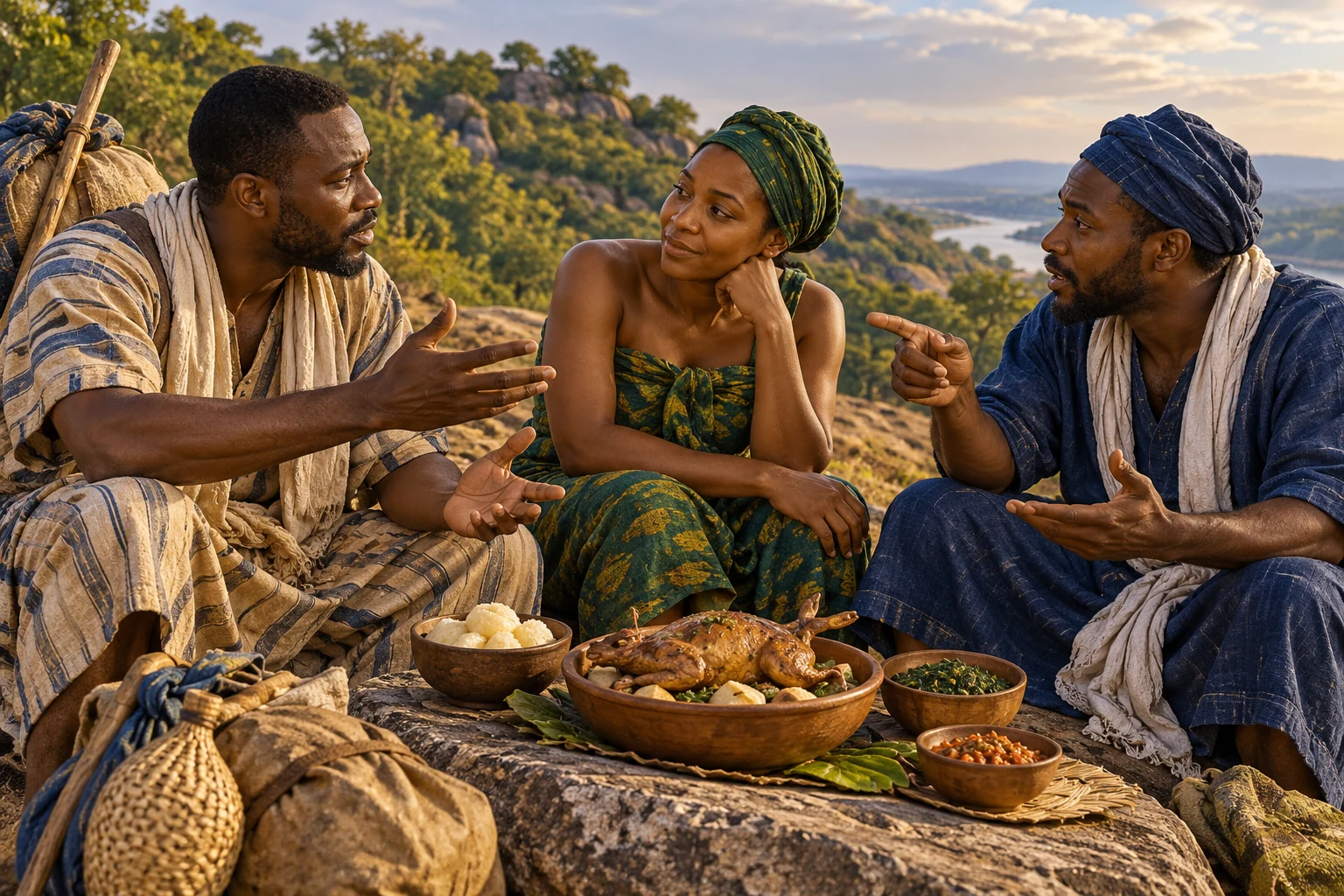
Three siblings travel to visit relatives. The eldest sees a rabbit and blocks its escape; the second brings the tree down so they can obtain it. Their sister carries it onward and unexpectedly presents it cooked when they stop. Each explains why their own contribution deserves greatest credit. The scene ends with the dispute continuing, despite the meal having required observation, force, and preparation together.
The source does not supply a final ranking, leaving the reader with an unresolved argument about value. That is useful: a completed outcome can depend on contributions that cannot be reduced to the same measure. The sister’s work is initially least visible but makes the animal edible. We can examine credit and domestic labor without claiming that women naturally cook or that one form of intelligence always outranks another.
Narrative setting: Cuban/Lukumí patakín identified in the selected account; no individual narrator is named.
Entry obtained at a cost
Eleguá guards the entrance to Olofin’s space and refuses Ṣàngó permission to pass. Ṣàngó distracts him and enters anyway, encountering a private situation and confronting Olofin. The confrontation ends with Ṣàngó sent to earth, where the descent leaves him severely hurt. Ọ̀sányìn receives and tends him. Once recovered within the story, Ṣàngó enters a pact of mutual service with his helper.
The episode separates the ability to get past a barrier from permission to cross it. Ṣàngó’s ingenuity solves access but does not settle privacy or the consequence of confrontation. The later pact provides a contrasting relationship founded on acknowledged assistance and reciprocity. The account’s bodily recovery remains a religious narrative, and its private divine scene should not be used to invent a universal theology or justify punitive expulsion from real communities.
Narrative setting: Cuban/Lukumí patakín identified in the selected account; no individual narrator is named.
Kóórì learns that an offering is not a private meal
Kóórì seeks children and repeatedly receives counsel concerning a religious response. On two occasions she consumes the food herself and remains without the desired outcome. Returning to Òrúnmìlà, she is told that she has not understood the response as given. The later account joins a corrected sacred action with gathering people rather than eating alone, and children are then affirmed in the verse’s ending. Repeated gong and drum images call a group together around the episode. The passage gives no human family biography or medical explanation; its distinctive movement concerns misunderstanding the relation enacted by an offering and then learning another form of participation.
The problem is not simply that Kóórì has failed to spend enough. She undertakes outward acts but turns what belongs within a religious relation back into private consumption. Òrúnmìlà’s correction therefore concerns the meaning of the response, not only its visible performance. The gathering gives the act a communal form while its sacred requirements remain specific and are not suitable for reconstruction as a public recipe. A contemporary reader can ask whether generosity or ritual has become another way of serving oneself, but should not infer that people without children are selfish or have misunderstood religious duty.
The verse’s outcome belongs to Kóórì’s own devotional narrative. The unresolved tension concerns the mockery that surrounds her earlier attempts: the source records it, yet successful correction does not make humiliation a necessary or admirable way to teach someone. The account can retain its religious logic without using the recipient’s longing as a pretext for blame.
Narrative witness and setting: Passage explicitly labeled Ayo Salami, with Yoruba verse and Spanish translation in the supplied compilation.
A community needs two estranged powers to be pacified
The second Salami unit places Òfún and Olòkànràn in an unresolved feud. Others try repeatedly to end the hostility, but the two do not listen. They are also the figures through whom divination is performed for Olúufè, so their disagreement affects a wider life than their private grievance. Counsel calls for both to be approached and pacified; afterward Olúufè’s life becomes cool and settled. The explanatory framing says that each side has an account capable of vindication. The verse does not narrate the original cause or a detailed settlement. Its concrete movement is from entrenched mutual anger toward a wider sacredly grounded restoration.
The account gives the quarrel consequences beyond the two participants because their religious roles remain connected with Olúufè. Pacification therefore is not merely a preference for politeness; it belongs to restoring a relation through which the community’s life can become cool. The framing’s recognition that both sides can explain themselves also does not prove that every actual conflict has equal blame or symmetrical claims. This is a particular witness whose original cause remains unreported. A contemporary interpretation can ask when being able to defend one’s position has become an obstacle to repairing a shared world.
The religiously active counsel should remain distinct from an invented negotiation script: the verse tells us that both are approached, not exactly how every grievance is heard or every obligation assigned. Its unresolved question concerns the durability of the change, since the ending celebrates coolness without describing what would sustain it if the disagreement returned.
Narrative witness and setting: Passage explicitly labeled Ayo Salami, with Yoruba verse and Spanish translation in the supplied compilation.
What was born in this Odù
“Born” can name an explicit traditional origin association or what emerges through a story: a capacity, relationship, practice or order of life. Interpretations drawn from a narrative are labelled below, so their basis remains clear.
Jet as a protective emblem
Selected traditional source association.
The source assigns jet to this sign within a protective religious association. It can be discussed as material symbolism and a local form of reassurance without claiming that the stone prevents harm or reproducing the object’s preparation.
Odùduwà Desi
Selected traditional source association.
The explicit origin list names Odùduwà Desi but does not define the designation in the selected passages. Preserve that limited association transparently rather than inventing an etymology, identifying a universal aspect, or assigning an unsupported narrative role.
Correlations to life dimensions
These questions bring the selected stories into contemporary life. They are interpretive invitations for study.
Work and resources
The siblings’ meal requires several kinds of effort, including preparation whose value is not evident at the moment of capture. A useful account of work should trace the full chain of contribution before allocating credit or reward.
Reflect: Which necessary contribution appears only at the end of your process?
Relationships and family
The sibling dispute persists because each person argues from their own indispensable act. Shared recognition may require describing how the acts fit together rather than finding a single winner whose achievement cancels the others of the journey.
Reflect: Can you name another person’s contribution as clearly as your own?
Character and inner life
Ṣàngó’s cleverness at the doorway does not answer whether entry is justified. The distinction encourages reflection on impulse, entitlement, and the temptation to equate overcoming a restriction with proving that the restriction had no legitimate purpose.
Reflect: When has success at getting access replaced consideration of permission?
Community and responsibility
The pact after care makes dependence explicit and reciprocal. Institutions can similarly recognize support through durable obligations, while maintaining boundaries that do not depend entirely on one gatekeeper’s uninterrupted attention after injury, exhaustion, or an interrupted journey.
Reflect: How does your community acknowledge people who restore others’ capacity to act?
A deeper reading of the sacred relationships
A religious act is defined by its relation, not appearance alone
Kóórì performs acts that resemble the requested response yet consumes them as a private meal; the correction makes the sacred relation and shared participation consequential. Òfún and Olòkànràn likewise cannot treat their religious work as isolated from the hostility between them, because Olúufè depends on that relation. The earlier Ṣàngó doorway story also distinguishes obtaining access from receiving permission. Together the accounts show that visible completion does not settle whether an action fits the sacred order in which it occurs. Contemporary reflection can ask about intention and effect, but should preserve offering, divinatory role, and pacification as religious realities rather than merely metaphors for teamwork or ethical procedure.
Gathering does different work in the two new units
The gong and drum images accompany calls to assemble, but one unit gathers people around Kóórì’s corrected response and the other seeks a settlement affecting Olúufè. Their shared sound does not make the situations identical. The earlier siblings also gather over a meal and then dispute whose contribution mattered most, showing that co-presence alone does not guarantee agreement. A contemporary reader can ask what a gathering is for, who remains able to speak, and what relation it actually acknowledges. Within the witnesses, sound and assembly belong to a religiously ordered act, not simply an event format. No drum pattern, invocation, or ceremonial sequence is reconstructed from the imagery.
A defensible part is not the whole account
Each sibling can name an indispensable contribution to the meal, while the Salami feud’s framing grants both sides a possible vindication. Those positions can remain true without explaining how a shared life should continue. Kóórì’s first attempts similarly allow her to say she has acted, yet leave the religious relation misunderstood. The doorway episode adds a figure who succeeds at passing a barrier without resolving whether entry is authorized. A contemporary synthesis can therefore distinguish a partial justification from an adequate account of the whole encounter. The comparison should not erase unequal harms or invent equal blame; it asks what each claim leaves outside its chosen frame.
Questions that deepen the study
Is the Kóórì account only a lesson about sharing food?
Sharing is part of the corrected scene, but the narrative’s center is a religious response whose meaning Kóórì has misunderstood. Consuming the material privately does not fulfill the relation the consultation discloses. Reducing that to ordinary etiquette would remove Ifá and Òrúnmìlà’s active role. A contemporary analogy about generosity can still be useful if identified as an analogy rather than the whole explanation. The source does not justify blaming people for childlessness, and a public reference should not reproduce its material procedure. It can explain why an offering is relational while keeping the particular outcome within the witness’s devotional voice.
Does the feud prove that every disagreement has two equally valid sides?
The explanatory framing says that both particular participants can give a defensible account, but the original cause is not narrated. That cannot become a universal rule for conflicts involving coercion, violence, or unequal claims. The verse’s more specific contribution is that continuing anger obstructs a wider life dependent on their religious roles. Pacifying both makes Olúufè’s world cool within the account. A contemporary reader may ask what responsibility extends beyond winning an argument, while leaving actual disputes to their own evidence. The witness supplies neither a modern mediation protocol nor a doctrine that restoration requires pretending every harm is symmetrical.
How do the siblings’ competing claims illuminate the new stories?
Each sibling explains a genuine contribution, yet the meal’s shared result cannot be attributed to one alone. The feud similarly shows how defending a position can leave collective wellbeing unresolved, while Kóórì’s account distinguishes having performed an act from understanding the relation it serves. The comparison is contemporary analysis grounded in the sources’ different scenes. It should not turn every family contribution into a measurable debt or every ritual into a cooperative project. The religious realities of Ifá, offering, and sacred pacification remain particular. Their shared question is what an adequate account must include beyond the part a participant can most easily claim.
What the four narratives reveal together
The additional Salami witnesses deepen Òfún Okanran through the difference between outward action and an adequately understood relation. Kóórì’s response becomes meaningful through corrected sacred participation; the estranged Òfún and Olòkànràn must be approached so that Olúufè’s life can become cool. These stand beside the siblings’ unresolved claims over a shared meal and Ṣàngó’s unauthorized passage through a guarded threshold. The four accounts therefore distinguish contribution, access, offering, and pacification rather than treating all successful action as rightful action.
Their religious logic remains central, with Ifá and named powers active in the relations described. Contemporary reflection can ask what a partial justification leaves out while avoiding a universal rule of equal blame or an accusation against people whose desires remain unfulfilled. The synthesis should preserve the unspecified causes, unreported aftermaths, and particular forms of gathering each witness actually provides.
Living with this Odù
A continuing life or initiatory relationship
For someone whose received life or initiatory Odù is Òfún Ọ̀kànràn, these accounts distinguish an indispensable part from a complete understanding of the whole. Each sibling contributes to the meal, yet none can establish a final hierarchy merely by naming their own necessity. Kóórì similarly acts outwardly while misunderstanding the relation her response was intended to enact. Long-term development can include acknowledging a defensible contribution without making it a claim to every benefit or authority.
Ṣàngó’s entry distinguishes access from permission, while his later pact with Ọ̀sányìn offers a different relation grounded in received help. The feuding powers further show that private vindication may leave a wider community unsettled. Across changing circumstances, a person may need to recognize less visible work, understand a boundary or attend to a shared world beyond personal grievance. Offering and pacification remain sacred realities within the Salami witnesses, not disguised teamwork exercises. The sign predicts no infertility and does not make every dispute symmetrical. Its enduring task is to ask what a claim leaves outside its chosen frame and whether an apparently completed action actually fits the relationship in which it occurs.
A particular consultation and its question
When Òfún Ọ̀kànràn appears in consultation, the narratives can help distinguish several reasons a visible action has not settled a situation. The siblings complete a meal without resolving credit. Ṣàngó passes a guarded entrance without authorization. Kóórì performs something resembling the response but directs it back into private consumption. These differences matter more than a generic instruction to cooperate.
The actual question may concern entrenched disagreement whose consequences reach beyond the parties. The Òfún–Olòkànràn witness grants each a possible account of vindication, but its absent origin cannot establish equal blame in every conflict. Pacification has religious standing because Olúufè’s wider life depends on the relation. It should not be converted into an invented negotiation script. A consultation result is not permanent identity, evidence of selfishness behind childlessness or permission to bypass another person’s privacy. Reflection can ask what an act is for, who has standing to authorize it and whose contribution remains unacknowledged. Sacred counsel and offering retain their specific meaning, while the actual encounter determines which relationship is disclosed and whether the appropriate next question concerns understanding, restraint or repair rather than repetition alone.
Constructive and adverse possibilities
Constructive possibilities include recognizing complementary work, understanding a religious response as relation rather than private consumption and cooling a feud whose effects extend to others. Ṣàngó’s later pact acknowledges assistance in a form different from his earlier unauthorized entry. The witnesses keep these sacred and social distinctions active together.
Adverse possibilities include equating access with entitlement, making one necessary contribution the measure of all value or pursuing vindication while a shared world remains unusable. Kóórì’s correction cannot justify humiliation or explain actual childlessness through selfishness. Nor does the feud prove every opponent equally responsible. These contrasts help examine constructive and adverse relations without determining the state of a real reading. An appropriate response depends on what has been misunderstood or excluded, rather than assuming that more visible performance, more force or simply gathering people will complete the relationship.
An illustrative situation in everyday life
Hypothetically, three colleagues deliver a public program through research, organization and presentation. Afterward, each claims the largest share of credit because the event could not have occurred without their contribution. The siblings’ meal structure makes their partial truth visible without ranking one ability as naturally superior. A constructive review would describe the different work and agree how future support is maintained. Kóórì’s witness adds a question about purpose: did an activity intended to serve a community become another way of consuming its resources privately? This is an illustrative modern comparison, not an assertion that the colleagues duplicate sacred figures or that shared work guarantees equal shares. It separates contribution, authorization and the relation an act is meant to sustain.
Sources and reading context
The first two narrative witnesses
These Cuban/Lukumí accounts do not name an individual narrator. The Odùduwà Desi entry remains undefined, and the jet association is symbolic rather than protective fact. The recovery episode supplies no medical instruction, and the sibling story’s unresolved ending is preserved.
Narrative motifs are summarized independently. The life-dimension reflections are contemporary interpretation. How these reference studies are built explains the wider source approach and the distinction between a reference article and personal divination.
Additional named witnesses
-
Ayo Salami. Kóórì’s repeated consultation and the Òfún–Olòkànràn feud affecting Olúufè come from the explicitly named bilingual block.
-
Cuban/Lukumí compilation witness. The earlier three-siblings meal and Ṣàngó doorway account remain distinct Cuban narratives.
The Kóórì material is summarized without its protected procedure or a fertility promise. The feud’s cause and settlement details remain unreported. Both sides’ possible vindication is local framing, not a universal rule for conflict or a requirement to equate unequal harms.
Bibliographic identification
- Ayo Salami. Ifá: A Complete Divination. Lagos: NIDD, 2002 catalogue record. Library catalogue record. Bibliographic identification of the named author and work; the edition behind the transmitted account remains to be matched.
Read the source method and wider scholarly context.
The catalogue links identify published works and their authors. They are separate from proof of an individual episode’s wording or attribution. Contemporary comparisons and the synthesis above are editorial interpretation. The author’s books and Academy companions below provide further study; their sales links are separate from the source references.