
Òkànràn Òfún is a mixed Odù in Ifá’s 256-part corpus. Okanran Ofun gives two different responses to loss and desire. A latecomer accepts a sack without understanding that it contains what others rejected, while Obatala addresses stolen rabbits through a gift that makes the thief confront his conduct. The first questions acquisition without judgment; the second imagines a nonconfrontational interruption of wrongdoing. Neither proves that passivity or generosity will reliably reform someone who steals or threatens another person.
A question to carry through the study: What are you accepting simply because it is available, and what do you actually know about it?

This Academy reads the right column first, then the left. Each row carries a single or double mark.
Where this Odù belongs
Òkànràn Òfún belongs to the Òkànràn family in this Academy’s study sequence. It is a mixed Odù, distinct from Òfún Òkànràn. The order matters. Its teaching is approached through its own narratives, rather than by adding two general descriptions of the principal signs together.
Key Òrìṣà and sacred relationships
The figures below are selected for their roles in the accounts discussed here. They offer connected reading paths through the tradition.
-
Èṣù. He reports the disorder around the sack and retrieves the latecomer for Olofin, making the consequences of an unexamined acquisition publicly visible.
-
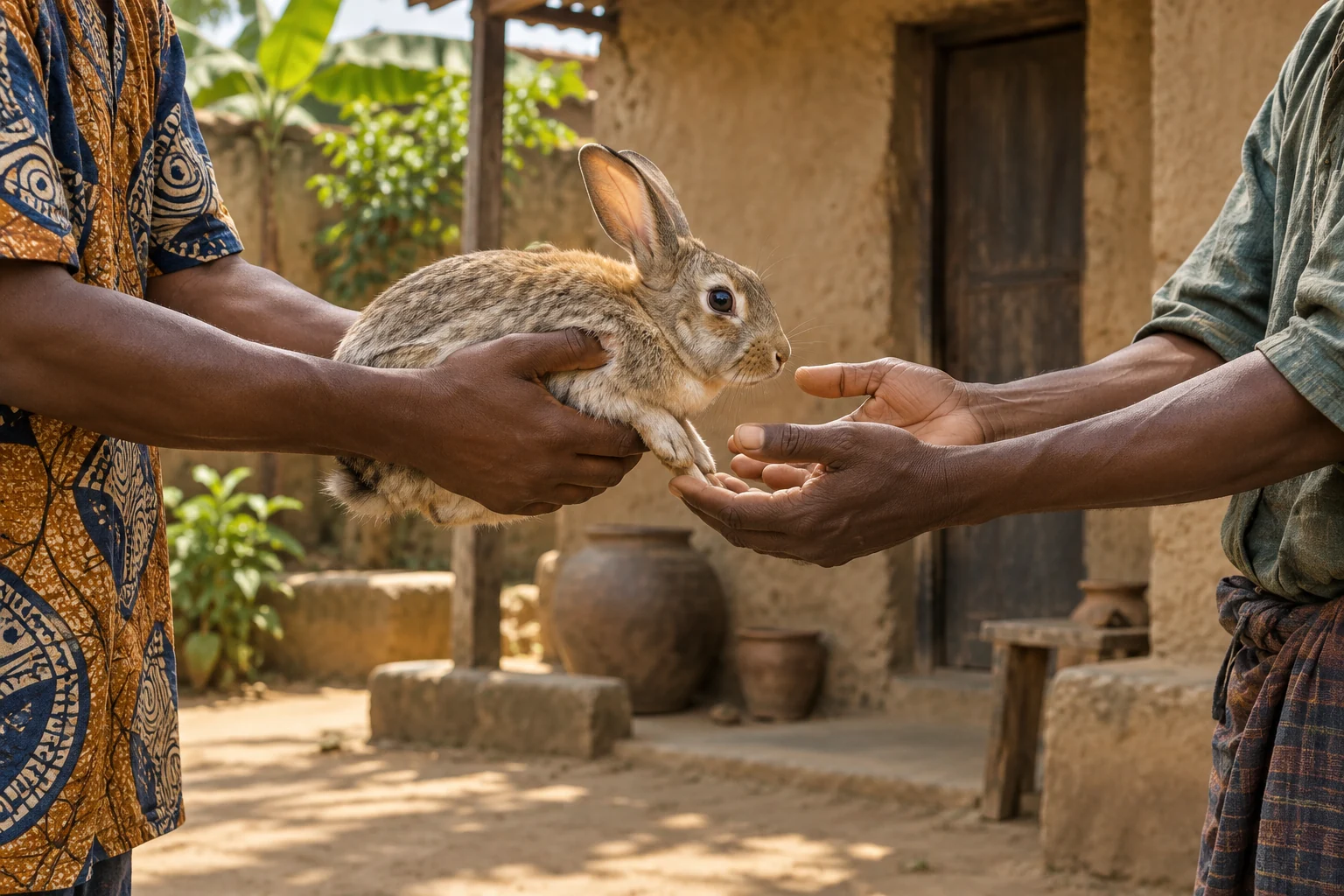
Obàtálá. He discovers that his rabbits are disappearing and approaches the suspected thief through a gift after consultation, rather than openly accusing him.
-
Ọ̀rúnmìlà. He identifies the theft and advises an indirect encounter, creating the narrative conditions in which Ogun recognizes the contradiction of his conduct.
-
Ògún. He is the rabbit thief who initially reacts angrily to Obatala’s visit, then feels unable to continue stealing after receiving a gift.
Key myths and their meanings
The sack nobody wanted
Divine powers leave their harmful qualities with Olofin while receiving desired virtues. A latecomer, hoping for a share of the distribution, accepts the remaining sack without considering its contents. Esu later brings news of the resulting situation, and Olofin retrieves the sack. The latecomer ends without the gain he expected.
Availability is not evidence of value. The account makes haste, limited information, and opportunism more important than the sack’s impressive scale. Its redistribution of harmful qualities also leaves a difficult theological question: the world’s mixed character is not resolved by simply removing one person’s burden. Avoid assigning this latecomer’s traits to anyone with the sign.
Narrative setting: Cuban/Lukumí patakín in a multilingual source compilation; no individual narrator is established.
Rabbits offered to the thief
Obatala notices a dwindling group of rabbits and consults. He is told that a direct accusation could endanger him. He visits Ogun and presents rabbits as a gift. Ogun first assumes he has been exposed, then recognizes that accepting generosity while continuing to steal would be untenable, and resolves to stop.
The gift changes the thief’s self-understanding without a public confrontation. That is a narrative possibility, not a reliable safety strategy. The power imbalance and risk of retaliation remain central. A contemporary reading can discuss alternative routes to accountability while affirming that a harmed person has no obligation to reward the person causing the harm.
Narrative setting: Cuban/Lukumí patakín in a multilingual source compilation; no individual narrator is established.
Wealth seeks a house prepared to receive her
Aje seeks followers and a fitting earthly dwelling, while Onigede seeks resources. Both consult and undertake a sacred response. Aje’s representative daughter reaches the boundary between domains, and Esu guides her toward Onigede’s house, where the conditions associated with her presence have been established. She settles there with the wealth she carries. Onigede later celebrates with his community and acknowledges Orunmila. The witness describes two seeking participants meeting through an effective sacred relation, not a passive treasure appearing in an empty place. Its later marital predictions are distinct applications and are not promises for a present reader.
The episode gives Wealth agency: she has a need for a fitting relation, rather than serving only as an object a human must seize. Onigede’s wish meets that desire through consultation, preparation, and Esu’s guidance. This is a religious account of welcome and settlement, not simply a modern claim that successful people create the right mindset. The earlier sack story offers a useful contrast: the latecomer accepts what is available without understanding what it contains. Here the received presence has a relation and a place rather than merely an impressive exterior.
The rabbit-gift episode adds another form of material encounter, one that interrupts wrongdoing without a direct accusation. The new household’s public feast also matters because provision circulates beyond the principal beneficiary in the ending. A contemporary reading may ask what makes a welcome adequate, while declining to turn Aje’s daughter into a formula about women delivering wealth or a universal obligation to marry any arriving stranger.
Narrative witness and setting: Translated excerpt in the multilingual compilation’s expressly attributed Cromwell Osamaro sequence, with Yoruba/Bini-facing material. The compilation’s language is not evidence of a Brazilian tradition.
The threatened monkey forms an alliance with trees
Stronger animals deny a monkey and its offspring a secure place, threatening them across generations. The monkey consults Orunmila and is directed toward a relation with the forest trees. After a feast, Esu speaks for the monkey and explains the need for shelter. The trees promise their branches as a responsive refuge and commit not to abandon the monkey’s family. The witness identifies a tree absent from the gathering as an exception to that alliance. It explains an inherited arboreal habitat through sacred agreement, not through a biological origin story or a guide to choosing real trees for physical safety.
The refuge is not discovered as an ownerless hiding place; it is established through a relation with living participants who can answer and promise. Esu’s advocacy and the trees’ commitment make the religious world explicit. The threat also extends to offspring, so the agreement addresses continuity rather than one emergency escape. Comparison with Aje’s settling reveals two different forms of a fitting place: one welcomes a desired presence, while the other shelters a threatened being through negotiated protection. The earlier rabbit gift likewise changes a relation without relying on direct retaliation, whereas the sack episode shows acquisition without adequate understanding.
A contemporary interpretation can ask how dependable support is formed, while preserving the trees’ sacred personhood rather than reducing them to an infrastructure metaphor. The stated exception should remain a local feature with an uncertain botanical name. The account does not prove that one species is spiritually hostile everywhere or that affiliation guarantees physical safety in real forests.
Narrative witness and setting: Translated excerpt in the multilingual compilation’s expressly attributed Cromwell Osamaro sequence, with Yoruba/Bini-facing material. The compilation’s language is not evidence of a Brazilian tradition.
What was born in this Odù
“Born” can name an explicit traditional origin association or what emerges through a story: a capacity, relationship, practice or order of life. Interpretations drawn from a narrative are labelled below, so their basis remains clear.
The guabina fish
Selected traditional source association.
The fish is explicitly listed as an origin association. The selected sack and rabbit stories do not explain its emergence, so it is retained as a local natural motif without invented mythology.
A head-related religious observance
Selected traditional source association.
The list associates the fish with care of the head. The note acknowledges that religious connection without reproducing a procedure, advising a personal rite, or asserting a health effect.
Correlations to life dimensions
These questions bring the selected stories into contemporary life. They are interpretive invitations for study.
Work and resources
The latecomer acquires what is left without checking whether it serves his purpose. A free or abundant resource can still carry unwanted obligations.
Reflect: What terms or contents need inspection before acceptance?
Relationships and family
Obatala’s gift changes the encounter but does not erase the theft. Reconciliation should include a realistic account of what was taken.
Reflect: What repair would matter beyond a changed mood?
Character and inner life
The rabbit thief confronts an internal contradiction. Another person’s generosity can invite reflection without guaranteeing remorse.
Reflect: Which contradiction in your conduct needs acknowledgment?
Community and responsibility
The sack’s retrieval redistributes a collective problem. Communities should examine where a burden goes when it disappears from immediate view.
Reflect: Are you resolving a problem or transferring it elsewhere?
A deeper reading of the sacred relationships
A fitting place arises through sacred relationship
Wealth’s representative is guided to a prepared dwelling, while the monkey’s family gains refuge through Orunmila’s counsel, Esu’s advocacy, and the trees’ answer. These are active relations, not only settings chosen by a clever protagonist. The witness makes welcome and shelter religiously effective through persons, living beings, and commitments. A contemporary discussion of support networks can follow, but should not replace Aje or the trees with an abstract social function. The earlier rabbit gift adds a different relational change, while the sack warns that merely obtaining something does not establish its fitness. A spiritually grounded study explains the specific relation before turning the motif into personal advice.
Receiving, possessing, and hosting are distinct acts
The latecomer carries a sack without understanding its contents; Onigede hosts an arriving presence through prepared relation; and Obatala offers rabbits in a way that changes the thief’s stance. The monkey receives a continuing refuge rather than ownership of the forest. These distinctions prevent material gain from becoming the sole measure of a favorable result. A contemporary reference can ask what sort of claim or responsibility comes with each act. The religious accounts do not provide one transferable technique for attracting every good. They give different forms of relation whose effects depend on what is received, why another participant approaches, and what continuing acknowledgment the ending contains.
The next generation changes the scale of protection
The monkey’s threat explicitly includes offspring and future generations, so its alliance with trees establishes more than a temporary hiding place. Aje’s settlement likewise gives a house an ongoing presence, while the sack’s failed acquisition has little durable relation beyond its holder. The rabbit episode changes a repeated pattern of theft rather than only recovering one loss. These differences make continuity a source-specific question. A contemporary interpretation can ask whether support responds to the ongoing condition or merely the latest event. The sacred narratives remain particular in how that continuity is made effective, and they do not establish a universal guarantee for every family that repeats an outward act.
Questions that deepen the study
Why describe Aje as seeking rather than only being sought?
The witness gives the wealth presence a desire for an appropriate dwelling and followers, while Onigede seeks resources from the human side. Their meeting is therefore a relation of reception, not just an object being captured. Esu’s guidance and the prepared house belong to that religious logic. A contemporary analogy about readiness may follow, but should not replace the divine person with a mindset or convert the story into a guaranteed wealth practice. The public feast also keeps the ending relational. The source’s later claim about an arriving woman is a different application, not proof that every partner carries a predetermined financial role.
How are the trees different from a convenient backdrop?
They hear the monkey’s need, receive an approach through sacred counsel and Esu, and answer with a promise of support. The narrative treats them as participants in an agreement whose effects extend to offspring. That religious personhood is lost if they are described only as useful scenery. A contemporary reader may compare a dependable refuge or alliance, while preserving the source’s own living forest. The exception of an absent tree also means the agreement has a boundary, not an undefined claim that all nature behaves identically. No physical safety advice or universal botanical identity follows from the myth.
What makes the new household different from the sack’s apparent opportunity?
The sack is accepted without a sound account of its contents, while the arriving wealth presence has a disclosed relation to the prepared place and the people within it. One acquisition therefore lacks understanding; the other is narrated as a fitting welcome mediated by sacred agencies. The rabbit gift adds a third form, where a voluntary transfer changes the recipient’s conduct, and the monkey’s alliance a fourth, where support is received without simple ownership. A contemporary study can use those differences to ask what makes an opportunity intelligible. It should not conclude that any prepared house or hospitable act will produce the same sacred result.
What the four narratives reveal together
The added witness makes Okanran Ofun’s material and protective relations more precise. Aje seeks an appropriate earthly welcome, while the threatened monkey gains a continuing alliance with trees. The earlier sack and rabbit episodes then supply distinct acts of unexamined possession and a gift that interrupts theft. Religious agency remains essential: Wealth, Esu, Orunmila, and the forest’s living participants act within the accounts rather than serving only as metaphors for opportunity or support.
Contemporary comparison can distinguish receiving, hosting, and shelter without turning a successful relation into a guarantee. The four stories do not make every gift beneficial or every acquisition wise. They ask what a presence needs, who may answer it, and how a continuing arrangement differs from holding a thing whose meaning has never been understood. That specificity supports depth without inventing a universal prosperity method.
Living with this Odù
A continuing life or initiatory relationship
For a person whose received life or initiatory sign is Òkànràn Òfún, receiving something can require an understanding different from merely carrying it away. The latecomer's sack is available but not beneficial; Onigede's dwelling receives an active presence whose own seeking matters. Across changing opportunities, these accounts can develop judgment about fitness, preparation and the kind of relation an acquisition establishes. Wealth is not only an object to seize, and its daughter cannot become a formula about women delivering prosperity.
The monkey's alliance makes refuge a continuing commitment among living participants, while the rabbit gift changes a repeated wrong without a direct accusation. These are different forms of relational change. Long-term character can include asking whether support addresses the ongoing condition or only the latest emergency, while recognizing that a harmed person is not obliged to reward a thief. Within the attributed witnesses, Aje, Esu and the trees have active sacred personhood. The received sign does not promise invulnerability, identify actual species as hostile or prescribe generosity as a safe response to theft. It keeps possession, welcome and shelter distinct so that a favorable result can be understood through the responsibilities and limits it actually carries.
A particular consultation and its question
In consultation, Òkànràn Òfún can clarify whether the question concerns acquisition, hosting or protection. The unwanted sack warns against inferring value from availability; Aje's arrival concerns a fitting dwelling and two seeking participants; the monkey receives refuge through a negotiated relation rather than ownership of the forest. A practitioner can examine what the client believes is being received and what the actual arrangement allows.
The rabbit encounter adds a different possibility of accountability under unequal power. Its indirect gift is effective within the Cuban narrative but cannot supply a safety plan for confronting theft or require a harmed person to offer more. In the attributed accounts, consultation, Esu's guidance and the trees' commitment remain real agencies without becoming a checklist that attracts every desired good. The monkey's next generation also changes the scale from temporary escape to continuity, while the uncertain tree exception stays local. Consultation may illuminate what makes support dependable now. It does not confer permanent identity as latecomer, host of wealth or threatened family, and it cannot guarantee physical safety by repeating an outward action detached from its religious setting.
Constructive and adverse possibilities
Constructive relations may establish a welcome that fits the arriving presence, negotiate support for an ongoing threat and change a repeated pattern without simply taking possession of everything involved. Aje's representative and the trees answer within a sacredly inhabited world, while Onigede's feast extends acknowledgment beyond private gain.
Adverse unfolding could include accepting an impressive burden without inquiry, mistaking refuge for unlimited ownership or assuming generosity reliably prevents retaliation. The latecomer's failed acquisition does not solve the world's mixed qualities, and the monkey's alliance includes an exception whose uncertain name cannot govern real forest safety. These contrasts leave an actual reading's state undetermined. They ask what has been received, what another participant seeks and which continuing condition makes the relation more substantial than a single favorable event or a desired possession.
An illustrative situation in everyday life
In a hypothetical housing project, a family receives emergency shelter but needs a dependable arrangement that will also accommodate their children over time. A temporary hiding place and a continuing alliance are not the same achievement. The monkey and trees help distinguish those scales, while Aje's dwelling adds a different question about whether a place is prepared for the presence it welcomes. The family also declines a large donated item whose hidden maintenance costs would overwhelm the household, recalling the sack's misleading availability. This illustration offers no spiritual safety guarantee. It asks what support actually provides, what it requires and how hosting differs from merely accepting something because it is the remaining offer.
Sources and reading context
The first two narrative witnesses
These are Cuban accounts with religious associations retained at limited scope. The rabbit encounter is not recommended as a safety plan for confronting theft. The born items are not used as fish biology, personal ritual advice, or medical guidance, and no broad equivalence among head-related practices is assumed.
Narrative motifs are summarized independently. The life-dimension reflections are contemporary interpretation. How these reference studies are built explains the wider source approach and the distinction between a reference article and personal divination.
Additional named witnesses
- Cromwell Osamaro Ibie. The surrounding sequence is expressly attributed to Cromwell Osamaro. These selected episodes are read through the multilingual compilation’s translated renderings; exact edition and original translation chain remain unverified.
The monkey’s excluded tree has an uncertain translated name and is not identified as a universal taboo species. Aje is the wealth presence in this account, not automatically the night powers of another strand. No marital forecast, habitat science, or ritual method is inferred.
Bibliographic identification
- C. Osamaro Ibie. Ifism: The Complete Work of Orunmila. Lagos; multivolume publication beginning 1986. Library catalogue record. Related bibliographic record for the named narrative witness. Exact volume, edition and page of the transmitted account have not been independently matched.
Read the source method and wider scholarly context.
The catalogue links identify published works and their authors. They are separate from proof of an individual episode’s wording or attribution. Contemporary comparisons and the synthesis above are editorial interpretation. The author’s books and Academy companions below provide further study; their sales links are separate from the source references.