
Ọ̀ṣẹ́ Ìrẹtẹ̀ is a mixed Odù in Ifá’s 256-part corpus. Òṣé Irete’s selected material turns on a forgotten partner and an unexpected protective community. Obí receives a gift that works only alongside Òṣé Bile, then mistakes public celebration for proof of self-sufficiency. Babá Doma, threatened for his intelligence, finds lasting safety through Òṣun, Elegbá, and children who close the gates to pursuers. Both motifs place practical efficacy in relationships that pride and hierarchy can make easy to overlook.
A question to carry through the study: Whose contribution disappears from view when your work receives public praise?

This Academy reads the right column first, then the left. Each row carries a single or double mark.
Where this Odù belongs
Ọ̀ṣẹ́ Ìrẹtẹ̀ belongs to the Ọ̀ṣẹ́ family in this Academy’s study sequence. It is a mixed Odù, distinct from Ìrẹtẹ̀ Ọ̀ṣẹ́. The order matters. Its teaching is approached through its own narratives, rather than by adding two general descriptions of the principal signs together.
Key Òrìṣà and sacred relationships
The figures below are selected for their roles in the accounts discussed here. They offer connected reading paths through the tradition.
-
Ọ̀rúnmìlà. Òrúnmìlà repeatedly explains that Obí’s gift requires another person and directs him toward the partnership; the narrative separates a granted capacity from the relationships needed to exercise it.
-
Òṣun. Òṣun shelters the displaced Babá Doma, questions why he has not used his intelligence, and accompanies him toward another possible refuge rather than leaving counsel unsupported.
-
Èṣù. Elegbá and the children provide the final secure refuge by barring Babá Doma’s pursuers, giving collective action a role that individual intelligence alone could not fulfill.
Key myths and their meanings
The celebrated partner left hungry
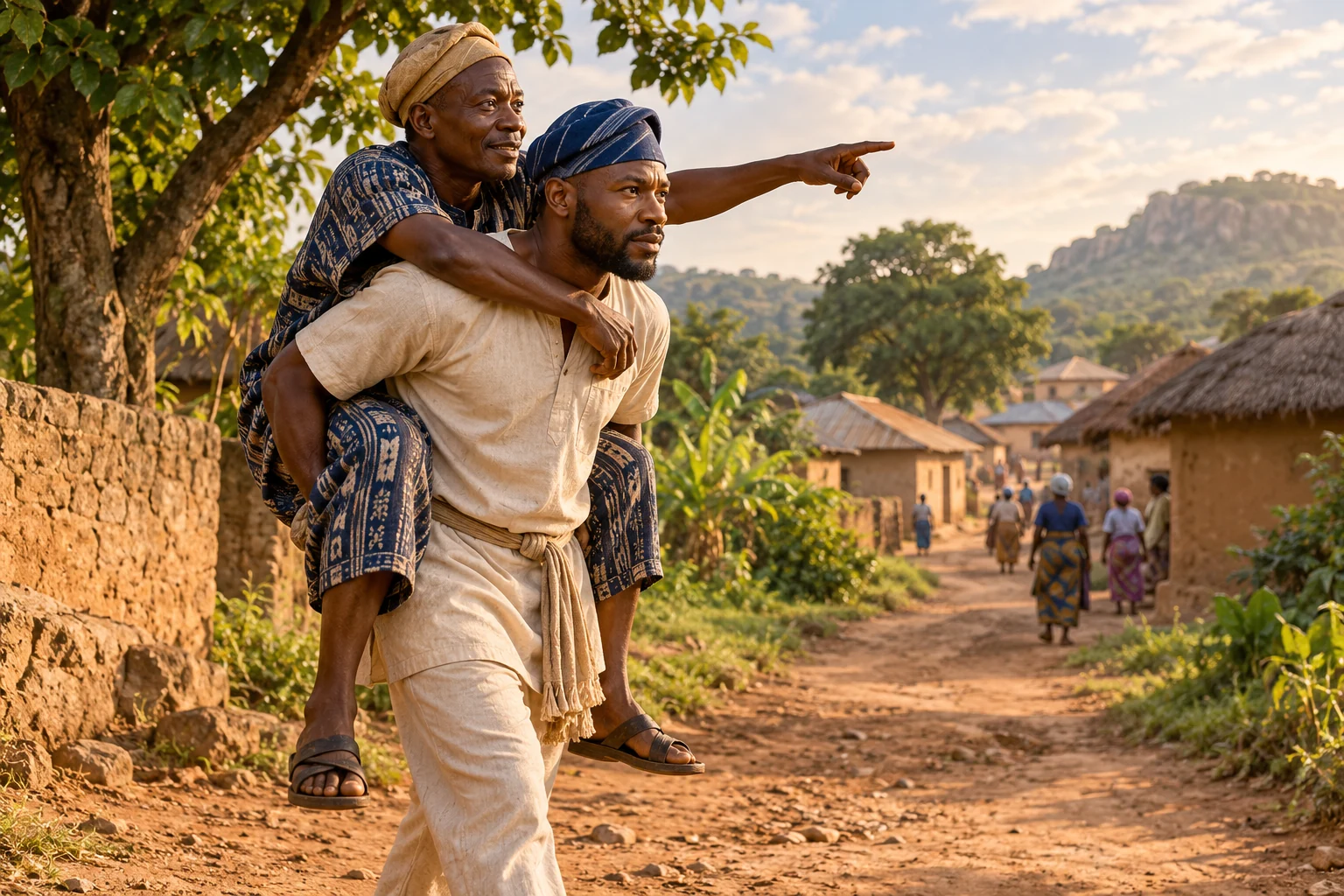
Òṣé Bile offers water to divine visitors and asks for communication with Olofin. Obí separately seeks usefulness. Òrúnmìlà explains that the gifts require a partnership, and Obí eventually carries the man who cannot walk to a community in need. Their combined work succeeds. During the celebration Obí neglects his partner, later speaks alone with disastrous results, and returns to acknowledge that neither contribution should be forgotten.
The story distinguishes recognition from actual independence. Public praise attaches to Obí’s visible performance, while the less visible partner remains hungry on the ground. The later failure exposes that misrecognition. Its central question concerns maintenance: shared success requires continuing care for the people whose contributions make it possible. The narrative’s claims of curing and forecasting must remain religious plot elements rather than practical health or military promises.
Narrative setting: Cuban/Lukumí patakín identified in the selected account; no individual narrator is named.
The children close the gates
Babá Doma is sought for his intelligence, provoking envy in neighboring powers who want to displace him. He leaves to prevent escalation and reaches Òṣun, who shelters him and encourages a more active use of his understanding. A crowded settlement provides temporary concealment, but his pursuers continue. In the land of children and Elegbá, they are finally kept outside by a community that closes its gates together.
The protagonist’s intelligence does not make refuge unnecessary. Òṣun’s assistance joins insight to shelter and accompaniment, while the final protection comes from people whom formal hierarchies might underestimate. The difference between anonymity in a crowd and active collective protection is especially useful: being unnoticed is not the same as being defended. Later writing can examine safe belonging without romanticizing children as responsible for confronting actual dangerous pursuers.
Narrative setting: Cuban/Lukumí patakín identified in the selected account; no individual narrator is named.
Adiatoto carries learned knowledge into an inheritance dispute
Biawe transmits differentiated coconut-divination knowledge among his sons, while Adiatoto eventually receives a more complete teaching as the others leave. After the father dies during Adiatoto’s absence, people raised in the household claim the property. Adiatoto returns, asks the ruler to hear the dispute, and presents his learned religious knowledge as evidence of his position. The oracle’s response is accepted, and he receives the inheritance. A later question concerns brothers who may return to claim a share. The account does not give a stable count and ordering of every child, so its essential movement is transmission, absence, contested succession, and sacred verification.
The knowledge functions as more than a possession hidden in a document. It is a transmitted religious capacity whose exercise is recognized within the judgment, joining teaching, lineage, and authority. The story therefore should not be secularized into a simple lesson that education is a better title deed. Its oracle is active within the account’s world, and the ruler’s acceptance belongs to that world’s particular relation between sacred knowledge and succession. At the same time, the source distinguishes biological and fostered children in a way that requires transparent treatment.
It does not establish a universal rule for contemporary families or demonstrate that care-based kinship lacks legitimacy. The later possibility of returning brothers also prevents the inheritance from ending as a wholly uncontested possession. A contemporary reading can examine what is actually transmitted across generations and how a claimant becomes recognized, while retaining the unresolved rights and voices that the short local narrative does not fully explore.
Narrative witness and setting: Passage explicitly located among Cuban revelations in the supplied compilation; no individual narrator is established.
A friend discovers a path and brings the other along
The Salami unit places Òsé and Ìretè in a friendship oriented toward a house of wealth. The explanatory opening asks the two recipients to respond together and inquire about what their Orí will accept. One friend discovers an opportunity, both set out, and the verse affirms shared prosperity and rejoicing. Its opening image of falling into a hollow associates experience with a lesson for those following. The translation alternates which named friend leads the other, so the secure narrative fact is reciprocal affiliation and a shared journey, not a fixed hierarchy between the two. No specific business or contractual division is identified.
The religious response is shared without erasing the two inner heads. Asking what their Orí accepts gives cooperation a sacred particularity: a common project still involves distinct recipients. The discovery also does not remain private advantage, because the friend brings the other toward it. This provides a positive contrast to accounts in which confidential knowledge is stolen, hoarded, or used to subordinate another person. Yet the short verse does not explain how benefit is distributed or whether later disagreements occur.
Those gaps should not be filled with an idealized partnership history. The opening fall-image adds another register, knowledge gained through experience that can aid a follower, but it does not report an actual injury to one of these friends. A contemporary interpretation can ask how opportunity is shared responsibly, while preserving the account’s affirmation that Orí, divination, and response participate in what makes their journey favorable.
Narrative witness and setting: Passage explicitly labeled Ayo Salami, with Yoruba verse and Spanish translation in the supplied compilation.
What was born in this Odù
“Born” can name an explicit traditional origin association or what emerges through a story: a capacity, relationship, practice or order of life. Interpretations drawn from a narrative are labelled below, so their basis remains clear.
Obí as a divinatory medium
Selected traditional source association.
The explicit beginning list places the coconut oracle here and names its differentiated powers. This supports discussion of a medium whose religious authority is relational; the interpretive patterns and consultation procedure are not reproduced.
The coconut’s vanity
Selected traditional source association.
A second origin entry assigns vanity to one expression of Obí. In the selected partnership story this can illuminate the mistake of accepting sole credit, without treating every use of the oracle or every practitioner as vain.
Correlations to life dimensions
These questions bring the selected stories into contemporary life. They are interpretive invitations for study.
Work and resources
The invisible partner contributes essential communication while receiving none of the celebration’s nourishment. A project’s success should be assessed partly by whether credit and material support reach everyone whose work makes the result possible at the celebration.
Reflect: Does the least visible contributor share in the benefits?
Relationships and family
Obí must return and acknowledge neglect before the partnership can be renewed. The story makes an apology meaningful through a durable agreement about future cooperation, rather than through a moment of embarrassment alone between the two contributors.
Reflect: What agreement would make an apology dependable?
Character and inner life
Babá Doma’s flight shows that intelligence can coexist with fear and displacement. Òṣun’s question helps him think again, but her shelter supplies conditions in which thought becomes possible; competence does not cancel the need for care.
Reflect: What support helps you use abilities that fear has interrupted?
Community and responsibility
The crowded settlement hides Babá Doma temporarily, whereas Elegbá’s community acts together to protect him. This distinction asks whether belonging means mere presence among many people or a shared commitment to prevent exclusion and harm.
Reflect: What turns a place you inhabit into a community that protects you?
A deeper reading of the sacred relationships
Religious transmission is exercised rather than merely owned
Adiatoto’s inherited knowledge becomes consequential when he exercises it within a disputed succession. The Salami companions likewise ask how their own Orí will receive a shared response, rather than assuming that association alone makes the path favorable. The earlier Obí partnership gives another precise form: one visible capacity depends on another person’s communication with heaven. Together these witnesses understand knowledge as active in sacred relationship, not merely as an object that can be stored or transferred unchanged. Contemporary questions about learning and recognition can emerge from this logic, but the oracle, Orí, and heavenly communication should remain the sources’ actual religious realities rather than be replaced by credentials or personal confidence.
Inheritance and affiliation do different work
The succession account authorizes a claim through a particular teaching and lineage history; the friendship verse shares an opening through chosen affiliation; Babá Doma finds protection through a community outside his threatened home; Obí’s efficacy depends on a partner he initially neglects. These relations should not be arranged into one hierarchy in which blood, friendship, or utility always wins. Their different settings explain what each relationship is asked to do. A contemporary reader can ask whether belonging transmits knowledge, shares opportunity, shelters a person, or sustains a combined capacity. The inheritance story’s restrictive family categories remain visible as features of that witness, rather than universal rules imposed on all forms of kinship.
A guide may contribute without becoming the sole author
In Salami’s verse, one friend finds the path, but both respond and travel. In the older Obí account, the public celebration attaches to a visible performer while the indispensable partner goes hungry. The comparison identifies a recurrent distinction between initiating contact and possessing the whole achievement. Adiatoto’s teaching adds another dimension, because the father’s transmission remains part of what makes the son’s later action possible. These scenes do not prescribe identical credit or equal shares in every situation. They invite a more concrete account of contributions: discovering, teaching, carrying, communicating, sheltering, and responding. A religiously grounded reading recognizes that sacred efficacy can involve several agents whose roles remain distinct.
Questions that deepen the study
Does the inheritance story establish a rule for modern family property?
It reports a particular religious judgment in which transmitted divinatory knowledge is accepted as evidence. The biological and fostered distinctions belong to that local narrative, not to a general account of legitimate family bonds or current inheritance law. A contemporary reader can examine what a parent teaches, what a household remembers, and how claims become recognized, while refusing to infer that someone raised in a family therefore lacks rights. The passage also anticipates returning brothers, leaving part of the succession unsettled. Preserving those limits is more faithful than turning a sacred verification scene into a universal legal precedent.
Which friend brings the other to the house of wealth?
The Spanish rendering gives both directions in different places, so the evidence does not support choosing one as the definitive leader. The more secure fact is that one discovers an opportunity and the two travel after a shared religious response. That uncertainty should remain explicit rather than being solved by the order of the Odù name or an arithmetic rule about its halves. Within the verse, both Orí are acknowledged and both recipients appear in the favorable ending. A contemporary discussion of mentorship or shared opportunity can proceed from that relation without inventing a permanent superior or a one-sided debt between the friends.
Why does cooperation still need attention after it succeeds?
The older Obí story supplies a direct answer: public success can make a visible participant forget the person whose contribution remains essential. The Salami friends’ shared celebration does not narrate such a failure, but it can stand beside that warning without being rewritten to contain it. Adiatoto’s inheritance likewise depends on knowledge received earlier, and Babá Doma’s safety depends on shelter and collective protection. A contemporary interpretation can therefore ask how gratitude becomes continuing acknowledgment rather than a single celebratory moment. The witnesses’ religious agency should remain intact: the issue concerns how people inhabit relationships through which sacred capacities and favorable circumstances have become possible.
What the four narratives reveal together
The additional witnesses give Òṣé Irete two distinct ways in which knowledge and opportunity travel: a father’s religious teaching enters a contested succession, and a friend’s discovery becomes a shared journey under the guidance of Orí. They stand beside the earlier partnership whose invisible contributor is neglected and the threatened sage protected by Òṣun, Elegbá, and children. The four accounts therefore deepen affiliation without making every relation identical. Teaching, discovery, communication, shelter, and collective defense each sustain a different possibility.
Their sacred logic is equally particular, involving an exercised oracle, distinct inner heads, heavenly address, and active divine protection. A contemporary synthesis can ask about credit, belonging, and responsibility while keeping these religious realities visible. It should not repair unstable sibling details, decide an ambiguous leader from the name’s order, or generalize a local inheritance judgment into a universal measure of family legitimacy.
Living with this Odù
A continuing life or initiatory relationship
For someone whose received life or initiatory Odù is Ọ̀ṣẹ́ Ìrẹtẹ̀, the witnesses ask how several contributions remain visible after success arrives. Obí’s celebrated performance depends on a partner left hungry, while Salami’s friends carry an opening into a shared journey without losing their distinct Orí. Long-term development includes recognizing what another person enables and making care continue beyond the moment of public praise. Discovering an opportunity is not ownership of the entire achievement.
Babá Doma’s refuge adds the difference between temporary anonymity and active protection. Adiatoto’s learned religious knowledge then participates in a disputed inheritance, whose local family distinctions cannot be generalized into a judgment against fostered children. These forms of belonging do different work: transmitting, sheltering, carrying and sharing. Across changing circumstances, a person may need to ask which relation is being neglected rather than assume blood, friendship or utility always takes precedence. The oracle, heavenly communication, Orí and Ifá remain actual sacred agencies within the witnesses. The sign predicts neither an inheritance victory nor a perfect partnership. Its continuing task is to make affiliation durable through precise acknowledgment of contributions and responsibilities before, during and after success.
A particular consultation and its question
In consultation, Ọ̀ṣẹ́ Ìrẹtẹ̀ can help distinguish a visible performer from the complete network of efficacy. The Obí account asks who has been omitted from celebration and who remains materially unsupported. Babá Doma asks whether a person is merely hidden in a crowd or defended by a community willing to act. Those are different problems even when each involves belonging.
The actual question may concern succession or shared opportunity instead. Adiatoto exercises transmitted sacred knowledge within a particular judgment; that cannot become a modern rule that religious knowledge overrides every other inheritance claim. Salami’s friends respond through distinct Orí, but the translation does not securely fix who always leads. An interpreter should retain that uncertainty rather than construct a compulsory hierarchy. A result encountered for one question is not permanent identity, proof of another person’s dependence or a guarantee of refuge. Reflection can ask what was learned, who provided it, whose role has become invisible and what support makes the present arrangement reliable. The source’s oracle and sacred response remain more than credentials or confidence, while the actual consultation determines which relationships and obligations are relevant.
Constructive and adverse possibilities
Constructive possibilities include partnership receiving continuing care, opportunity being shared without erasing distinct recipients and refuge becoming a collective commitment rather than accidental concealment. Learned knowledge becomes active through a sacred relationship in the succession account; it is not simply a stored credential.
Adverse unfolding can involve a celebrated participant treating an indispensable partner as disposable, intelligence being mistaken for freedom from need or one local inheritance outcome being used to deny other forms of kinship. The short friendship verse does not prove that later disagreements never occur, and children’s protective role cannot make actual children responsible for confronting danger. These tensions require attention to what each relation is asked to sustain. They can inform an actual reading’s constructive and adverse possibilities without assigning its state, idealizing every partnership or making received knowledge an unlimited claim over other people’s rights.
An illustrative situation in everyday life
Hypothetically, a public speaker and a researcher create a successful community project. Invitations and praise go to the speaker, while the researcher works unpaid and misses meals during events. The speaker begins believing that visibility proves independence. The Obí structure helps identify the forgotten contribution and the care required for continued efficacy. A constructive change would acknowledge roles and agree sustainable conditions before another event. The friendship witness adds that finding an opportunity can include bringing a companion along without claiming identical destinies or predetermined shares. This hypothetical example concerns recognition and maintenance. It does not reproduce sacred communication with heaven, promise business success or establish a universal rule for allocating credit, money or inheritance.
Sources and reading context
The first two narrative witnesses
This study draws on Cuban/Lukumí narratives and the local names Obí and Òṣé Bile without expanding them into unsupported etymologies. The source’s health and battle outcomes remain narrative. Children’s collective protection is symbolic, not an instruction to place children in dangerous roles.
Narrative motifs are summarized independently. The life-dimension reflections are contemporary interpretation. How these reference studies are built explains the wider source approach and the distinction between a reference article and personal divination.
Additional named witnesses
-
Ayo Salami. The friends’ shared response and journey toward wealth come from the explicitly named bilingual source block.
-
Cuban/Lukumí compilation witness. Biawe and Adiatoto, the Obí partnership, and Babá Doma’s refuge are separately headed Cuban narratives.
The inheritance account has unstable numbering and ordering of children; no exact family tree is reconstructed. The Salami translation alternates who guides whom. Oracle patterns and procedures are omitted, and local distinctions between biological and fostered heirs are not adopted as universal rules.
Bibliographic identification
- Ayo Salami. Ifá: A Complete Divination. Lagos: NIDD, 2002 catalogue record. Library catalogue record. Bibliographic identification of the named author and work; the edition behind the transmitted account remains to be matched.
Read the source method and wider scholarly context.
The catalogue links identify published works and their authors. They are separate from proof of an individual episode’s wording or attribution. Contemporary comparisons and the synthesis above are editorial interpretation. The author’s books and Academy companions below provide further study; their sales links are separate from the source references.