
Ọ̀ṣẹ́ Òwónrín is a mixed Odù in Ifá’s 256-part corpus. The selected Òṣé Owonrin material juxtaposes a thief who becomes a crucial witness with a roadside host who welcomes a traveler before recognizing any reward. Its origin catalog emphasizes the harm of presenting one face while pursuing another purpose. The resulting question concerns how to assess conduct when social labels, domestic familiarity, and visible status all fail to identify reliably who will help or harm.
A question to carry through the study: What act would change your judgment of someone whose social label has already shaped your expectations?

This Academy reads the right column first, then the left. Each row carries a single or double mark.
Where this Odù belongs
Ọ̀ṣẹ́ Òwónrín belongs to the Ọ̀ṣẹ́ family in this Academy’s study sequence. It is a mixed Odù, distinct from Òwónrín Ọ̀ṣẹ́. The order matters. Its teaching is approached through its own narratives, rather than by adding two general descriptions of the principal signs together.
Key Òrìṣà and sacred relationships
The figures below are selected for their roles in the accounts discussed here. They offer connected reading paths through the tradition.
-
Èṣù. Èṣù appears in an adjacent narrative as the power who repeatedly tests Iron after ignored counsel; that story reinforces the section’s concern with appearances and apparently escaped consequences.
-
Ọ̀rúnmìlà. Òrúnmìlà advises the three diviners in the Iron episode before one disregards the response; he represents counsel available before subsequent escalation.
Key myths and their meanings
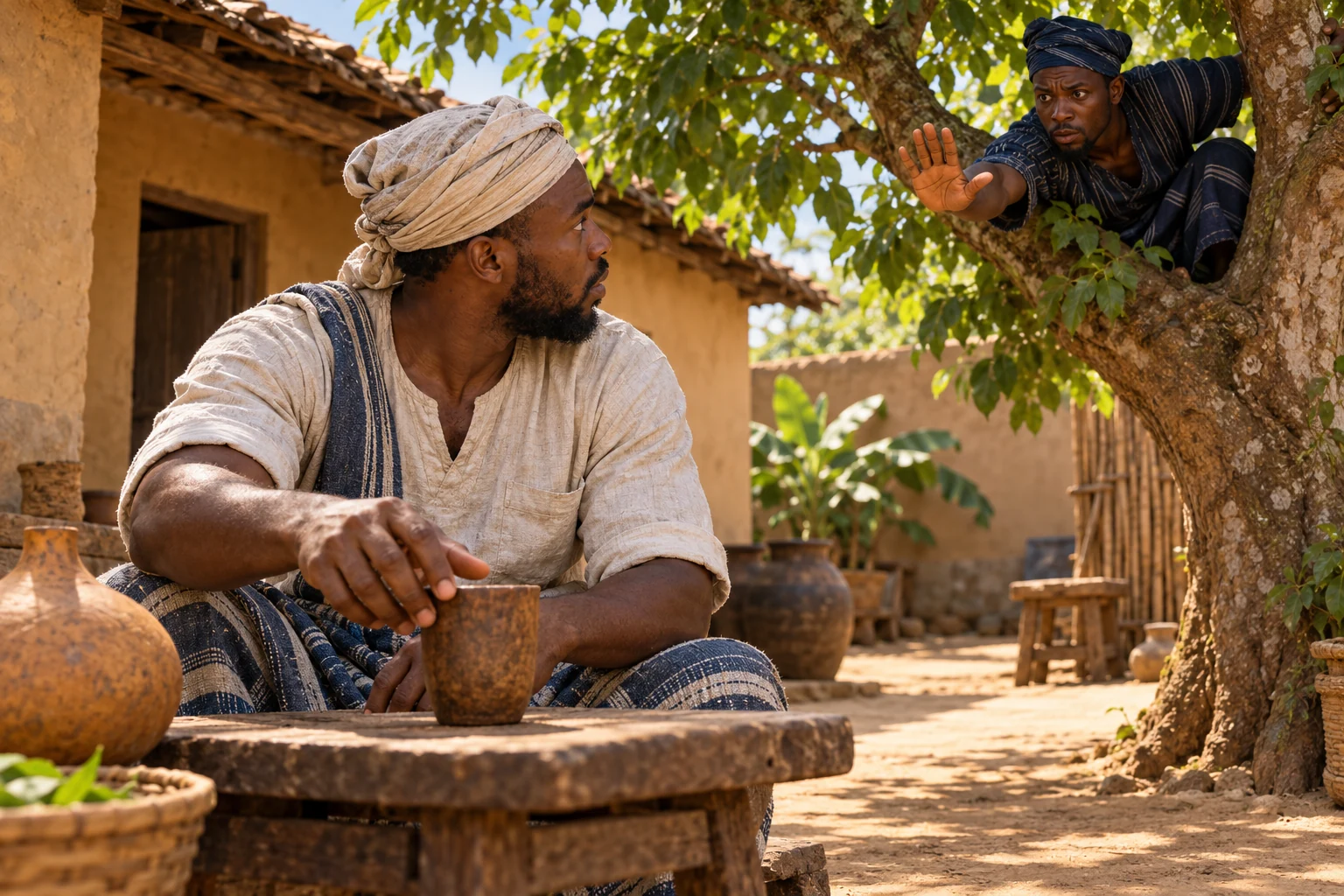
The unintended witness above the house
A field worker returns to his familiar routine while his wife and her lover prepare a poisoned drink. A thief watching from a tree has seen the plot and interrupts before the husband drinks. He admits his original intention to steal and supplies the information that exposes the danger. The tale ends with the husband forcing the drink on his wife, producing another death.
The most useful insight is the separation of a person’s label from the truth of a particular testimony. A thief can witness a real crime, and a familiar home can conceal danger. The ending also requires a clear ethical boundary: retaliatory killing is part of the story, not an acceptable model of justice. The source’s address to the husband as Ofun inside this section is an internal naming inconsistency.
Narrative setting: Cuban/Lukumí patakín identified in the selected account; no individual narrator is named.
A room offered before recognition
Orgini Yorbi lives beside a road. One night Olofin arrives asking for a place to stay, and the host prepares a room for him. During the visit, the host also makes room for an embarrassing bodily need rather than rejecting the guest. The account transforms this unreserved hospitality into extraordinary wealth. The traveler’s identity makes the reversal intelligible within the religious narrative.
The motif turns attention toward the inconvenience of care, not only its public display. A room and welcome are offered before a reward becomes visible, while the bodily episode tests the limits of respectable hospitality. The miraculous conversion into wealth should not become a promise that kindness produces money. It instead opens a question about whether generosity survives contact with another person’s ordinary dependency and lack of dignity.
Narrative setting: Cuban/Lukumí patakín identified in the selected account; no individual narrator is named.
Ṣàngó takes his place in a house of rest
The Salami unit begins with a concern about building a house and obtaining rest. It places Onílée Káà and Onílé Kótó in parallel consultations, then explicitly identifies the first designation with Ṣàngó. The recipients ask whether life can become good and receive counsel to which Ṣàngó responds. He subsequently occupies a resting hall, sits there securely, and enjoys the change. Praise passes from him to his diviner and from the diviner to Ifá. The text does not narrate construction work, the acquisition of land, or the second recipient’s later fate. Its concrete scene is a divinely recognized place of repose.
The association of Ṣàngó with rest expands a figure often approached through thunder, kingship, or force. Here the desired good is not another conquest but the ability to occupy a place and lean back within it. The passage does not remove his other powers; it supplies a particular religious situation in which shelter and repose are worthy of consultation. The parallel naming also suggests a wider field than one isolated hero, although the short unit develops Ṣàngó’s response more fully than the other recipient’s.
A contemporary reading may ask what makes a house habitable beyond its visible structure, but the account itself grounds the change in response to Ifá. Its unresolved limit is the absence of social or material explanation for the house. That absence should not be filled with invented property history, nor should the devotional affirmation become an assurance that a reader’s housing difficulties will resolve through the same sequence.
Narrative witness and setting: Passage explicitly labeled Ayo Salami, with Yoruba verse and Spanish translation in the supplied compilation.
A guarantor confronts an unreturned obligation
Òrúnmìlà acts as guarantor for Ọ̀sányìn’s borrowing and later cannot obtain repayment. The verse frames their difficulty through two complementary parts of a lock, each acquired at equal cost, before describing repeated requests for the money. Òrúnmìlà consults and responds to Ifá, receiving an efficacious utterance within the religious account. At a later encounter, he again asks for repayment in that sacred form, and Ọ̀sányìn returns the money. The narrative names a specific breach between divine figures; it does not describe a general system of lending, interest charges, courts, or a change in their broader religious standing.
The lock image gives the conflict a language of counterpart and proportion. The guarantor has enabled another person’s access to a resource, but that help has not been answered by the promised return. The verse therefore treats reciprocity as something more concrete than affectionate intention. Its religious resolution is also specific: consultation, response, and authoritative speech restore what ordinary repeated requests did not secure. A faithful analysis should preserve that efficacy inside the witness rather than redescribe the utterance as mere assertiveness.
At the same time, the account does not make every divine association an idealized model of flawless conduct; Ọ̀sányìn can be the particular party who fails an obligation without becoming a universal emblem of dishonesty. The contemporary question concerns the boundaries of helping when another person can transfer a cost to the helper. It remains unresolved whether the repayment also repairs trust, because the verse ends before that larger relationship is described.
Narrative witness and setting: Passage explicitly labeled Ayo Salami, with Yoruba verse and Spanish translation in the supplied compilation.
What was born in this Odù
“Born” can name an explicit traditional origin association or what emerges through a story: a capacity, relationship, practice or order of life. Interpretations drawn from a narrative are labelled below, so their basis remains clear.
A deceptive public face
Selected traditional source association.
The only explicit origin entry assigns the contrast between appearance and concealed purpose to this sign. Read beside the thief story, it supports examination of particular actions and evidence, rather than suspicion based on identity or generalized distrust.
Hospitality includes inconvenient needs
Contemporary interpretation from the selected myth.
The roadside host’s response can be interpreted as the emergence of generosity beyond respectable appearances. This is a contemporary reading of the selected hospitality story, not a traditional origin entry or a promise that welcoming discomfort produces wealth.
Correlations to life dimensions
These questions bring the selected stories into contemporary life. They are interpretive invitations for study.
Work and resources
The field worker’s routine makes the plot predictable, while the roadside home becomes a place of unexpected encounter. These details support attention to ordinary infrastructures of trust: food, shelter, labor, and the people who observe them.
Reflect: Which routine relies on trust you have never examined?
Relationships and family
Domestic closeness does not establish truth, and a warning from outside the household may deserve investigation. The story supports listening and verification without generalizing betrayal to spouses or treating violence as a justified response to suspicion.
Reflect: How can you investigate a serious warning without escalating harm?
Character and inner life
The thief acknowledges his own intended wrongdoing while telling the truth about another danger. This unsettles a simple division of people into permanent good and bad categories and permits a more precise judgment of a particular intervention.
Reflect: Can you acknowledge a truthful act without excusing other conduct?
Community and responsibility
Hospitality in the second tale includes private inconvenience rather than public prestige. A community’s generosity becomes more credible when it can accommodate vulnerable travelers and ordinary needs without requiring people to appear impressive or entirely self-sufficient.
Reflect: What ordinary need does your community make embarrassing to admit?
A deeper reading of the sacred relationships
Ifá gives repose and authoritative speech different forms
The two Salami units show different goods becoming possible through response to Ifá. Ṣàngó receives an inhabitable place of rest; Òrúnmìlà receives sacred speech effective within an unresolved obligation. These are not interchangeable rewards for generic compliance. Each addresses a particular relationship between a recipient, a need, and the disclosed religious response. The earlier hospitality account likewise gives Olofin’s visit a transformative reality beyond the host’s social courtesy. A spiritually grounded interpretation should therefore preserve divine agency, consultation, and efficacious utterance as active within these settings. Contemporary language about wellbeing, boundaries, or communication can illuminate an application, but should not replace the witness’s own account of what changes the situation.
Three relations to a house
The four-story group places a house in sharply different relations. Orgini Yorbi’s dwelling opens to a traveler and accommodates an inconvenient need. The field worker’s home conceals a lethal plot that an outsider witnesses. Ṣàngó’s hall offers rest after a response to counsel. The guarantor story then supplies a relationship whose cost travels beyond any single house. These differences prevent domestic space from being treated as automatically safe, corrupt, sacred, or generous. What matters is who can act there, what is concealed, and whether the relation acknowledges another being’s need. The comparison also preserves the host’s voluntary welcome as distinct from an obligation that another party has undertaken and then refused.
Truthful help does not erase other conduct
The earlier thief tells a crucial truth without ceasing to be a person who intended to steal. The new debt story similarly allows a revered figure to fail in a particular obligation without turning that failure into his total identity. These cases require more precise judgment than permanent labels of good helper or bad actor. The religious accounts do not erase consequences: a warning interrupts danger, and repayment returns a resource. They leave further questions about trust open. A contemporary reflection can acknowledge a useful act, a real debt, and an unresolved pattern at the same time, rather than forcing one event to decide every aspect of a person or sacred figure.
Questions that deepen the study
Why does Ṣàngó’s resting hall deserve religious attention?
The witness treats rest and a place to inhabit as goods of life rather than as trivial concerns beneath a powerful figure. Ṣàngó’s response to Ifá and his subsequent praise make repose part of a sacred relationship. A contemporary reader may ask about exhaustion or housing security, but those are applications rather than the passage’s complete meaning. The unit does not narrate how the building is financed or constructed, so those details cannot be supplied. Its distinctive contribution is that an honored capacity can include being able to sit securely, not only the ability to command, fight, produce, or travel.
Does the guarantor story advise refusing every request for help?
The introductory explanation warns about guaranteeing another person, but the narrated case is particular: Òrúnmìlà has already helped, the debt is real, and repayment is withheld. The story’s religious resolution restores an obligation rather than declaring all assistance mistaken. Read beside the roadside host, it also distinguishes a freely offered welcome from a promise to return resources. Contemporary reflection can ask which responsibilities are clearly agreed and whether the helper can bear the cost if they are ignored. That is a practical interpretation, not financial advice derived from divine precedent or a claim that every borrower will behave like this particular Ọ̀sányìn.
What remains after a harmful situation has been interrupted?
The thief’s warning prevents one intended death but the account ends with retaliatory killing, leaving an ethically difficult household aftermath. Repayment in the new verse restores money but does not explicitly restore trust. Ṣàngó’s rest and the host’s reward offer more affirmative endings, yet they do not answer those unresolved questions on behalf of the other stories. The comparison shows why a reference entry should distinguish a narrative’s completed action from the larger relationship it leaves unreported. Contemporary readers can ask about repair, safety, and continuing responsibility without claiming that the sources themselves provide a single procedure or verdict for every aftermath.
What the four narratives reveal together
The new Salami witnesses broaden Òṣé Owonrin through repose and an obligation made effective again. They differ from the original thief’s warning and the roadside host’s extraordinary welcome, while preserving the family’s concern with appearances, trust, and what another being actually does. A house can conceal danger, receive a guest, or become a place of sacredly grounded rest. A helper can contribute truth while having another troubling intention; a respected divine figure can fail a particular promise without that episode defining every manifestation of the figure.
The religious logic is equally differentiated: Olofin’s visit, response to Ifá, and efficacious speech are active causes within their accounts, not interchangeable metaphors for social skill. An authoritative synthesis can retain those realities and still distinguish repayment from restored trust, refuge from ownership, and a favorable ending from a completed answer to every ethical question.
Living with this Odù
A continuing life or initiatory relationship
For someone whose received life or initiatory Odù is Ọ̀ṣẹ́ Ọ̀wọ́nrín, these witnesses require judgments more exact than permanent labels of trustworthy insider or unworthy outsider. The thief gives a crucial warning despite intending theft; the familiar home conceals danger. Neither fact makes retaliatory killing a model of justice. A long-term task is to assess particular testimony and conduct without allowing one useful act to erase everything else about a relationship.
Hospitality offered before Olofin’s recognition introduces voluntary generosity, whereas Òrúnmìlà’s guarantee concerns a specific obligation Ọ̀sányìn later fails to return. Giving freely and enforcing an agreed return are not contradictions. Ṣàngó’s resting hall adds the good of a place one can inhabit without continual performance. Across changing circumstances, a person may need openness, verification, a boundary around transferred costs or permission to rest. Ifá’s efficacy and sacred speech remain real within the Salami account rather than being redescribed as assertiveness. The sign predicts neither domestic betrayal nor miraculous wealth. It invites sustained discernment about how houses and helping relationships are organized, what is actually promised and whether recognition includes another being’s inconvenient needs.
A particular consultation and its question
In a consultation involving Ọ̀ṣẹ́ Ọ̀wọ́nrín, the accounts help distinguish a witness’s standing from the truth of a specific report. An imperfect messenger can supply real information; familiarity is not evidence that a setting is safe. Yet the poison plot cannot authorize suspicion toward a client’s spouse, and its violent ending cannot prescribe retaliation. The internal Ofun naming inconsistency also remains a source limit, not grounds for silently relocating the story.
The actual question may instead concern help. Was a welcome voluntary, as in Olofin’s visit, or has someone shifted an agreed financial burden onto a guarantor? Has repayment occurred without the wider trust being repaired? Ṣàngó’s hall raises a further issue of repose without supplying a property history or guaranteed housing outcome. Each distinction requires the real question and sacred interpretation of the encounter. The divinatory response and efficacious utterance in the debt witness should retain their source-specific agency. A result is not equivalent to permanent affiliation or a description of the client’s character. Contemporary reflection can clarify evidence, consent and obligation while preserving uncertainty about what the consultation actually discloses.
Constructive and adverse possibilities
Constructive possibilities include hearing an unwelcome truth accurately, offering hospitality without visible advantage, recovering an unreturned obligation and obtaining a place of rest. Ifá’s response gives these goods different forms rather than one interchangeable reward for kindness. The guarantor’s sacred speech is specific to that religious account.
Adverse unfolding can involve a familiar label concealing danger, help becoming an unacknowledged transfer of cost or repayment being mistaken for complete restoration of trust. The retaliatory death remains harm within a story, even after a true warning saves the husband. Olofin’s extraordinary reward should not make generosity a strategy for obtaining money. These contrasts keep acknowledgment of a useful act separate from blanket endorsement of its actor. They help examine a reading’s relationships without deciding its state or claiming that everyone linked to this sign faces the same domestic or financial pattern.
An illustrative situation in everyday life
Hypothetically, a colleague known for cutting corners notices evidence that a respected manager has falsified safety records. The team is tempted to dismiss the report because of the messenger’s reputation. A constructive response checks the evidence without declaring the colleague wholly vindicated in every matter. The unintended-witness structure makes that distinction visible. If the allegation is supported, proportionate accountability still differs from the story’s revenge. The guarantor witness adds that one beneficial intervention does not erase existing unpaid obligations. This is a hypothetical situation about evaluating testimony and conduct together. It neither accuses an actual person nor converts the source’s sacred resolution into an ordinary communication technique or a promise that exposing wrongdoing will produce a favorable outcome.
Sources and reading context
The first two narrative witnesses
These Cuban/Lukumí accounts lack individual narrator attribution. The thief story unexpectedly calls its protagonist Ofun, an internal naming problem; its retaliatory death is examined critically. One origin is explicit. The added hospitality emergence motif is contemporary interpretation rather than a traditional origin-list claim.
Narrative motifs are summarized independently. The life-dimension reflections are contemporary interpretation. How these reference studies are built explains the wider source approach and the distinction between a reference article and personal divination.
Additional named witnesses
-
Ayo Salami. Ṣàngó’s hall of rest and the Òrúnmìlà–Ọ̀sányìn guarantor conflict are selected from the explicitly named bilingual source block.
-
Cuban/Lukumí compilation witness. The prior thief and hospitality narratives remain separately attributed Cuban witnesses.
The second house-recipient’s fate is not given. The lock image is not used to invent an etymology or technical practice. Sacred repayment speech is described without reproduction. The source’s advice and devotional assurances do not become universal judgments about borrowers, houses, or any Òrìṣà.
Bibliographic identification
- Ayo Salami. Ifá: A Complete Divination. Lagos: NIDD, 2002 catalogue record. Library catalogue record. Bibliographic identification of the named author and work; the edition behind the transmitted account remains to be matched.
Read the source method and wider scholarly context.
The catalogue links identify published works and their authors. They are separate from proof of an individual episode’s wording or attribution. Contemporary comparisons and the synthesis above are editorial interpretation. The author’s books and Academy companions below provide further study; their sales links are separate from the source references.