
Òwónrín Ọ̀ṣẹ́ is a mixed Odù in Ifá’s 256-part corpus. Òwónrín Òṣé’s selected narratives place hospitality beside a conflict over recognition. A farmer welcomes an inconvenient guest without knowing that the visitor is Fortune. In a separate account, Òrúnmìlà strikes a brother whose exceptional abilities and request for initiation threaten his standing; the eventual settlement requires wider access to Awofaka. The source frames that brother through discriminatory assumptions, so its account must be read critically rather than used to prescribe limits on contemporary identities.
A question to carry through the study: Can you recognize another person’s ability without making it a threat to your own standing?

This Academy reads the right column first, then the left. Each row carries a single or double mark.
Where this Odù belongs
Òwónrín Ọ̀ṣẹ́ belongs to the Òwónrín family in this Academy’s study sequence. It is a mixed Odù, distinct from Ọ̀ṣẹ́ Òwónrín. The order matters. Its teaching is approached through its own narratives, rather than by adding two general descriptions of the principal signs together.
Key Òrìṣà and sacred relationships
The figures below are selected for their roles in the accounts discussed here. They offer connected reading paths through the tradition.
-
Ọ̀rúnmìlà. Òrúnmìlà refuses his brother’s request and reacts violently, then must accept a condition widening access to Awofaka. His recognized authority does not place his conduct beyond correction.
-
Èṣù. Elegbara retaliates after the brother’s mistreatment, causing Òrúnmìlà’s loss of hand movement within the story. The retaliation is reported without endorsing harm as a route to justice.
-
Obàtálá. Obatalá participates in the settlement that links Òrúnmìlà’s restored capacity with changed treatment of those seeking Awofaka. The settlement remains limited by the source’s exclusionary initiation framework.
Key myths and their meanings
A brother’s ability and a restricted settlement
Agbaranife’s reputed insight attracts people who no longer consult his brother Òrúnmìlà. Hoping to preserve Òrúnmìlà’s standing, he asks to enter Ifá, but is struck and goes before Olofin. Elegbara retaliates, and Òrúnmìlà loses use of a hand. Mediation eventually restores his capacity under a condition: he must give Awofaka to his brother and others who seek it, while a further initiation restriction remains.
The account recognizes ability in a person whom the compiler stigmatizes for gender expression. Its partial opening should not be mistaken for full inclusion, and its remaining restriction should not become contemporary guidance. The useful ethical question is how an institution corrects exclusion when a recognized authority is threatened by someone else’s capacity. Neither the initial assault nor retaliatory injury needs to be endorsed for that question to matter.
Narrative setting: Account explicitly labeled Cuba.
The guest who was Fortune
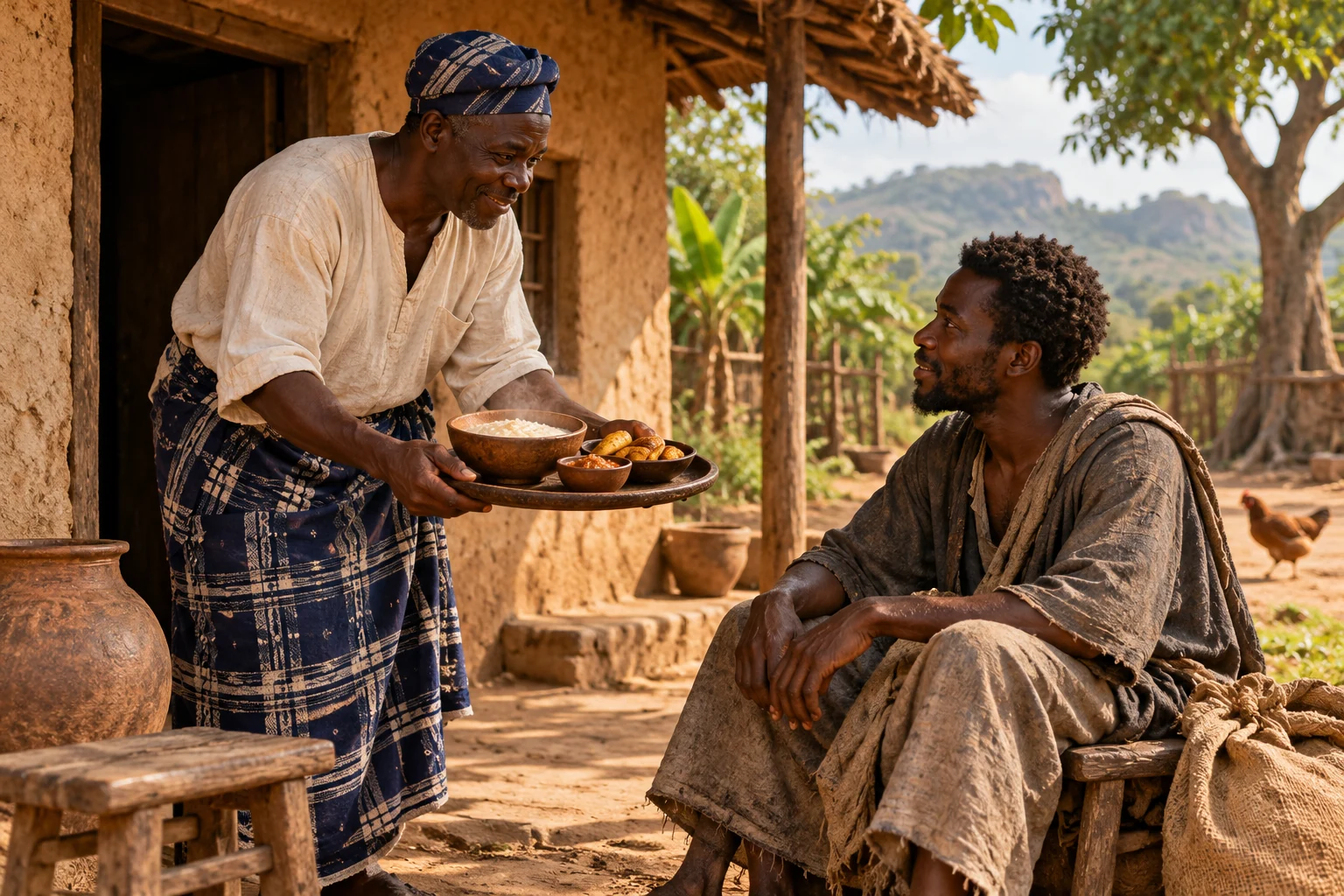
A generous farmer receives a traveler asking for shelter. During the night the guest wakes him with an inconvenient bodily need. The farmer responds patiently and offers to clean afterward rather than sending the visitor into darkness and cold. Unknown to him, the guest is Fortune, who fills the room with money and leaves. In the morning, the farmer has already prepared breakfast before discovering the unexpected gift.
Hospitality is demonstrated before the host knows the visitor’s identity or can expect a reward. The later wealth should remain a fable ending rather than a promise that kindness guarantees money. The specific force lies in the farmer’s response to inconvenience: he treats the guest’s immediate vulnerability as intelligible. A contemporary reading can retain that generosity while allowing hosts reasonable limits and practical boundaries.
Narrative setting: Spanish hospitality account.
Nomo’s return to a forbidden gathering becomes a sacred origin of silent witness
Nomo leaves for an unfamiliar place after declining counsel. He meets a man described as having severe physical impairments and reluctantly carries him home. Unexpected provisions appear, and the visitor later asks to be carried to a night gathering, explicitly telling Nomo not to return before morning. Curiosity draws Nomo back. He sees the visitor moving without the impairments he had assumed and is called into the assembly. Accused of spying, he is transformed and killed. The account connects his resulting sacred presence with a witness who sees later proceedings but cannot disclose them, giving the episode an origin function within religious objects and knowledge.
The narrative makes restricted knowledge consequential through a real night assembly, not merely through Nomo’s fear of the unfamiliar. His visitor’s apparent bodily condition does not establish the limits of that person’s power, and the provisions already challenge the traveler’s first assessment. The final origin account explains a sacred witness whose inability to speak is part of its role. These details should be presented without reproducing preparations or turning the visitor’s impairment into a stereotype about disabled people.
Compared with the earlier guest who brings Fortune, hospitality here does not lead to a simple reward; an explicit boundary within the relation is crossed. Contemporary interpretation can ask why being allowed to carry or host someone does not automatically grant access to every aspect of their life. The lethal punishment remains a severe feature of the witness, not an acceptable contemporary consequence for curiosity or a universal command against investigating religious authority.
Narrative witness and setting: Cromwell Osamaro, the traveler and the night assembly
Òrúnmìlà makes unheard petitions impossible for the deities to overlook
Òrúnmìlà works without progress and consults about the obstruction. He is told that the deities have not heard his requests. The advised response deliberately presents them with what they ordinarily reject, prompting them to ask why he is treating them this way. He answers that he has repeatedly appealed without receiving attention. They say they had not known and declare his troubles ended. The account closes in dance and praise of the diviners and Ifá. The reversal depends on a provocative act within a divined encounter, through which a complaint becomes a direct exchange rather than remaining an unanswered petition.
The episode gives the worshipper a voice in a sacred relation that has not functioned as expected. The deities are not dismissed as unreal because the requests appear unheard; instead, the relation is made explicit through a troubling, exceptional response. Their question and Òrúnmìlà’s answer transform assumed indifference into acknowledged ignorance. This should not be presented as a general permission to violate sacred prohibitions. The act is specifically counseled within this witness and gains its meaning from that particular exchange.
Compared with Nomo’s fatal entry into a restricted gathering, the new account shows a different boundary: complaint can be addressed to divine powers rather than silenced altogether. Contemporary interpretation can ask what makes a need audible to those expected to respond, while preserving the account’s actual theology of petition, provocation, and recognition. It should not reduce the sequence to customer service or promise that deliberate offense will force a desired outcome.
Narrative witness and setting: Ayo Salami, explicitly introduced verse with Spanish explanatory rendering
What was born in this Odù
“Born” can name an explicit traditional origin association or what emerges through a story: a capacity, relationship, practice or order of life. Interpretations drawn from a narrative are labelled below, so their basis remains clear.
Hospitality before a promised reward
Contemporary interpretation from the selected myth.
As a contemporary interpretation, the farmer’s welcome suggests the emergence of care offered before the visitor’s identity is known. The fable’s money is not treated as a guarantee, and the motif is not a canonical born association.
Authority becomes answerable for exclusion
Contemporary interpretation from the selected myth.
As a contemporary interpretation, the Awofaka settlement suggests an emergence of accountability for a respected authority’s mistreatment of another person. This reading critically recognizes the remaining restriction and does not endorse it as contemporary guidance.
Correlations to life dimensions
These questions bring the selected stories into contemporary life. They are interpretive invitations for study.
Work and resources
Agbaranife’s popularity is described as reducing Òrúnmìlà’s consultations. The story makes recognition feel economically competitive, suggesting why institutions need to distinguish protecting a livelihood from suppressing a person whose ability brings a different contribution. The brother’s proposed affiliation already acknowledges that relationship.
Reflect: What would collaboration offer where competition now dominates?
Relationships and family
The brothers’ shared household does not protect the less powerful one from assault. The account can support examining how familiarity is used to dismiss or control a relative, rather than assuming that family belonging guarantees equal dignity.
Reflect: Whose ability is harder for you to acknowledge because they are close?
Character and inner life
The farmer responds to interruption without first assessing whether the guest will repay him. The narrative invites attention to spontaneous regard, while avoiding a moral demand that one person always absorb the inconvenience or costs of another’s needs.
Reflect: What response would be kind and still honest about your limits?
Community and responsibility
The Awofaka settlement widens one form of access while retaining exclusion elsewhere. A responsible community must be able to recognize such partial change without treating it as a complete solution or allowing improvement to shield continuing discrimination from scrutiny.
Reflect: What barrier remains after a celebrated reform?
A deeper reading of the sacred relationships
Sacred responsibility includes both boundaries and address
Nomo receives a direct limit on returning to the night gathering, whereas Òrúnmìlà receives counsel for making a complaint to the deities. Their different outcomes should not be forced into a universal rule of either silence or defiance. Within each witness, consultation and the specific relation determine what an act means. The night assembly’s restricted knowledge and the deities’ acknowledgment of unheard petitions remain spiritual realities in the accounts. Contemporary interpretation can examine access and voice without claiming authority to decide which boundary a reader may cross. The careful explanation is relational: permission to host differs from permission to witness, and a counseled complaint differs from arbitrary offense.
An initial appearance can misstate another’s capacity
Nomo assumes that the visitor’s apparent impairments make him negligible, then encounters provisions and a night presence beyond that first assessment. The deities’ apparent refusal to respond is later described by them as lack of awareness. These are different corrections of an initial reading. The earlier stigmatized brother’s capacities add another important comparison about judging ability through an expected social form. Contemporary reflection can ask what evidence supports a judgment and what a changed encounter reveals. The source’s bodily description should not become a claim that disabled people conceal dangerous power, nor should unheard petitions be universally explained as divine ignorance. The witnesses narrate particular reversals.
Seeing and being heard distribute power differently
Nomo wants to see what has been withheld and becomes a silent sacred witness after the assembly’s punishment. Òrúnmìlà wants his requests heard and uses a divined act that provokes an answer. One sequence restricts disclosure; the other opens address. Contemporary comparison can examine why access to information and the ability to make a claim are different forms of participation. The earlier fortunate guest adds a third relation, where a household receives an unexpected presence without fully knowing what it brings. These comparisons do not reconcile every asymmetry. They make it possible to discuss knowledge and speech without reducing all sacred secrecy to oppression or every challenge to authority to liberation.
Questions that deepen the study
Does Nomo’s story prohibit questioning religious authority?
The account concerns a specific traveler who returns to a particular restricted assembly after an explicit instruction. Its origin function explains a sacred presence that sees but cannot disclose. It does not supply a universal rule against inquiry, and the neighboring Salami account gives Òrúnmìlà a direct complaint to the deities. Contemporary interpretation can distinguish curiosity, permitted access, and the right to ask for a response. The lethal punishment should be reported as the witness’s severe outcome rather than endorsed. Nor does a claim of secrecy by a living authority automatically acquire legitimacy from this story’s setting.
Can the unheard-petition episode justify offering deities what they reject?
Only as a description of the exceptional act specifically counseled in this narrative. The account does not establish a general license, and the research need not reproduce the rejected substances or turn the sequence into a procedure. Its religious point is that a relation can include a complaint that becomes audible through divination and direct address. Contemporary interpretation may ask how unmet needs are acknowledged, but should not promise that offense compels divine attention. The deities’ answer and the favorable ending belong to this witness’s episode, not a universal guarantee attached to repeating its outward form.
Why keep the visitor’s bodily description without making it a stereotype?
The description explains Nomo’s initial dismissal and the shock of seeing the visitor move differently at the gathering. It is therefore part of the narrative sequence. The inference that disabled people generally conceal danger or supernatural power does not follow. Contemporary interpretation can identify the failed assessment while leaving actual people outside the tale’s classification. The same care applies to the deities’ apparent silence: one episode’s explanation is not a universal diagnosis. An authoritative article can preserve difficult source details, explain their function, and state the limit of the comparison without erasing the witness’s spiritual world.
What the four narratives reveal together
The additional Òwónrín Òṣé witnesses place restricted seeing beside a demand to be heard. Nomo crosses an explicit boundary and becomes part of an origin account for silent sacred witness; Salami’s Òrúnmìlà brings unheard petitions into direct exchange with the deities. The earlier stigmatized brother and fortunate guest add other mismatches between appearance, capacity, and reception. The comparison is strongest when neither secrecy nor challenge becomes an absolute rule. Each account gives a specific relation and a specific counsel its force. Contemporary interpretation can examine access, address, and the assumptions that make another’s capacity invisible, while retaining the actual night assembly and divine dialogue. The severe punishment, the visitor’s bodily description, and the exceptional use of rejected offerings require careful limits rather than endorsement, diagnosis, or an instruction to repeat the narrative’s acts.
Living with this Odù
A continuing life or initiatory relationship
For someone carrying Òwónrín Ọ̀ṣẹ́ within a received spiritual history, recognition may expose the gap between another’s capacity and the institution’s willingness to receive it. Agbaranife’s ability unsettles his brother’s standing, and mediation changes access while retaining an exclusionary restriction. The witness’s discriminatory premise cannot become a rule for judging contemporary identity or a definition of Awofaka as priestly initiation. The hospitable farmer offers a different relation to another’s needs, meeting inconvenience before knowing who the guest is.
Nomo’s encounter introduces restricted knowledge and a severe sacred consequence, but its treatment of bodily impairment cannot justify suspicion toward actual disabled people. Ayọ̀ Salami’s unheard-petition witness then gives complaint an active religious place: Òrúnmìlà’s response changes unanswered appeal into a direct exchange with the deities. Across a life, reflection may concern threatened status, patient welcome, a boundary of access, or the need to make a request intelligible. The person is not fixed as excluded or specially rewarded. The sign invites character able to acknowledge ability without defending prestige at another’s expense, and to distinguish a living sacred encounter from an automatic rule about who may speak or belong.
A particular consultation and its question
In consultation, Òwónrín Ọ̀ṣẹ́ can help distinguish a person’s demonstrated capacity from the status a particular institution permits. The brother’s settlement remains restricted, so its resolution cannot validate the discriminatory premise or determine the client’s eligibility. The farmer’s encounter instead asks how hospitality responds before the recipient’s identity or possible reward is known. These are different configurations of recognition.
Nomo’s forbidden return adds the relation between access and a stated limit, while its violent sacred ending cannot authorize punishment or tell an interpreter that a disabled visitor conceals deception. Ayọ̀ Salami’s verse adds a complaint unheard by the deities and made consequential through a divined encounter. It is not a general license to provoke sacred powers or manipulate another’s attention. A practitioner may examine whether the client’s request has been heard, whether prestige is obstructing recognition, and which boundary actually belongs to the relationship. The actual question supplies the context. Consultation does not identify Fortune in a stranger, promise money for hospitality, or turn a narrative restriction into a permanent spiritual verdict on a person. The different witnesses remain open as precedents rather than one rule of admission.
Constructive and adverse possibilities
Constructive unfolding may include ability acknowledged without rivalry controlling the response, hospitality that attends to need before reward, and a petition becoming a direct sacred exchange. In Ayọ̀ Salami’s witness, the deities’ acknowledgment changes the relation rather than merely affirming the speaker’s private confidence.
Adverse unfolding can involve an institution protecting status through exclusion, another’s inconvenience treated as grounds for contempt, or access assumed to erase a stated boundary. The Agbaranife account’s restriction remains an ethical problem rather than a universal initiation principle. Nomo’s bodily description likewise cannot establish a real person’s concealed capacity or trustworthiness. These contrasts preserve the gravity of exclusion and the specificity of sacred knowledge. They neither promise wealth nor prescribe provocation, and they do not determine a real reading’s constructive or adverse condition. Recognition and religious status remain distinct questions requiring situated understanding.
An illustrative situation in everyday life
Imagine a hypothetical training circle where an outsider demonstrates a useful ability and attracts people who once depended on the founder. The outsider asks for a recognized place, but the founder treats the request as a threat and invokes a restriction that the group has never examined. Agbaranife’s account makes the conflict between capacity, status, and exclusion visible without validating the restriction. The unheard-petition witness adds the question of whether a request has actually entered an intelligible exchange. The founder may fear becoming unnecessary; the applicant may need acknowledgment without accepting humiliation. An accountable discussion could address both standing and the basis of the rule. This illustration does not decide an actual initiation’s terms or turn sacred protest into a manipulative technique.
Sources and reading context
The first two narrative witnesses
The first account is labeled Cuban and contains discriminatory claims about gender expression and initiation; these are critically contextualized, not endorsed. Its note also misdefines Awofaka as priestly initiation. The only explicit born item is exclusionary, so two contemporary emergence interpretations are given instead.
Narrative motifs are summarized independently. The life-dimension reflections are contemporary interpretation. How these reference studies are built explains the wider source approach and the distinction between a reference article and personal divination.
Additional named witnesses
-
Cromwell Osamaro. Explicit heading supports Nomo’s travel, visitor, night assembly, and sacred origin sequence.
-
Ayo Salami. Explicit heading precedes the verse and Spanish rendering about unheard petitions and divine acknowledgment.
Nomo’s ending is summarized without object preparation or violent procedure. The visitor’s impairment is not generalized. Salami’s counseled exception is not a license to violate prohibitions, and no materials or ritual instructions are supplied.
Bibliographic identification
-
C. Osamaro Ibie. Ifism: The Complete Work of Orunmila. Lagos; multivolume publication beginning 1986. Library catalogue record. Related bibliographic record for the named narrative witness. Exact volume, edition and page of the transmitted account have not been independently matched.
-
Ayo Salami. Ifá: A Complete Divination. Lagos: NIDD, 2002 catalogue record. Library catalogue record. Bibliographic identification of the named author and work; the edition behind the transmitted account remains to be matched.
Read the source method and wider scholarly context.
The catalogue links identify published works and their authors. They are separate from proof of an individual episode’s wording or attribution. Contemporary comparisons and the synthesis above are editorial interpretation. The author’s books and Academy companions below provide further study; their sales links are separate from the source references.