
Òwónrín Ìrẹtẹ̀ is a mixed Odù in Ifá’s 256-part corpus. Òwónrín Ìretè’s selected narratives set inheritance beside the obligations and limits of rescue. A younger son wastes his share, returns hungry, and is welcomed by a father whose older son resents the apparent unfairness. In another account, guards dismiss a warning about a prince’s river bathing and later must seek an Awó to rescue him. Both stories ask how assistance should recognize prior conduct without making error a reason to abandon a person in need.
A question to carry through the study: How can you welcome someone back while also recognizing those who remained responsible?

This Academy reads the right column first, then the left. Each row carries a single or double mark.
Where this Odù belongs
Òwónrín Ìrẹtẹ̀ belongs to the Òwónrín family in this Academy’s study sequence. It is a mixed Odù, distinct from Ìrẹtẹ̀ Òwónrín. The order matters. Its teaching is approached through its own narratives, rather than by adding two general descriptions of the principal signs together.
Key Òrìṣà and sacred relationships
The figures below are selected for their roles in the accounts discussed here. They offer connected reading paths through the tradition.
-
Ọ̀rúnmìlà. Òrúnmìlà warns the younger son before his losses and alerts the ruler to the river danger through the returning news. His role is counsel whose value is not recognized before a crisis.
-
Èṣù. Èṣù is explicitly included in the traveling Awó’s preparation before the encounter with the guards. The association is narrow and not expanded into an unseen rescue scene.
Key myths and their meanings
The return that angers the faithful sibling
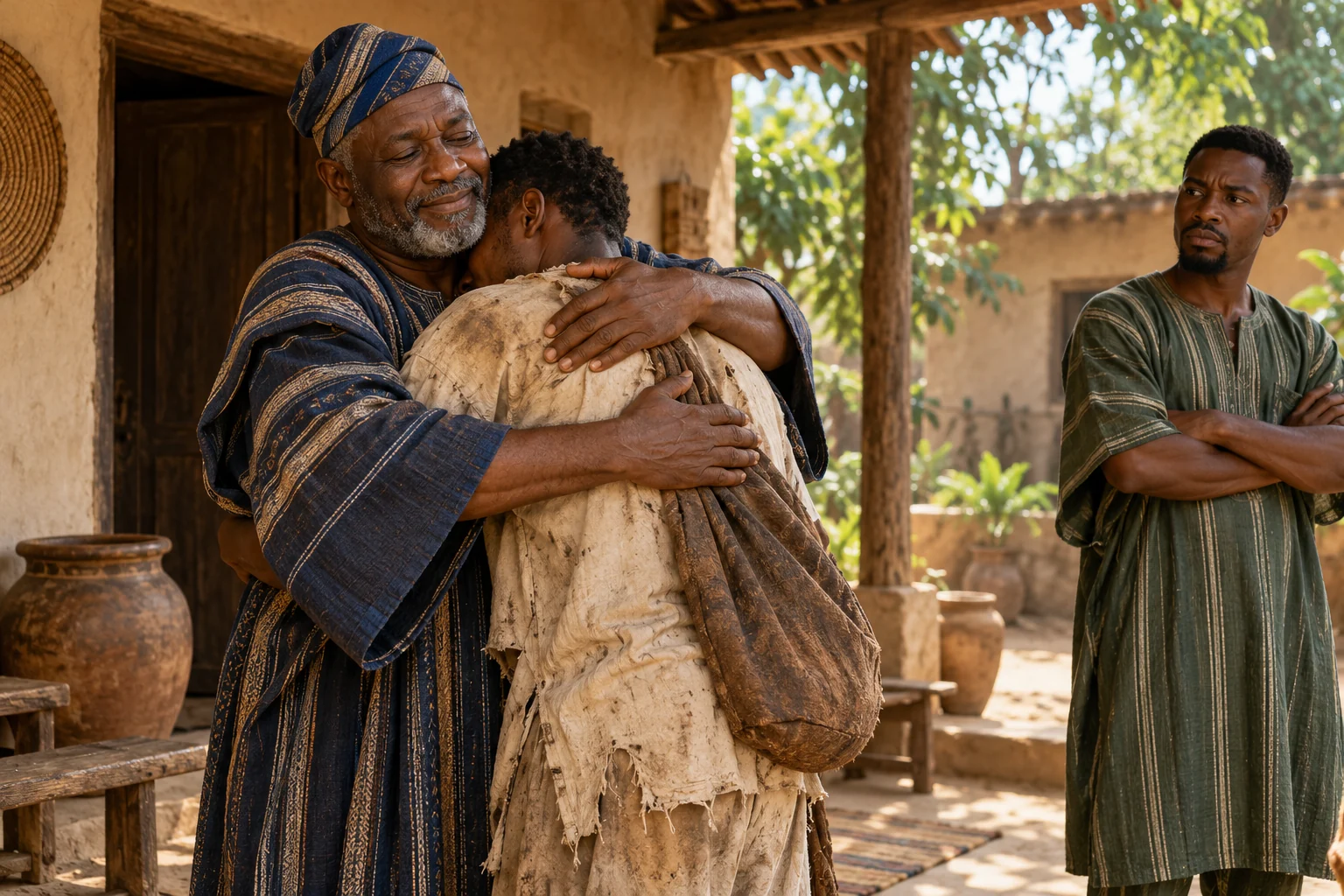
A younger son receives his inheritance, leaves, and disregards counsel before wasting his capital. A famine exposes his dependence, and he returns intending to ask for work rather than restored status. His father embraces him and celebrates. The older son, who has continued laboring, refuses to join the feast. The father affirms his standing while insisting that the lost brother’s return deserves joy.
The episode carries the recognizable structure of the Christian prodigal-son parable into a setting that includes consultation with Òrúnmìlà. Its ethical tension is not resolved by calling the older son ungenerous: continued service also needs recognition. A careful reading can ask how welcome after failure and fairness toward those who carried responsibility might coexist, without making deprivation a necessary lesson or affection a wage.
Narrative setting: Spanish adaptation of the prodigal-son motif.
The warning the guards believed they could replace
A traveling Awó’s encounter with three guards reaches the ruler, who consults Òrúnmìlà and is told to keep his son from the river. The guards believe their presence is sufficient. When the prince becomes trapped in the depths, they cannot rescue him and seek the Awó. He asks for payment before joining them and succeeds within the account, afterward receiving further recognition from the ruler.
The guards confuse confidence in their role with the capacity required by a particular danger. The rescue also raises a question about bargaining when someone’s need is urgent and unequal power is unavoidable. A responsible reading can recognize specialist labor without treating every demanded price as fair simply because help succeeds. The religious rescue is not a model for real water emergencies or a guarantee of efficacy.
Narrative setting: Spanish river-rescue account.
The rooster wins the digging contest but cannot return his bride unchanged
A tall rooster seeks Ser-ege, the sea deity’s child. Her parent makes completion of farm rows the marriage condition. The rooster responds to counsel and enters late. Rivals repeatedly break his hoe through words, but replacement tools and Èṣù’s intervention let him finish first. Ser-ege welcomes him. The defeated rivals then plot on the road and push him into water. Trying to protect her, he has placed her in his mouth and swallows her during the fall. At home he calls for her to emerge, but she becomes the long tail feather instead. Victory in the contest does not preserve the marriage in its expected form.
The account’s ending changes the meaning of the contest. Finishing first and receiving the bride do not complete the danger anticipated by counsel. Words act on hoes, Èṣù opens intervals of advantage, and the final calling becomes part of an origin account for the rooster’s voice and feather. These are real sacred transformations within the witness, not merely a lesson about a winner becoming boastful. Ser-ege’s expressed welcome also matters, even though her parent sets the contest and the ending transforms her into a feature of the rooster.
Compared with the earlier returning son and endangered prince, the new episode gives return an irreversible cost rather than a full restoration. Contemporary interpretation can ask what happens when success is defined too narrowly at the moment of acquisition. It should not blame the transformed bride, endorse her treatment as a prize, or merge this Bascom sequence with the adjacent Osamaro variant, whose competitors, interventions, and ending differ.
Narrative witness and setting: William Bascom, the tall rooster and Ser-ege
Sea hosts the head service while rivers neglect their own
Sea receives counsel to attend to his head, invite others, and maintain certain limits during the occasion. He completes the response and receives the invited practitioners. The rivers are also advised to attend to their own heads but go to help Sea without doing so. Lake alone completes its own response and does not join Sea’s gathering. The rivers drink after the ceremony and move toward Sea. The account explains their flow as a relation of dependence on Olókun, while Lake’s independence follows its different response. A shared gathering thus produces different positions within a sacred account of waters.
The distinction is not simply between sociability and isolation. Sea hosts a religious responsibility that belongs to him, while the rivers fail to establish their own relation before attending his. Lake’s independence is consequently narrated through a completed response, not through superior force or contempt for others. The story gives Orí and the direction of water a shared sacred frame. Compared with the earlier guards who ignore a warning around a prince, it concerns a quieter displacement of responsibility through participation in another’s occasion.
Contemporary interpretation can ask whether supporting a powerful center has replaced attending to one’s own obligations. It should not turn Lake into a universal ideal of self-sufficiency or use the story to claim that all rivers scientifically end at sea. The source supplies a cosmological relationship among personified waters, and the terminology of dependence should remain attached to that account rather than imposed as a personal prohibition against communal help.
Narrative witness and setting: Cromwell Osamaro, Sea, rivers, and the independent lake
What was born in this Odù
“Born” can name an explicit traditional origin association or what emerges through a story: a capacity, relationship, practice or order of life. Interpretations drawn from a narrative are labelled below, so their basis remains clear.
Religious inheritance
Selected traditional source association.
The explicit origin list names a dynasty or succession of religious inheritance. This local association can frame continuity of responsibility, but does not prove that descent alone establishes competence or that every lineage uses the same inheritance structure.
Welcome after a failed independence
Contemporary interpretation from the selected myth.
As a contemporary interpretation, the returning son’s reception suggests an emergence of belonging that survives failure. This reading retains the older brother’s fairness question and does not present the adapted parable as a traditional born-list claim.
Correlations to life dimensions
These questions bring the selected stories into contemporary life. They are interpretive invitations for study.
Work and resources
The younger son treats inherited resources as independence without a sustainable arrangement. The older son’s continued field work then makes fairness a question of labor as well as property, requiring attention to what each has contributed and what each needs now.
Reflect: What responsibility accompanies a resource received without earning it?
Relationships and family
The father welcomes the returning son while the older brother stands outside. A family’s generosity toward one person can feel like disregard toward another if ordinary loyalty has gone unacknowledged; both relationships need direct attention.
Reflect: Who needs acknowledgment when someone else receives a second chance?
Character and inner life
The guards believe confidence and official standing can replace a specific warning. The account asks whether a person knows the limits of their competence before an urgent event reveals them, rather than judging readiness by courage or title alone.
Reflect: What situation is beyond the capacity your role usually requires?
Community and responsibility
The rescuer’s fee is negotiated during danger. Communities should support necessary expertise before emergencies, reducing dependence on bargaining at the moment when one party has the least freedom to refuse or evaluate terms. The guards’ earlier assurance has left no alternative ready.
Reflect: What provision would make urgent help less dependent on unequal bargaining?
A deeper reading of the sacred relationships
Orí remains a responsibility amid relations with others
Sea’s ceremony and the rivers’ response make the head a focus of sacred responsibility, not simply a metaphor for private ambition. The rivers participate in another’s occasion without completing their own counsel, while Lake’s separate response yields a different relation. Bascom’s rooster also receives counsel whose significance extends beyond the initial contest. Together the witnesses give religious preparation distinct purposes and continuing consequences. Contemporary explanation can discuss the difference between helping and neglecting oneself, but should not replace Orí with a purely psychological idea of self-care. Nor does the narrative permit an article to infer a reader’s destiny or prescribe withdrawal from an actual community.
Winning an event does not settle the journey afterward
The rooster finishes first, receives Ser-ege, and still encounters the rivals’ attack on the road. The earlier returned-son narrative offers a more favorable homecoming, while the prince’s danger shows how ignored warnings can shape a passage. These differences prevent return from becoming one generic symbol of success. Contemporary interpretation can ask what remains exposed after a public victory or formal decision. The source’s final transformation should retain its irreversibility: Ser-ege does not simply step out unharmed after the threat. An authoritative comparison can recognize the sacred origin account while refusing to call the ending complete marital fulfillment or supply a recovery the witness does not narrate.
Participation can redistribute dependence without an explicit conquest
The rivers move toward Sea after joining the ceremony, whereas Lake retains a different position. No military defeat is narrated. The rooster’s competitors, by contrast, turn a lost contest into direct violence. These are distinct ways a relation changes: dependence through an unfinished responsibility, and injury through refusal to accept an outcome. Contemporary comparison can examine whether a person recognizes what a gathering or competition leaves unresolved. It should not equate every communal event with domination or every disappointed rival with an attacker. The witnesses provide specific sequences, and the religious account of waters remains different from the social conflict among the rooster’s competitors.
Questions that deepen the study
Should the Bascom rooster story be blended with the adjacent Osamaro version?
No. Both involve a courtship contest and threatened tools, but Bascom’s selected account includes Èṣù’s prepared intervention, an attack at the river, the swallowing of Ser-ege, and her transformation into a tail feather. The adjacent version develops different interventions and later episodes. Blending them would create a composite that neither witness actually tells. Contemporary comparison may identify shared motifs while keeping the sequences separate. The distinction also matters to interpretation: Bascom’s ending does not leave the bride simply restored, so a summary should not borrow a happier or more straightforward outcome from another account.
Does Lake’s independence mean people should refuse communal obligations?
The account contrasts different responses to counsel, not a universal virtue of refusing invitations. Sea completes his own responsibility, the rivers neglect theirs before helping him, and Lake completes its response separately. Contemporary interpretation can ask whether participation has displaced an obligation that cannot be transferred to another person. That is narrower than advising isolation or denying the value of shared work. Within the witness, the explanation concerns heads, Olókun, and personified waters. It should not become a personal rule that readers must avoid another’s ceremony, nor a scientific claim about all lakes and rivers.
Why retain Ser-ege’s welcome when the ending transforms her?
Her response shows that the account does not present the marriage solely as a contest among rivals and a parental award. She welcomes the rooster after he finishes. The later transformation nevertheless limits her narrated agency and makes her part of his bodily origin story. Keeping both details permits a more exact reading than either erasing her preference or treating the final outcome as an uncomplicated reward. Contemporary interpretation can ask how a desired relation changes when violence interrupts it. The source does not narrate her later speech or restoration, so an article should not invent either to resolve that tension.
What the four narratives reveal together
The added Òwónrín Ìrẹtẹ̀ witnesses distinguish an achieved event from the relations that continue afterward. Bascom’s rooster wins the contest but returns with Ser-ege transformed, while Osamaro’s rivers join Sea’s occasion without completing their own responsibility and enter a relation of dependence. The earlier family return and prince’s rescue add other outcomes of passage and recognition. Their comparison is strongest when the differences remain intact: a contest, an attack, a head service, and a flow of waters are not one interchangeable lesson.
Religious logic includes consequential words, Èṣù’s intervention, Orí, and Olókun. Contemporary interpretation can examine what victory or participation leaves unresolved while acknowledging Ser-ege’s limited agency, preserving distinct variants, and refusing to turn a sacred water account into hydrology or a general instruction to withdraw from communal life. The rooster’s continuing voice recalls a return whose loss has not been undone.
Living with this Odù
A continuing life or initiatory relationship
A received relationship with Òwónrín Ìrẹtẹ̀ can sustain attention to the different claims present in a return. The younger son seeks work after wasting resources; the father’s welcome does not erase the older sibling’s continuing labor. Because this witness adapts the prodigal-son motif, its comparative value does not establish an independent ancient Ifá origin. The river account then distinguishes a warning from the guards’ confidence that their presence can replace it, while the rescuer’s demand for payment introduces the conditions of timely help.
The rooster’s contest adds a desired victory whose later passage does not preserve the relationship as expected. Sea’s head service gives another distinction: helping at another’s gathering cannot automatically fulfill one’s own sacred responsibility. Lake’s different relation remains consequential without making independence a universal moral superiority. Across a life, reflection may concern welcome, fair acknowledgment, preparation, or the limits of success. The person is not destined for reckless departure or a faithful sibling’s resentment. The sign invites character able to receive a return without forgetting those who remained, and to distinguish obtaining a benefit from carrying it safely into continuing life.
A particular consultation and its question
In consultation, Òwónrín Ìrẹtẹ̀ can distinguish the wish to restore belonging from an assumption that every earlier standing must return unchanged. The father welcomes the younger son while acknowledging the older one; a present situation still requires attention to what each has carried. The river witness adds a different problem, where confidence in personnel displaces a specific warning and later assistance has terms. The actual question determines which issue matters.
The rooster’s completed rows and subsequent loss separate winning a condition from sustaining the desired relationship through the journey home. Bascom’s sacred account cannot become a prediction about a client’s marriage or a rule for contesting partners. Sea, rivers, and Lake add the possibility that participating in another’s religious occasion has left one’s own head unattended. That is a particular sacred configuration, not a generic injunction toward self-interest. A practitioner can examine what the client seeks to regain, what responsibility remains personal, and what a successful first stage has left unfinished. These questions do not identify an unknown rescuer’s motives, predict a river danger, or confer a permanent identity. Consultation remains a situated result within its own religious and practical context.
Constructive and adverse possibilities
Constructive unfolding may include welcome that also hears sustained labor, a warning treated as more than redundant advice, and help received with its actual terms understood. Lake’s separate response preserves one sacred relation while the rivers’ attendance at Sea’s gathering leads toward another.
Adverse unfolding can involve a return used to erase earlier consequence, confidence substituting for preparation, or success at a contest mistaken for security in every later passage. The rooster’s transformed outcome remains more complex than simple victory or failure. The source’s service of the head cannot establish that every dependent relation follows spiritual neglect. These contrasts make belonging, timing, and continuing responsibility distinguishable without promising restoration or declaring the sign favorable or adverse. The adapted prodigal witness also remains a distinct narrative strand rather than evidence of one uniform origin for all the selections.
An illustrative situation in everyday life
In a hypothetical example, an adult returns to a family enterprise after an unsuccessful venture. The parent welcomes him enthusiastically, while the sibling who maintained the business feels that years of work have vanished from recognition. The returning-son account permits welcome and acknowledgment to coexist without making either person’s feeling the whole arrangement. Sea’s gathering adds a different question if the returning member immediately devotes himself to another project while leaving his own commitments unclear. The inner conflict involves shame on one side and feared disposability on the other. Clarifying roles and recognizing the sustained work could change the external conditions of return. This illustration does not validate an inheritance claim, forecast reconciliation, or equate a family enterprise with sacred waters.
Sources and reading context
The first two narrative witnesses
The Spanish return narrative is an evident adaptation of the Christian prodigal-son motif, rather than independent evidence of an ancient Ifá origin. The river account is distinct. A single explicit born association is supplemented by a labeled contemporary emergence reading.
Narrative motifs are summarized independently. The life-dimension reflections are contemporary interpretation. How these reference studies are built explains the wider source approach and the distinction between a reference article and personal divination.
Additional named witnesses
-
William Bascom. Explicit heading supports the tall rooster, Ser-ege, contested digging, and final feather transformation.
-
Cromwell Osamaro. Named heading governs the Sea-rivers-Lake head-service account.
Bascom’s variant is kept separate from the adjacent rooster accounts. Gendered marriage conditions and transformation are described without endorsement. The waters are sacred personifications, not hydrological evidence or a personal ban on attending communal occasions.
Bibliographic identification
-
C. Osamaro Ibie. Ifism: The Complete Work of Orunmila. Lagos; multivolume publication beginning 1986. Library catalogue record. Related bibliographic record for the named narrative witness. Exact volume, edition and page of the transmitted account have not been independently matched.
-
William Bascom. Ifa Divination: Communication between Gods and Men in West Africa. Bloomington: Indiana University Press, 1969. Library catalogue record. University library record for the named scholar’s Ifá study; citation does not imply a verified page for every narrative summarized here.
Read the source method and wider scholarly context.
The catalogue links identify published works and their authors. They are separate from proof of an individual episode’s wording or attribution. Contemporary comparisons and the synthesis above are editorial interpretation. The author’s books and Academy companions below provide further study; their sales links are separate from the source references.