
Òwónrín Òfún is a mixed Odù in Ifá’s 256-part corpus. Òwónrín Òfún’s selected accounts place agriculture and trade inside relationships that cannot be ignored. Òrúnmìlà’s successful field is damaged, and a response involving a termite spirit becomes the account’s origin of iyefá. A merchant enters a new settlement without learning its tribute obligations and comes into conflict with Elegbara, its ruler. Both stories connect a useful resource with the terms under which it can be cultivated, carried, or exchanged among others.
A question to carry through the study: What relationship or obligation have you omitted from your plan to begin somewhere new?

This Academy reads the right column first, then the left. Each row carries a single or double mark.
Where this Odù belongs
Òwónrín Òfún belongs to the Òwónrín family in this Academy’s study sequence. It is a mixed Odù, distinct from Òfún Òwónrín. The order matters. Its teaching is approached through its own narratives, rather than by adding two general descriptions of the principal signs together.
Key Òrìṣà and sacred relationships
The figures below are selected for their roles in the accounts discussed here. They offer connected reading paths through the tradition.
-
Ọ̀rúnmìlà. Òrúnmìlà cultivates land in Araoko and responds to damage through consultation and a relation with Kurubole, the termite spirit. The narrative connects agricultural material with divinatory practice.
-
Èṣù. Elegbara governs the merchant’s new settlement, enforces an unacknowledged tribute, and later returns the goods while recognizing the trader elsewhere. His conduct raises questions about authority as well as the newcomer’s obligations.
Key myths and their meanings
A damaged field becomes a divinatory material
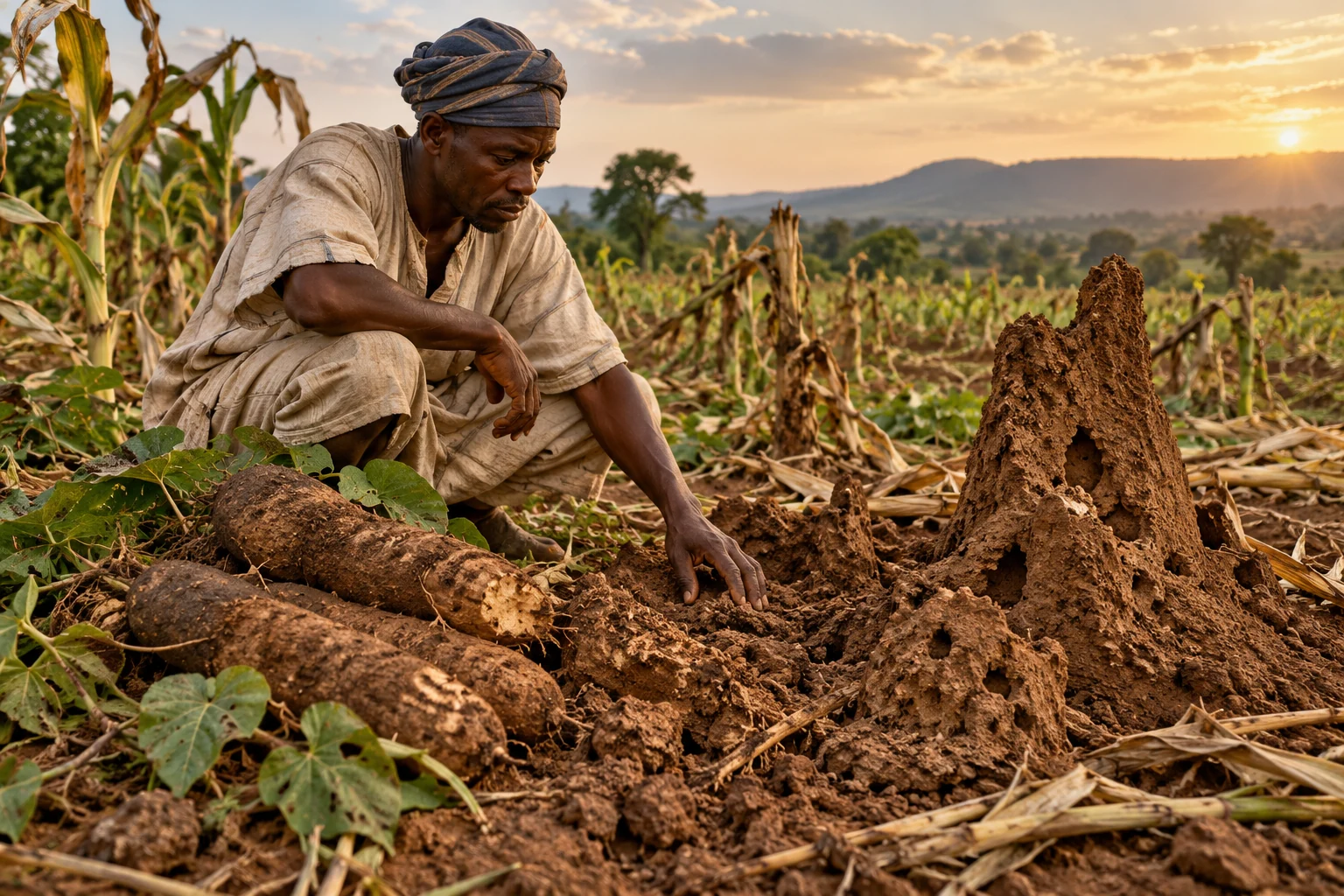
Òrúnmìlà moves to Araoko, a land of farmers, and plants a productive field. Neighbors resent its success, and pests overwhelm the crops. Consultation directs him into a relationship with Kurubole, a termite spirit. Through the narrative’s religious transformation of surviving yams, the cultivated material becomes iyefá and a means of overcoming opposition. The account connects farming, ground, insects, and the divining board.
The field is not merely a backdrop for sacred practice: its material becomes part of the practice’s account of itself. A careful reading can examine relationships between cultivation and knowledge while leaving the claim of hostile causation inside the story. It should not diagnose crop failure as a neighbor’s envy, supply a preparation procedure, or treat one sacred origin as an exhaustive history of divinatory powder.
Narrative setting: Spanish sacred origin of iyefá.
The trader who did not learn the settlement’s terms
A merchant whose business has failed moves to a settlement ruled by Elegbara. He establishes himself without paying the customary tribute or consulting others. Elegbara visits and removes a valuable necklace from the goods. The merchant initially declares conflict, then learns who the visitor is and returns home. Elegbara later restores the merchandise and gives him recognized standing in his original land.
Arrival brings obligations, but the ruler’s removal of property also deserves scrutiny rather than automatic approval. The story gives no transparent process for learning or challenging the dues before sanction. The useful question is how newcomers discover local terms and how authorities enforce them fairly. Its eventual reward is a narrative reversal, not evidence that every imposed charge is legitimate or that leaving always brings recognition.
Narrative setting: Account explicitly labeled Cuba.
A heavenly loan becomes a communal responsibility on earth
Before coming to earth, Òwónrín fears that he cannot complete the required preparation. He borrows from Elenini, who warns him to repay. On earth he becomes both a practitioner and a priest of a communal divinity, but does not prosper or discharge the debt. Returning to heaven, he is detained by the creditor. His guardian provides repayment and directs him more fully toward the communal role. He receives instruction and sacred objects connected with that divinity. Back on earth, households contribute to a shared feast, prosperity returns to the settlement, and an annual ceremonial arrangement is established through collective participation.
The debt is not erased by pretending the creditor is only a malevolent obstacle. Elenini supplied the means for the original preparation and later requires the promised return. The guardian’s rescue then opens a clearer relation to the protagonist’s communal office. The account therefore joins pre-earthly exchange, earthly vocation, and household contributions without reducing them to one private transaction. Compared with the earlier merchant’s neglected tribute, this episode makes the outstanding obligation originate before arrival on earth and resolves it through a guardian before a wider communal response.
Contemporary interpretation can ask whether a role has been accepted without the relationships needed to sustain it. It should not announce that a reader owes a heavenly debt or use the story to justify unrestricted demands on a community. The translated name and description of the communal divinity remain uncertain, and the narrative’s restricted knowledge should be acknowledged without inventing a lineage or reproducing ceremonial procedures.
Narrative witness and setting: Cromwell Osamaro, the debtor and Umole-ilu
A royal diviner obtains his own sacred regalia through a false commission
A royal diviner consults for himself and is advised to obtain regalia for his own response. Rather than pay for them, he presents the requirements to the ruler as though they belong to palace work. He takes the goods home and boasts that he possesses everything the king has. The ruler then consults Òrúnmìlà. After the response, Èṣù first creates a reason for gratitude at the diviner’s house, then borrows the ornaments for an occasion. Palace officers arrest Èṣù for unauthorized royal dress, and the goods return to the ruler. The practitioner’s deception is reversed through another carefully staged exchange.
The initiating wrong is not the diviner’s possession of sacred objects but the misuse of a client’s trust to fund a personal requirement. Professional knowledge gives him the means to disguise the transfer, and boasting makes the concealed act publicly legible as a challenge to the ruler. Èṣù’s later borrowing reverses the movement without the original client simply seizing goods by force. The narrative also makes gratitude a source of exposure: after receiving help, the practitioner agrees to lend what he had improperly acquired.
Compared with the earlier termite-origin account, the new story concerns the ethics of an existing religious office rather than the emergence of a substance. Contemporary interpretation can discuss conflicts of interest and the separation of personal need from commissioned work. It should not accept the compilation’s later warning against generosity as the only lesson, nor turn the recovery into an endorsed method of entrapment or a claim that every regalia dispute conceals fraud.
Narrative witness and setting: Cromwell Osamaro, palace goods and the borrowed ornaments
What was born in this Odù
“Born” can name an explicit traditional origin association or what emerges through a story: a capacity, relationship, practice or order of life. Interpretations drawn from a narrative are labelled below, so their basis remains clear.
Funerary administration
Selected traditional source association.
The explicit born list names deaths and mortuary arrangements. This places practical responsibility around death within the sign’s local field, without predicting a death, reproducing funeral procedures, or assuming identical practice across communities.
Iyefá
Selected traditional source association.
The list names iyefá’s secret, and the agricultural narrative supplies one sacred origin account. Only the association between cultivated material and divination is retained; restricted combinations, preparation, and claims of efficacy are not reproduced.
Correlations to life dimensions
These questions bring the selected stories into contemporary life. They are interpretive invitations for study.
Work and resources
The merchant moves after failure but carries incomplete knowledge of the new settlement’s economy. The story makes local relationships part of business preparation, while the field account shows a resource becoming meaningful through more than its sale value.
Reflect: What must you learn about a place before beginning work there?
Relationships and family
The trader’s conflict changes when other merchants explain who Elegbara is. Peer knowledge supplies context that the newcomer lacked, making orientation and shared information important forms of support rather than leaving each arrival to discover every rule through punishment.
Reflect: Who can help a newcomer understand the local terms?
Character and inner life
The merchant’s first response to the missing goods is confrontation before inquiry. The narrative invites a pause to understand an event, while still allowing criticism of the authority that created the confrontation through unilateral action.
Reflect: What do you need to understand before deciding how to respond?
Community and responsibility
Tribute obligations are known to established traders but not made clear to the newcomer in the account. Communities have a responsibility to make consequential rules accessible and challengeable, especially when sanctions can threaten someone’s entire livelihood.
Reflect: How can someone learn and question a rule before being punished?
A deeper reading of the sacred relationships
Sacred exchange does not remove the specificity of a debt
The heavenly loan has a lender, a purpose, and a promised repayment. The guardian’s help pays that obligation before the communal work is renewed. In the palace account, the diviner also has a personal requirement, but transfers its cost to someone else through a false claim. Both concern resources for religious action, yet their legitimacy differs. This is part of the witness’s religious logic: an offering is not detached from how its means were obtained or whom an obligation actually concerns. Contemporary explanation can discuss accountability while preserving Elenini, the guardian, the communal divinity, and Èṣù as real agents within the accounts rather than mere names for financial behavior.
A communal contribution needs an intelligible relation to its purpose
The households’ contributions support a named communal office and shared feast after the protagonist receives renewed instruction. The royal diviner instead hides the personal purpose of his request. These sequences distinguish collective support from misrepresented funding. The earlier merchant’s tribute story adds another form of payment linked to standing within a place. Contemporary interpretation can ask who knows what a contribution is for and who benefits from it. The narratives do not provide a modern accounting system or authorize unlimited demands by religious officials. Their useful contrast lies in whether the relation between request, purpose, and beneficiary is disclosed or concealed.
Recovery can expose a second vulnerability
The heavenly debtor needs a guardian’s assistance before returning to a more effective communal role. The fraudulent practitioner receives help in a staged encounter and then lends the goods through gratitude, enabling their recovery. Help therefore enters very different relations: one resolves an acknowledged debt, while the other makes a concealed appropriation reversible. Contemporary comparison can ask whether a favorable encounter clarifies responsibility or merely changes who holds a resource. It should not conclude that gratitude is dangerous in itself. The palace sequence concerns particular improperly acquired goods, and the source does not establish that every generous loan will lead to loss or that suspicion is the proper response to all assistance.
Questions that deepen the study
Does the heavenly-loan account establish that readers have debts to Elenini?
It establishes one protagonist’s pre-earthly borrowing, warning, detention, and repayment within this witness. An article has no basis to transfer those particulars to a reader. The account can explain how sacred exchange and vocation are related without announcing an unseen liability or demanding payment. Contemporary interpretation may ask whether an accepted role includes obligations that have been left unclear. The guardian’s intervention and communal renewal remain actual religious events in the narrative, not evidence that any financial difficulty must have a heavenly creditor. The precise identity and name of the communal divinity also remain limited by the translation.
What is wrong with the royal diviner’s request if the objects are religiously required?
The requirement belongs to his own consultation, but he presents it as palace work and makes the ruler supply it. The issue is therefore the hidden transfer of a personal cost through professional authority. The source does not condemn religious objects or the practice of receiving resources for legitimate work. Contemporary interpretation can recognize a conflict between a practitioner’s need and a client’s informed understanding. The later boast makes the appropriation visible as more than an innocent misunderstanding. The recovery through Èṣù belongs to the narrative’s sacred reversal and should not be offered as a practical method for settling an actual dispute.
Why does the favorable heavenly return involve the whole settlement?
The guardian redirects the protagonist toward a communal priestly role, and the renewed work requires households to participate in a shared feast. The outcome is described as prosperity for the people as well as the practitioner. That makes the role wider than a private career correction. Contemporary reflection can ask what support and accountability accompany a communal office, while refusing to infer that every community must fund whatever an official requests. The palace-diviner episode supplies a direct contrast in which a religious request conceals its personal beneficiary. Both accounts require attention to the actual relation between responsibility, resources, and those expected to contribute.
What the four narratives reveal together
The added Òwónrín Òfún accounts make the origin and purpose of religious resources consequential. A heavenly borrower receives help to repay and returns to a communal office sustained by household participation. A royal diviner hides his personal requirement inside a client’s commission, and Èṣù reverses the appropriation. The earlier tribute and termite-origin stories add other relations among standing, payment, and sacred materials. These selections resist the idea that an offering’s religious purpose makes every means of obtaining it equivalent. Within the witness, creditors, guardians, communal powers, and Èṣù act in specific exchanges. Contemporary interpretation can examine disclosure and responsibility without announcing invisible debts, authorizing unlimited contributions, or treating gratitude as inherently unsafe. The uncertain communal-divinity terminology and the account’s restricted dimensions should remain visible limits rather than occasions for invented precision.
Living with this Odù
A continuing life or initiatory relationship
For someone whose received life or initiatory history includes Òwónrín Òfún, a changed situation can require another relation to what has been cultivated or entrusted. Òrúnmìlà’s damaged field becomes a divinatory material through Kurubole’s particular agency, not merely through an optimistic reassessment of loss. The trader’s arrival introduces terms he has not learned before establishing himself in Elegbara’s settlement. Initiative and a right understanding of the place remain different matters.
The heavenly loan adds an obligation that accompanies earthly life until the guardian’s repayment and a fuller communal role change the arrangement. The royal diviner gives a contrasting use of sacred need: personal requirements are falsely presented as palace work. Across changing circumstances, reflection may concern an injured livelihood, the conditions of arrival, responsibility carried across a passage, or the truthful allocation of expense and credit. The person is not destined for hidden sabotage or indebtedness. The sign invites character able to learn a setting’s terms, recognize a communal relation, and distinguish a genuine religious purpose from a deceptive means of financing it. Beneficial reversals remain source-specific and cannot prove every intervening action exemplary.
A particular consultation and its question
In consultation, Òwónrín Òfún helps distinguish a resource transformed through a sacred relation from a resource appropriated through misrepresentation. Kurubole participates in the field’s narrated change, while the royal diviner uses a false commission to obtain his own regalia. The presence of a religious purpose therefore cannot by itself settle the integrity of the means. The actual question determines which relation needs examination.
The merchant’s arrival adds the possibility that a new setting’s obligations have been assumed away. That does not validate every powerful ruler’s demand or make an unknown loss proof of neglected tribute. The heavenly debtor introduces a different configuration, where a guardian’s assistance redirects attention toward a communal divinity and households’ shared participation. A practitioner can examine what has been entrusted, which terms were known, and how private and communal responsibilities are being represented. The sacred agents retain their own actions, including Elegbara, Elenini, the guardian, and Èṣù. A present result cannot identify a pest problem as opposition, prescribe iyefá production, or guarantee a profitable return. Consultation concerns the particular arrangement and differs from a lifelong identity derived from these narrative precedents.
Constructive and adverse possibilities
Constructive unfolding may include a damaged livelihood entering another meaningful relation, arrival informed by the place’s actual terms, and a communal responsibility shared rather than privately appropriated. Kurubole and the guardian remain distinct sacred agents in their different witnesses, not interchangeable names for resilience or support.
Adverse unfolding can involve initiative used to bypass obligations, an unpaid commitment treated as though distance erased it, or a personal requirement disguised as an institutional expense. The regalia’s staged return does not make deception a constructive remedy for modern accounts. The merchant’s eventual standing also cannot prove every prior demand legitimate. These contrasts keep purpose, means, and consequence distinguishable. They do not forecast crop damage, illness, wealth, or punishment, and they cannot determine the state of an actual consultation. Religious transformation remains larger than a practical lesson while truthful representation remains a concrete human responsibility.
An illustrative situation in everyday life
In a hypothetical example, a project leader needs equipment for personal professional development and tells a sponsor that the items are required for the institution’s work. Later she claims the equipment demonstrates her equality with the director. The royal diviner’s false commission clarifies the difference between a genuine need and the account used to obtain support. The heavenly loan adds a separate question about an obligation carried forward rather than erased by a new role. Her inward anxiety about recognition may explain the temptation without making the representation truthful. An honest allocation of ownership and expense could address the modern arrangement. This illustration makes no claim of divine retribution and does not convert sacred regalia into a generic financial object.
Sources and reading context
The first two narrative witnesses
The iyefá account is Spanish Cuban-style and the merchant narrative is explicitly labeled Cuba. Kurubole is retained as a named termite spirit without an invented deity key. Funerary and agricultural claims remain contextual, with no ritual or medicinal procedures given.
Narrative motifs are summarized independently. The life-dimension reflections are contemporary interpretation. How these reference studies are built explains the wider source approach and the distinction between a reference article and personal divination.
Additional named witnesses
- Cromwell Osamaro. Explicit heading supports the heavenly borrowing and Umole-ilu communal role, followed by the fraudulent royal-diviner account.
Umole-ilu naming and translated descriptions are uncertain; no identification with a specific rain deity or lineage is imposed. Restricted practice is acknowledged without procedure. Heavenly debts are not assigned to readers, and palace recovery is not advice for entrapment.
Bibliographic identification
- C. Osamaro Ibie. Ifism: The Complete Work of Orunmila. Lagos; multivolume publication beginning 1986. Library catalogue record. Related bibliographic record for the named narrative witness. Exact volume, edition and page of the transmitted account have not been independently matched.
Read the source method and wider scholarly context.
The catalogue links identify published works and their authors. They are separate from proof of an individual episode’s wording or attribution. Contemporary comparisons and the synthesis above are editorial interpretation. The author’s books and Academy companions below provide further study; their sales links are separate from the source references.