
Òtúrá Ìrẹtẹ̀ is a mixed Odù in Ifá’s 256-part corpus. The selected Òtúrá Ìrẹtẹ̀ narratives concern people who assume that proximity to power makes them entitled to act without its obligations. Two godchildren take over their teacher’s commission and divert its resources. In a separate rivalry, hunters rely differently on counsel and defensive territory while pursuing Ṣàngó’s wife. These stories support scrutiny of appropriation and overconfidence, while requiring explicit distance from their severe punishments and possessive treatment of relationships.
A question to carry through the study: Where have you mistaken association with an expert for authority to act in their name?

This Academy reads the right column first, then the left. Each row carries a single or double mark.
Where this Odù belongs
Òtúrá Ìrẹtẹ̀ belongs to the Òtúrá family in this Academy’s study sequence. It is a mixed Odù, distinct from Ìrẹtẹ̀ Òtúrá. The order matters. Its teaching is approached through its own narratives, rather than by adding two general descriptions of the principal signs together.
Key Òrìṣà and sacred relationships
The figures below are selected for their roles in the accounts discussed here. They offer connected reading paths through the tradition.
-
Ọ̀rúnmìlà. Ọ̀rúnmìlà confronts godchildren who replace his commissioned work while claiming his authority; the story also depicts his punitive response, which requires critical contextual treatment.
-
Ògún. Ògún appears both as the executor summoned against the fraudulent godchildren and as one of the rival suitors in a separate episode; neither role should be generalized beyond these tellings.
-
Ọ̀ṣọ́ọ̀sì. Ọ̀ṣọ́ọ̀sì trusts his territorial defenses and dismisses counsel in the rivalry episode; their destruction exposes the limits of protection built on pride and presumed control.
-
Ṣàngó. Ṣàngó is implicated in the community’s unrest in the first story and destroys the savanna defenses in the second; these particular acts are narrative roles, not a complete characterization.
Key myths and their meanings
The commission taken in the teacher’s name
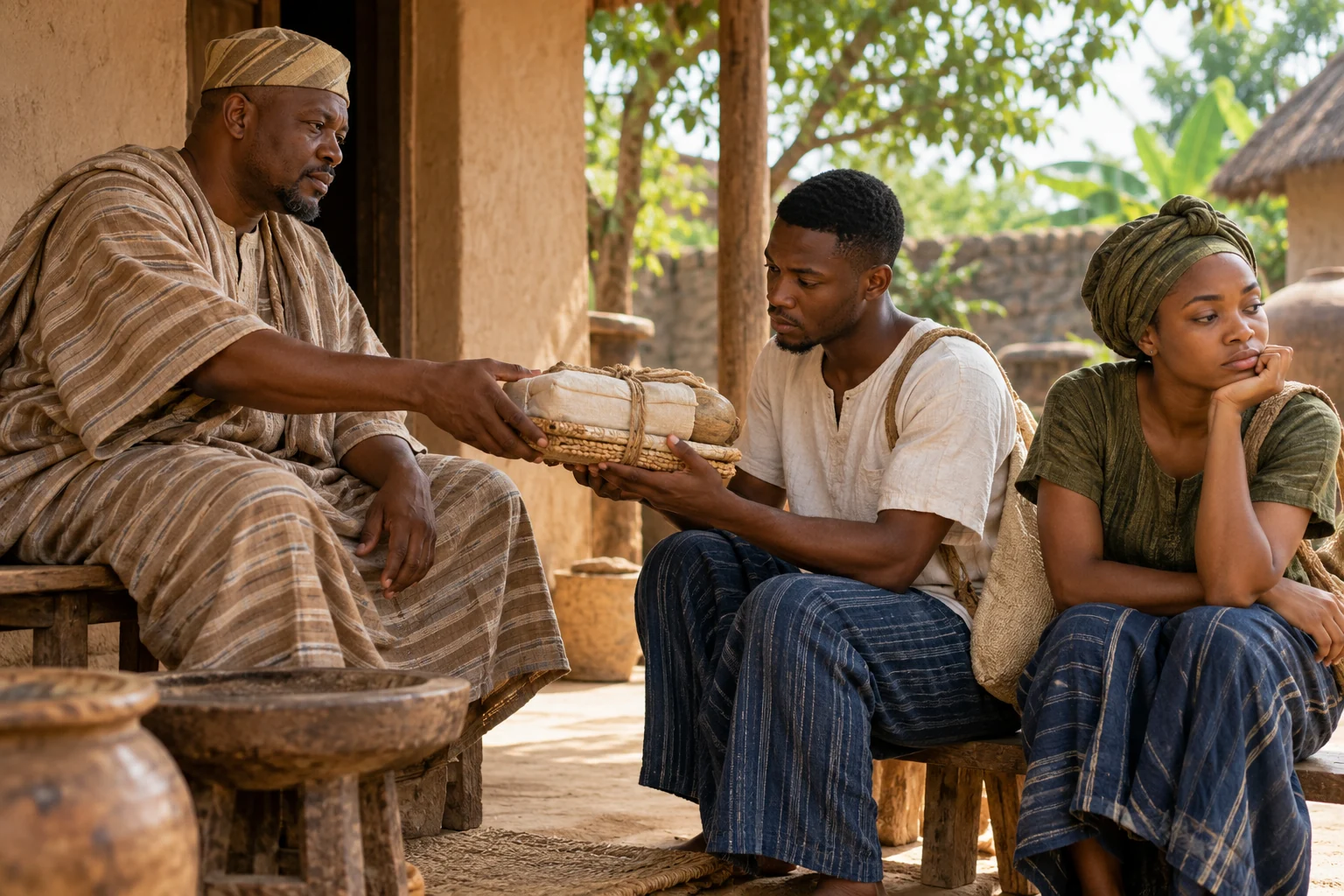
A ruler postpones work commissioned from a visiting diviner. Two of the diviner’s godchildren offer to perform it instead, claiming equivalent authority. They redirect resources to themselves and the promised improvement does not occur. When the teacher returns, the ruler blames him until the substitution is exposed. He performs the work, then demands the godchildren’s execution, leaving the story with both a professional breach and a deeply disproportionate punishment.
The specific ethical breach involves misrepresentation, diverted resources and responsibility imposed on someone who did not perform the task. This is stronger material than a generic warning against disobedience. The punishment, however, cannot be quietly converted into exemplary justice. We can keep accountability separate from revenge and preserve the king’s own role in accepting an unverified replacement.
Narrative setting: Cuban compilation, Ọ̀rúnmìlà and two godchildren episode.
A defensive landscape fails its owner
Ògún and Ọ̀ṣọ́ọ̀sì separately seek assistance while pursuing Ṣàngó’s wife. Ọ̀ṣọ́ọ̀sì refuses the advised preparation, confident that his savanna’s hostile plants will defend him. Ògún accepts it. When the woman approaches Ọ̀ṣọ́ọ̀sì, Èṣù informs Ṣàngó, whose fiery response destroys the defenses and forces the hunter to flee. The forest occupied by Ògún remains spared, producing a contrast between accepted counsel and presumed territorial invulnerability.
The episode places a sharp limit on defensive pride, but its relationship politics are not a suitable modern moral template. The wife’s desire appears mainly through competing men and surveillance. A responsible reading can discuss overconfidence and consequences while noting that romantic agency should not be erased by the source’s possessive frame or that violence settles legitimate relational claims.
Narrative setting: Cuban compilation, rival suitors episode.
Rooster explains away the crown that kept Fox distant
Rooster consults before entering earthly life about danger arising through speech, but completes only part of the preparation. On earth, the bright crown on his head makes other creatures fear him. He befriends Fox, who nevertheless remains distant because the crown looks like fire. Rooster laughs at that interpretation, explains that the crest is harmless and invites Fox to touch it. The feared boundary disappears once the explanation is confirmed. Fox returns and attacks through the very part of the body previously believed dangerous. The account links the loss to speech that gives another creature precise access to a vulnerability.
The narrative does not make Rooster’s statement false; its danger is that he treats truth as a reason to disclose everything to a predator whose relation to him remains unexamined. His laughter also changes the exchange from simple reassurance into a demonstration that dismantles his own protective appearance. Within the religious account, the incomplete preparation matters to the danger foreseen through divination. A contemporary reading can ask about discretion without concluding that honesty is inherently unsafe or that all apparent friends are concealed enemies.
Compared with the earlier godchildren’s fraud, Rooster does not misuse someone else’s authority; he misjudges what the recipient will do with accurate information. Compared with Ọ̀ṣọ́ọ̀sì’s defensive landscape, the boundary works through another person’s belief rather than through material obstacles. The new episode therefore adds a particular relation among appearance, knowledge and access, not a universal instruction to hide one’s true nature.
Narrative witness and setting: Portuguese African narrative in the section explicitly credited to Cromwell Osamaro.
The youngest bird receives a sea-court recognition
Three bird siblings approach the succession to their father’s position. The older contenders treat sacred preparation as unnecessary or futile because inheritance seems already determined. Oken, the youngest, completes the exchange and goes to the river with the living birds entrusted to him. Olókun’s guards attempt to seize them for a palace need, and Oken resists an abrupt surrender. Before Olókun, the guards are rebuked and Oken is asked why he has come. His purpose is acknowledged, and a transformation gives him distinctive long feathers. He returns with a newly recognized standing beyond the succession the older siblings had assumed.
The episode does not present seniority as meaningless, but it refuses to make inherited expectation the only agency shaping a future. Oken participates in a sacred relation when both confidence and resignation have kept the others from doing so. His encounter with Olókun also includes an important correction of conduct: the guards’ rough treatment is not accepted simply because they serve a divine palace. Recognition proceeds through a question about his purpose, an assurance and a willing transfer after that exchange.
The resulting feathers are not mere decoration. They make sacred standing visible within an origin explanation that extends toward chiefly regalia. Compared with the godchildren who claim equivalence with a teacher, Oken does not obtain authority through an unverified assertion of borrowed competence. Compared with Rooster’s crest, his visible distinction comes from an acknowledged relation rather than a mistaken fear. These differences make the crown imagery theologically specific instead of an undifferentiated symbol of prestige.
Narrative witness and setting: Portuguese African narrative credited to Cromwell Osamaro, with Yorùbá and Bini bird names in the passage.
What was born in this Odù
“Born” can name an explicit traditional origin association or what emerges through a story: a capacity, relationship, practice or order of life. Interpretations drawn from a narrative are labelled below, so their basis remains clear.
Nuns
Selected traditional source association.
The origin list names nuns, bringing a Christian form of religious vocation into the compilation. The entry establishes presence, not an etymology, chronology or universal connection between this sign and women’s celibate religious institutions.
Receding waves
Selected traditional source association.
The list associates the sign with the sea’s backward movement. As an interpretive image it can suggest that advance and withdrawal belong to one movement, but the selected stories do not provide a detailed ocean teaching and should not be forced into one.
Correlations to life dimensions
These questions bring the selected stories into contemporary life. They are interpretive invitations for study.
Work and resources
The godchildren use another person’s authority to obtain work and redirect its resources. The ruler’s complaint reaches the absent teacher. This supports clear attribution of responsibility and verification of delegation rather than assuming shared lineage makes every practitioner interchangeable.
Reflect: What would make another person’s authority to represent you verifiable?
Character and inner life
Ọ̀ṣọ́ọ̀sì’s defenses become the reason he dismisses counsel. The story gives confidence a concrete material basis and then destroys it. The story invites us to ask when accumulated protections prevent a person from revising the assumptions that make those protections necessary.
Reflect: Which safeguard has made you less willing to reconsider your conduct?
Relationships and family
The suitors’ episode treats a woman through rivalry and surveillance. interpretive interpretation should acknowledge that limit while drawing attention to consent and direct, uncoerced communication between partners as questions the preserved plot does not adequately resolve.
Reflect: Whose own account is missing when others debate a relationship?
Community and responsibility
The ruler’s troubled territory becomes the stage for professional fraud and retaliation. The severe ending invites a distinction between restoring public trust, recovering resources and inflicting revenge; those are different responses even when a breach is real.
Reflect: What consequence would repair trust without reproducing the abuse of power?
A deeper reading of the sacred relationships
Sacred recognition can exceed the order people assume
The older birds reason from apparent inheritance, but Oken’s exchange opens a relation with Olókun that the expected order does not contain. Divine acknowledgment then becomes visible in transformed feathers and a new standing. Rooster’s incomplete preparation offers a contrast: a striking crest produces fear without securing the relation needed to govern what speech will expose. The earlier royal commission likewise depends on the particular work and divine recipients that the fraudulent substitutes fail to address. These accounts give sacred agency more specificity than generic luck. A contemporary comparison about opportunity or credentials can follow, but should preserve the religious claim that an effective relation can alter what inherited expectation or impressive appearance seems to guarantee.
Access is given under different kinds of trust
Rooster supplies Fox with accurate knowledge that removes a deterrent. The godchildren use a teacher’s name to secure resources and a commission. Oken initially refuses a seizure until the purpose and terms can be addressed before Olókun. The hunters’ rivalry gives surveillance another role, as knowledge of a visit reaches Ṣàngó through Èṣù. These are distinct channels of access: disclosure, claimed delegation, compelled transfer and reporting. A reference should identify the relation authorizing each rather than assuming that all information exchange is either openness or betrayal. Contemporary questions about consent and verification are strongest when they remain tied to the precise way another person gains a capacity to act.
A protective appearance can be mistaken for a secured relation
Rooster’s crest works only while Fox misreads it. Ọ̀ṣọ́ọ̀sì’s landscape gives him confidence until fire changes what the defenses can do. The godchildren’s association with Ọ̀rúnmìlà appears sufficient to the ruler, but does not make their substituted work effective. Oken’s feathers have a different narrative ground: they follow an acknowledged encounter with Olókun. These comparisons distinguish belief, material protection, lineage association and sacred authorization. None is interchangeable with the others merely because it looks impressive. A contemporary interpretation can ask what actually sustains a boundary or claim, while leaving open the separate ethical question of how a powerful person uses the protection or authority once it is recognized.
Questions that deepen the study
Is Rooster condemned for telling the truth?
The story makes an accurate disclosure consequential, but does not establish a universal opposition between truth and safety. Rooster reveals a particular vulnerability to a predator and invites direct confirmation of it. The religious framing also recalls a preparation left incomplete after that danger had been foreseen. A contemporary reading can distinguish truthful speech from an assumption that every listener has earned the same access. It should not imply that concealing wrongdoing is sacred discretion or that people harmed by a confidant are responsible for the harm. The source gives a specific origin account, not a complete ethics of disclosure.
Why can the youngest bird’s future differ from the apparent inheritance?
The older siblings treat the visible order as final, whereas Oken enters a sacred relation that makes another recognition possible. His encounter at the water boundary also includes a hearing: Olókun asks the purpose of the offering and corrects the guards’ treatment. The account therefore combines sacred preparation, a specific divine recipient and acknowledged intent. The feathers make that outcome visible. A contemporary reader may compare the story with opportunity beyond seniority, but should not reduce it to meritocracy or conclude that youth is inherently more deserving. The witness describes this relationship, not a universal succession rule.
How does Oken’s recognition differ from the godchildren’s claim of authority?
The godchildren rely on proximity to Ọ̀rúnmìlà to present themselves as interchangeable with him, then divert the resources of work they have taken over. Oken’s standing follows an encounter in which his purpose is asked, his relation is acknowledged and a transformation is conferred. The distinction is between asserting borrowed equivalence and receiving a particular recognition. Neither story can alone define every legitimate form of apprenticeship or office. Their comparison is useful because it asks what supports a claim beyond association, while the earlier punitive ending still requires separation from a contemporary account of proportionate accountability.
What the four narratives reveal together
The African-attributed Rooster and bird-succession episodes add precision to the earlier Cuban concerns with false delegation and defensive pride. Rooster’s crest is effective through a mistaken belief that his own disclosure removes. Oken’s feathers instead follow sacred preparation and an acknowledged relation with Olókun, opening a future the older siblings assume unavailable. The godchildren’s claim fails because association does not make substituted work equivalent, while the hunter’s landscape cannot sustain its owner’s confidence against a different force. Together the witnesses distinguish appearance, information, inherited standing and spiritually conferred recognition. Their shared imagery of protection and authority should not collapse those differences. A contemporary reader may ask about verification, access and proportionate response, while the reference preserves the religious agencies through which these accounts explain why a claim becomes effective or why a boundary fails.
Living with this Odù
A continuing life or initiatory relationship
A received life or initiatory relation with Òtúrá Ìrẹtẹ̀ can invite a long term inquiry into the different foundations of authority and protection. The godchildren claim their teacher's standing without his participation, diverting resources and exposing him to blame. Rooster discloses accurate information about his own crest but fails to consider what Fox will do with it. These are distinct breaches: misrepresentation of another's competence differs from a person's unguarded revelation of vulnerability. Across changing circumstances, a bearer can ask what authorizes a promise, who will be held responsible and what relationship makes disclosure appropriate.
Oken's sea court encounter adds recognition through acknowledged purpose and willing transfer, rather than borrowed assertion or coercive seizure. The savanna story exposes territorial confidence while retaining possessive relationship assumptions that should not govern modern consent. The witnesses do not predict betrayal, violence or inherited precedence for a bearer. Sacred preparation, Èṣù's intervention and Olókun's acknowledgment remain active in their separate religious worlds. Contemporary inner development involves accepting that truthful speech needs discernment and that legitimate standing requires more than appearing equivalent to someone already trusted. It also keeps accountability separate from the teacher's lethal and disproportionate demand for revenge.
A particular consultation and its question
In consultation, Òtúrá Ìrẹtẹ̀ can help distinguish whether a boundary rests on material protection, another's belief or an acknowledged religious relation. The hunter relies on a hostile landscape; Rooster dismantles an appearance that kept a predator distant; Oken receives a visible distinction after his purpose is heard. Those forms are not interchangeable. The commission story directs attention to verification: who actually accepted the task, who performed it and whose name was used? A practitioner can ask those questions without announcing that an unknown client is facing fraud or infidelity.
The wife's limited agency in the savanna account must remain visible rather than disappear beneath a general lesson about obedience. Likewise, the teacher's competence does not make his requested executions proportionate. The actual consultation supplies the question and result; receiving the sign is not identical with a lifelong identity. Religious efficacy remains part of the accounts, including Olókun's correction of the guards and the consequences of incomplete preparation. Contemporary reflection adds distinctions among informed disclosure, borrowed authority, willingness and coercion. It should help the person understand what relation is operating now instead of issuing a universal command to conceal one's true nature or treat every friendship as predatory.
Constructive and adverse possibilities
Constructive unfolding may involve verified responsibility, discretion fitted to the recipient and recognition that hears purpose before requiring surrender. Oken's encounter is distinctive because the guards' rough conduct is corrected rather than sanctified by their palace role. Adverse unfolding includes using another's name without authority, treating defenses as absolute or disclosing vulnerability to a recipient whose relation remains unexamined. Rooster's statement is true, so the issue is not a simple opposition between honesty and lying. Actual iré or òṣogbo belongs to the reading. A successful teacher may still demand a deeply unjust punishment, while a favored younger sibling does not establish that seniority is universally meaningless.
The narratives preserve religious agency without making every advantageous result morally complete. Contemporary interpretation can keep the wife's consent, the godchildren's accountability and the proportionality of redress as separate questions rather than allowing prestige or sacred effectiveness to decide them all.
An illustrative situation in everyday life
Imagine a hypothetical consultant whose trainees accept a commission in the consultant's name, spend the resources and leave the client blaming the absent teacher. During the dispute, a colleague casually reveals an access weakness to someone whose interests are unclear. A junior applicant, by contrast, receives recognition after an authority asks what they actually came to do and corrects an assistant's coercive behavior. The narratives distinguish fraudulent equivalence, unconsidered disclosure and earned acknowledgment through a stated relation. The consultant's anger is intelligible, yet it does not justify unlimited punishment. This is an illustrative contemporary interpretation, not a divinatory accusation. Its practical question is what makes participation authorized and informed, and how a response can establish responsibility without turning correction into revenge or an impressive title into exemption from ordinary scrutiny.
Sources and reading context
The first two narrative witnesses
The selected stories belong to the Cuban compilation. They include lethal punishment and possessive relationship assumptions, which are identified rather than endorsed. Christian monastic and marine origin entries remain local associations. No personal fidelity claim, diagnostic statement, ritual method or inevitable consequence is drawn from the narratives.
Narrative motifs are summarized independently. The life-dimension reflections are contemporary interpretation. How these reference studies are built explains the wider source approach and the distinction between a reference article and personal divination.
Additional named witnesses
- Cromwell Osamaro. The credited African section contains Rooster’s disclosure to Fox and Oken’s succession encounter with Olókun.
The bird-sibling passage has unstable pronouns and vernacular names, so no modern species identification or fixed gender reconstruction is imposed. The source relates feathers to regalia without providing verified historical chronology. The earlier godchildren story’s execution is not treated as acceptable accountability, and Rooster’s fate is not transferred into personal predictions.
Bibliographic identification
- C. Osamaro Ibie. Ifism: The Complete Work of Orunmila. Lagos; multivolume publication beginning 1986. Library catalogue record. Related bibliographic record for the named narrative witness. Exact volume, edition and page of the transmitted account have not been independently matched.
Read the source method and wider scholarly context.
The catalogue links identify published works and their authors. They are separate from proof of an individual episode’s wording or attribution. Contemporary comparisons and the synthesis above are editorial interpretation. The author’s books and Academy companions below provide further study; their sales links are separate from the source references.