
Òtúrá Òkànràn is a mixed Odù in Ifá’s 256-part corpus. The selected Òtúrá Ọ̀kànràn episodes connect disregard for counsel with a wider concern for children’s continuity. A commercially troubled man mistakes access to a masked gathering for entitlement to participate. Elsewhere children respond to danger while adults disparage their efforts, until a negotiated intervention confronts the elders’ distrust. The narratives give faith a social setting: who is heard, who is dismissed, and who carries the consequences when adults refuse responsibility.
A question to carry through the study: Whose useful contribution are you dismissing because of their age or position?

This Academy reads the right column first, then the left. Each row carries a single or double mark.
Where this Odù belongs
Òtúrá Òkànràn belongs to the Òtúrá family in this Academy’s study sequence. It is a mixed Odù, distinct from Òkànràn Òtúrá. The order matters. Its teaching is approached through its own narratives, rather than by adding two general descriptions of the principal signs together.
Key Òrìṣà and sacred relationships
The figures below are selected for their roles in the accounts discussed here. They offer connected reading paths through the tradition.
-
Ọ̀rúnmìlà. Ọ̀rúnmìlà’s counsel provides a boundary in the masked-gathering story; in the community episode he negotiates with Death to create time for adults to respond differently.
-
Èṣù. Eleguá draws Death toward Ọ̀rúnmìlà and thereby helps create time for intervention in the threatened community; his movement is strategic mediation rather than direct overpowering.
-
Ọya. Oyá is associated with the masked figures’ cleansing activity in the first episode. Her role establishes that the gathering has a particular purpose the curious visitor does not understand.
Key myths and their meanings
A mask is mistaken for permission
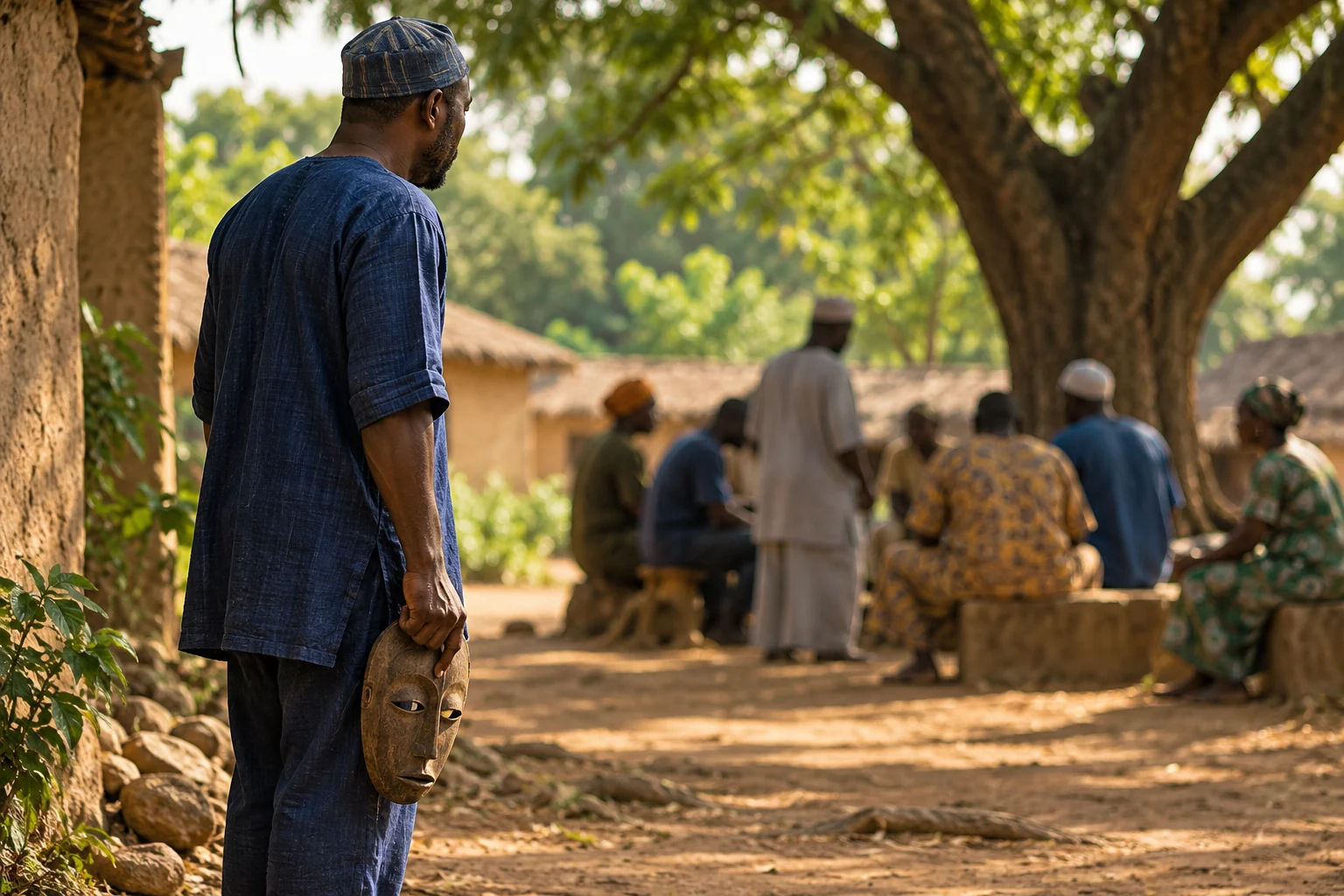
A studious, intensely curious trader seeks help after his enterprise deteriorates. Consultation gives him instructions about avoiding a masked gathering and delaying use of his own mask. Wanting to discover what the group is doing, he approaches in disguise and enters a situation intended for the participants’ different needs. His condition worsens within the story. Returning to counsel and acting on it precede the eventual recovery described.
The mask makes a useful distinction between resemblance and belonging: looking like participants does not give the newcomer their knowledge, preparation or purpose. His appetite for understanding is not inherently a fault; its problem is the assumption that every available scene is his to enter. The narrative can support boundaries around participation without treating learning or inquiry as spiritually dangerous.
Narrative setting: Cuban compilation, Erfeoyu episode.
Children sustain what adults disparage
A community fears that its elders will not remain to finish raising their children. The children respond to danger through their own faithful efforts, but adults dismiss those efforts and accuse the threatening power of manipulation. Eleguá and Ọ̀rúnmìlà create a pause in the confrontation, allowing the adults to appeal for the chance to continue caring for the young. One adult’s refusal leaves the story with a severe unresolved exception.
Children are moral actors in this account rather than passive dependents. Their elders depend on work they simultaneously belittle. The tale therefore opens questions about respect across generations and the vulnerability created when caregivers cannot imagine receiving help. Its fatal exception must remain a feature of the story’s punitive logic, never a prediction about skeptical people or parents.
Narrative setting: Cuban compilation, Iñabi Inle community episode.
Three creatures are approached through what they desire to eat
Rat, Fish and Bird prepare to enter earthly life and consult together. They are warned that food offered by others can become the means of drawing them into danger, but they decline the head-centered exchange proposed. After their arrival, Èṣù tells humans what attracts the three creatures. Food becomes bait adapted to their different environments, and ordinary appetite now leads them toward capture. The account explains an enduring vulnerability through a relationship left unaddressed before arrival. It does not narrate a later rescue or a second consultation that reverses what has become established.
The same appetite can sustain life and make it accessible to another person’s design. That is more specific than saying desire is always dangerous. Rat, Fish and Bird are not harmed by all food or by an inherent moral defect; their preferred nourishment is deliberately placed within an arrangement intended to capture them. Within the religious account, Èṣù’s disclosure joins the refused exchange to the earthly condition that follows. A contemporary interpretation can then examine inducement, but should not turn the episode into suspicion of every shared meal or a claim that actual poisoning can be inferred through a sign.
The earlier masked-gathering story also concerns entering a situation on the basis of an attractive surface without grasping its purpose. The new episode differs because no disguise is needed: the creatures’ own known preferences make the approach work. The children’s communal faith episode supplies another contrast, where responding together preserves rather than exploits a vulnerable relation.
Narrative witness and setting: Portuguese African narrative in the section explicitly credited to Cromwell Osamaro.
A defendant’s remembered divine companions become witnesses
Before earthly arrival, Ọ̀rúnmìlà prepares for hostile accusations through relationships with several powers. He enters the world with Ṣàngó and Ògún, but their paths separate. Later his poverty helps make him vulnerable to a charge of destructive spiritual practice. Further consultation reconnects him with the companions. At the hearing, people he has helped testify, and Ṣàngó and Ògún also appear in support. The judge finds no proven case. The ruler then seeks his assistance and grants him public standing. The account turns the anticipated accusation into a setting where his constructive religious work becomes recognizable.
This episode distinguishes the presence of spiritual power from an allegation about how it has been used. The defense is not that Ọ̀rúnmìlà possesses no extraordinary capacity, but that his practice has brought help and that destructive use has not been established. The sacred relationships formed before arrival become active within an earthly hearing; the companions’ witness does not function as a decorative metaphor for confidence. Human recipients also speak, giving the process several kinds of testimony. Compared with the earlier masked visitor, the defendant is not seeking covert access to someone else’s operation.
Compared with the disparaged children, his response depends on those whose contributions are often discounted being allowed to matter. The ruler’s later reward includes people granted into dependent roles, which complicates the fortunate conclusion. A contemporary interpretation can value a hearing and evidentiary restraint while refusing to treat rank, wealth or divine backing as proof that every subsequent arrangement is just.
Narrative witness and setting: Portuguese African narrative credited to Cromwell Osamaro.
What was born in this Odù
“Born” can name an explicit traditional origin association or what emerges through a story: a capacity, relationship, practice or order of life. Interpretations drawn from a narrative are labelled below, so their basis remains clear.
Calling the mother
Selected traditional source association.
The origin list links kashioro with calling the mother in important undertakings. This can support attention to maternal recognition and continuity; the brief entry does not establish one universal practice or a rule governing every family decision.
Beginning the Olofin ceremony
Selected traditional source association.
The list assigns the beginning of an Olofin ceremony to this sign. Its safe significance is threshold and authorized commencement; the source association should not be expanded into instructions or an invented history of that ceremony.
Correlations to life dimensions
These questions bring the selected stories into contemporary life. They are interpretive invitations for study.
Community and responsibility
The children’s effort sustains the community before the adults recognize its value. The narrative encourages attention to dismissed contributors and to the distinction between criticizing an approach and acknowledging the care already being offered through it.
Reflect: Whose effort deserves acknowledgment even where you disagree about the method?
Relationships and family
The adults’ central appeal concerns surviving long enough to finish raising children. The episode places continuity of care above status. A grounded modern reflection can ask what arrangements support children when a caregiver is absent, without importing the tale’s supernatural threats.
Reflect: What practical plan would help children receive steady care during an adult’s absence?
Character and inner life
Erfeoyu’s desire to understand becomes an assumption that he may approach any activity in disguise. The story gives curiosity a boundary of relationship and purpose: a person can value knowledge while respecting that observation and participation require different forms of permission.
Reflect: Where would asking about a purpose serve you better than copying an appearance?
Work and resources
The trader’s business trouble makes him seek quick access to a process he has not understood. His return to the counselor illustrates the need to revisit assumptions after a failed intervention, rather than intensifying imitation of others’ methods.
Reflect: Which borrowed method are you using without understanding the problem it was designed to solve?
A deeper reading of the sacred relationships
Pre-earthly relationships remain available through renewed exchange
The new defendant account makes Ṣàngó and Ògún companions from before their separate earthly occupations. When consultation identifies the need to renew those relations, they become present as witnesses. Sacred preparation therefore establishes continuity across a separation ordinary memory and social position do not exhaust. Rat, Fish and Bird leave a different relation unaddressed, and Èṣù’s agency makes their preferred food consequential. The older children’s episode likewise treats religious attention as an active source of protection rather than a private opinion. Contemporary analysis of testimony or temptation can be useful, but should preserve this underlying claim that spiritual relationships have causal force across the boundary between heaven and earth.
A purpose can be concealed behind an ordinary invitation
Food attracts the three creatures because it looks like nourishment, not a trap. The curious trader approaches a masked gathering because he wants knowledge, not because he understands its specific work. The defendant’s court summons has another structure: it makes an accusation explicit and eventually allows a response. These differences matter because a boundary is not equally knowable in every scene. A contemporary reader can ask what information is available before entry and whether the person offering access has disclosed its actual purpose. The stories do not justify avoiding every invitation. They distinguish an occasion organized for care, capture, inquiry or judgment, with different responsibilities attached to those who arrange it.
The vulnerable are not all given the same voice
The three creatures do not speak again after humans learn how to capture them. The earlier children answer communal danger while adults belittle their actions. The defendant, by contrast, is eventually heard alongside beneficiaries of his work and divine companions. Comparing these voices helps a reference avoid making vulnerability a single passive condition. Some actors can interpret, organize or testify; others appear mainly through the designs imposed on them. The source’s silence about a creature’s later response should not be filled with invented consent or a second chance. Contemporary interpretation may ask who could speak, but the narrative evidence must remain the basis for describing whose speech actually changes an outcome.
Questions that deepen the study
Does the food episode teach that appetite is a moral failure?
It locates danger in a constructed relation between appetite and capture. The creatures’ preferences become useful to humans after Èṣù discloses them; the food is not simply harmful in itself. Within the religious explanation, their earlier refusal matters, but a contemporary reading should not turn the story into contempt for bodily needs. Its specific question is how a sustaining desire can be used by another agent without the recipient understanding the arrangement. The episode supplies an origin motif for the three creatures, not a method for identifying poisoned food or predicting betrayal at an actual meal.
Why do Ṣàngó and Ògún appear at the hearing?
They belong to relationships established before earthly arrival and renewed through the later consultation. Their testimony expresses the continuity of those sacred ties, rather than an accidental meeting of prestigious allies. The account also includes people helped through Ọ̀rúnmìlà’s work, so divine witness and human experience stand together. The charge concerns destructive use of spiritual power; the answer makes constructive religious practice visible without denying that power exists. A contemporary account of a fair hearing can recognize the value of speaking and evidence, while the tradition’s own logic gives the divine companions a reality beyond supportive symbolism.
How does the acquittal differ from the earlier demand for obedience?
The defendant is permitted to answer an allegation, and the case fails because destructive action is not proved. The masked visitor’s problem instead concerns a boundary whose purpose he disregards, while the older community episode concerns adults refusing to acknowledge the children’s religious effort. These are not identical tests of loyalty. The new account adds a distinction between possessing spiritual capacity and being guilty of a particular use of it. A reference should preserve that distinction rather than assuming all questioning is disbelief or all protection depends on submitting to an authority without explanation.
What the four narratives reveal together
The African-attributed additions give the sign two different relations between vulnerability and knowledge. Rat, Fish and Bird become accessible through appetites another agent understands, while Ọ̀rúnmìlà’s defense makes the constructive use of his power knowable in court. Sacred exchange and divine companionship are active within those outcomes. The older masked-gathering episode concerns entry without understanding purpose; the children’s account concerns religious action dismissed by those who depend on it.
Together they distinguish capture, participation, protection and judgment. That range prevents obedience from becoming the only interpretive category. Some scenes require respect for a particular boundary, while another requires hearing a challenged person and distinguishing an allegation from proof. The fortunate defendant’s later elevation also leaves questions about dependent people within the reward, reminding a contemporary reader that exoneration and the justice of every subsequent arrangement are different matters.
Living with this Odù
A continuing life or initiatory relationship
For someone whose received life or initiatory Odù is Òtúrá Ọ̀kànràn, the stories can sustain a long term inquiry into access, help and the evidence by which another person is judged. The masked trader confuses resemblance with a right to participate, while Rat, Fish and Bird encounter deliberate arrangements built around genuine needs. Their vulnerability is not proof that curiosity or appetite is inherently wrong. The children supply another contrast: adults rely on contributions they are unwilling to respect. Across a life, these tensions can prompt attention to when one is entering beyond one's knowledge and when discounted help deserves recognition. Ọ̀rúnmìlà's hearing then distinguishes extraordinary capacity from an unproven allegation of harmful use.
A bearer is not assigned suspicion, danger or a fixed relation to authority. The witnesses preserve sacred causation through Èṣù's disclosures, divine companions and pre earthly preparation, while the Cuban masked and communal episodes remain distinct. Contemporary inner development asks how desire, pride or fear affects participation without forgetting who deliberately constructs the external risk. It also asks whether public vindication creates a responsibility to examine dependent people within the new standing, rather than treating recognition as proof that everything afterward is just.
A particular consultation and its question
In a consultation, Òtúrá Ọ̀kànràn can help distinguish informed entry, manipulated inducement and accusation without established evidence. The trader approaches a gathering in disguise, whereas the defendant is brought before a hearing about alleged conduct; neither situation should be interpreted as the other. Rat, Fish and Bird show preferences being used by someone else to create vulnerability, and the children show underestimated participants sustaining a community. The actual question determines which relation needs examination. A practitioner can ask what appearance is being mistaken for permission, whether an attractive offer serves an undisclosed purpose and whose testimony has been excluded.
These inquiries do not identify real poisoners or justify suspicion of shared food. Nor do the children's severe narrative outcomes predict mortality for skeptical adults. The religious worlds make Èṣù, Ṣàngó, Ògún and divine preparation consequential beyond ordinary prudence, so contemporary questions about consent and evidence are additional interpretation. Receiving the sign in one consultation does not make it a permanent identity or announce a person's moral status. Its situational strength lies in differentiating a person's capacity from allegations about its use, and in asking whether help is being recognized before authority dismisses it or turns it into spectacle.
Constructive and adverse possibilities
Constructive unfolding can include respecting the difference between public appearance and prepared participation, allowing underestimated contributors to matter and withholding condemnation when harmful use has not been established. Ọ̀rúnmìlà's human beneficiaries and divine companions offer different kinds of testimony within a religious hearing. Adverse unfolding includes entering under borrowed appearance, exploiting another's necessary appetite or depending on children while belittling their efforts. No actual iré or òṣogbo follows automatically from these possibilities. The animals' account has no later rescue, while the trader returns for renewed counsel; the outcomes should remain different.
The fortunate defendant's later standing includes dependent people, complicating a wholly celebratory conclusion. Divine support may establish a new possibility within a narrative without certifying every social relation it creates. Contemporary interpretation can therefore value protection and evidentiary restraint while continuing to ask whose agency and safety remain unexamined after the principal figure succeeds.
An illustrative situation in everyday life
In a hypothetical research organization, a new worker wears the same badge as specialists and assumes they may join a restricted process without preparation. Elsewhere, an offer tailored to staff members' financial needs conceals an exploitative obligation. Junior assistants warn about both problems, but senior managers dismiss them until an accused colleague requests a hearing with actual witnesses. The narratives distinguish unauthorized access, deliberate inducement and unproven allegation rather than explaining everything through one person's foolishness. A manager may feel that receiving junior help undermines status, yet refusing that help increases collective vulnerability. This is an illustrative interpretation, not a report of sacred intervention or a claim that a particular sign reveals misconduct. Its practical question is what establishes permission and evidence, and who is allowed to contribute to that determination.
Sources and reading context
The first two narrative witnesses
The selected Cuban narratives include masked practices, Death and divine negotiation. They are treated as religious storytelling, without procedures, prognoses or claims that disbelief causes mortality. Kashioro and the Olofin entry are retained at the level of named associations because their broader histories are not established here.
Narrative motifs are summarized independently. The life-dimension reflections are contemporary interpretation. How these reference studies are built explains the wider source approach and the distinction between a reference article and personal divination.
Additional named witnesses
- Cromwell Osamaro. The credited African section contains the three creatures’ food vulnerability and Ọ̀rúnmìlà’s accusation, divine witnesses and acquittal.
The Portuguese rendering is uneven and later extends the acquittal into bodily restoration claims that are not developed here. The powers remain named as transmitted. No actual accusation of sorcery, diagnosis of poisoning or promise of legal success is drawn from the narratives. Earlier Cuban accounts retain their own attribution and religious setting.
Bibliographic identification
- C. Osamaro Ibie. Ifism: The Complete Work of Orunmila. Lagos; multivolume publication beginning 1986. Library catalogue record. Related bibliographic record for the named narrative witness. Exact volume, edition and page of the transmitted account have not been independently matched.
Read the source method and wider scholarly context.
The catalogue links identify published works and their authors. They are separate from proof of an individual episode’s wording or attribution. Contemporary comparisons and the synthesis above are editorial interpretation. The author’s books and Academy companions below provide further study; their sales links are separate from the source references.