
Òwónrín Òkànràn is a mixed Odù in Ifá’s 256-part corpus. Òwónrín Òkànràn’s selected stories make disregard for limits consequential in different ways. A father delegates an important errand to his son without ensuring its purpose is understood, and a misplaced object causes harm in a public setting. A fisherman cannot stop gathering, loses what he catches through delay, then pursues deeper riches and dies in Olókun’s domain. Both narratives question acquisition or completion that ignores place, timing, and the people affected.
A question to carry through the study: What condition are you treating as incidental even though others depend on it?
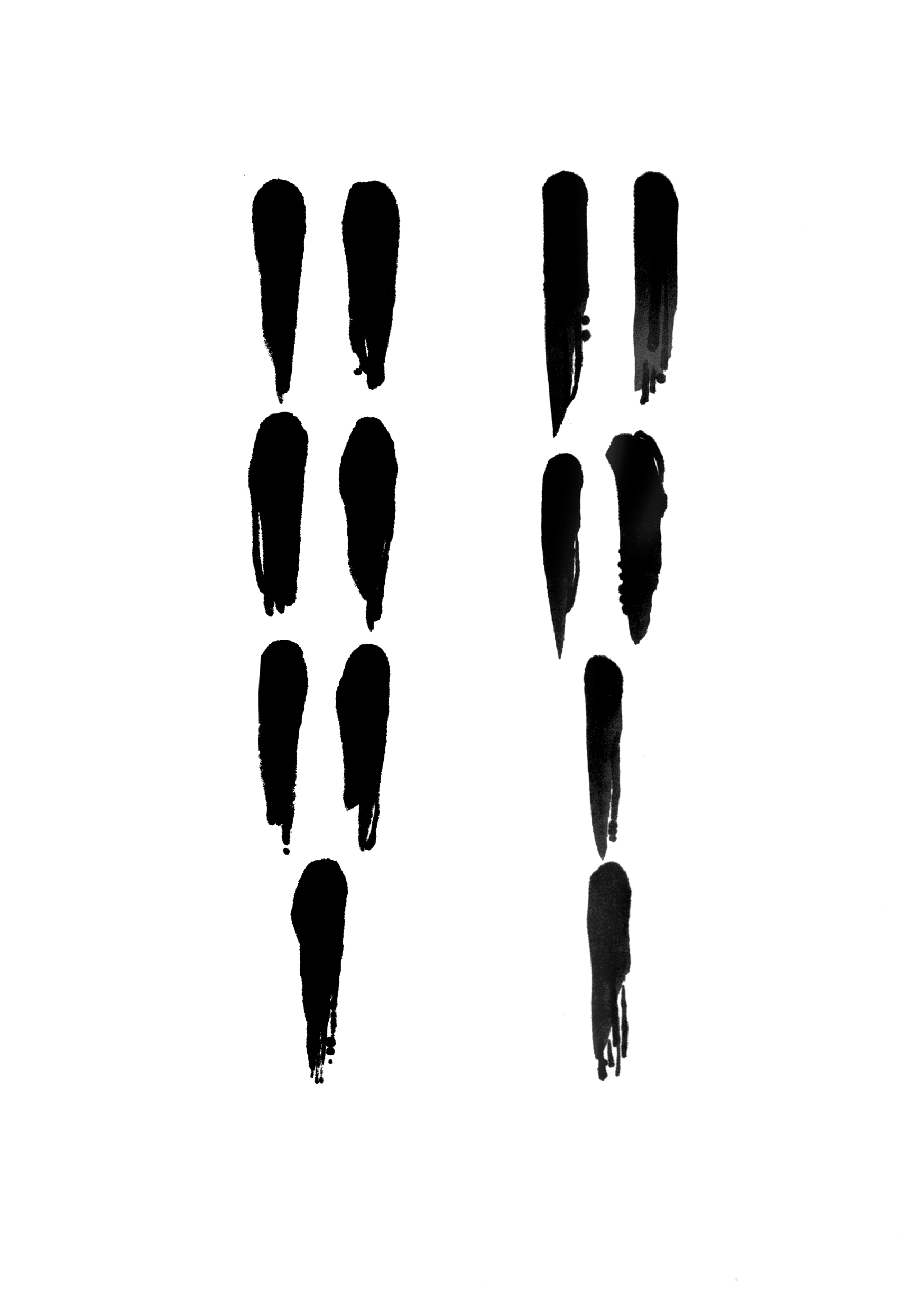
This Academy reads the right column first, then the left. Each row carries a single or double mark.

Where this Odù belongs
Òwónrín Òkànràn belongs to the Òwónrín family in this Academy’s study sequence. It is a mixed Odù, distinct from Òkànràn Òwónrín. The order matters. Its teaching is approached through its own narratives, rather than by adding two general descriptions of the principal signs together.
Key Òrìṣà and sacred relationships
The figures below are selected for their roles in the accounts discussed here. They offer connected reading paths through the tradition.
-
Ọ̀rúnmìlà. Òrúnmìlà directs the father’s response after a delegated errand goes wrong and also warns the fisherman about the sea. Consultation does not substitute for the characters understanding the limits of their actions.
-
Olókun. Olókun confronts the fisherman who enters the deep seeking a more extraordinary catch. His domain marks a limit to what the fisher assumes can be acquired and carried back.
Key myths and their meanings
The errand whose destination mattered
A man in difficulty sends his son to deliver an important religious object. Distracted by a circus procession and believing any destination will do, the son leaves it near animals. The object later injures the ruler’s child, and the ruler threatens the messenger’s life. The father returns to Òrúnmìlà and personally completes a renewed response. The account ends with the child’s recovery and the household’s changed circumstances.
The father’s delegation and the son’s improvisation both matter, but neither makes the ruler’s threat of retaliatory killing proportionate. A responsible reading can ask whether an instruction’s purpose was explained, and whether the person assigned it could judge consequences. The recovery remains a religious narrative, not a medical promise. Accountability is more useful than a simple claim that obedience prevents every accident.
Narrative setting: Spanish Cuban-style account.
The fisherman who could never finish
A fisherman continually wants a larger catch. He stays so late that the fish spoil before he can sell them, losing the benefit of his labor. Hearing that still more beautiful fish exist in the depths, he consults but ignores the limit described. With a mask he descends to Olókun’s realm, sees a secret treasure, and cannot return after Olókun removes the aid on which his survival depends.
More acquisition initially reduces value because timing and use have been ignored. The later descent repeats the same pattern on a larger scale: a boundary is treated as a technical obstacle to be overcome by an implement. The story can support reflection on sufficiency and dependence without endorsing fatal punishment, giving diving advice, or suggesting that real maritime accidents disclose a person’s greed.
Narrative setting: Spanish Olókun account.
Two predators destroy one another after Guinea fowl escapes
Guinea fowl receives counsel about enemies who intend to eat her and completes the response. A hunter and snake also consult but leave their own advised response unfinished. Both search for the bird and her young. When the hunter prepares to fire into their tree, Èṣù shakes the branch and the birds escape. Leaves conceal the snake below, and the hunter steps on it. Their encounter becomes mutually fatal. The account attributes the bird family’s survival to the completed response and Èṣù’s intervention, while the would-be attackers become exposed to one another after losing their shared target.
The threatened figure does not defeat either attacker through superior force. A change in the tree’s movement opens an escape, and the predators’ own proximity creates the later collision. The account gives that sequence a religious cause through Èṣù and the different responses to counsel. Its animal naming is unstable: the translated snake is described with venomous behavior inconsistent with the familiar zoological meaning of boa. That uncertainty should remain visible rather than being corrected into a confidently named species.
Compared with the earlier fisherman’s fatal desire for deeper access, the new story concerns survival through withdrawal from an approaching attack rather than crossing a boundary to gain more. Contemporary interpretation can examine whether adversaries’ convergence creates vulnerabilities they do not see. It must not identify real opponents as predators, promise their destruction, or present the fatal encounter as a protective technique readers can reproduce.
Narrative witness and setting: Cromwell Osamaro, Guinea fowl, hunter, and snake
Tortoise’s smile cannot carry the weight of false accusation indefinitely
Tortoise is told that the day brings unjust accusations and receives counsel about a response. She initially refuses, asserting that no amount of sadness can remove the smile from her face. The accusations later become too heavy for that stance. She returns and completes the response, but is told that its requirement has increased. The account includes further religious care after her return. Its movement is from confident dismissal to acknowledgment of a burden that cheerfulness has not removed. The source does not supply the content of the charges or an extended court scene, keeping the focus on her changing response.
The smile is not condemned as a character defect. What fails is the claim that maintaining it can substitute for addressing a specific threat. The account also makes delay consequential through the increased requirement, a detail that should not be converted into approval of arbitrary fees or a warning that readers must purchase help immediately. Within the witness, Tortoise’s return acknowledges the limits of her initial self-sufficiency and reopens a sacred relation. Compared with the earlier delegated errand that harms a prince, this is a situation in which the protagonist is explicitly described as facing unjust accusation rather than having caused the initiating injury.
Contemporary interpretation can discuss emotional presentation without treating visible calm as proof that no help is needed. The source’s brevity leaves the eventual social resolution unstated, so an article should not invent a public acquittal or claim that the response automatically removes every consequence of the charges.
Narrative witness and setting: Epega Afolabi, a day of accusation and delayed response
What was born in this Odù
“Born” can name an explicit traditional origin association or what emerges through a story: a capacity, relationship, practice or order of life. Interpretations drawn from a narrative are labelled below, so their basis remains clear.
Responsibility for a delegated destination
Contemporary interpretation from the selected myth.
As a contemporary interpretation, the failed errand suggests an emergence of responsibility for explaining why an assigned task’s destination matters. This reading concerns preparation and delegation, not a reconstructed traditional born list or an endorsement of retaliation.
Sufficiency before another descent
Contemporary interpretation from the selected myth.
As a contemporary interpretation, the spoiled catch and fatal descent suggest an emergence of limits on acquisition. The reflection is grounded in the fisherman’s repeated failure to stop, not claimed as a canonical origin of moderation.
Correlations to life dimensions
These questions bring the selected stories into contemporary life. They are interpretive invitations for study.
Work and resources
The fisherman’s problem is partly a failure to stop while the catch still has use. The story makes value depend on timing, preservation, and access to a market, rather than assuming that a larger quantity automatically means a better result.
Reflect: When does continuing to gather reduce what you can use?
Relationships and family
The father gives his son a task but the narrated outcome suggests the son does not understand why its destination matters. Delegation to a dependent person requires explanation and preparation, not merely transfer of the visible burden.
Reflect: What does a younger helper need to understand before acting alone?
Character and inner life
The fisherman repeatedly looks beyond the available catch toward what seems more extraordinary. The account invites a reflection on dissatisfaction, asking whether the desire for more has displaced the purpose for which gathering began.
Reflect: What purpose would let you recognize that you have enough?
Community and responsibility
The ruler responds to injury by threatening another child. The narrative’s resolution does not require accepting that response as justice. Communities need proportionate procedures that can investigate an accident without making dependents hostages to another family’s distress.
Reflect: How can accountability protect children on every side?
A deeper reading of the sacred relationships
Protection works through particular relations, not invulnerability
Guinea fowl completes counsel and escapes through Èṣù’s movement of the tree. Tortoise initially refuses counsel, then returns when the accusations exceed her confident stance. Neither account presents a protagonist whose identity alone guarantees immunity. Their religious logic gives consultation and response a real role in how a situation changes. The source nevertheless does not license diagnosing every attack or accusation as a failure to respond properly. Guinea fowl’s enemies have their own counsel, and Tortoise’s charges remain explicitly unjust. A contemporary explanation can preserve responsibility without transferring blame for another’s aggression onto the person targeted by it. The distinction keeps the aggressors’ initiative visible alongside the protagonists’ capacity to seek help.
Visible composure can conceal an unresolved burden
Tortoise’s smile initially appears stronger than the accusations, but her later return shows that appearance does not settle their weight. The earlier father-and-son errand likewise places public assumptions beside a sequence whose consequences require further attention. Guinea fowl’s tree offers another misleading surface: the hunter sees birds above but not the snake below. Contemporary comparison can ask what a visible scene leaves out, whether emotional strain, missing information, or a nearby danger. The accounts do not establish that smiling is deceptive or that every scene hides an enemy. Their narrower contribution is to challenge confidence based on one immediately available sign.
A shared target does not create a stable alliance
The hunter and snake converge on the same bird family but are not protected from one another. When the birds leave, their proximity becomes destructive. The earlier fisherman account concerns another unstable relation between a desired resource and the means used to reach it. Contemporary interpretation can examine whether an apparent alignment rests only on a common object and lacks any care for the participants themselves. That comparison should remain distinct from the witness’s sacred causality through Èṣù. Nor should it become a prediction that people who oppose someone will inevitably harm one another. The narrated collision is specific, fatal, and not a general law of conflict.
Questions that deepen the study
Does Tortoise’s smile mean she should never show distress?
The story shows the limit of claiming that a smile makes further response unnecessary. It does not command a particular emotional display. Tortoise later acknowledges that the charges are too heavy and returns for help. Contemporary interpretation can recognize that someone may appear composed while facing an unresolved burden. The account’s religious response remains specific to the witness, and the increased requirement should not be used to pressure readers into immediate spending. Because the source does not narrate an explicit acquittal, a summary should stop at the renewed response rather than promise a complete social or emotional resolution.
Why should the snake remain unnamed beyond the source’s uncertain translation?
The compilation uses a term commonly rendered as boa while describing a lethal venomous bite. Those features do not justify a confident modern species identification. The narrative relation is clear enough: a concealed predator and a hunter collide after their intended prey escapes. An article can explain that sequence without claiming zoological precision the witness does not support. This also prevents sacred narrative from being mistaken for a factual account of animal behavior. The theological agency belongs to Èṣù and the completed or omitted responses, while the biological inconsistency remains an honest limit on how the translated details can be used.
Do these accounts make the targeted person responsible for the attack?
They give the protagonists consequential religious responses, but that is different from declaring the aggression deserved. Tortoise’s accusations are called unjust. Guinea fowl is hunted for food by figures pursuing their own aims. Contemporary interpretation should preserve the distinction between a person’s possible response and responsibility for another’s harmful conduct. The witness explains survival and renewed help through divination, yet it does not authorize an article to blame a reader who has been attacked or falsely accused. The earlier errand story, where an actual injury initiates the crisis, is a different narrative situation and should not be merged with these two.
What the four narratives reveal together
The added Òwónrín Òkànràn witnesses distinguish escaping an attack from acknowledging the weight of accusation. Guinea fowl survives through a completed response and Èṣù’s intervention, while Tortoise returns after discovering that visible cheerfulness cannot carry an unresolved burden. The earlier errand and fishing narratives add different relations between action, consequence, and the limits of access. Together they resist judging a situation by one appearance: birds in a tree do not reveal the snake below, a smile does not erase a charge, and a common target does not make predators safe from one another.
Their religious logic should remain explicit without becoming blame. A response can matter within a story while the initiating aggression remains another party’s act. The uncertain snake translation and the unstated outcome of Tortoise’s case also mark limits that an authoritative account should preserve.
Living with this Odù
A continuing life or initiatory relationship
Someone whose received life or initiatory history includes Òwónrín Òkànràn can return to the difference between completing an act and placing it in its proper relation. The son delivers the entrusted object somewhere, but the destination matters to what follows. The fisherman also works intensely, yet his inability to finish makes the catch unusable before the further descent crosses Olókun’s limit. Effort alone cannot determine whether a passage serves life.
Guinea fowl’s protection introduces an external threat changed through Èṣù’s intervention, while Tortoise’s smile shows that an inward stance does not erase the weight of false accusation. Across a life, reflection may concern a delegated responsibility, a limit to acquisition, a protective arrangement, or the point at which optimism prevents acknowledgment of a burden. The person is not destined for carelessness or accusation. The sign invites character able to understand where a task belongs, recognize when more becomes loss, and receive the significance of a difficulty without letting it become total identity. The narratives’ sacred agents retain their specific action; they cannot become a universal explanation for an unknown injury, failed undertaking, or hostile relationship.
A particular consultation and its question
In consultation, Òwónrín Òkànràn helps distinguish an incomplete errand from endless acquisition. The son assumes that any destination counts, while the fisherman cannot accept an end even after the value of his catch is deteriorating. A practitioner might ask whether the problem is understanding the task’s purpose or being unable to stop pursuing a further gain. Those configurations require different discernment.
Guinea fowl’s threatened family adds the possibility of external danger rather than a flaw in the recipient’s attitude. Its protection remains attributed to the completed response and Èṣù’s intervention; the mutually fatal attackers cannot become a practical model for a client. Tortoise adds the burden of accusation that cheerfulness initially refuses to register. The actual result must establish what is relevant rather than making every distraction a fault or every smile a denial. A careful conversation can examine the destination, the limit, and what support the present burden requires. It does not identify hidden predators, predict an encounter with Olókun, or reconstruct a traditional origin from the source’s incomplete born phrase. Consultation remains situated rather than a lifelong classification.
Constructive and adverse possibilities
Constructive unfolding may include a delegated task understood in relation to its destination, an ending accepted while benefit remains usable, and a burden acknowledged before confidence becomes isolation. Tortoise’s return to counsel changes its relation to accusation without making the accusation true.
Adverse unfolding can involve distraction altering an entrusted passage, desire making every gain insufficient, or a positive self-description used to avoid receiving help. Guinea fowl’s witness adds a different adverse configuration, where another’s actual intended predation matters. These differences prevent a moral explanation in which all danger is produced by the threatened person. Olókun’s realm and Èṣù’s action retain sacred scope rather than becoming ordinary advice about ambition. No forecast of injury, false accusation, or final rescue follows, and the sign alone cannot determine an actual consultation’s constructive or adverse direction.
An illustrative situation in everyday life
Imagine a hypothetical volunteer entrusted with a document that must reach a particular office before a deadline. Distracted by a public event, he leaves it with someone nearby and later insists that he completed the delivery. Meanwhile, his supervisor keeps asking for additional achievements and misses the value of work already done. The errand and fisherman narratives distinguish misplaced completion from inability to finish. Tortoise adds a separate question if the volunteer uses cheerfulness to avoid acknowledging the resulting burden. Establishing where the document went and defining the supervisor’s actual goal would address different conditions. This example makes no prediction of harm or spiritual punishment; it shows how purpose, destination, and an appropriate ending can matter more than visible activity.
Sources and reading context
The first two narrative witnesses
Both selections are Spanish Cuban-style accounts. The introductory born item is truncated after an incomplete phrase, so no origin claim is reconstructed from it. Two emergence motifs are contemporary interpretations of the selected narratives, and source completeness remains partial.
Narrative motifs are summarized independently. The life-dimension reflections are contemporary interpretation. How these reference studies are built explains the wider source approach and the distinction between a reference article and personal divination.
Additional named witnesses
-
Cromwell Osamaro. Explicit heading supports the Guinea fowl, hunter, and snake episode.
-
Epega Afolabi. Explicit heading supports the tortoise’s unjust accusations and delayed response.
The snake’s translated identity is biologically inconsistent and is not normalized to a species. Tortoise’s eventual acquittal is not narrated. Increased ritual requirements are reported without endorsing urgency-based financial pressure or supplying a procedure.
Bibliographic identification
-
C. Osamaro Ibie. Ifism: The Complete Work of Orunmila. Lagos; multivolume publication beginning 1986. Library catalogue record. Related bibliographic record for the named narrative witness. Exact volume, edition and page of the transmitted account have not been independently matched.
-
Afolabi A. Epega and Philip John Neimark. The Sacred Ifa Oracle. San Francisco: HarperSanFrancisco, 1995. Library catalogue record. First-edition bibliographic record. The particular edition underlying the narrative witness has not been established.
Read the source method and wider scholarly context.
The catalogue links identify published works and their authors. They are separate from proof of an individual episode’s wording or attribution. Contemporary comparisons and the synthesis above are editorial interpretation. The author’s books and Academy companions below provide further study; their sales links are separate from the source references.