
Òyèkú Ọ̀ṣẹ́ is a mixed Odù in Ifá’s 256-part corpus. A visiting Orunmila is dismissed by court physicians before his contribution is recognized, while another episode places Eshu Borde as a faithful watcher in a town whose inhabitants have died. These distinct stories place care beside memory and public acknowledgment. The sign’s funerary vehicle and new-town associations allow study on continuity without repeating the nearby narrative’s claims about reproductive or medical outcomes.
A question to carry through the study: Who keeps care going when its recipients can no longer offer recognition in return?

This Academy reads the right column first, then the left. Each row carries a single or double mark.
Where this Odù belongs
Òyèkú Ọ̀ṣẹ́ belongs to the Òyèkú family in this Academy’s study sequence. It is a mixed Odù, distinct from Ọ̀ṣẹ́ Òyèkú. The order matters. Its teaching is approached through its own narratives, rather than by adding two general descriptions of the principal signs together.
Key Òrìṣà and sacred relationships
The figures below are selected for their roles in the accounts discussed here. They offer connected reading paths through the tradition.
-
Ọ̀rúnmìlà. He offers help to the ill ruler, remains beside him, and later explains the threat from jealous rivals; in the dead town he asks who still watches over its inhabitants.
-
Èṣù. As Eshu Borde, he remains among the dead as a faithful guardian and directs Orunmila’s attention toward a sign of continuing communal dignity on the hill.
Key myths and their meanings
The visitor in the palace kitchen
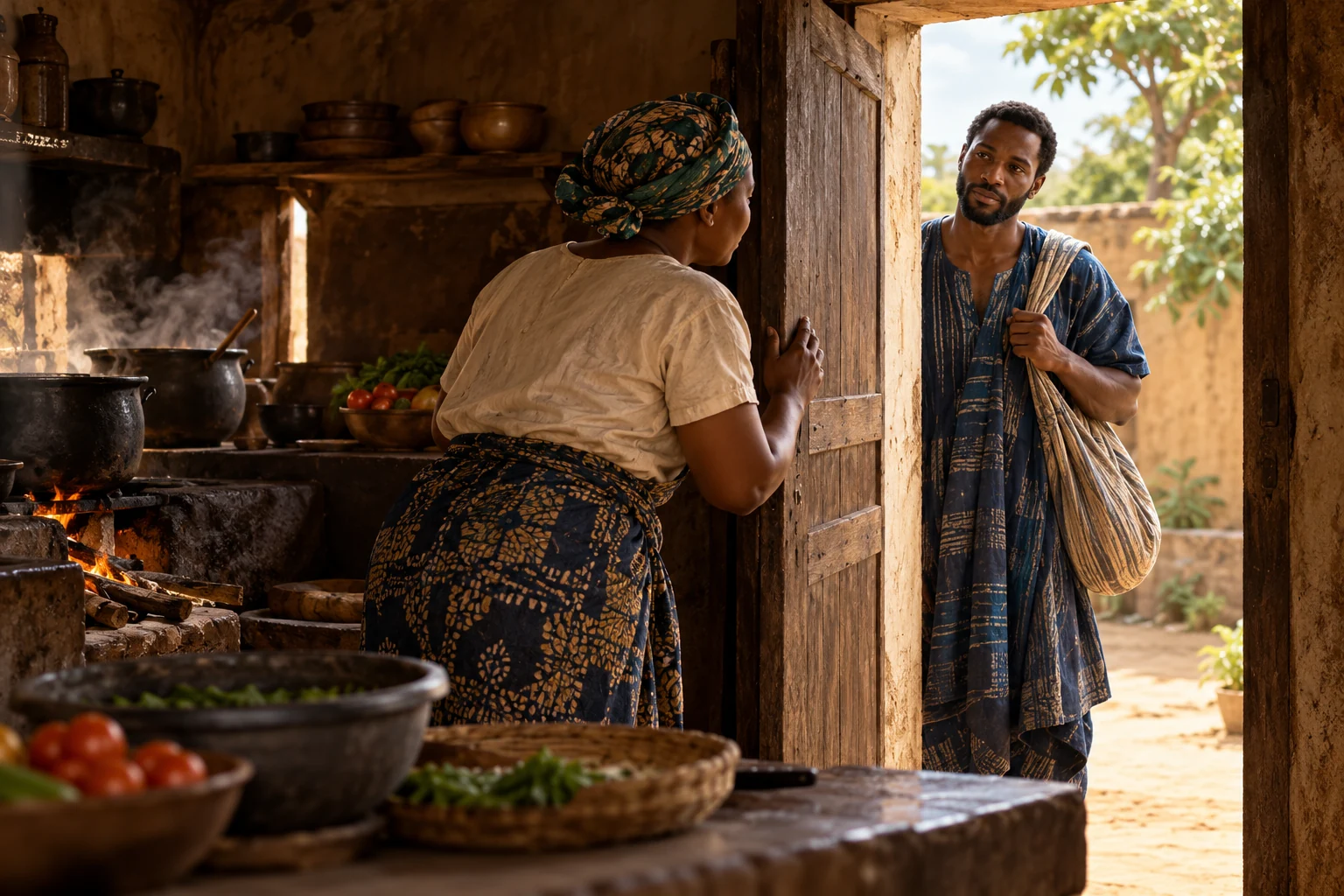
A ruler is gravely ill, and crowds come to see him. Orunmila’s offer to help is dismissed by the physicians, but the ruler insists on hearing him. The narrative describes improvement after sustained attendance. Threatened by rivals, Orunmila returns quietly through the kitchen. The cook informs the ruler, who publicly acknowledges the visitor and rejects the plot against him.
The cook supplies the connection between threatened service and public recognition, giving a less prestigious worker a decisive role. The story also depicts exclusion by an established profession, yet it should not be used to discredit actual medical care or promise an alternative cure. The useful focus is credit, rivalry, and protecting someone whose contribution has become inconvenient to others.
Narrative setting: Cuban/Lukumí-labeled patakín in the multilingual source compilation; individual narrator and publication history are not established.
The guardian in the empty town
Orunmila enters a place where he finds no living residents. Eshu explains that all have died and that he remains as their faithful watcher. Named Eshu Borde, he directs attention to the hill and a standing emblem associated with fallen rulers. The short episode then connects this continuing presence with the birth of a new people, without supplying an extended account of how that renewal occurs.
The guardian’s work persists after ordinary reciprocity has ended: the watched cannot reward him in the usual way. The hill emblem gives absence a visible place in communal memory. The renewal statement is brief and should remain so; we can ask how remembering the dead and preparing for new members coexist without claiming that the source narrates a complete cycle of reincarnation.
Narrative setting: Cuban/Lukumí-labeled patakín in the multilingual source compilation; individual narrator and publication history are not established.
Fear wins the contest before anyone sees its face
Divinities compete for a divine daughter, and the creator requires evidence of a violent task. Ogun and Death boast that their powers make them the likely victors. Orunmila consults and completes responses involving Eshu and Fear, then waits near the passage between worlds. Fear sounds a threatening challenge as the stronger contestants return, and they abandon their burdens and flee without seeing the challenger. Eshu directs Orunmila to collect what they left and present it. He receives the promised union. The account explicitly gives Fear agency before a feared event and portrays its unseen intervention as decisive over figures known for visible destructive power.
The narrative makes Fear a spiritual actor, not only a feeling inside another protagonist. Its power precedes verification: the contestants infer that anyone bold enough to threaten them must have the capacity to defeat them. Orunmila’s preparation and Eshu’s coordination bring that agency into the contest, so his success is not explained by physical strength or private cleverness alone. The scene also has an ethically difficult frame. The violent task and the daughter treated as a prize remain part of its theological telling, while the daughter’s own perspective is not supplied.
Contemporary interpretation can ask how imagined danger changes action before encounter and how an intimidating claim becomes authoritative without proof. That question should not erase Fear’s divinity within the source or make every anxious experience a direct supernatural event for a reader. The account’s power lies in distinguishing unseen force, expected violence, and the actual sequence through which a competition is decided, not in offering a practical technique for frightening rivals.
Narrative witness and setting: Section explicitly headed revelations of Cromwell Osamaro; theological account of Fear as a divinity.
The missing elephant is acknowledged as a mountain
Oku consults before hunting in Metolonfin’s realm. He kills an elephant, takes its tail as evidence, and returns for people to carry the meat. At the site they find no animal because it has become a mountain. Oku insists that the tail confirms what occurred, while Legba tells him to rest. The town then loses rain and generative flourishing. Consultation directs attention back to the missing elephant, and the ruler provides a religious response carried with Oku to the mountain. Prayer and acknowledgment there restore rain and fertility within the account. The landscape receives a name connecting it with Oku’s encounter.
The tail establishes that something happened but does not explain what the participants now face. The elephant’s transformation makes the landscape an active sacred presence, not merely an absent stock of meat. The town’s later response therefore cannot be reduced to finding a misplaced carcass or proving the hunter honest. It acknowledges a changed relation between ruler, hunter, mountain, and the conditions of communal life. Within the Fon religious account, Fá discloses that relation and the response restores its generative flow.
Contemporary analysis can ask what a community overlooks when it treats a living or sacred place only as an extractable resource. That is an interpretive question, not a replacement ecological science or a claim that actual drought and childbirth difficulties have this cause. The local naming should also remain the story’s declaration rather than a verified universal etymology. Its outcome changes the town’s relation to the mountain; it does not establish that every unexplained landscape feature is a transformed animal.
Narrative witness and setting: Fon Fá narrative under an explicit Bernard Maupoil heading; Oku, Metolonfin, and Legba retain their local names.
What was born in this Odù
“Born” can name an explicit traditional origin association or what emerges through a story: a capacity, relationship, practice or order of life. Interpretations drawn from a narrative are labelled below, so their basis remains clear.
The funerary vehicle
Selected traditional source association.
The explicit origin inventory names the hearse. This is a local material association with carrying and honoring the dead, not a documented historical invention or a statement that all communities must use the same funerary form.
A new town after the fallen rulers
Origin motif within the selected narrative.
The guardian episode explicitly speaks of the birth of a new town in relation to the continuing emblem. This narrative-origin association is separate from the inventory’s funerary vehicle and should not be expanded into an unprovided cosmology.
Correlations to life dimensions
These questions bring the selected stories into contemporary life. They are interpretive invitations for study.
Work and resources
Orunmila’s extended attendance and the cook’s communication are distinct kinds of service. The narrative’s public outcome depends on both. We can examine how institutions protect necessary care when established workers experience another contributor’s recognition as a threat.
Reflect: Whose contribution is hidden behind a recognized service?
Relationships and family
The guardian remains when the usual social relationship can no longer continue. That image supports questions about responsibilities toward absent or deceased members, while allowing contemporary readers to distinguish meaningful remembrance from obligations they have not freely accepted.
Reflect: What form of remembrance is meaningful and sustainable?
Character and inner life
Orunmila avoids the public celebration because he perceives danger around his success. His quiet return to the kitchen reveals the emotional cost of receiving hostile recognition. A focused reading can consider the difference between public honor and actual security.
Reflect: Does being celebrated also mean being protected?
Community and responsibility
The ruler publicly credits the helper after learning of the conspiracy, while Eshu preserves dignity in a place of collective loss. Both episodes concern who is remembered and who can speak for those whose contributions are easily erased.
Reflect: How does the community make acknowledgment visible?
A deeper reading of the sacred relationships
The unseen is an active participant in the accounts
Fear acts before its face is known, and the mountain’s sacred relation becomes consequential before the town understands the elephant’s transformation. The earlier Eshu Borde narrative likewise places continuing guardianship where ordinary life appears absent, while Orunmila’s court service involves a form of knowledge other practitioners dismiss. A religious depth treatment should explain these agencies without reducing them to psychological impressions or collective symbolism. Their effects also differ: flight, renewed generative conditions, watchfulness, and recovery of a ruler. Contemporary questions about evidence and responsibility can be added after those distinctions are clear, rather than assuming that every unseen presence performs the same function or proves the same doctrine.
Evidence can establish an event without exhausting its meaning
Oku’s tail supports the hunt but cannot explain a mountain. The frightened contestants hear a challenge but never verify the figure they fear. The earlier court physicians dismiss a visitor whose claim the ruler chooses to hear, while the empty-town guardian directs attention to a continuing sign on the hill. These scenes ask different things of evidence: corroboration, inference, willingness to listen, and recognition. A depth study can compare them without making empirical proof the only language available to religious narrative. It can also ask when an apparent sign is being asked to establish more than it actually shows. The sources preserve that tension rather than supplying a single procedure that settles every kind of claim.
A common good can depend on a relation people neglect
The mountain response concerns the conditions of a whole town, while the parable of the visiting helper concerns a court that nearly discards useful care. Eshu Borde remains when the dead cannot offer ordinary reward, and the Fear episode reveals how much action depends on a presence others do not yet know how to name. These are different forms of dependence rather than one bargain for benefits. Contemporary interpretation can ask what a community takes for granted because its sustaining relation is not immediately visible. The religious account may answer through Fá, sacred guardianship, or a particular divinity, and those answers should remain explicit instead of being replaced by a generic lesson about gratitude.
Questions that deepen the study
Can Fear be described as a divinity without diagnosing a reader’s anxiety?
The source explicitly gives Fear a theological identity and an action in a particular competition. That can be explained directly while keeping it distinct from claims about any contemporary person’s mental or physical condition. Within the story, Fear precedes verification and changes the conduct of powerful rivals; Orunmila’s religious preparation and Eshu’s intervention establish the relation. Contemporary reflection may ask how anticipated harm affects choice, but it should not declare that every anxious feeling proves the presence of this divinity. Respecting the account means preserving both its spiritual specificity and the boundary between a narrated sacred event and a personal diagnosis.
Why is the mountain more than a substitute for the elephant’s missing body?
The transformation changes the kind of relation required. The town cannot simply recover meat or accept the tail as the end of the matter, because its generative conditions become bound to acknowledging the mountain. Fá identifies that need, and the ruler and Oku respond there. A contemporary ecological interpretation may be useful, but it remains additional to the source’s sacred landscape and efficacious prayer. The story does not provide a general theory of mountains or real drought. Its specific movement is from treating a hunted animal as a resource to recognizing a continuing presence whose relation affects the community’s life.
What do the new witnesses add to recognition and watchfulness?
The earlier pair concerns a helper’s disputed contribution at court and a guardian who remains among the dead. The additions make two more unseen relations consequential: Fear changes a contest without appearing, and a transformed mountain changes a town before its meaning is acknowledged. Together the accounts expand what can require recognition without giving all such relations the same form. Their spiritual agencies remain named and active. Contemporary interpretation can ask what evidence a community accepts and what obligations follow acknowledgment, while preserving the limits of each outcome. A defeated rival, renewed rain, public credit, and faithful guardianship are distinct results rather than one universal restoration.
What the four narratives reveal together
The original Cuban narratives bring care and memory into a palace and a town of the dead. The new Osamaro and Maupoil witnesses extend the inquiry to a divinity acting before perception and a landscape whose transformed presence requires recognition. Fear, Eshu, Fá, Oku, the mountain, and Eshu Borde are not interchangeable symbols; their religious actions define different relations to human and divine life. Contemporary questions about evidence, anticipated danger, and neglected dependence can deepen those accounts without replacing their spiritual realities.
The four endings also remain different: a helper receives public credit, a guardian continues watching, a contest is won through unseen intervention, and a town renews its relation to a sacred place. A depth study should preserve the ethical difficulty of the competition and the landscape’s specific origin claim rather than forcing either into an unqualified story of benevolent power or universal factual explanation.
Living with this Odù
A continuing life or initiatory relationship
For someone whose received life or initiatory Odù is Òyèkú Ọ̀ṣẹ́, service may require recognition while remaining larger than the recognition it receives. The palace visitor depends on the cook to connect threatened work with public acknowledgment. Eshu Borde’s watching continues where ordinary recipients can no longer return praise. Together the motifs distinguish protecting a living contributor from sustaining memory after reciprocal reward has ended. A life can need both forms of fidelity at different times.
Fear’s contest adds an inquiry into authority accepted before verification, while the missing elephant changes from presumed resource into an acknowledged mountain relation. The person may need to distinguish what a sign proves from what it leaves unexplained. A tail confirms an encounter but not the present status of the landscape; an unseen challenge produces flight without an actual contest.
A received sign does not promise healing, explain drought, or identify all fear as direct supernatural intervention. The religious field includes Orunmila’s service, Eshu Borde’s continuing presence, Fear’s divine agency, and the Fon relation among Oku, Legba, ruler, and mountain. Across changing circumstances, long study can ask who keeps care going, who names its contribution, and what must be acknowledged when a relationship changes form.
A particular consultation and its question
In consultation, Òyèkú Ọ̀ṣẹ́ can distinguish a useful contribution from the institution’s willingness to recognize it. The palace kitchen gives a less prestigious worker a decisive role when rival professionals threaten a visitor’s standing. A practitioner can ask who has witnessed the service and who controls its public account without using the story to discredit actual medicine or promise an alternative outcome.
The empty-town watcher asks a different question about care whose recipients cannot offer ordinary acknowledgment. Fear’s contest asks how anticipated danger acquires authority without being seen. The elephant mountain asks what a piece of evidence establishes when the situation has changed into something the first account cannot explain. These motifs should not be collapsed into one general instruction to trust appearances or dismiss fear.
The actual result determines the relation to the visitor’s question. It does not announce a hidden guardian, predict communal death, or explain physical drought through an unacknowledged sacred animal. Religious reality within the accounts remains distinct from personal prognosis. Consultation can sharpen inquiry into credit, continuing memory, untested intimidation, and acknowledgment of a changed place, without making one encounter a permanent identity as caretaker, threatened healer, or privileged witness.
Constructive and adverse possibilities
Constructively, a witness can protect threatened service through public acknowledgment, and continuing care can preserve a place for those no longer able to reciprocate. A transformed landscape can receive the recognition its new relation requires. These religious accounts make continuity active through cooks, watchers, consultation, and acknowledgment rather than merely through an individual’s enduring intention.
Adversely, professional rivalry can obscure contribution, anticipated violence can govern decisions before verification, and a living or sacred place can be treated only as something available for extraction. Favorable outcomes also leave omissions: Fear’s contest does not preserve the daughter’s perspective, and the empty town does not narrate a complete renewal process. Iré and adverse conditions remain specific to the reading. The motifs ask whether recognition includes care and whether fear or possession has displaced the more exact question of what relation now requires acknowledgment.
An illustrative situation in everyday life
Hypothetically, a municipal worker quietly maintains a memorial garden after the original organizing families have moved away. A new administrator calls the work unnecessary because nobody is requesting it. Eshu Borde’s watching asks whether care must always be justified by immediate reward from its recipients. Another employee knows that the gardener also solved a maintenance problem but that a senior team claimed the credit. The palace cook motif makes a modest witness consequential to public acknowledgment. The administrator can distinguish continuing memory from neglected living labor, preserving the garden while crediting actual work. This hypothetical example concerns two forms of recognition, not a claim that a site contains a particular spirit or that remembrance produces physical or reproductive renewal.
Sources and reading context
The first two narrative witnesses
Two distinct Cuban episodes are used; variant accounts of the ruler’s recovery are not counted twice. Medical outcomes remain narrative claims, not evidence for treatment. Cuban Osun in the empty-town passage is not silently equated with Oshun or assigned an unsupported figure key.
Narrative motifs are summarized independently. The life-dimension reflections are contemporary interpretation. How these reference studies are built explains the wider source approach and the distinction between a reference article and personal divination.
Additional named witnesses
-
Cromwell Osamaro. The explicit section heading introduces Fear’s theological identity and the contest involving Orunmila, Eshu, Ogun, and Death.
-
Bernard Maupoil; Fon Fá tradition. The elephant/mountain narrative appears under an explicit heading and names Oku, Metolonfin, and Legba.
The source’s comparison with biblical temptation is not adopted as an independent historical claim. Fear is not used to diagnose readers, and mountain fertility is not medical or weather advice. The daughter’s voice is absent in the contest. The Fon naming remains local; edition/pages are unverified.
Bibliographic identification
-
C. Osamaro Ibie. Ifism: The Complete Work of Orunmila. Lagos; multivolume publication beginning 1986. Library catalogue record. Related bibliographic record for the named narrative witness. Exact volume, edition and page of the transmitted account have not been independently matched.
-
Bernard Maupoil. La Géomancie à l’ancienne Côte des Esclaves. Paris: Institut d’ethnologie, 1943. Library catalogue record. Historical bibliographic context for the Fon Fá witness; Fon and Yorùbá traditions retain their distinct settings.
Read the source method and wider scholarly context.
The catalogue links identify published works and their authors. They are separate from proof of an individual episode’s wording or attribution. Contemporary comparisons and the synthesis above are editorial interpretation. The author’s books and Academy companions below provide further study; their sales links are separate from the source references.